
全球经济复苏

Search documents
需求回暖:波罗的海干散货运价指数迎来全线反弹
Jin Rong Jie· 2026-01-23 14:10
Core Insights - The Baltic Dry Index (BDI) has shown a strong rebound, rising by 79 points (4.79%) to 1729 points on January 20, 2026, marking a three-week high and three consecutive days of increases [1][2] - The increase is driven by various ship types, particularly Capesize vessels, which transport bulk commodities like iron ore and coal, indicating improved market sentiment and stable demand [1][2] Group 1: Index Performance - The BDI's rebound is broad-based, with the Capesize index (BCI) surging by 167 points (7%) to 2570 points, leading to an average daily charter rate increase of $1511 to $19804 [2] - The Panamax index (BPI) rose by 49 points (3.2%) to 1570 points, while the Supramax index (BSI) increased by 13 points to 983 points, reflecting a widespread uptrend across different market segments [2] Group 2: Driving Factors - The primary driver of the price increase is a shift in the supply-demand balance, with the market currently in a "genuine tight balance" [3] - Demand for key commodities remains stable, with notable growth in bauxite transportation from West Africa, where China's bauxite unloading volume reached approximately 213 million tons in 2025, a 25% increase year-on-year [3] Group 3: Supply-Side Support - Effective turnaround of shipping capacity has also supported the market, with reduced rainfall in Brazil leading to smoother port operations and improved efficiency in available shipping capacity [4] - The strengthening of the Forward Freight Agreement (FFA) market has positively influenced the sentiment of participants in the spot market [4] Group 4: Macro Perspective - The BDI's movements are closely tied to global economic conditions, reflecting the trade activity of essential raw materials, which correlates with global manufacturing demand and international trade vitality [5][6] - The recent increase in the BDI aligns with rising container throughput at major Chinese ports, indicating resilience and stable growth in China's foreign trade [6] Group 5: Future Outlook - Despite the positive start to the year, future trends face uncertainties, including the traditional first-quarter seasonal effects and the pace of industrial activity recovery in China post-holiday [7] - Long-term positive factors are accumulating, with expectations that dry bulk shipping will benefit from changes in the global monetary environment and new cargo from key mineral projects [7][8]
“为推动全球经济复苏与发展贡献重要力量”——国际人士积极评价2025年中国经济成绩单
Ren Min Ri Bao· 2026-01-22 00:12
Group 1: Economic Growth and Stability - In 2025, China's GDP reached 140 trillion RMB, marking a 5.0% increase from the previous year, showcasing resilience amid complex domestic and international economic conditions [1] - China's economic growth rate is expected to remain among the highest globally, contributing approximately 30% to world economic growth [2] - The ability of China to maintain stable economic performance despite external pressures is attributed to its robust macroeconomic management and competitive industrial base [2][3] Group 2: Innovation and Green Development - The proportion of high-tech manufacturing value added in China's industrial output rose to 17.1%, with significant growth in digital product manufacturing [4] - China has become a global leader in renewable energy, with installed capacity for wind and solar power surpassing that of thermal power for the first time in 2025 [5] - The rapid development in high-tech manufacturing and green economy sectors reflects China's commitment to high-quality development and innovation [5][6] Group 3: Global Economic Impact - International organizations have raised their growth forecasts for China, indicating confidence in its long-term economic stability and potential to create new opportunities for global economic recovery [7] - China's economic structure and demand for high-quality products are expected to enhance regional cooperation and provide significant benefits to developing countries [8] - The ongoing development of China's economy is anticipated to contribute positively to global sustainable growth and industrialization efforts in other nations [7][8]
“为推动全球经济复苏与发展贡献重要力量”
Ren Min Ri Bao· 2026-01-21 23:31
Economic Growth and Performance - In 2025, China's GDP reached 140 trillion RMB, marking a 5.0% increase from the previous year, demonstrating resilience amid complex domestic and international economic conditions [1] - China's economic growth rate is expected to contribute approximately 30% to global economic growth, maintaining its position as a major contributor and stabilizer in the world economy [2][3] - The ability of China to maintain stable economic performance amidst geopolitical tensions and uncertainties highlights its robust macroeconomic management and competitive industrial base [2][3] Innovation and High-Quality Development - The proportion of high-tech manufacturing value added to total industrial value added rose to 17.1%, with digital product manufacturing increasing by 9.3% [4] - China has become a global leader in renewable energy, with installed capacity for wind and solar power surpassing that of thermal power for the first time in 2025 [5] - The rapid development in high-tech manufacturing, digital economy, and green economy reflects China's commitment to high-quality development and innovation [5][6] Global Economic Impact and Opportunities - International organizations have raised their growth forecasts for China, indicating confidence in its long-term economic stability and potential to create new opportunities for global economic recovery [7] - China's economic structure and demand for high-quality products and services are expected to enhance regional cooperation and provide opportunities for developing countries [8] - The ongoing development of projects under the "Belt and Road" initiative is anticipated to further contribute to global economic recovery and sustainable development [8]
普华永道中国主席何睦宁:中国将继续为全球经济复苏提供有力支撑
Xin Lang Cai Jing· 2026-01-21 01:00
Core Viewpoint - China remains a key driver of global economic growth and innovation, contributing approximately 30% to global economic growth and continuing to support global economic recovery [1] Group 1: Economic Contribution - China has a large and highly skilled labor force, with around 5 million graduates in science, technology, engineering, and mathematics entering the market each year, which drives the growth of high-quality industries such as electric vehicles and solar energy [1] - A recent PwC global CEO survey indicates that 44% of mainland Chinese CEOs expect economic growth to improve in the coming year, a slight increase from the previous year, while 61% of Hong Kong CEOs share this optimistic outlook, an increase of nearly 20 percentage points [1] Group 2: Supply Chain Stability - China acts as a "stabilizer of the supply chain," providing critical support for the stable operation of global industrial chains through its complete industrial system and leading manufacturing capabilities [2] - High levels of foreign investment, the internationalization of the Renminbi, and deepening regional financial cooperation offer diversified risk management options for global southern countries, making China a primary market for overseas investment in the eyes of global CEOs [2] Group 3: Technological Advancement - Chinese companies are more capable and willing to adopt technology on a large scale to transform their businesses, with AI technology usage rates significantly higher than the global average [2] - China contributes over 60% of global electric vehicle production, over 70% of lithium-ion battery production, and over 90% of solar silicon wafer capacity, playing a crucial role in promoting green transformation [2] Group 4: International Expansion - The overseas expansion of Chinese companies has a positive impact on local economies, creating numerous job opportunities and helping local industries upgrade to higher value chains, particularly in renewable energy and infrastructure projects in Southeast Asia and Latin America [3] - The acceleration of the digital economy and artificial intelligence industries in China presents significant opportunities, while green low-carbon transformation will continue to be a growth driver [3]


技术分析:WTI原油期货价格短期内有望延续涨势
Jin Rong Jie· 2026-01-19 06:08
Core Viewpoint - WTI crude oil futures are showing strong upward momentum driven by multiple favorable factors, including global supply tightness and ongoing production cuts by major oil-producing countries [1] Group 1: Market Dynamics - Market participants are focused on the impact of geopolitical risks, which are providing support for oil prices [1] - The gradual recovery of the global economy is leading to sustained growth in energy demand, further pushing up WTI crude oil futures prices [1] Group 2: Currency Influence - Fluctuations in the US dollar exchange rate are affecting oil price trends; a weaker dollar typically enhances the attractiveness of WTI crude oil futures priced in dollars [1] Group 3: Technical Analysis - WTI crude oil futures prices have broken through key resistance levels, indicating a potential continuation of the upward trend in the short term [1] Group 4: Future Monitoring - Investors are advised to closely monitor upcoming macroeconomic data and changes in OPEC+ policies to assess the future trajectory of oil prices [1]
逾300家A股公司发布2025年业绩预告
Zheng Quan Ri Bao· 2026-01-16 16:36
Group 1: Core Insights - Over 300 A-share companies have released performance forecasts for 2025, with 6 companies expecting net profits exceeding 10 billion yuan [1] - Zijin Mining Group is projected to achieve a net profit of approximately 51 to 52 billion yuan for 2025, representing a year-on-year increase of about 59% to 62% [1] - The increase in Zijin Mining's profits is attributed to a rise in the production of key mineral products, including gold, copper, silver, and lithium carbonate [1] Group 2: Industry Trends - Other companies in the non-ferrous metals sector, such as Luoyang Luanchuan Molybdenum and Zhejiang Huayou Cobalt, are also expected to see significant year-on-year profit growth due to rising product prices and operational efficiencies [2] - The recovery of the domestic economy, infrastructure development, and the growth of the new energy vehicle industry are driving demand for non-ferrous metals [2] - Despite challenges in the photovoltaic industry, such as rising costs and increased competition, long-term profitability is expected to improve with technological advancements and market expansion [2]

温彬:进出口高位收官,2026出口有望量稳质升
Di Yi Cai Jing· 2026-01-15 03:16
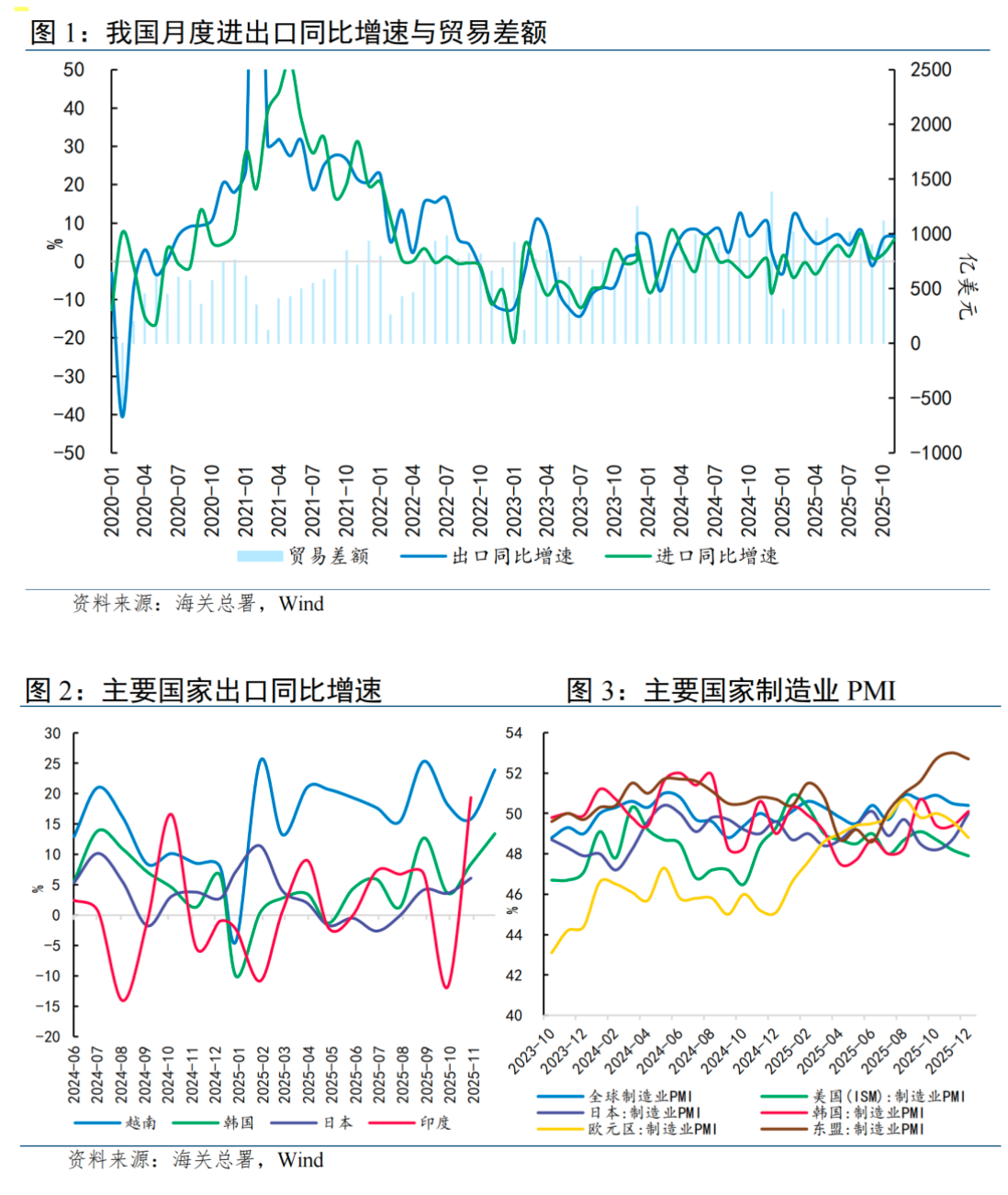
Core Viewpoint - China's export scale in December 2025 exceeded expectations, setting a historical monthly export record, while imports also reached a high point since 2022 [3][2]. Group 1: Import and Export Growth - In December 2025, China's total import and export value reached $601.42 billion, with a cumulative annual total of $635.48 billion, reflecting a year-on-year growth of 3.2% [2]. - Monthly exports amounted to $357.78 billion, a year-on-year increase of 6.6%, while annual exports totaled $3.77 trillion, up 5.5% [2]. - Monthly imports were $243.64 billion, showing a year-on-year growth of 5.7%, with annual imports at $2.58 trillion, remaining flat compared to the previous year [2]. Group 2: Factors Supporting Export Growth - Three main factors supported the high growth in exports: seasonal overseas stocking demand, AI-driven semiconductor industry growth, and steady international economic recovery [3]. - Seasonal demand from overseas retailers ahead of Christmas led to increased orders in consumer electronics, toys, and small appliances, contributing to a monthly export growth of 8.4% in December [3]. - The AI boom significantly boosted the semiconductor supply chain, with integrated circuit exports surging by 47.4%, and overall machinery and electronics product exports growing by 12.1% [3]. Group 3: International Economic Recovery - The global manufacturing PMI recorded 50.4 in December 2025, indicating a steady recovery in the international economy, with mixed performance among major economies [4]. - The U.S. ISM manufacturing PMI fell to 47.9, while the Eurozone and Japan showed slight declines, and South Korea's PMI rose to 50.1, reflecting a rebound in exports [4]. Group 4: Export Performance by Region - Exports to the U.S. in December 2025 were $34.2 billion, with a year-on-year decline of 30%, influenced by high base effects and tariff expectations [7]. - Exports to the EU reached $51.9 billion, the highest for the year, with an 11.6% year-on-year increase, driven by seasonal demand for consumer goods [7]. - Exports to ASEAN countries totaled $66.4 billion, also the highest for the year, with a year-on-year growth of 11.2% [9]. Group 5: Import Trends - Imports from the U.S. continued to decline for ten consecutive months, with a year-on-year drop of 28.7% in December 2025 [10]. - Imports from ASEAN countries fell by 5.3%, while imports from other regions, including Hong Kong and Japan, showed growth [10]. - High-tech product imports increased by 13.5%, indicating a diverse performance across various categories [15]. Group 6: Export Structure Improvement - The export structure continued to improve, with machinery and electronics leading the growth, particularly in automotive and semiconductor sectors [13]. - Exports of integrated circuits increased by 47.7%, with both volume and price rising [14]. - Labor-intensive products continued to decline, although the rate of decline has narrowed for some categories [14].
车主必看!今日全国加油站调价后,92、95号汽油新售价出炉
Sou Hu Cai Jing· 2026-01-13 01:51
Core Viewpoint - The article discusses the volatility of international oil prices influenced by geopolitical conflicts, particularly the recent clashes between Israel and Hezbollah, and its implications for Chinese car owners in 2026 [3][5]. Group 1: Oil Price Fluctuations - International oil prices have experienced a "V-shaped reversal," with WTI crude oil rising by 2.35% to $59.12 per barrel and Brent crude reaching $63.34 per barrel [3]. - The recent geopolitical tensions have exacerbated the already fragile oil price system, with significant military engagements impacting global energy transport routes [3][5]. Group 2: Domestic Oil Pricing Mechanism - Despite a 6% increase in international oil prices over the past week, China's domestic refined oil pricing mechanism shows resilience, with a current crude oil change rate of -0.53%, indicating a theoretical price drop of 30 yuan per ton [5]. - The upcoming price adjustment window on January 20 is likely to see a decrease if international prices do not spike dramatically, as the adjustment mechanism is close to the 50 yuan per ton threshold [5]. Group 3: Consumer Sentiment and Market Dynamics - The shift in consumer sentiment is notable, with anxiety over rising fuel costs being replaced by expectations of potential price drops, leading to reduced traffic at gas stations [5]. - The article highlights the importance of consumer confidence in the context of inflation and stagnant income growth, where every penny spent on fuel impacts household budgets [5]. Group 4: Regional Fuel Prices - The article provides a detailed breakdown of fuel prices across various regions in China, with 92-octane gasoline prices ranging from 6.53 to 7.82 yuan per liter [6][7].

2025年全球制造业PMI均值为49.6% 亚洲、非洲制造业有所回升
Zheng Quan Ri Bao Wang· 2026-01-08 02:42
Group 1: Global Manufacturing PMI Overview - In December 2025, the global manufacturing PMI was 49.5%, a slight decrease of 0.1 percentage points from November 2025, remaining within the 49% to 50% range for ten consecutive months [1] - The average global manufacturing PMI for 2025 was 49.6%, an increase of 0.3 percentage points compared to 2024, indicating a weak recovery in the global economy [1] - Analysts suggest that the recovery momentum is slowing, and further efforts are needed to strengthen the recovery, particularly in light of tariff policies and geopolitical conflicts [1] Group 2: Regional Manufacturing Performance - In December 2025, Asia's manufacturing PMI was 51.1%, up 0.4 percentage points from the previous month, indicating continued expansion and a key support role for the global economy [2] - Africa's manufacturing PMI rose to 50.7% in December 2025, an increase of 1.3 percentage points, suggesting a strengthening recovery in the African economy [3] - In contrast, Europe’s manufacturing PMI was 49.3%, down 0.3 percentage points, reflecting a weak recovery with ongoing uncertainties affecting the region [4] Group 3: Specific Country Insights - The IMF and World Bank have raised China's economic growth forecasts for 2025 and 2026, with the IMF projecting growth rates of 5.0% and 4.5%, respectively [3] - The U.S. manufacturing PMI was reported at 47.9% in December 2025, a decline of 0.3 percentage points, indicating a worsening trend in the U.S. manufacturing sector [5] - Analysts predict that the U.S. economy will maintain a growth rate around 2% by the end of 2026, but inflation pressures and labor market slowdowns may complicate future monetary policy decisions [5]
格林大华期货早盘提示-20260108
Ge Lin Qi Huo· 2026-01-07 23:30
1. Report Industry Investment Rating - The report gives a "downward" rating for the global economy in the macro and financial sector [1] 2. Core View of the Report - The global economy is facing significant uncertainties and challenges. The US's political and economic policies, along with the development of AI and the performance of financial markets, all contribute to an overall downward trend in the global economy [1][2] 3. Summary by Relevant Catalogs 3.1 Important Information in the Morning Session - Musk states that once Starship achieves full and rapid reuse, launch costs will drop below $100 per kilogram, and a 100GW - level "space solar AI satellite array" can be built through 10,000 flights per year to send 1 million tons of payload into orbit [1] - Musk believes the future bottleneck of AI lies in electricity, not chips. The lack of power, heat dissipation, and liquid - cooling may prevent GPUs from working, which is why TSMC is worried about over - expansion [1] - Musk predicts that the next three to seven years will be an extremely turbulent transition period. AI will rapidly replace many white - collar jobs, causing unemployment and social unrest, while at the same time, production efficiency will be fully released, leading to an abundance of goods and services [1] - J.P. Morgan Asset Management warns that the prosperity of the US stock market is dominated by generative AI, and trillions of capital expenditures face uncertainties in profit returns and US power infrastructure bottlenecks. If expectations are not met, the market will face a severe liquidation risk [1] - Goldman Sachs warns that the current P/E ratio of the S&P 500 is approaching the 2000 bubble peak, and the top ten stocks account for 41% of the market value. This "high valuation + extreme concentration" combination is similar to that before previous market crashes [1] - Since April, the US dollar has been flat while the commodity index has risen significantly. Goldman Sachs' Privorotsky believes this may indicate either a full - scale depreciation of the US dollar or a rapid recovery of the global economy [1] - Citigroup points out that the copper price may rise to $14,000 per ton in the next three months but may peak this month without new catalysts, which could balance the global copper spot market in 2026 [1] - Global investors' confidence in emerging market bonds has reached a 13 - year high, with the risk premium relative to US bonds narrowing to about 2.5 percentage points, the lowest since early 2013 [1] 3.2 Global Economic Logic - The US's actions against Venezuela's president bring great uncertainty to the global economic and political order. Nomura expects the uncertainty of the Federal Reserve to peak from July to November 2026, which may lead to a "flight from US assets" [2] - The Federal Reserve cuts interest rates by 25 basis points in December, buys $40 billion in short - term bonds monthly, and restarts the expansion of its balance sheet. Trump may fire Fed Chairman Powell [2] - Goldman Sachs analysts warn that the decline in Las Vegas gambling revenues is similar to the early warning signals before the 2008 financial crisis [2] - The US releases a new National Security Strategy, abandons global hegemony, and will adjust economic relations with China to revitalize its economic autonomy [2] - The Federal Reserve's Beige Book shows that consumer K - shaped differentiation is intensifying, with high - income consumers maintaining spending while middle - and low - income families are cutting back [2] - The Bank of Japan raises interest rates by 25 basis points, and the yield of Japan's 10 - year government bonds rises to 2.0% [2] - Google's AI infrastructure head says the company must double AI computing power every six months and achieve an additional 1000 - fold increase in the next 4 to 5 years [2] - NVIDIA CEO Huang Renxun believes China will win the AI competition due to a more favorable regulatory environment and lower energy costs [2] - J.P. Morgan strategists think the construction boom of AI data centers will require at least $5 trillion in the next five years [2] - The US unemployment rate rises to 4.6%, and economists worry that large - scale corporate layoffs are an economic warning signal [2] - The US's return to the Monroe Doctrine and global contraction will have a profound and subversive impact on major asset classes such as the global economy, US bonds, US stocks, the US dollar, precious metals, and industrial metals [2] - Due to the US's continuous wrong policies, the global economy has passed its peak and is starting to decline [2]