
大模型商业化

Search documents
千问的爆发,是近年来阿里最成功的战略进攻之一
3 6 Ke· 2026-02-10 00:45
Core Insights - The launch of the "30 billion Spring Festival free order event" on the Qianwen APP resulted in over 10 million orders within just 9 hours, indicating a significant consumer demand and engagement with AI-driven services [1][2] - Alibaba's strategic decision to integrate AI as a core component of its e-commerce operations aims to establish AI as the next generation interaction portal for consumer internet [1][2] - The event serves as a large-scale validation of AI's practical value and interaction capabilities in everyday consumer scenarios, with most users expressing acceptance and satisfaction [1][2] Group 1 - Alibaba's AI strategy emphasizes both large models and practical applications, rapidly transitioning AI from a "technological wonder" to everyday commercial use across various sectors, including e-commerce and entertainment [2] - The Qianwen APP connects multiple services, including Taobao Flash Purchase and Hema, enhancing its appeal during the Spring Festival by facilitating orders for food, fresh produce, and holiday goods [2] - The successful integration of AI into consumer shopping experiences demonstrates a significant shift in user behavior, marking a pivotal moment for AI's role in daily life [2] Group 2 - Criticism suggesting that Chinese tech companies are lagging behind their U.S. counterparts overlooks the unique capabilities of Alibaba, which combines both consumer scenarios and robust foundational models [3][6] - The challenge of enhancing AI's commercial viability at the consumer level is a new global issue, with existing models often relying on subscription fees, which limits growth potential [4] - Alibaba's ability to simultaneously develop models and consumer applications positions it uniquely in the market, allowing for a comprehensive ecosystem that few competitors can match [6][7] Group 3 - The logistics and fulfillment capabilities of Alibaba are unmatched in China, enabling efficient responses to consumer demands, unlike competitors who struggle with similar tasks [7][8] - The potential for AI applications to revolutionize both consumer and enterprise software development is significant, with advancements in programming capabilities expected to enhance efficiency and reduce costs for businesses [8] - The recent surge in Qianwen's popularity highlights Alibaba's successful strategic push into instant retail, demonstrating the integration of advanced technology with everyday consumer needs [9]



每日投行/机构观点梳理(2026-02-04)
Jin Shi Shu Ju· 2026-02-04 12:31
Group 1: Precious Metals and Currency Predictions - Goldman Sachs maintains a significant upward risk for its 2026 gold price forecast of $5,400 per ounce, attributing January's price fluctuations primarily to Western capital flows rather than speculative behavior, with silver experiencing larger adjustments due to tight liquidity in the London market [1] - Danske Bank indicates that the nomination of Waller as Fed Chair has shifted short-term risks favorably for the US dollar, alleviating concerns about the Fed's independence and allowing for a tactical window for dollar rebound [2] - RHB Retail Research suggests that unless gold closes above $5,090 per ounce, the bearish technical outlook remains intact, with strong selling pressure expected at this resistance level [3] Group 2: Interest Rate Expectations and Currency Risks - ING notes that the Australian dollar faces a risk of weakening due to overly aggressive market expectations for further interest rate hikes, despite the RBA's projected inflation rate of 3.7% for June [4] - Eastern Wealth Management anticipates that the European Central Bank may lower interest rates later this year due to lower-than-expected inflation, with current deposit rates at 2.00% [5] Group 3: Domestic Economic Insights - CICC asserts that the choice of Fed Chair is unlikely to significantly impact the normalization of the balance sheet expansion, as current liquidity conditions remain tight, contributing to market panic selling [6] - CITIC Securities predicts a high probability of a reserve requirement ratio cut in Q2 2026, driven by the need to support banks amid narrowing net interest margins and significant government debt issuance [7] - CITIC Securities highlights a continuing price increase in the electronic components industry, driven by supply-demand tightness and rising upstream metal prices, recommending focus on sectors benefiting from this trend [8] Group 4: Technology and Market Trends - CITIC Securities reports that OpenAI will launch its first ads in early February 2026, indicating a shift towards monetization strategies for large models, balancing user experience with revenue generation [9] - CITIC Securities expresses optimism about the solid-state battery sector, anticipating significant developments in 2026 as multiple manufacturers prepare for testing and small-scale production [10] - CITIC Securities notes that the global commercial space industry is entering a new phase focused on large-scale deployment and ecosystem building, with significant advancements driven by both US and Chinese companies [11] Group 5: Consumer and Market Behavior - Galaxy Securities highlights the strong demand for travel during the 2026 Spring Festival, benefiting OTA platforms and the duty-free sector, with significant revenue growth expected [12] - Tianfeng Securities suggests that the "Spring Rally" may be more sustained this year due to solid foundations, including policy expectations and increased consumer spending [13] - Huatai Securities indicates that the recent VAT adjustment for telecom operators may have a lower-than-expected impact on profits, as companies adapt through technological upgrades [14]
OpenAI首推广告变现,大模型商业化从“烧钱”转向“造血”?
Sou Hu Cai Jing· 2026-02-04 04:39
国内市场亦呈现类似逻辑。2025年上半年,中国模型即服务(MaaS)市场规模达12.9亿元,同比增长 421.2%;AI大模型解决方案市场规模达30.7亿元,同比增长122.1%。火山引擎、阿里巴巴等厂商通过分 层定价、开源模型、多模态能力升级等策略降低企业接入成本,推动行业从概念验证(PoC)阶段迈向 规模化生产。 尽管广告为短期"回血"提供了路径,但长期来看,大模型商业化仍需依赖技术突破与生态协同。中信建 投分析,原生多模态模型(如端到端架构实现文本、图像、语音、视频统一生成)将成为头部厂商的主 流方向,推动交互式AI在复杂场景落地。同时,开源生态的崛起(以DeepSeek为代表)虽降低了使用 门槛,但也加剧了同质化竞争与价格下探,监管趋严、算力供给与工程化能力将成为商业化落地的关键 约束。 在此背景下,广告成为挖掘免费用户商业价值、缓解成本压力的必然选择。中信建投分析指出,大模型 行业与传统互联网经济模式存在本质差异:移动互联网时代,用户增长可摊薄服务器、带宽等固定成 本,形成规模效应;而大模型每轮对话均需消耗独立算力资源,用户对话量增长曲线远陡峭于活跃用户 数(WAU),导致成本随用户规模扩张同步激增 ...

宜信好望角:双轨并行,谁能率先跑通大模型闭环
Jin Tou Wang· 2026-02-03 08:30
Core Insights - The financial details and business models of two leading domestic large model companies, Zhipu AI and MiniMax, have been publicly revealed through their IPO filings, showcasing distinct paths in monetization despite operating in a high-growth, high-investment, and unprofitable industry phase [1][2] Group 1: Zhipu AI - Zhipu AI adopts a "technology-driven" approach, focusing on the B2B market, with revenue primarily derived from localized deployment projects for large enterprises and cloud-based API MaaS services for a broader range of small and medium clients [1] - The company's high gross margin is supported by its business model, although the overall gross margin is projected to decline from 64.6% in 2023 to approximately 50% by mid-2025 due to the increasing share of cloud services [1] - Zhipu AI's B2B strategy is built on strong technical barriers and industry understanding, leading to relatively stable and predictable growth, particularly in the current market emphasizing security and control [1] Group 2: MiniMax - MiniMax's C2B approach is characterized by greater imagination and uncertainty, with the potential for rapid scale and network effects if the product meets user needs, but it also faces intense competition from major internet companies and similar startups [2] - The company must continuously create hit products and excel in product iteration, user operations, and ecosystem development to succeed in the competitive landscape [2] - Both companies highlight their market positions in their IPO filings, with Zhipu AI focusing on its share in the domestic large language model development platform market, while MiniMax emphasizes its global ranking based on model revenue [2] Group 3: Market Implications - The IPOs represent only the initial challenge for both companies; Zhipu AI must demonstrate its platform services can achieve scalable growth while maintaining profitability, whereas MiniMax needs to prove its C2B applications can surpass profitability thresholds and establish a sustainable product matrix [2] - The paths taken by these companies will not only determine their own futures but also provide a clearer roadmap for the commercialization of large models for future entrants in the industry [2] - The evolving technology and market landscape indicates that there are multiple pathways to success, with the capital market's scrutiny just beginning [2]
云知声大模型营收破6亿:下半年超速增长
Sou Hu Cai Jing· 2026-01-29 04:01
Core Insights - The Chinese AI industry is entering a critical phase of authenticity after two years of competition, with 2024 seen as an exploration year and 2025 as a decisive year for commercial realization [1] - Cloud Wisdom (9678.HK) forecasts a revenue of 1.18 to 1.24 billion yuan for 2025, with a significant portion coming from large model-related business, indicating a shift from experimental validation to scalable revenue generation [1][5] Revenue Growth - Cloud Wisdom's large model revenue is expected to reach 600 to 620 million yuan in 2025, reflecting a staggering year-on-year growth of 1057% [1][5] - The company achieved approximately 100 million yuan in large model revenue in the first half of 2025, doubling from 51.87 million yuan in 2024 [4] - The second half of 2025 is projected to generate around 500 million yuan in large model revenue, marking a fivefold increase from the first half and a tenfold increase compared to the entire 2024 revenue [5][11] Strategic Transformation - Cloud Wisdom has transitioned from selling models to providing services and digital labor, which has contributed to the concentrated release of its performance in the second half of 2025 [7][8] - The launch of the Shouya Agent Platform has been pivotal, enabling the encapsulation of model capabilities into specialized digital employees, thus lowering the usage threshold for B-end clients [8] Industry Focus - The company is focusing on high-barrier industries such as healthcare and transportation, rather than relying on C-end traffic or general applications [9][10] - The "Shan Hai·Zhi Yi Medical Model 5.0" was released in December 2025, showcasing its dominance in serious medical scenarios and addressing compliance needs in hospitals [9] - In the transportation sector, Cloud Wisdom's intelligent customer service system has significantly reduced operational costs and provided stable order guarantees for revenue growth [10] Future Strategy - Looking ahead to 2026, Cloud Wisdom aims to solidify its position as a leader in professional models and intelligent agents, focusing on high-barrier industries [12][13] - The company plans to evolve from a digital employee provider to an intelligent agent ecosystem builder, enabling partners to create their own specialized intelligent agents [13] - The 2025 revenue forecast serves as a reference for the commercialization of AI large models, demonstrating that companies can achieve scalable revenue growth by focusing on vertical industries and enhancing engineering delivery capabilities [14]

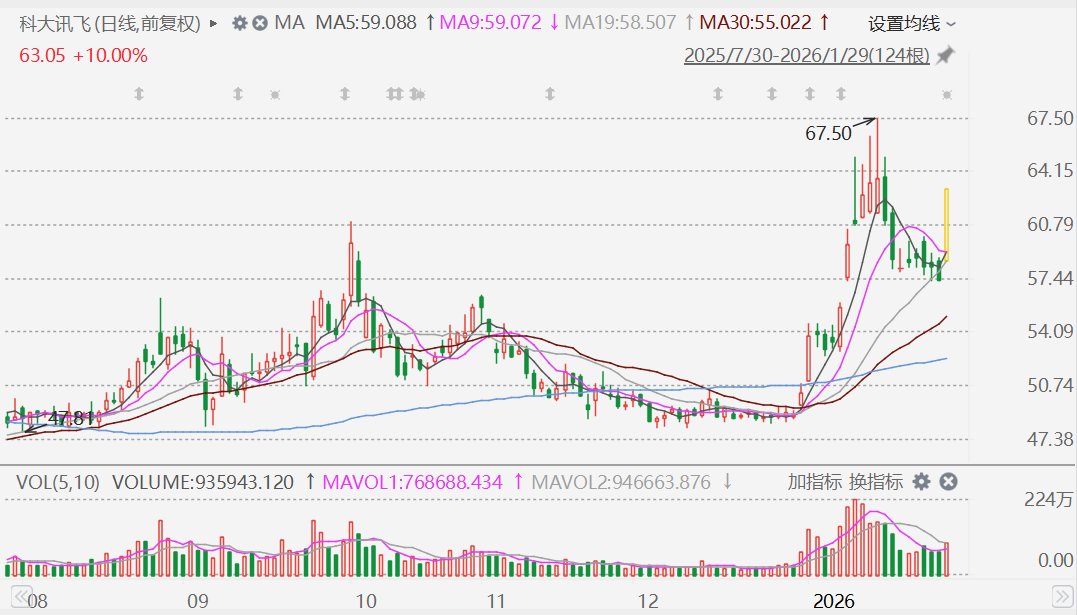
A股异动丨科大讯飞封涨停板,2025年净利预增40%-70%
Ge Long Hui A P P· 2026-01-29 02:17
Core Viewpoint - The company, iFlytek, has seen a significant stock price increase, reaching a limit up at 63.05 yuan, following the announcement of its projected net profit for 2025, which is expected to be between 785 million and 950 million yuan, representing a growth of 40% to 70% year-on-year [1] Group 1: Financial Performance - The projected net profit for 2025 is estimated to be between 785 million and 950 million yuan [1] - This represents a year-on-year growth of 40% to 70% [1] Group 2: Business Development - The growth in performance is attributed to the full commercialization of iFlytek's large model technology [1] - In 2025, the contract amount for the Spark large model projects is expected to reach 2.316 billion yuan [1] Group 3: Market Position - iFlytek maintains a leading position in the market with rapid implementation and market share in government, education, and industrial sectors [1] - The Spark large model has driven strong sales in consumer products such as AI learning machines and smart office notebooks, becoming a key revenue driver [1] Group 4: Industry Integration - The deep integration of the Spark large model with various industries has significantly increased order volumes in smart city, smart healthcare, and intelligent manufacturing sectors [1] - The commercial value of industry empowerment continues to be released [1]

智谱与MiniMax登陆港股 引爆2026年AI上市潮?
Xin Lang Cai Jing· 2026-01-16 20:08
Core Insights - The recent IPOs of domestic AI model companies, Zhipu (02513.HK) and MiniMax (00100.HK), have attracted significant investor interest, showcasing different business models and market performances [1][2] Company Analysis - Zhipu focuses on the MaaS (Model as a Service) and B-end market, with a revenue increase of 325% year-on-year in the first half of 2025, where local deployments contribute over 80% of its income [1][2] - MiniMax targets the C-end market with a global approach, surpassing one million paid users and achieving over 70% of its revenue from overseas, with a shift from negative to positive gross margins [1][2] - Zhipu's strategy emphasizes "model as a channel," with a significant portion of its 8,000 enterprise clients coming from the internet sector, projected to exceed 50% by 2024 [2][3] Market Trends - The IPOs of Zhipu and MiniMax have revitalized the Hong Kong tech sector, with the AI application index experiencing a single-day increase of over 4%, breaking the pessimistic expectations of a "capital winter" [6][7] - There has been a surge in IPO activities in the tech sector, with over 60 companies pursuing IPOs in the past six months, indicating a strong focus on AI and related technologies [6][7] Financial Performance - Both Zhipu and MiniMax are currently operating at a loss, indicating that traditional valuation metrics like PE and PB are not applicable for pricing these AI model companies [4][5] - The market is expected to develop a clearer classification valuation system as more AI companies go public, with revenue, gross margins, and cash flow becoming key comparative metrics [5][6] Industry Outlook - The focus of policy support is shifting from developing the strongest models to enhancing industrial capabilities and application implementation, which is expected to boost market confidence and liquidity [7] - The competition in artificial intelligence is seen as a core battleground for the restructuring of the global tech landscape, with the success of Zhipu and MiniMax marking the beginning of a new journey for China's AI industry [7]
智谱与Minimax港股对决 或引爆2026年人工智能上市潮
Zhong Guo Jing Ying Bao· 2026-01-14 12:38
Core Insights - The recent IPOs of domestic AI model companies, Zhipu (02513.HK) and MiniMax (00100.HK), have attracted significant investor interest, showcasing different business models and market performances [1][2] - Zhipu focuses on the B-end market with a MaaS (Model as a Service) approach, achieving a 325% year-on-year revenue increase in the first half of 2025, while MiniMax targets the C-end market with over one million paid users and more than 70% of revenue from overseas [1][2] Company Summaries - Zhipu's business model is centered around B2B and G2B services, emphasizing long-term contracts and service delivery, which aligns with stable growth and long-term value investment logic [2][5] - MiniMax's strategy involves a balanced revenue stream from both individual and enterprise clients, with a focus on high-frequency usage and user engagement, reflecting an internet product logic [3][4] Market Performance - Both companies are currently in a loss-making phase, indicating that traditional valuation metrics like PE and PB are not applicable for pricing these AI model firms [4] - The recent IPOs have catalyzed a surge in the Hong Kong AI sector, with the AI application index rising over 4% in a single day, breaking the pessimistic expectations of a "capital winter" [6][7] Future Outlook - The AI industry is expected to see continued growth driven by policy support and market demand, with a focus shifting from model strength to industrial application and value realization [7][8] - The competition in AI is viewed as a critical battleground for global technology restructuring, with the need for continuous innovation and ecosystem development to maintain a competitive edge [7][8]
【西街观察】大模型:第一股,第一考
Bei Jing Shang Bao· 2026-01-08 15:12
1月8日,智谱登陆港股,首日股价较发行价上涨超13%,成功拿下"大模型全球第一股"。从北京到香 港,从高校实验室到股票交易所,智谱在资本市场的一小步,也是大模型在公众视野的一大步。 尽管大模型成熟期言之尚早,其成长历程不可能只有上市这一次考试,但大考毕竟广受关注。 大考智谱走过的路,是中国大模型产业从技术探索走向商业验证的缩影。智谱董事长刘德兵说,IPO最 重要的是对"技术逻辑能否跑通商业逻辑"的实战检验。 智谱上市踩中了人工智能资本化的风口期。近段时间,国产GPU摩尔线程和沐曦股份上市接连引爆市 场。国产大模型赛道的智谱敲钟,再度推高市场对AI企业的商业化预期。 智谱上市,恰逢人工智能从参数竞赛转向场景落地的关键节点,是从大模型的浅水区游向深水区。水浅 意味着近岸和安全,我们见识了诸多"小龙""小虎"的热闹非凡;水深象征着危险,有时候需要持久的潜 行,但只有深水区才能承载楼船巨舰。 如何将宏大的技术叙事,转化为稳健的财务数字和清晰的盈利前景。投资者的耐心是有限的,他们追问 的不再只是"模型有多聪明",还关心"成本如何下降""盈利何时到来"…… 智谱一家诠释不了,行业必须共同回答:在解决了"从0到1"的技术突 ...
从智谱与 MiniMax 看大模型商业化路径
Changjiang Securities· 2026-01-08 00:47
Investment Rating - The report maintains a "Positive" investment rating for the industry [10] Core Insights - The Chinese large model industry is transitioning from a "hundred model war" to a tier of leading players by 2025, with Zhipu AI and MiniMax representing different commercialization paths. Both companies are set to IPO in Hong Kong on January 8 and 9, 2026, marking them as the first publicly listed large model companies globally, which serves as a significant industry benchmark [4][19] - The development paradigm of large models is moving into a new phase, shifting from early parameter competition and task performance comparisons to a core focus on a "scene-data-model" positive cycle. The ability to deeply root in real scenarios, provide smoother product experiences, and foster tighter ecological collaboration will determine competitive advantages in the next stage [4][9] Summary by Sections Historical Review: Genetic Differences Determine Commercialization Paths - Zhipu AI, founded in 2019, is one of the earliest companies in China to develop large language models (LLMs) and the first to release a self-developed large model. Its development is characterized by a strong platform thinking and aims to maximize the utilization of its technical assets through an ecosystem of developers [7][20] - MiniMax, established in 2021, has a strong "commercial product" gene, with a team background in gaming and content communities, giving it advantages in user experience (UX), retention rates, and multimodal interactions [7][42] Current Status: Commercialization Progress of Zhipu and MiniMax - Zhipu focuses on general large model capabilities, emphasizing deep integration with enterprise business processes, positioning itself as an "AI infrastructure provider." In contrast, MiniMax aims to productize model capabilities and build a user ecosystem around native AI applications, positioning itself as an "AI native content and interaction platform" [8] - Zhipu's revenue growth relies on deep engagement with B-end clients and long-term partnerships, while MiniMax's commercialization depends on user scale and activity on the C-end, utilizing subscription models and value-added services for monetization [8] Future: Moving Towards a "Scene-Data-Model" Positive Cycle - The key to future development is constructing a closed loop driven by real scene demands, generating high-quality data that continuously feeds back to optimize model capabilities, ultimately serving the scenes more accurately and creating a dual value loop of commercial and technical benefits [9] - Both Zhipu and MiniMax have entered the "scene-data-model" positive cycle, with Zhipu focusing on B-end clients and edge entry points, while MiniMax concentrates on creative content generation and enterprise automation [9]