美元熊市

Search documents
罕见“坚定看空”的大行,瑞银:看空美国经济、看空美元、看空美股
Hua Er Jie Jian Wen· 2025-08-13 05:56
Core Viewpoint - UBS has adopted a rare "triple bearish" stance, issuing warnings on the US economy, the US dollar, and US equities simultaneously [1] Economic Outlook - UBS predicts a sharp slowdown in US GDP growth from 2.0% in Q2 to 0.9% in Q4, significantly below the consensus estimate of 1% [6] - The firm highlights several factors contributing to this outlook, including pre-tariff demand exhaustion, depletion of excess savings, immigration slowdown, and fiscal drag from the Infrastructure Investment and Jobs Act [6][2] - Despite potential upward risks, UBS emphasizes that the trend of economic slowdown is unavoidable [6] Interest Rate Predictions - UBS forecasts a 1% decline in interest rates by year-end, which is double the market consensus of 0.5% [6] - The firm notes that the sensitivity of the economy to short-term rates is unusually low due to a high proportion of fixed-rate debt among households and corporations [6] US Dollar Analysis - UBS maintains a long-term bearish outlook on the US dollar, citing that the net investment position has reached -88% of GDP, suggesting a necessary correction before a new dollar bull market [11][7] - The firm acknowledges recent dollar rebounds but asserts that the fundamental logic for a dollar bear market remains intact [12] Equity Market Concerns - UBS sets a target of 960 points for the MSCI Global Index by year-end and 1000 points by 2026, warning of significant downside risks in the near term [15] - The firm expresses concerns over valuation and positioning, noting that global stock exposure is near historical highs [15][20] - UBS identifies a concentration risk in tech stocks, with about 70% of earnings growth attributed to generative AI, and warns that capital expenditure growth for large firms may slow significantly [21] Tariff Risks - UBS believes that the market is complacent regarding tariff risks, as evidenced by the performance of tariff-affected baskets in the US and Europe [22] - The firm emphasizes that the US accounts for only 16% of global trade, with many non-US countries reducing trade barriers among themselves [22]


美元迈向熊市轨迹! 外汇交易市场正在上演一场“范式转变”
智通财经网· 2025-07-14 08:04
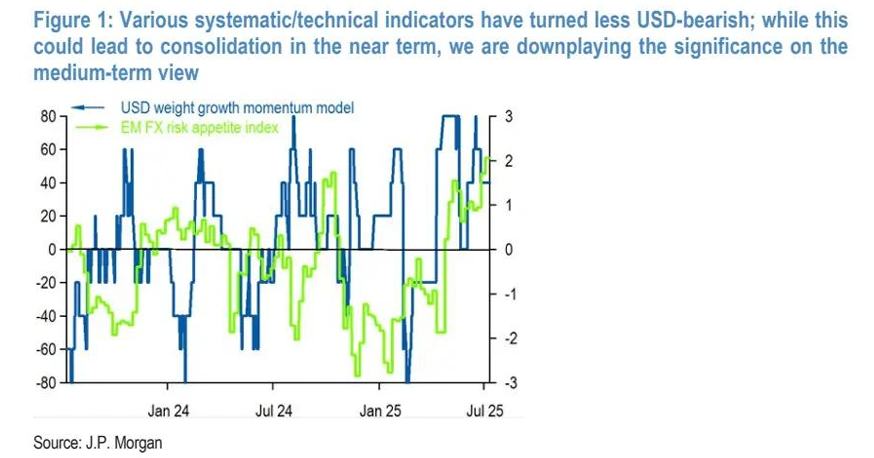
Core Viewpoint - The article discusses the prevailing bearish sentiment towards the US dollar, with major Wall Street firms like Goldman Sachs and Morgan Stanley warning of a new bear market for the dollar, driven by both cyclical and structural factors [1][6][7]. Group 1: Dollar Performance and Market Sentiment - The US dollar index has experienced its weakest performance in the first half of the year since the Nixon administration ended the gold standard, with a decline of approximately 10% year-to-date [1][7]. - Major financial institutions predict that the dollar may enter a bear market trajectory until at least the end of 2026, influenced by the chaotic trade policies of the Trump administration [2][6]. Group 2: Investment Strategies and Recommendations - Morgan Stanley's forex strategy team recommends establishing short positions on the dollar and suggests going long on currencies such as the euro, Australian dollar, and Norwegian krone, which are seen as cyclical strong currencies [5][8]. - The report emphasizes that despite some short-term technical indicators suggesting a potential rebound for the dollar, the overall bearish trend remains intact due to accumulating fundamental disadvantages [5][7]. Group 3: Structural and Cyclical Factors - The dollar's mid-term bearish outlook is attributed to factors such as slowing US economic growth, narrowing interest rate differentials, high dollar valuations, and increasing fiscal deficits [7][8]. - The report highlights that trade policy uncertainties, particularly regarding tariffs, pose significant risks to the dollar's future performance, potentially undermining investor confidence [11][12]. Group 4: Trade Risks and Tariff Policies - The potential for renewed tariffs under the Trump administration is identified as a critical risk factor that could negatively impact the dollar and the broader US economy [11][12]. - The report warns that if widespread tariffs are implemented, it could lead to a significant loss of confidence in dollar assets, prompting a shift towards defensive currencies like the Swiss franc and Japanese yen [11][12].


从华盛顿噪音到欧亚机遇:欧洲资管巨头Amundi押注欧洲与新兴市场崛起
智通财经网· 2025-06-17 09:25
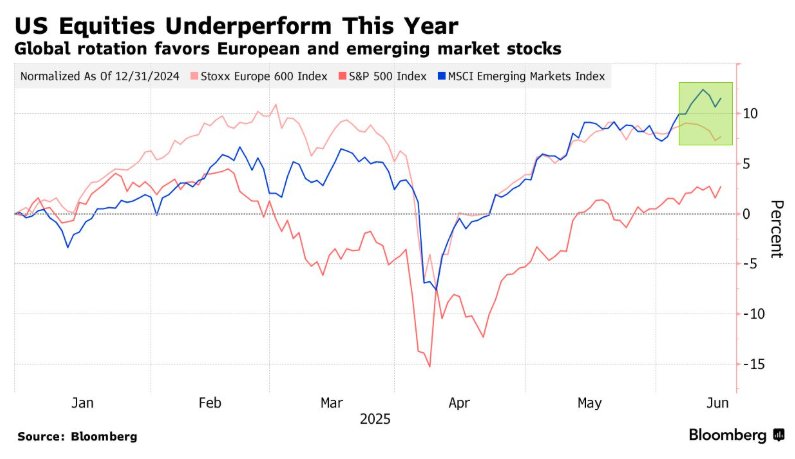
Core Viewpoint - Amundi SA, a major European asset management firm, is shifting its investment focus from the US to Europe and emerging markets due to anticipated economic slowdown in the US and potential market volatility caused by US tax and trade policies [1][2][5] Investment Strategy - Amundi is adopting a "moderate risk preference" and advises investors to hedge against inflation and currency fluctuations [1] - The firm expects US economic growth to slow significantly to 1.6% by 2025-2026, prompting a diversification of investment portfolios away from US assets [1][5] - The asset manager favors Japanese yen and euro over the traditionally preferred US dollar, indicating a long-term bearish outlook on the dollar [5] Market Trends - The "American exceptionalism" narrative is collapsing, leading to a sell-off of US assets by international investors and some Wall Street firms [2][5] - The S&P 500 index has seen a modest increase of less than 3% this year, while the Stoxx 600 index has surged by 20% after adjusting for dollar exchange rates [2] - Amundi highlights a structural change in global trade and international relations under the Trump administration, which is expected to have lasting effects beyond the current government term [5] Emerging Markets Focus - Amundi is increasingly focusing on European defense and infrastructure stocks, as well as Asian markets, particularly the "Make in India" initiative [5] - The firm holds a positive outlook on emerging market bonds, which are seen as providing significant buffers against volatility in the US Treasury market [5] Broader Market Sentiment - Jeffrey Gundlach, CEO of DoubleLine Capital, echoes Amundi's sentiment, predicting a long-term decline in the dollar and suggesting that international stocks, particularly from emerging markets, will outperform US equities [7] - Other analysts, including those from JPMorgan, predict that markets in Japan, the EU, and China will outperform the US over the next 10 to 15 years, driven by concerns over US fiscal debt and high market valuations [8]
如何迎接史上最大美元熊市?海外资管机构首席策略师闭门分享应对策略
Hua Er Jie Jian Wen· 2025-06-11 11:10
Core Insights - The article discusses the impact of Trump's second term on global markets, particularly the decline of the US dollar, leading to a consensus on "de-dollarization" [1] - The dollar index has fallen from a peak of 110.18 on January 18, 2025, to below 100, raising questions about a potential long-term depreciation of the dollar [1] - A closed-door event featuring analysts will provide insights into the long-term trends of the dollar and its implications for global and Chinese assets [1] Group 1 - The dollar index's significant drop indicates a loss of market confidence in dollar assets, prompting discussions about a major bear market for the dollar [1] - The upcoming closed-door sessions will feature prominent analysts, including Kevin Wang from Clocktower Group, who will discuss the potential for the largest dollar bear market in history [1][2] - The sessions aim to help participants understand the broader trends in global assets and clarify investment strategies in light of the dollar's trajectory [1] Group 2 - Another closed-door event is scheduled for June 15, featuring economist Peng Fu, focusing on a review of key asset trends in the first half of 2025 and opportunities and risks for the second half [4] - Membership in the Alpha closed-door sessions provides access to a total of 13 online discussions throughout the year, enhancing participants' understanding of market dynamics [4]

大摩关键预测!风暴眼:美元熊市持续
智通财经网· 2025-06-11 05:57
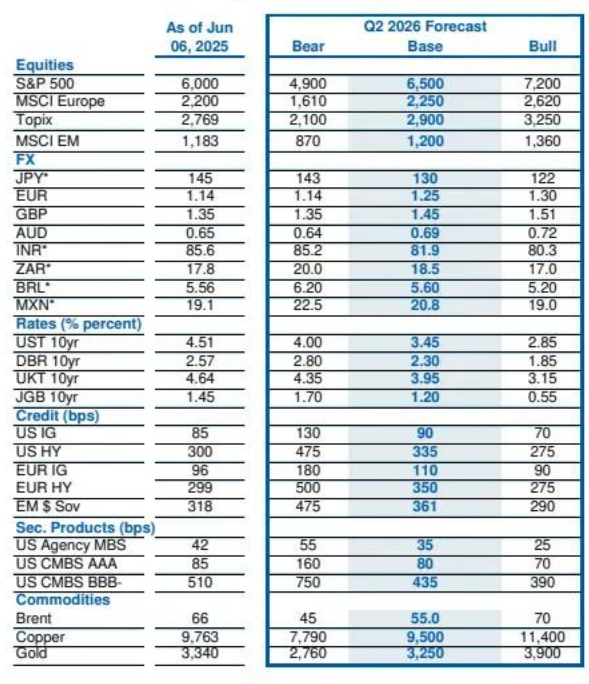
Core Viewpoint - Morgan Stanley maintains a positive outlook on US dollar assets, recommending investors to overweight US stocks, US Treasuries, and US investment-grade corporate credit, while expressing a bearish view on the US dollar due to narrowing economic growth and yield differentials with other countries [1][4]. Economic Forecasts - The forecast for the S&P 500 index is set at 6,000 for June 2025, with a range of 4,900 in a bear scenario and 7,200 in a bull scenario by Q2 2026 [2]. - Global GDP growth is expected to decline from 3.5% in Q4 2024 to 2.5% in 2025, with US GDP growth slowing from 2.5% to 1.0% over the same period [3][8]. Asset Class Recommendations - Investors are advised to focus on high-quality cyclical stocks and large-cap defensive stocks in the US, while in Europe, sectors such as defense, banking, software, telecommunications, and diversified finance are recommended for overweighting [5]. - Emerging markets should focus on financial sectors and companies with strong profitability, favoring domestic businesses over export-oriented firms [5]. Currency and Interest Rate Outlook - The US dollar index (DXY) is projected to decline by 9% to 91 by mid-2026, influenced by converging US interest rates and economic growth with other countries [9]. - The 10-year US Treasury yield is expected to drop to 4.00% by the end of 2025, with the Federal Reserve anticipated to cut rates by 175 basis points in 2026 [9][10]. Commodity Market Insights - Oil prices are expected to face downward pressure due to potential supply increases, with Brent crude projected to fall to the low $50 range by mid-2026 [11]. - Gold is favored as a safe-haven asset, supported by strong central bank demand and ETF inflows, while industrial metals may face downward price risks due to potential economic slowdowns [12].
“新债王”冈拉克重磅预测:美元熊市难避免 远离美股拥抱新兴市场
智通财经网· 2025-06-11 02:57
Group 1 - The CEO of DoubleLine Capital, Jeffrey Gundlach, predicts a long-term decline of the US dollar, suggesting that international stocks, particularly from emerging markets, will outperform US equities [1][2] - Gundlach emphasizes a trading strategy focused on holding stocks outside the US, particularly in regions like China and Southeast Asia, as the dollar enters a bear market [1][3] - The ICE Dollar Index has dropped approximately 8% this year, reflecting a weakening dollar since 2025 due to aggressive policies from the Trump administration [1][3] Group 2 - Gundlach identifies India as a preferred long-term investment in emerging markets, while also considering Southeast Asia, Mexico, and Latin America as viable options [2] - Concerns over geopolitical tensions and unpredictable US policies may lead foreign investors to delay capital investments in the US market, potentially benefiting international markets [2] - Gundlach has maintained a negative outlook on the US market, citing several recession indicators and predicting a 3% inflation rate in the US by the end of 2025 [2] Group 3 - Many Wall Street institutions believe the recent rebound of the dollar is temporary, warning of a prolonged "dollar bear market" triggered by the chaotic trade policies of the Trump administration [3] - Morgan Stanley has issued warnings about the dollar's future, predicting a significant depreciation, with the dollar index potentially falling by 9% in the next year [3] - Non-US equities have significantly outperformed US stocks this year, with expectations that a new bull market will emerge in emerging markets as the dollar declines [3]
突破还是崩盘?美银Hartnett:美股等风险资产迎来关键时刻,关注“三大领先指标”
华尔街见闻· 2025-06-01 11:16
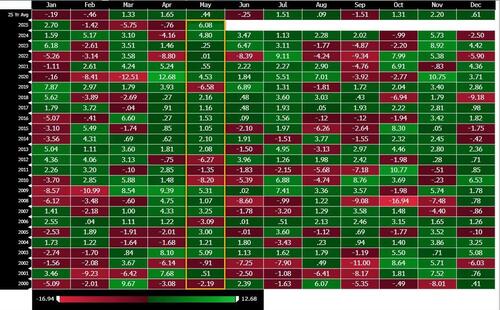
Core Insights - The S&P 500 index is approaching the 6000-point mark while the 10-year Treasury yield remains high, prompting warnings from Bank of America’s Chief Investment Officer Michael Hartnett about potential market movements based on three key indicators: broker stocks, bank stocks, and Bitcoin [1][11] - A bearish signal will be indicated if these three assets form a double top pattern, while a clean upward breakout would suggest a bullish outlook [1] Group 1: Market Dynamics - The recent performance of the S&P 500 index in May saw a 6% increase, marking its best monthly performance since 1990 [1] - In contrast, the dollar is struggling to gain traction, leading to speculation about a potential bear market for the dollar [2] Group 2: Economic Indicators - A weak dollar is seen as a tool to revitalize U.S. manufacturing, which currently accounts for only 8% of U.S. jobs, potentially leading to a bear market for the dollar and boosting gold, emerging markets, and international assets [3] Group 3: Investment Strategies - Investors are positioning themselves for potential market shifts, with bearish investors favoring defensive sectors like healthcare, consumer staples, and utilities, which currently represent only 18% of the S&P 500, the lowest since 2000 [5] - Bullish investors are employing a barbell strategy by going long on the "Tech Seven" and value stocks in other regions to hedge against potential bubbles in the U.S. market and risks from excessive EU fiscal spending [7] Group 4: Fund Flows - Recent fund flow data indicates a divergence in market sentiment, with cryptocurrencies seeing an inflow of $2.6 billion, the largest weekly inflow since January [9] - Other notable fund flows include $1.8 billion into gold, with an annualized inflow reaching a record $75 billion, and $2.8 billion into emerging market bonds, marking the largest inflow since January 2023 [9] Group 5: Valuation Concerns - The Tech Seven stocks have seen a resurgence, with their price-to-earnings ratio returning to 42 times, suggesting a potential 30% upside based on historical bubble patterns [10] - Historically, 12 out of the last 14 asset bubbles were accompanied by rising bond yields, with the current 30-year real yield nearing 3%, the highest since November 2008, indicating the presence of a bubble [11]

突破还是崩盘?美银Hartnett:美股等风险资产迎来关键时刻,关注“三大领先指标”
Hua Er Jie Jian Wen· 2025-06-01 01:57
Core Viewpoint - The performance of U.S. stocks and risk assets is closely tied to three key indicators: broker stocks, bank stocks, and Bitcoin, which will serve as signals for market direction [1][10]. Group 1: Market Indicators - Broker stocks, bank stocks, and Bitcoin are identified as the best indicators for market trends, with a double top pattern signaling a bearish outlook and a clean upward breakout indicating a bullish outlook [1]. - The S&P 500 index recorded its best May performance since 1990, surging 6%, while the 30-year Treasury bond saw an increase following recommendations to invest in "humiliated" assets [1][10]. Group 2: Dollar and Economic Sentiment - In contrast to the rally in risk assets, the dollar is struggling to gain traction, leading to speculation about a potential bear market for the dollar [3]. - The weak dollar is viewed as a tool to revitalize U.S. manufacturing, which currently accounts for only 8% of U.S. jobs, potentially leading to a bear market for the dollar and a bull market for gold, emerging markets, and international assets [6]. Group 3: Investment Strategies - Bearish investors are positioning themselves defensively by allocating to healthcare, consumer staples, and utility stocks, which currently represent only 18% of the S&P 500, the lowest level since 2000 [5]. - Bullish investors are employing a barbell strategy by going long on the "Magnificent Seven" tech stocks and value stocks from other regions to hedge against potential market bubbles and risks from excessive EU fiscal spending [8]. Group 4: Fund Flows and Market Dynamics - Recent fund flow data indicates a divergence in market sentiment, with cryptocurrencies seeing a significant inflow of $2.6 billion, the largest weekly inflow since January [10]. - Despite the bullish outlook for the "Magnificent Seven," historical data suggests that market bubbles typically peak at a P/E ratio of 58x and a 244% increase, indicating that there may still be 30% upside potential [10]. Group 5: Historical Context - The current market environment is reminiscent of past asset bubbles, with 12 out of the last 14 bubbles accompanied by rising bond yields, and the 30-year real interest rate nearing its highest level since November 2008 [11].
美银:全球股市遭遇年内最大单周净流出,新兴市场股票则迎来最大净流入,美元进入熊市
Hua Er Jie Jian Wen· 2025-05-30 13:40
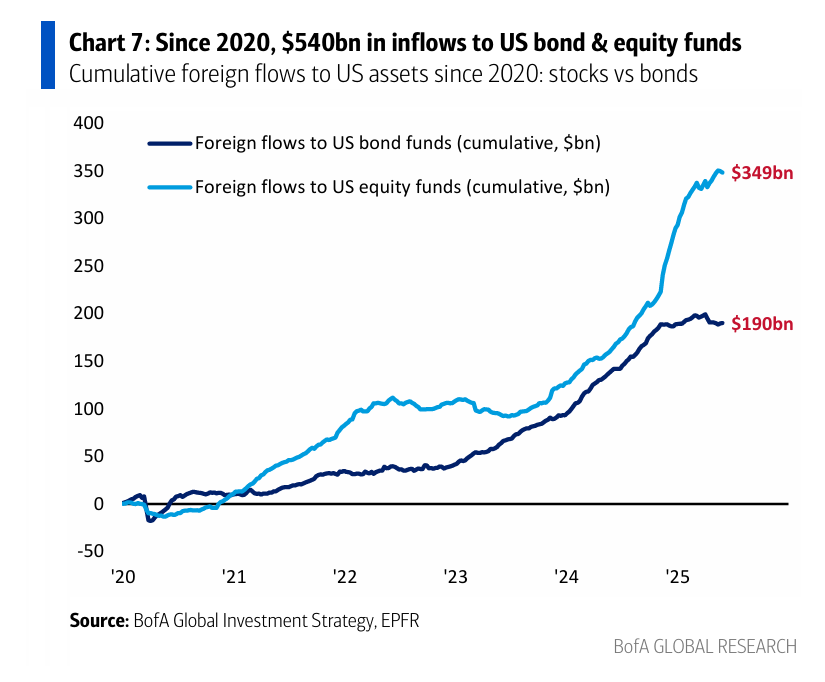
Core Viewpoint - Global stock markets are experiencing significant outflows, while gold and bonds are emerging as winners amid a weak dollar environment [1][9]. Group 1: Market Trends - Global stock funds faced the largest weekly net outflow since 2025, totaling $9.5 billion, with ETFs losing $3.2 billion and actively managed funds losing $6.4 billion [2][12]. - Bond assets attracted $19.3 billion this week, marking five consecutive weeks of inflows, with emerging market debt seeing $2.8 billion, the highest since January 2023 [2][5]. - Gold funds received $1.8 billion in inflows this week, with an annualized inflow reaching a record $75 billion, surpassing other asset classes [5][23]. Group 2: Currency and Asset Rotation - The weak dollar is driving asset rotation, benefiting cryptocurrencies, gold, emerging market bonds, and real estate investment trusts, which saw a net inflow of $300 million, the largest since October of last year [9][11]. - The dollar is entering a bear market, influenced by tariff policies and a shift in Federal Reserve independence, which supports a bullish outlook for gold and emerging markets [11][23]. Group 3: Investment Strategies - The "BIG" strategy (Bonds, International Stocks, Gold) is recommended for investors, as it aligns with the current market dynamics [23]. - The S&P 500 defensive sector's share has dropped to 18%, the lowest since 2000, indicating a high-risk appetite in the market [15][18]. - The "Seven Giants" stocks are trading at a price-to-earnings ratio of 42, suggesting a potential for further gains despite being below historical bubble averages [18][23].
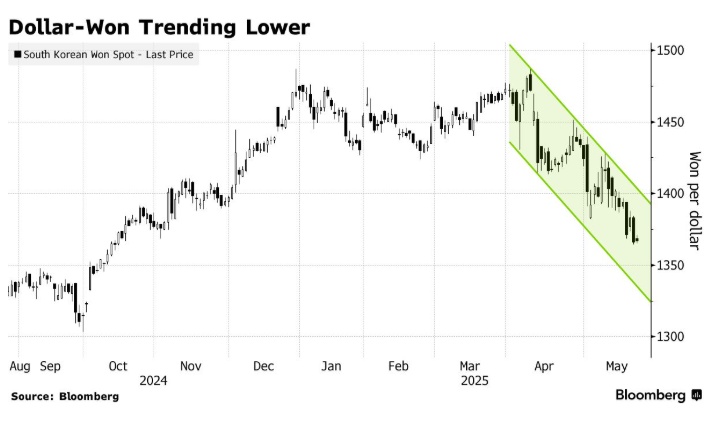
对冲基金们真金白银押注“下一个新台币”:韩元,就你了
Zhi Tong Cai Jing· 2025-05-27 03:08
Core Viewpoint - Global hedge funds are heavily betting on the options market, believing that the long-underestimated South Korean won will replicate the recent record appreciation trend of the New Taiwan dollar against the US dollar [1][4]. Group 1: Market Dynamics - There has been a significant increase in demand for bearish options on the USD/KRW pair, with a put-to-call ratio of 3:2, indicating a strong bearish sentiment towards the dollar and bullish outlook for the won [1][5]. - The trading volume of USD/KRW options surged to its highest level of the year, reflecting market speculation on the potential direction of the won amid discussions between South Korea and the US regarding currency negotiations [4][5]. - The optimism surrounding global trade dynamics, particularly the easing of tensions between the US and China, has led investors to believe that the South Korean authorities may tolerate a stronger currency [4][6]. Group 2: Investment Sentiment - The recent substantial appreciation of the New Taiwan dollar has reshaped investor expectations for Asian currency exchange rates, positioning the won as a likely candidate to follow suit [4][6]. - Hedge funds are increasingly interested in which currencies might replicate the New Taiwan dollar's sharp gains, leading to a notable demand for both digital and vanilla put options on the USD/KRW pair [4][6]. - The risk reversal indicator, which measures the cost of hedging against a decline in the USD/KRW exchange rate, approached a 21-year high last week, further emphasizing the market's bearish outlook on the dollar [5]. Group 3: Economic Implications - The Trump administration's trade policies and potential acceptance of a weaker dollar could significantly impact the USD/KRW exchange rate, as many investors view the won as a proxy for changes in trade dynamics between the US and Asia [6][7]. - Analysts from major banks, including JPMorgan and Deutsche Bank, maintain a bearish stance on the dollar, suggesting that the current rebound in the dollar index may be temporary and that a prolonged dollar bear market is beginning [7]. - The erosion of the "American exceptionalism" narrative is seen as a contributing factor to the declining confidence in dollar assets, with market participants increasingly skeptical of the US's economic policies [7].