
新型政策性金融工具

Search documents
全力冲刺四季度经济 哪些增量政策值得期待?
Shang Hai Zheng Quan Bao· 2025-10-12 17:10
Group 1: Economic Policy and Investment - The fourth quarter is crucial for economic performance, with an estimated investment requirement of around 15 trillion yuan and consumption between 13 trillion to 14 trillion yuan [1] - A package of macro policies is being implemented to stabilize investment, consumption, and foreign trade, with a focus on enhancing existing policy execution [1] - New policy financial tools worth 500 billion yuan are expected to support project capital, particularly for ongoing or upcoming projects [3] Group 2: Consumer Support Policies - The government is expected to further enhance support for large-scale consumption, including expanding subsidies for vehicle trade-ins and simplifying application processes [2] - Policies may also promote consumption in health, medical, cultural tourism, and digital sectors, potentially including the issuance of consumption vouchers [2] - The total retail sales of consumer goods are projected to exceed 50 trillion yuan, with consumption contributing over 50% to GDP [2] Group 3: Infrastructure and Project Development - Local governments are mobilizing for major project construction, with significant investments announced, such as 332.38 billion yuan for 587 projects in Anhui [3] - There is an emphasis on using special local government bonds to ensure that issued funds translate into tangible project outcomes [4] - Policies to encourage private investment in new productive forces and emerging service industries are anticipated [4][5] Group 4: Foreign Trade and Market Access - China is expected to make substantial progress in high-level opening-up, with the Hainan Free Trade Port set to officially operate by December 2025 [6] - The 138th China Import and Export Fair will take place from October 15 to November 4, with new measures to support foreign trade enterprises [6] - The 2025 Action Plan for Stabilizing Foreign Investment includes expanding the scope of encouraged foreign investment, particularly in advanced manufacturing and modern services [6]
宏观周报:科学看待当前经济发展态势-20251012
KAIYUAN SECURITIES· 2025-10-12 13:42
Domestic Macro Policy - The central government is focusing on the formulation of the 15th Five-Year Plan, emphasizing long-term strategic adjustments to macroeconomic policies rather than short-term gains[4] - The National Development and Reform Commission (NDRC) announced a new policy financial tool worth CNY 500 billion to support effective investment[5] - The People's Bank of China (PBOC) is shifting its monetary policy focus from "implementation" to "execution," aiming for a moderately loose monetary policy[8] Infrastructure and Industry - Policies are being introduced to stabilize growth in key industries such as steel, petrochemicals, and machinery, with an emphasis on capacity reduction[6] - The steel industry aims for an average annual growth of around 4% in value added over the next two years[7] Real Estate Policy - Cities like Guangzhou and Wuhan are implementing measures to optimize land use and stimulate demand, including interest subsidies for home loans[9] - The focus is on utilizing existing urban land effectively as China enters a "stock era" in urban development[9] Trade Relations - The U.S.-China trade conflict is escalating, with the U.S. imposing a 100% tariff on Chinese products starting November 1, 2025[12] - China has responded with export controls on rare earth technologies, affecting various critical sectors[11] Overseas Macro Policy - The U.S. government is facing a shutdown due to funding issues, impacting federal employees and public services[15] - The Federal Reserve's future interest rate decisions remain uncertain, with discussions around potential rate cuts to address labor market concerns[16] Market Trends - In the first week of October, major overseas stock indices, including the S&P 500 and Nasdaq, experienced declines of approximately 2.43% and 2.53%, respectively[18] - Gold prices continued to rise, with COMEX gold reaching USD 3,986.20 per ounce, reflecting a 2.68% increase[19] Risk Factors - There is a risk of divergence in domestic and international monetary policies, with domestic policy execution potentially falling short of expectations[20]
四季度:政策对冲会重现吗?
SINOLINK SECURITIES· 2025-10-12 11:09
Group 1 - The report highlights that the fourth quarter is traditionally a high-frequency window for fiscal policy to intensify, especially under weak domestic demand conditions, where the pressure to meet annual economic targets becomes more pronounced [2][8][10] - The cumulative GDP growth for the first three quarters is projected to exceed the annual target, suggesting that the pressure to implement large-scale counter-cyclical policies in the fourth quarter is lower than in previous years [10][11] - The report indicates that even if the economic growth continues to moderate in the fourth quarter, as long as it does not deviate significantly from the central level, the growth rate is expected to remain stable within a reasonable range [11][18] Group 2 - The establishment of 500 billion new policy financial tools at the end of the third quarter is noted as a significant measure to support project initiation in the fourth quarter, which could leverage local matching investments and potentially create a multiplier effect of around one trillion [3][11] - The report suggests that the reliance on large-scale additional stimulus is decreasing, indicating that the fiscal policy's focus may shift towards consolidating the economic fundamentals rather than introducing substantial new measures [11][18] - The report emphasizes that the short-term market dynamics are likely to be driven more by risk appetite and market microstructure rather than significant policy changes, with a notable recovery in market sentiment observed [4][14][18] Group 3 - The report discusses the potential for emotional recovery and risk preference resonance in the market, suggesting that the current low sentiment levels may lead to a phase of recovery, although this is subject to external shocks or internal sentiment weakening [4][14] - It is noted that the market's microstructure is currently similar to that of April, with sentiment indicators at a two-year low, reflecting a comprehensive pricing of negative factors [14][18] - The report concludes that while there is some room for fiscal policy intervention, the urgency is not as pronounced as in previous years, and the market's mid-term expectations have shifted significantly compared to earlier in the year [18]
高频跟踪周报20251011:基建实物工作量的积极变化-20251011
Tianfeng Securities· 2025-10-11 14:42
Group 1: Demand - New housing transaction volume in 20 cities decreased by 61% week-on-week and 48% year-on-year, remaining below seasonal levels [13][15][29] - First-tier cities saw significant declines in new housing transactions, with Beijing, Shanghai, Guangzhou, and Shenzhen experiencing week-on-week drops of 78%, 72%, 61%, and 85% respectively [13][15] - Automotive consumption showed a notable increase, with average daily retail sales of passenger cars rising by 49.3% week-on-week, despite a year-on-year decline of 4.8% [38] Group 2: Production - PTA operating rate remained stable at 77.7%, while the operating rate for rebar decreased by 0.3 percentage points to 40.0% [47] - The operating rate for asphalt facilities increased to a year-to-date high of 40.1%, reflecting a 5.7 percentage point rise [47] - Downstream production rates for automotive tires decreased significantly, with full steel tire operating rates dropping by 14.9% and semi-steel tire rates by 18.3% [47][59] Group 3: Investment - Apparent consumption of rebar fell by 39.4% week-on-week to 146.0 million tons, with prices slightly decreasing to 3260.0 yuan per ton [62] - Cement shipment rates decreased week-on-week, with the cement price index dropping by 0.6% to 104.9 points [62][70] - The implementation of 500 billion yuan in new policy financial tools is expected to accelerate infrastructure investment in the fourth quarter [1] Group 4: Trade - Port container throughput increased by 8.8% week-on-week, surpassing last year's levels, while the CCFI comprehensive index fell by 6.7% [73] - Export shipping prices continued to decline, with significant drops in rates for European and American routes [73][77] - The BDI index also experienced a decline of 4.4% week-on-week [73] Group 5: Prices - Agricultural product wholesale prices saw a slight decrease, with the 200 index dropping by 0.1% [83] - Pork prices fell by 2.7% week-on-week, while vegetable prices decreased by 2.9% [83][86] - The PPI for industrial products decreased by 0.2%, with Brent crude oil prices falling by 0.6% [87] Group 6: Interest Rate Bonds - As of October 10, the cumulative issuance progress of replacement bonds reached 99.3%, with a total issuance of 19,862 billion yuan [102][104] - New general bonds issued totaled 6,717 billion yuan, with a cumulative issuance progress of 84.0% [107] - The total issuance of government bonds for the year was 121,835 billion yuan, with a net financing scale of 55,837 billion yuan [109]
金融数据预测月报(2025.09.01-2025.09.30):9月社融增速或持续下探,新增信贷同比多增-20251011
China Post Securities· 2025-10-11 07:56
证券研究报告:银行|行业周报 证券研究报告:银行|金融数据预测月报 发布时间:2025-10-11 行业投资评级 中性 |维持 | 行业基本情况 | | | --- | --- | | 收盘点位 | 3981.95 | | 52 周最高 | 4670.31 | | 52 周最低 | 3596.91 | 行业相对指数表现 2024-10 2024-12 2025-03 2025-05 2025-07 2025-10 -10% -6% -2% 2% 6% 10% 14% 18% 22% 银行 沪深300 资料来源:聚源,中邮证券研究所 研究所 分析师:张银新 SAC 登记编号:S1340525040001 Email:zhangyinxin@cnpsec.com 近期研究报告 《进入四季度银行负债端压力如何》 - 2025.09.29 金融数据预测月报 (2025.09.01-2025.09.30) 9 月社融增速或持续下探,新增信贷同比多增 l 投资要点 (1)预计 9 月新增人民币贷款(信贷口径)约 17000 亿元,同 比多增约 1100 亿元:9 月不同类型企业经营情况整体改善但仍现分 化,大型企业供需两 ...
内需表现持稳,价格或加速修复:——9月经济数据预测
Huachuang Securities· 2025-10-10 14:54
1. Report Industry Investment Rating There is no information provided regarding the report's industry investment rating in the given content. 2. Core Viewpoints of the Report - The economic operation in September was stable, but due to the rising year - on - year base, it was difficult to have an unexpectedly high reading. The GDP growth rate in the third quarter was expected to be around 4.7% [2][53]. - For the bond market, the "broad credit" policy was intensified in the fourth quarter, and it was expected that the annual economic growth target could be achieved. Short - term attention should be paid to the effects of new policy - based financial instruments, and October was an important window period. The bond market should look for structural opportunities in October, and the 10 - year Treasury bond yield above 1.8% gradually had allocation value, with 1.9% as the upper - limit protection for the year [2][54]. 3. Summary by Relevant Catalogs 3.1 Inflation - **CPI**: Affected by high - temperature rainfall and the holiday effect, food prices rose, while non - food items were affected by falling oil prices and might be weaker than the seasonal level. It was expected that the CPI in September would have a month - on - month increase of about 0.3% and a year - on - year increase to around - 0.1%. Specifically, the food item was expected to have a month - on - month increase of 0.9% and a year - on - year decrease to around - 4.2%, and the non - food item was expected to have a month - on - month increase of around 0.1% and a year - on - year increase of around 0.8% [7][12]. - **PPI**: Due to the weak terminal demand for domestic bulk commodities, the "Golden September" performance was rather dull. It was expected that the PPI in September would have a month - on - month decrease of around - 0.1%, and the sharp rise in the carry - over effect would push the year - on - year increase to around - 2.4% [16]. 3.2 Foreign Trade - **Export**: It was expected that the export growth rate in September would remain stable at around 4.5%. In terms of price, the decline of the CCFI index year - on - year in September narrowed significantly compared with August, indicating that the price drag might improve. In terms of quantity, the year - on - year growth rates of port container throughput and cargo throughput in September were basically the same as those in August. Also, the growth rate of the feed - processing trade, which led exports by about one month, remained stable in August, so the export reading in September was likely to remain stable compared with August [21]. - **Import**: It was expected that the import growth rate in September would be around 0.8%. The year - on - year increase of the CRB spot index in September narrowed, and the year - on - year decline of the CDFI index monthly average also widened slightly, indicating that the supporting effect of price on imports might continue to weaken [21]. 3.3 Industry The industrial growth rate in September was expected to drop to around 4.9%. Although the production sub - index of the PMI in September increased seasonally, the month - on - month increase was lower than the seasonal level. Considering the short - term impact of "anti - involution" and important events on the production rhythm and the fact that high - frequency data of downstream investment demand did not show super - seasonal performance, the year - on - year industrial added value was expected to decline slightly [23]. 3.4 Investment - **Manufacturing Investment**: The cumulative growth rate of manufacturing investment from January to September was expected to be around 4.3%. The boosting effect of the "Two - New" policies on manufacturing investment had been weakening since the third quarter, and the growth rate of equipment purchases had been falling from July to August. Some enterprises might delay their expansion plans under the promotion of "anti - involution", and the uncertainty of Sino - US economic and trade frictions continued to postpone, which might lead to a temporary slowdown in manufacturing investment [28]. - **Infrastructure Investment (excluding electricity)**: The cumulative growth rate of infrastructure investment (excluding electricity) from January to September was expected to be around 1.1%. According to the China Federation of Logistics and Purchasing, the PMI of civil engineering construction, which represented infrastructure investment, was below 50% in September, indicating that the short - term growth of investment - related construction activities was still weak. It was expected that the single - month year - on - year growth of infrastructure investment would remain negative, and the cumulative growth rate would continue to decline to around 1.1% [28]. - **Real Estate Investment**: The cumulative year - on - year growth rate of real estate investment from January to September was expected to be around - 13.4%. In terms of sales, high - frequency data showed that the year - on - year growth rate of the transaction area of new homes in 30 cities turned positive, and the growth rate of the sales area bottomed out due to the low - base effect. In terms of investment, the construction PMI showed that the activity index of housing construction was below 50%, indicating that the real estate investment growth rate might continue to decline to - 13.4% [32]. - **Overall Fixed - Asset Investment**: It was comprehensively judged that the fixed - asset investment growth rate in September would be around 0.2% [35]. 3.5 Social Retail The year - on - year growth rate of social retail was expected to drop to around 4.3%. According to the data from the Passenger Car Association, the base in September last year increased slightly, and the slowdown of subsidy issuance in some regions led to a slowdown in automobile sales. Considering the high base of durable - goods retail caused by the "trade - in" policy in the same period last year, the year - on - year growth rate of social retail in September was expected to continue to decline [37]. 3.6 Financial Data - **Credit**: It was expected that the new credit in September would be about 150 billion yuan, slightly lower than the level of the same period last year. The new social financing was about 3.1 trillion yuan, a year - on - year decrease of 66 billion yuan. The residents' credit in September was expected to be around 25 billion yuan, a slight increase compared with the same period last year [45]. - **Components of Social Financing**: In the off - balance - sheet items, trust loans in September might increase slightly by 2 billion yuan, entrusted loans might decrease slightly by about 1.5 billion yuan, undiscounted bills might increase by 10.72 billion yuan, the loan write - off scale might be 17.52 billion yuan, and the net financing scale of credit ABS was around 1.43 billion yuan. In direct financing, the new financing amount of corporate bonds was 8.47 billion yuan, and stock financing might be 4.16 billion yuan. The net financing scale of government bonds in the month might be close to 1.2 trillion yuan, and its year - on - year support for social financing might weaken [45]. - **M2 Growth Rate**: Affected by the high base of last year, it was expected that the year - on - year growth rate of M2 would decline to around 8.4% [48].
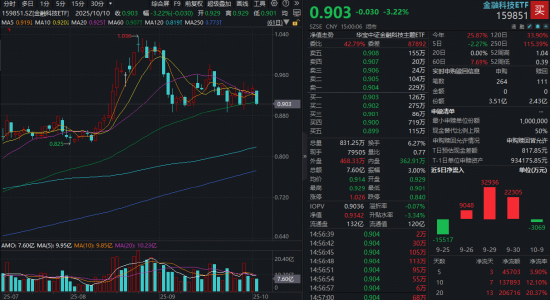
金融科技跌超3%回踩60日均线,资金单日借道159851加仓超1亿份,逻辑有哪些?
Xin Lang Ji Jin· 2025-10-10 11:54
Core Viewpoint - The A-share market experienced a decline, with the Shanghai Composite Index falling nearly 1% and the financial technology sector facing significant losses, indicating a potential shift in investor sentiment and market dynamics [1][3]. Market Performance - The financial technology theme index dropped over 3%, with only a few stocks like Advanced Digital and Electronic Science and Technology showing gains [1]. - The popular financial technology ETF (159851) saw a decline of 3.22%, with a total trading volume of 760 million yuan, indicating reduced investor activity [1][3]. Investment Logic - Three main factors support the recent increase in investment: 1. Valuation corrections as the financial technology sector approaches the 60-day moving average, showing a significant drop from previous highs [3]. 2. High trading activity suggests greater elasticity in financial technology investments [3]. 3. New policy and innovation opportunities in the financial technology sector [3]. Trading Activity - The total trading volume in both markets has exceeded 2 trillion yuan for 16 consecutive trading days, reflecting a robust liquidity environment [3]. - Western Securities highlighted that the combination of ample liquidity and improved risk appetite makes the consumer-facing financial technology sector an attractive investment opportunity [3]. Policy Support - Financial policies are being actively implemented to support macroeconomic operations, including the introduction of new policy financial tools totaling 500 billion yuan aimed at bolstering project capital [3][4]. - The establishment of the digital renminbi international operation center in Shanghai marks a significant step in financial innovation, enhancing cross-border digital payment capabilities [3][4]. Future Outlook - The financial technology sector is poised for a new wave of policy and innovation-driven opportunities, with a focus on internet finance leaders, financial technology vendors, securities IT firms, and cross-border payment providers [4]. - The financial technology ETF (159851) and its associated funds are recommended for investment, given their comprehensive coverage of key themes in the sector [4].

基建ETF(159619)盘中上涨1.1%,消费制造和装备制造业边际改善
Mei Ri Jing Ji Xin Wen· 2025-10-10 06:38
Group 1 - The core viewpoint indicates that the construction industry is showing signs of recovery, with the business activity index rising to 49.3%, an increase of 0.2 percentage points from the previous month [1] - New orders and business activity expectation indices have improved by 1.6 and 0.7 percentage points respectively, indicating a synchronized improvement in the sector [1] - The National Development and Reform Commission has announced a total of 500 billion yuan in new policy financial tools aimed at supplementing project capital, with funds being rapidly allocated to specific projects [1] Group 2 - The construction industry is expected to see a rebound in prosperity due to the accelerated implementation of key construction projects and special bond funds [1] - The manufacturing PMI production index has reached its highest level since April 2025, with external demand improving more than internal demand, which may indirectly support the construction and decoration industries [1] - The Infrastructure ETF (159619) tracks the CSI Infrastructure Index (930608), which selects listed companies involved in the construction and machinery sectors to reflect the overall performance of the infrastructure construction field in China [1] Group 3 - The CSI Infrastructure Index has a high industry concentration, clearly reflecting the "infrastructure" theme, with constituent stocks primarily consisting of leading enterprises in the industry [1] - The index has a high state-owned enterprise characteristic, relatively low valuation levels, and good liquidity [1]
FICC日报:A股10月开门红,短期关注美政府停摆事件-20251010
Hua Tai Qi Huo· 2025-10-10 06:08
Report Industry Investment Rating No relevant content provided. Core Viewpoints - The gap between strong expectations and weak reality in the domestic market has widened. In August, China's economic data showed signs of weakness, with characteristics such as "slow industrial growth, weak investment, and sluggish consumption." Meanwhile, external tariff pressure has increased, and the domestic government has frequently mentioned pro - growth policies [1]. - Attention should be paid to the duration of the US government shutdown. The shutdown has affected economic data releases, and there are differences among Fed officials on the magnitude of interest rate cuts [2]. - In the commodity market, focus on sectors such as gold and non - ferrous metals. The black sector is still dragged down by downstream demand expectations, while the non - ferrous sector is boosted by global easing expectations [3]. - For commodities and stock index futures, it is recommended to allocate long positions in industrial products and precious metals at low prices [4]. Summary by Relevant Catalogs Market Analysis - Domestic economic pressure increased marginally in August, with weakening economic data and rising external tariff pressure. The government has introduced pro - growth policies, such as the central bank's call for strengthened monetary policy regulation and the planned use of 500 billion yuan in new policy - based financial instruments [1]. - On October 9, the A - share market had a good start, with the Shanghai Composite Index breaking through the 3,900 - point mark for the first time in a decade. The non - ferrous metal sector rose, and the semiconductor industry chain was active. The Hong Kong stock market fluctuated downward, and the pharmaceutical and biological sectors adjusted. Treasury bonds rebounded, and commodities such as gold and copper rose [1]. - The US government shutdown entered its second week on October 8, affecting economic data releases. There are differences among Fed officials on the magnitude of interest rate cuts. US economic data showed mixed performance, with the manufacturing and service PMIs slightly declining in September, while retail sales and new home sales performed well [2]. Commodity Market - The black sector is still affected by downstream demand expectations, and attention should be paid to the "anti - involution" situation. The non - ferrous sector is still facing long - term supply constraints and is recently boosted by global easing expectations [3]. - OPEC + announced that eight oil - producing countries will increase production by 137,000 barrels per day in November, and the first - stage cease - fire agreement in Gaza has come into effect [3]. - In the chemical sector, the "anti - involution" space of varieties such as methanol, PVC, caustic soda, and urea is worthy of attention. Agricultural products are driven by tariff and inflation expectations in the short term, but still need signals from the fundamentals [3]. - Due to the US government shutdown and continuous central bank purchases, gold is expected to continue to strengthen, and attention should be paid to the game at key points [3]. Strategy - For commodities and stock index futures, it is recommended to allocate long positions in industrial products and precious metals at low prices [4]. Key News - The Ministry of Commerce and the General Administration of Customs jointly announced export controls on some medium - heavy rare earth - related items, which will take effect on November 8, 2025 [5]. - On October 9, the People's Bank of China conducted 1.1 trillion yuan in fixed - quantity, interest - rate - tendered, multiple - price - winning买断式 reverse repurchase operations with a term of 3 months [5]. - The Shanghai Composite Index rose 1.32%, the Shenzhen Component Index rose 1.47%, and the ChiNext Index rose 0.73%. More than 3,100 stocks in the Shanghai, Shenzhen, and Beijing stock markets rose, and the trading volume exceeded 2.67 trillion yuan [5]. - Most Fed officials said that continued easing this year may be appropriate, and they emphasized the upside risks to inflation. Employment faces relatively high downside risks [5]. - The US dollar against the Japanese yen rose to 153, up 0.2% on the day, for the first time since February [2][5]. - The first - stage cease - fire agreement in Gaza officially came into effect at noon on October 9 [3][5].
前三季度地方发债 约8.5万亿元
Sou Hu Cai Jing· 2025-10-09 16:26
Core Viewpoint - Local governments are increasing their borrowing to stabilize investment and mitigate risks, but the pace of borrowing is gradually slowing down as the issuance of bonds approaches its end [1] Group 1: Bond Issuance and Borrowing Scale - In the first three quarters of this year, local government bond issuance totaled approximately 8.54 trillion yuan, a year-on-year increase of about 27% [2] - The broad fiscal revenue of local governments for the first eight months was about 10.75 trillion yuan, with borrowing amounting to approximately 7.7 trillion yuan, accounting for about 72% of the broad fiscal revenue [3] - Approximately 60% of the funds raised are used for repaying old debts, while nearly 40% are directed towards major project construction [3] Group 2: Refinancing and Debt Management - The issuance of refinancing bonds reached about 4.19 trillion yuan, a year-on-year increase of approximately 69%, primarily due to the completion of 2 trillion yuan in refinancing bonds for replacing hidden debts [4] - The total issuance of government bonds aimed at repaying old debts is about 5.39 trillion yuan, which constitutes around 63% of the total bond issuance [4][5] Group 3: Project Investment and Economic Impact - Approximately 3.15 trillion yuan of the new local government bonds is allocated for major project construction, with about 2.5 trillion yuan specifically for special bonds [5] - The allocation of special bond funds includes approximately 28% for municipal and industrial park infrastructure, 18% for transportation infrastructure, and 12% for social projects such as healthcare and education [5] - Infrastructure investment in the third sector grew by 2.0% year-on-year in the first eight months, surpassing the overall fixed asset investment growth rate of 0.5% [7] Group 4: Future Outlook and Policy Recommendations - The total issuance of local government bonds for the year is capped at 5.2 trillion yuan, with about 84% already issued by the end of the third quarter, indicating that the issuance is nearing its end [7] - Experts suggest considering the early issuance of some quotas for replacing hidden debts in the fourth quarter to alleviate local repayment pressures [7]