
即时零售

Search documents
下沉与出海:拼多多双线夺路闯关
3 6 Ke· 2026-02-04 01:43
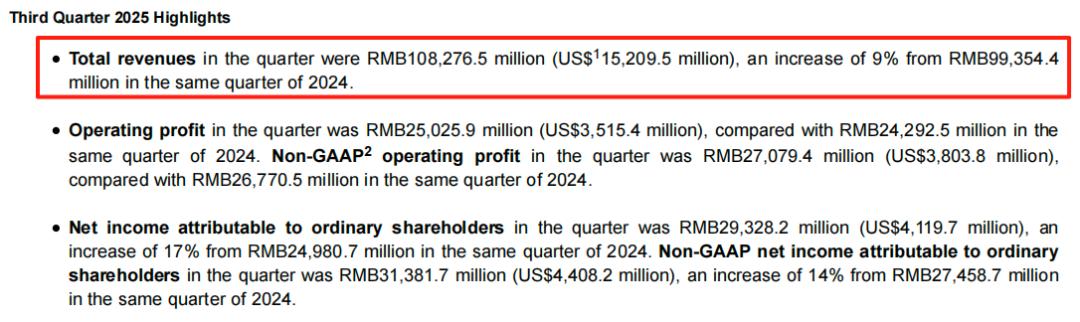
Core Viewpoint - Pinduoduo is experiencing a significant strategic transformation, facing challenges in both domestic and international markets, with a shift from aggressive growth strategies to a focus on efficiency and structural adjustments [2][3][6]. Domestic Market Performance - In Q3 2025, Pinduoduo reported total revenue of RMB 1,082.8 billion, a year-on-year increase of 9%, marking a shift to single-digit growth rates [3][6]. - Online marketing services and other revenues grew by only 8.1%, the lowest increase in recent years, indicating systemic challenges in its core monetization capabilities [6]. - The absence of state subsidies during major sales events has led to a decline in consumer spending, particularly on non-essential items, further impacting revenue [6][12]. - The company's gross merchandise volume (GMV) growth slowed to 10%, primarily driven by an increase in average order value rather than transaction volume [12]. Competitive Landscape - The Chinese e-commerce market is undergoing structural changes due to the rise of instant retail and AI technologies, posing significant challenges to Pinduoduo's low-price and social marketing model [7][11]. - Pinduoduo's core user base, which is price-sensitive and tolerant of longer delivery times, is at odds with the efficiency-driven user profiles of instant retail competitors [13]. - The company's community group buying business, Duoduo Maicai, has seen strategic contraction due to mismatched capabilities in real-time delivery and local operations [13]. International Expansion Challenges - Temu, Pinduoduo's global strategy core, has seen a 68% year-on-year increase in monthly active users, but faces regulatory pressures in the U.S. and EU that threaten its low-price business model [15][18]. - The U.S. has implemented significant tariffs and removed tax exemptions for low-value imports, while the EU plans to increase taxes on imports, impacting Temu's operational costs [18][19]. - In contrast, the Latin American market shows strong growth, with a 122% increase in monthly active users, but logistical challenges and high costs hinder effective operations [21][22]. - Temu's reliance on low prices may lead to higher subsidy costs in Latin America, where purchasing power is lower compared to North America and Europe [23]. Strategic Adjustments - Pinduoduo is shifting from a growth-first approach to a model that balances compliance and growth, requiring deeper involvement in supply chain and logistics management [24][25]. - The company faces short-term pain with slowing growth and rising costs, but this transition is essential for establishing a sustainable competitive position in the global retail landscape [25].


三全食品(002216) - 2026年2月3日投资者关系活动记录表
2026-02-03 12:20
Group 1: Company Performance in 2025 - The company launched new products such as "China's Good Dumplings" and "Golden Ratio Dumplings," leading to rapid revenue growth from new products [2] - The soup product line introduced three series targeting different consumer needs, contributing to overall sales improvement [2] - The direct sales channel showed significant improvement, with a notable reduction in revenue decline and profit losses [3] Group 2: Sales Channel Optimization - The company implemented organizational adjustments in the direct sales channel, enhancing management efficiency through multi-dimensional data analysis [3] - Collaboration with major retail systems was deepened, resulting in improved service capabilities and profitability [3] - The company capitalized on opportunities in the supermarket sector by expanding customized product offerings [3] Group 3: Growth Opportunities for 2026 - Continuous product development and upgrades are planned to enrich the product matrix and enhance competitiveness [3] - The company aims to deepen customized cooperation in the direct sales channel and expand into previously uncovered regional chains [3] - The membership supermarket business is expected to achieve significant growth due to improved product strength and service response [3] Group 4: Future Business Directions - The company views instant retail as a growing channel and plans to strategically develop this area in collaboration with platforms like Taobao and Meituan [3] - The company has obtained necessary certifications for overseas investment and is progressing with its international expansion plans [3]

顺丰同城(09699):盈喜符合预期,看好即时配送未来增长:顺丰同城(09699):
Shenwan Hongyuan Securities· 2026-02-03 07:16
Investment Rating - The report maintains an "Outperform" rating for the company [2][3] Core Views - The company is expected to see significant growth in its instant delivery segment, driven by increasing demand and strategic positioning within the market [3][4] - The company has reported a strong performance forecast for 2025, with net profit expected to be no less than RMB 238 million, representing an 80% increase from 2024 [3][4] - The report highlights the company's independent third-party platform as a key differentiator, enabling it to capture market opportunities and enhance customer relationships with major brands [3][4] Financial Data and Profit Forecast - Revenue projections for the company are as follows: - 2023: RMB 12.4 billion - 2024: RMB 15.746 billion - 2025E: RMB 22.051 billion - 2026E: RMB 30.202 billion - 2027E: RMB 39.568 billion - Year-on-year revenue growth rates are projected at: - 2023: 20.80% - 2024: 26.98% - 2025E: 40.04% - 2026E: 36.96% - 2027E: 31.01% [3][7] - Net profit attributable to ordinary shareholders is forecasted as follows: - 2023: RMB 51 million - 2024: RMB 132 million - 2025E: RMB 238 million - 2026E: RMB 452 million - 2027E: RMB 755 million - Year-on-year net profit growth rates are projected at: - 2023: -117.63% - 2024: 161.81% - 2025E: 80.03% - 2026E: 89.46% - 2027E: 67.04% [3][7] - Earnings per share (EPS) is expected to increase from RMB 0.06 in 2023 to RMB 0.82 in 2027 [3][7] - The report notes a decrease in the price-to-earnings (PE) ratio from 48x in 2025E to 15x in 2027E, indicating a favorable valuation compared to peers [3][4]
顺丰同城(09699):盈喜符合预期,看好即时配送未来增长
Shenwan Hongyuan Securities· 2026-02-03 05:46
Investment Rating - The report maintains a rating of "Outperform" for the company [1] Core Insights - The company is expected to see significant growth in its revenue and net profit, with a projected revenue of RMB 22.05 billion in 2025, representing a year-on-year growth of 40.04% [2] - The demand for instant retail is rapidly increasing, and the company is well-positioned to capture this growth, especially with the strategic focus of major players like Alibaba on instant retail [5] - The company's independent third-party platform is a key differentiator, allowing it to serve a diverse range of clients and enhance its logistics capabilities [5] - The profit forecast has been adjusted downwards due to short-term impacts from new rider recruitment and share payments, but long-term growth prospects remain strong [5] Financial Data and Profit Forecast - Revenue projections for the company are as follows: - 2023: RMB 12.4 billion - 2024: RMB 15.746 billion - 2025E: RMB 22.051 billion - 2026E: RMB 30.202 billion - 2027E: RMB 39.568 billion - Net profit attributable to ordinary shareholders is expected to be: - 2023: RMB 51 million - 2024: RMB 132 million - 2025E: RMB 238 million - 2026E: RMB 452 million - 2027E: RMB 755 million - The company’s earnings per share (EPS) is projected to grow from RMB 0.06 in 2023 to RMB 0.82 in 2027 [2][6]
近15万人次打卡!京东七鲜超市荟聚店点亮春节前线下消费活力
Sou Hu Wang· 2026-02-03 03:48
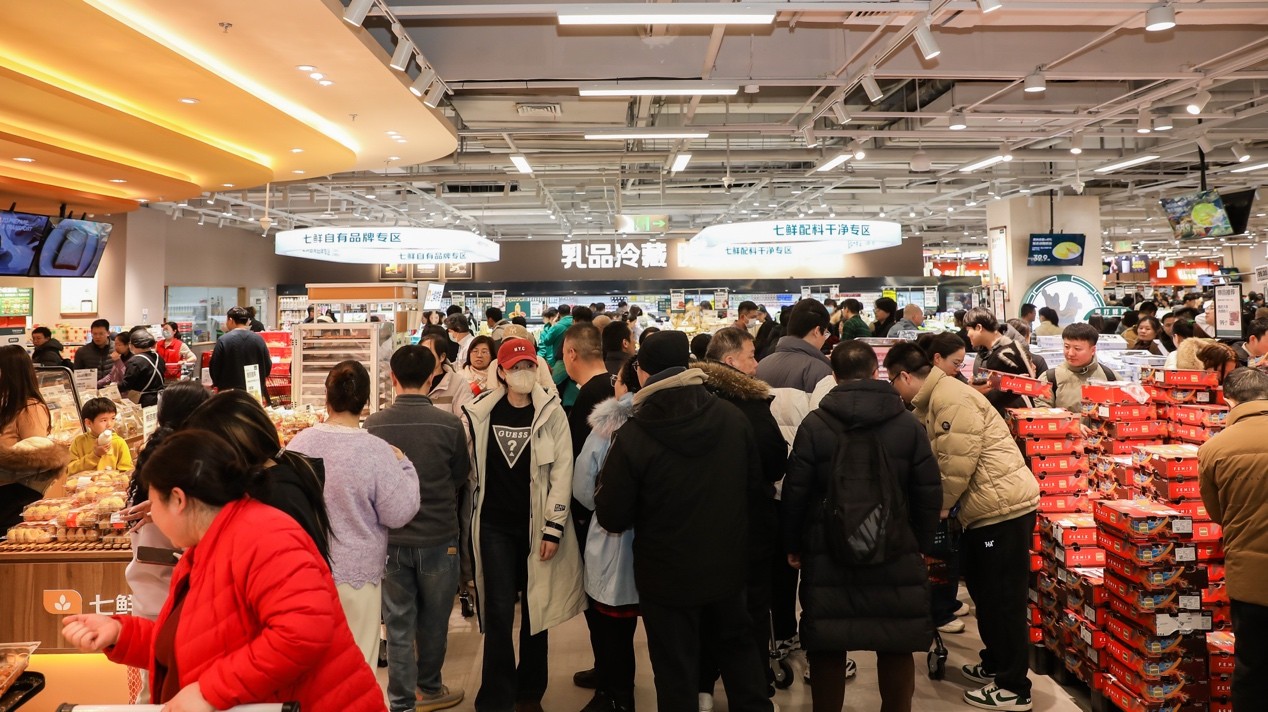
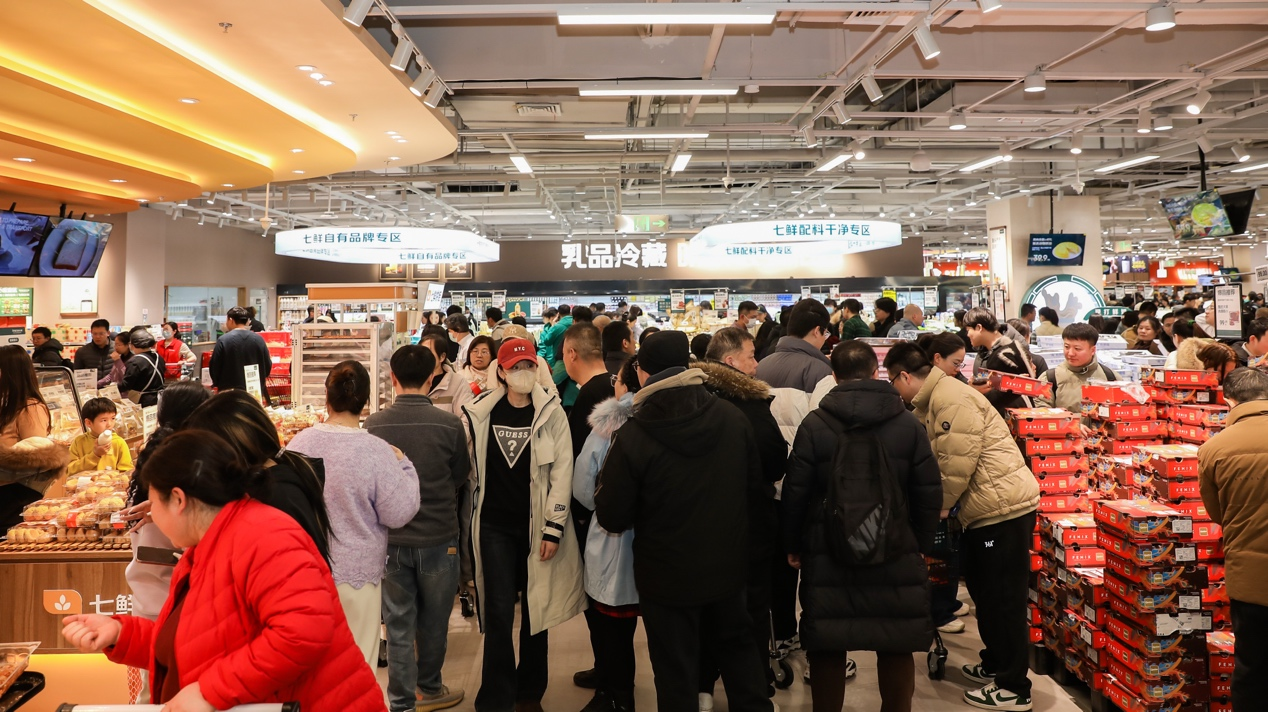
Core Insights - JD's Qixian Supermarket in Beijing's Huiju store has become a significant driver of offline consumption, attracting nearly 150,000 visitors in its first three days of operation since January 30 [1][3] Group 1: Customer Engagement and Popularity - The store's opening has generated substantial buzz on social media, with customers sharing experiences of long lines and high product demand, making it a popular "check-in" location [3] - Customers have reported overwhelming crowds, with some likening the experience to the Spring Festival travel rush, indicating strong consumer interest and engagement [4] Group 2: Product Offerings and Freshness - The supermarket's success is attributed to its focus on high-quality products that meet consumer demands, particularly the "24-hour fresh product matrix," which ensures that items are delivered from farm to shelf within 24 hours [8] - Freshly cut beef, available within 3-6 hours post-slaughter, has also been a hit, with customers appreciating the lack of additives and the freshness of the product [11] Group 3: Sales Performance - The store sold over 10 tons of imported durian on its opening day, showcasing the popularity of its fruit offerings [13] - High-demand items include live king crabs priced at 799 yuan each and fresh salmon, which have become popular choices for family gatherings [15] Group 4: Strategic Expansion - With the opening of the Beijing Huiju store, JD's Qixian Supermarket has successfully implemented its innovative "1+N" model, consisting of one central store and multiple satellite stores, marking a significant step towards stable and scalable operations in the instant retail sector [19]

港股异动 | 顺丰同城(09699)涨超4% 预计2025年盈利同比增长不少于80%
智通财经网· 2026-02-03 03:25
Core Viewpoint - SF Express City (顺丰同城) has announced a positive earnings forecast, indicating significant growth in profit and revenue for the upcoming fiscal year [1] Financial Performance - The expected profit attributable to the company's owners for the year ending December 31, 2025, is projected to be no less than RMB 238 million, representing an increase of at least 80% compared to the fiscal year 2024 [1] - The adjusted net profit is anticipated to be no less than RMB 376 million, reflecting a growth of at least 158% from 2024 [1] - Revenue is expected to reach no less than RMB 22 billion, which is an increase of at least 40% compared to 2024 [1] Market Position and Strategy - The company is capitalizing on the opportunities in the instant retail market, with a rapid increase in demand for instant delivery services [1] - All business segments are experiencing balanced and high-quality development, leading to healthy growth in order volume and revenue, significantly enhancing scale [1] - The company has established a neutral and open third-party market positioning, providing high-quality services across all categories and timeframes, which has fostered long-term customer trust and steady business growth [1] Operational Efficiency - Lean operations of the rider base and innovations in digital technology have improved network quality and efficiency, further enhancing scale effects [1] - The continuous manifestation of operational leverage has improved the efficiency of resource input and output, contributing to profit release [1]
攀高向新 把握主动——我国民营企业内生动力持续增强
Xin Hua Wang· 2026-02-02 13:32
Group 1: Private Enterprises and Market Trends - The core viewpoint emphasizes the increasing internal motivation of private enterprises in China, showcasing their confidence and innovative spirit in navigating challenges and seizing new opportunities [1][6] - Private enterprises are focusing on innovation and practical solutions, as seen in the case of Anhui Shenghua Bo Automotive Electric Co., which invested 150 million yuan in automating its production lines, achieving a product qualification rate of 99% and capturing over 30% of the national market share for wipers [1] - The health food sector is also expanding, with companies like Binzhou Zhongyu Food Co. planning to invest 2.7 billion yuan in new product lines, including dietary fibers and protein peptides, to tap into the growing health consumption market [2] Group 2: Technological Advancements and Consumer Services - Companies are leveraging technology to enhance consumer services, as demonstrated by Xiaoxiang Supermarket, which has optimized its supply chain for deep-sea fish, reducing the time from catch to delivery to under 36 hours [3] - The instant retail market in China is projected to reach 971.4 billion yuan by 2025, with expectations to exceed 1 trillion yuan by 2026, indicating significant growth potential in this sector [3] - The introduction of smart air conditioning products by companies like Aux is a response to market demand, with plans for increased R&D investment to develop new health-focused air management systems [4] Group 3: International Expansion and Supply Chain Strategies - Private enterprises are increasingly looking to expand internationally, as seen with Yadea Technology's strategy to establish a factory in Vietnam, contributing to double-digit growth in overseas sales [5] - Payment platforms like PingPong are addressing the challenges faced by chain brands in international markets by offering comprehensive management solutions for global operations [5] - The Chinese manufacturing system is positioned to rapidly develop in the field of embodied intelligence, supported by a highly coordinated supply chain [5] Group 4: Policy Support for Private Enterprises - Recent policy measures, including structural interest rate cuts and expanded financial support for equipment upgrades, are aimed at fostering the growth of private enterprises [6] - The introduction of a 500 billion yuan special guarantee plan for private investment is expected to stimulate innovation and provide substantial momentum for high-quality economic development in China [6]
促进民营经济高质量发展丨攀高向新 把握主动——我国民营企业内生动力持续增强
Xin Hua Wang· 2026-02-02 10:33
Group 1 - The core viewpoint emphasizes the continuous enhancement of the internal driving force of private enterprises in China, showcasing their confidence and innovative spirit in the face of challenges [1][6] - Anhui Shenghua Bo Automotive Electric Co., Ltd. has invested 150 million yuan in fully automating its wiper production line, achieving a product qualification rate of 99% and capturing over 30% of the national market share for wipers [1] - The company is focusing on the lightweight and noise reduction requirements of wipers for new energy vehicles, successfully launching the first batch of brushless motor wipers [1] Group 2 - Binzhou Zhongyu Food Co., Ltd. is focusing on the health industry by investing 2.7 billion yuan to build a production line for wheat arabinoxylan and expanding its product lines in dietary fiber and protein peptides [2] - Didi Chuxing has upgraded its transportation model with the launch of station buses, collaborating with over 200 domestic passenger transport companies and operating in more than 120 cities across 20 provinces [2] - The instant retail market in China is projected to reach 971.4 billion yuan by 2025, with expectations to exceed 1 trillion yuan by 2026 [3] Group 3 - Aokang has introduced smart voice air conditioning products, with plans to increase R&D investment and launch a new "Air Butler" series to enhance air quality management [4] - Private enterprises are actively exploring new sectors such as artificial intelligence, new materials, and low-altitude economy, with a focus on creating value and expanding their market presence [5] - Yadea Technology has adopted an "outbound" strategy by establishing a new factory in Vietnam, maintaining double-digit growth in overseas market sales [5] Group 4 - Recent policy measures, including structural interest rate cuts and expanded financial support for equipment upgrades, are aimed at fostering the growth of private enterprises [6] - These practical initiatives are expected to stimulate innovation and creativity within private enterprises, contributing to high-quality economic development in China [6]
3天近15万客流!京东七鲜超市北京荟聚店引爆春节前线下消费热潮
Zhong Jin Zai Xian· 2026-02-02 08:32
Core Insights - JD's Seven Fresh Supermarket in Beijing's Huiju store has attracted nearly 150,000 visitors in its first three days, becoming a "traffic engine" for offline consumption before the Spring Festival [1][3] Group 1: Store Performance - The store spans over 4,000 square meters and features a variety of products, including fresh produce, seafood, baked goods, and private label items, all of which have seen high customer engagement [1][7] - Social media buzz highlights the store's popularity, with customers sharing experiences of long lines and high-value products, indicating a strong recovery in offline retail [5][9] Group 2: Product Offerings - The "24-hour fresh product matrix" is a key highlight, with items like fresh vegetables and eggs being sold within 24 hours of harvest, leading to high demand and rapid sales [7][9] - Specialty items such as fresh-cut beef and milk are also in high demand, with parents particularly interested in the quality and value for children [9][11] Group 3: Seasonal and Festive Appeal - The store's offerings include popular seasonal items like imported durians and Chilean cherries, which have sold over 10 tons on the opening day [11] - The prepared food section features traditional items like roasted pork and marinated meats, appealing to families preparing for festive meals [15][17] Group 4: Business Model and Strategy - The opening of the Beijing Huiju store marks a significant step in JD's "1+N" model, which combines a central store with multiple satellite locations, indicating a move towards a mature and scalable operation in the instant retail sector [17]
行业周报:国产AI应用访问量攀升,关注卡位瘦身需求产品潜力
KAIYUAN SECURITIES· 2026-02-02 00:25
Investment Rating - The investment rating for the social services industry is "Positive" (maintained) [1] Core Insights - The report highlights a strong performance in the duty-free sales sector in Hainan, with January sales reaching 4.26 billion yuan, a year-on-year increase of 32% [5][15] - The company "Guoquan" is expected to achieve a revenue of 7.75-7.85 billion yuan in 2025, representing a year-on-year growth of 19.8%-21.3%, with net profit projected to be 443-463 million yuan, a significant increase of 83.7%-92% [21][24] - The AI application sector is experiencing notable growth, with "Meitu Design Studio" and "Kuaishou Keling" seeing substantial increases in user engagement and revenue [26][31] Summary by Sections Duty-Free Sales - Duty-free sales in Hainan are showing strong growth, with cumulative shopping amounts reaching 10.05 billion yuan since the new policy implementation, a year-on-year increase of 25.32% [15][17] - The average daily passenger flow at Haikou Meilan and Sanya Phoenix airports has increased, indicating a robust tourism market [18][19] Guoquan - Guoquan's revenue for 2025 is projected to be between 7.75-7.85 billion yuan, with a net profit of 443-463 million yuan, reflecting a strong growth trajectory [21][24] - The company plans to expand its store network significantly, adding 1,416 new stores to reach a total of 11,566, focusing on lower-tier markets [22][27] AI Applications - "Meitu Design Studio" has seen a significant increase in domestic traffic, with a month-on-month growth of 29.76% in November and 23.53% in December 2025 [30][31] - "Kuaishou Keling" has launched a new model, achieving a 350% increase in paid users and generating over 20 million USD in revenue in December 2025 [31][33] Beauty and Health Brands - "Qingmu Technology" is expected to see a profit increase of 30%-50% in 2025, with its private care brand "Keman Duo" showing strong sales growth [34][35] - "Zuccari" is also projected to grow significantly, with a revenue increase of over 95% in the first half of 2025 [36] Instant Retail - The instant retail market in China is expected to exceed 1 trillion yuan by 2026, with Alibaba's "Taobao Flash Purchase" showing rapid growth in order volume and revenue [57][59] - The report indicates that the demand for instant delivery services is increasing, benefiting companies like "SF Same City" [61][62]