
消费复苏

Search documents
利好来了!7只股票集体涨停,龙头4连板!
Zheng Quan Ri Bao Wang· 2025-12-10 02:58
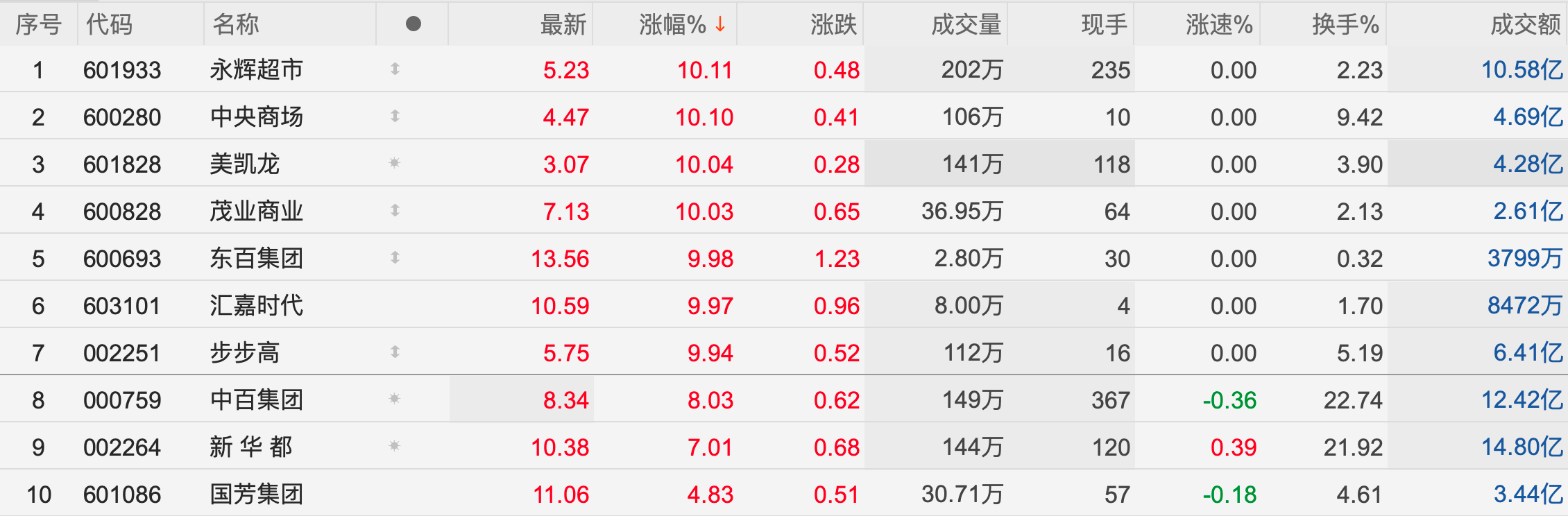
Group 1 - The A-share retail sector continues to show strong performance, with multiple stocks hitting the daily limit up, indicating high market confidence in the retail industry's growth prospects [1][3] - Notable stocks that reached the limit up include Yonghui Supermarket, Central Plaza, Meikailong, and others, with Dongbai Group achieving a four-day limit up and Yonghui Supermarket a three-day limit up [1][2] - The National Retail Innovation Development Conference held on December 9-10 is a significant catalyst for the retail sector's strength, with the Ministry of Commerce emphasizing the importance of retail in fostering a complete domestic demand system [3][4] Group 2 - The retail industry has made substantial contributions to consumption and investment since the 14th Five-Year Plan, with a projected 3.5% year-on-year growth in national social retail sales in 2024, showcasing strong resilience [3] - Different retail formats, including convenience stores and supermarkets, have shown positive year-on-year growth rates in the first three quarters of 2025, indicating a collaborative development among various retail formats [3] - The Ministry of Commerce highlighted the need for improvements in network layout, supply-demand matching, and the balance between online and offline operations, advocating for high-quality goods and services to attract consumers [3][4] Group 3 - Analysts predict that consumer recovery will be the main theme for the retail industry by 2026, suggesting a focus on high-quality segments with both short-term recovery potential and long-term growth [4] - The successful conclusion of the National Retail Innovation Development Conference is expected to provide new development opportunities for retail enterprises and favorable investment targets for investors [4] - Investors are encouraged to focus on retail companies with core competitiveness and long-term development potential to share in the industry's growth dividends [4]




食品饮料行业跟踪报告:汾酒召开经销商大会,稳健姿态应对行业调整
Shanghai Aijian Securities· 2025-12-08 13:12
Investment Rating - The report rates the industry as "Outperforming the Market" [3][20]. Core Insights - The liquor industry is entering a phase of rapid performance clearing, with demand expected to show weak recovery as policy pressures ease. The industry is currently at a low valuation, and pessimistic expectations are fully priced in, indicating a clearer direction for future industry clearing [2]. - The report emphasizes the importance of focusing on high-growth consumer goods sectors, where new products and channels are expected to drive market interest and valuation premiums for "scarce" growth targets [2]. - The report highlights the strategic responses of leading companies like Shanxi Fenjiu and Wuliangye to industry adjustments, focusing on brand value maintenance and consumer-driven strategies [3]. Summary by Sections Liquor Sector - The liquor sector is expected to see a weak recovery in demand due to easing policy pressures, with leading companies like Guizhou Moutai and Shanxi Fenjiu being recommended for their stable pricing and strong dividend yields [2]. - Shanxi Fenjiu's 2025 global dealer conference outlined a focus on national expansion, youth engagement, and precise consumer targeting, indicating a proactive approach to market share growth during industry adjustments [3]. - Wuliangye has adjusted its 2025 investment plan, reducing total investment while increasing brand promotion efforts, aiming to stabilize pricing and maintain brand integrity amid market discussions about price reductions [3]. Consumer Goods Sector - The report suggests focusing on high-growth consumer goods, with companies like Wancheng Group and Dongpeng Beverage showing promising growth trajectories [2]. - The consumer goods sector is characterized by ongoing innovation and new channel development, which are expected to attract market interest and valuation premiums [2].

中信建投:茅台批价寻底,关注潜在政策催化下的跨年机会
Xin Lang Cai Jing· 2025-12-07 13:05
Core Viewpoint - The recent decline in Moutai's wholesale prices has temporarily suppressed the performance of the sector, but potential policy-driven consumption catalysts in December are noteworthy. Current valuations in the food and beverage sector are at relatively low historical levels, indicating clear bottom logic for quality assets like liquor. The focus on three main lines in the consumer goods sector presents structural opportunities, with recommendations to continue investing in liquor and consumer goods with specific logic. It is expected that the consumer goods sector will outperform liquor, with liquor demand stabilizing as the market awaits the Spring Festival [1][14]. Group 1: Market Performance - This week, the A-share market rose, with the Shanghai Composite Index closing at 3902.81 points, a weekly change of 0.37%. The food and beverage sector experienced a weekly decline of 1.90%, underperforming the market by 2.27 percentage points, ranking 30th among Shenwan's primary industry classifications [2][15]. - Among the various sub-sectors of food and beverage, the performance from highest to lowest was as follows: pre-processed foods (+1.51%), beer (+1.20%), soft drinks (+0.43%), meat products (-0.11%), health products (-0.17%), seasoning and fermented products (-0.32%), snacks (-0.73%), dairy products (-1.74%), liquor (-2.59%), and other alcoholic beverages (-3.06%) [2][15]. Group 2: Investment Recommendations - Clear signals of industry bottoming are evident, presenting opportunities for undervalued investments. Liquor demand is in a bottoming phase, with sales still under pressure but gradually recovering compared to Q3. Liquor companies are expected to continue the trend of performance clearing, actively alleviating market burdens. The liquor sector's valuation is at historical lows, providing strong bottom configuration value, while potential consumption policy catalysts are also noteworthy [3][16]. - For consumer goods, focus on three structural opportunities: 1) Improvement in the restaurant supply chain and supermarket customization, with a reduction in price wars and lighter channel inventory burdens as the traditional peak season approaches. 2) The health and functional product segment is experiencing high growth, with leading oat brands benefiting from the "oat+" health trend. 3) The price cycle is nearing a turning point, with expected improvements in upstream profitability as raw milk prices stabilize [3][16]. Group 3: Sector-Specific Insights - In the liquor sector, the recent global distributor conference for Fenjiu emphasized the certainty of future growth, with expectations for the domestic economy to stabilize and recover, supported by policy and consumption revival. This is anticipated to lead to a dual leap in cultural value and market scale for liquor as a cyclical industry [4][17]. - The average milk price in major production areas was 3.02 yuan/kg in the last week of November, down 0.1 yuan/kg, indicating a continued bottoming of raw milk prices. The first batch of deep-processed products from Mengniu has passed testing and is expected to contribute to performance improvements in the dairy sector as production capacity increases [20].





周专题:PVH集团FY2025Q3营收同比增长2%,中国业务表现优异
GOLDEN SUN SECURITIES· 2025-12-07 08:24
Investment Rating - The report maintains a "Buy" rating for key companies such as Shenzhou International and Huali Group, with specific price-to-earnings (PE) ratios projected for 2026 [9][38]. Core Insights - The textile and apparel industry is experiencing a weak recovery in the Chinese consumer market, while the U.S. and European markets show steady growth. The overall industry inventory is considered healthy, with expectations for upstream order growth driven by stable downstream replenishment [31][32]. - The report highlights the strong performance of direct-to-consumer (DTC) channels in the Asia-Pacific region, particularly in China, where DTC revenue growth is driven by e-commerce [18][23]. - Key investment themes include a focus on high-quality stocks in apparel manufacturing, brand apparel with stable growth or reversal logic, and strong alpha candidates in the gold and jewelry sector [21][22][33]. Summary by Sections Weekly Topic - PVH Group reported a 2% year-over-year revenue increase for FY2025Q3, reaching $2.294 billion, with a notable decline in gross margin due to increased tariffs and a challenging promotional environment [1][14]. Regional Performance - Asia-Pacific: FY2025Q3 revenue decreased by 1% year-over-year, but DTC business showed low single-digit growth, particularly in China [18][23]. - EMEA: Revenue grew by 4% year-over-year, but DTC and wholesale businesses faced declines due to a weak consumer environment [23]. - Americas: Revenue increased by 2%, driven by adjustments in the women's product line, although direct sales faced challenges [23]. Investment Themes - **Apparel Manufacturing**: Recommendations include Shenzhou International (PE of 12x) and Huali Group (PE of 18x), with expectations for improved core customer orders in 2026 [21][31]. - **Brand Apparel**: Focus on companies like Tmall and Anta Sports, with PE ratios of 15x and 16x respectively, and a recommendation for Bosideng (PE of 14x) [21][32]. - **Gold and Jewelry**: Companies like Chow Tai Fook and Chow Hong Ki are highlighted for their strong product differentiation and brand strength, with PE ratios of 17x and 21x respectively [22][33]. Recent Reports - The report emphasizes the importance of maintaining a long-term perspective in the apparel manufacturing sector, with expectations for revenue growth exceeding 10% CAGR from 2025 to 2026 for Shenzhou International [34][38].




中国家庭财富与消费报告2025年第三季度
Sou Hu Cai Jing· 2025-12-07 05:59
Group 1: Core Insights - The report indicates that Chinese household wealth and consumption are showing signs of recovery, with stable income and increasing consumer confidence, particularly in first-tier cities [1][3] - The average annual income per household is reported at 55,500 yuan, with wage income constituting 62.1% of total income [12][13] - Housing remains the core asset for families, with nearly 50% owning a home and over 56% of families being mortgage-free [12][13] Group 2: Income and Wealth Structure - Income diversification is evident, with approximately 25.9% of families relying on multiple income sources, including wages, business, and property [12] - First-tier cities show significantly higher household incomes, particularly among middle-aged groups, reflecting advantages in employment quality and salary levels [12][13] - The financial asset allocation is becoming more diversified, with cash and deposits still dominant, but first-tier city households are increasingly investing in stocks and funds, with a holding rate exceeding 53% [12][13] Group 3: Consumption Trends - The average monthly consumption expenditure per household is 3,004 yuan, with first-tier cities averaging 4,442 yuan, indicating a clear regional disparity in consumption patterns [2][12] - Young consumers are active in entertainment, dining, and durable goods, while middle-aged consumers focus on education and healthcare expenditures [2][14] - Households with property exhibit stronger consumption capabilities across all age groups, highlighting the significant impact of housing assets on consumer confidence [15] Group 4: Debt and Financial Health - The overall debt situation is healthy, with nearly half of households having no debt, and a low percentage of high-debt households [2][12] - The report notes a U-shaped distribution of household debt, with 49.2% of families having no debt and only 10.8% with a debt ratio exceeding 100% [12][13] - Stable housing prices positively influence consumption, with the report suggesting that a halt in price declines can boost consumer willingness to spend [2][12] Group 5: Future Consumption Expectations - Consumer confidence is improving, with about 69% of households planning to maintain their current consumption levels, influenced by employment stability [2][16] - The report highlights that flexible employment and social security systems are crucial for enhancing consumer confidence and spending [19] - There is a notable trend of prioritizing the reduction of discretionary spending, particularly in entertainment and dining, during periods of income uncertainty [17][18] Group 6: Policy Recommendations - The report suggests optimizing housing finance structures to alleviate the financial burden of home purchases, which currently limits spending in other areas [18] - It recommends the introduction of inclusive financial products to guide household savings into stable investments, thereby supporting the real economy [18] - Enhancing employment security and providing targeted consumption incentives are also proposed to stimulate spending across all age groups [19]

商业地产系列报告之二:购物中心价值重估:聚合消费最强音,价值重估新篇章
Shenwan Hongyuan Securities· 2025-12-05 03:43
Investment Rating - The report maintains a "Positive" rating for the real estate and property management sectors, particularly focusing on the shopping center industry [4][5]. Core Insights - The report emphasizes that the consumption industry and shopping center sector in China still have significant growth potential, driven by an expected increase in total consumption and a structural recovery [4][5]. - Leading commercial companies have achieved stable same-store growth and expansion through operational alpha, which may lead to a revaluation of IP (Intellectual Property) values [4][5]. - The report draws comparisons with the U.S. commercial real estate market, highlighting that during five interest rate cut cycles, commercial real estate indices consistently yielded positive returns, significantly outperforming other asset classes [4][5]. Summary by Sections Macro Perspective - The domestic consumption sector remains under pressure, with retail sales growth gradually recovering to +4.3% as of October 2025, while CPI remains low at +0.2% [14][21]. - Compared to the U.S. and Japan during their real estate crises, China's consumption resilience is still relatively strong [14][21]. - Long-term growth potential exists in the consumption sector, particularly in shopping centers, as GDP per capita and retail sales per capita are expected to rise [28][31]. Mid-level Perspective - As of Q3 2025, the total area of centralized commercial space in China reached 661 million square meters, with a year-on-year growth of +4.4% [49]. - The number of new openings has decreased, but the proportion of reopened projects after adjustments has increased, indicating a shift in strategy [53]. - The report notes that 57% of existing projects have been open for over five years, highlighting the importance of effective asset management [53]. Micro Perspective - Leading companies in the sector exhibit significant operational efficiency, with top firms showing a concentration of 19% in opening area as of 2024 [4][5]. - Key companies are expected to see a revaluation of their IP, with potential increases of 39% for China Resources Land and 33% for New World Development [4][5]. - The report indicates that the average operating profit margin for IP is between 55% and 84%, with dividend yields for major companies exceeding 5% [4][5]. U.S. Market Review - The report highlights that during five interest rate cut cycles, the NCREIF commercial real estate price index achieved an average return of 31%, second only to gold [4][5]. - The long-term same-store NOI (Net Operating Income) growth in the U.S. has been stable, correlating positively with GDP growth [4][5]. Catalysts for Growth - The report suggests that the high barriers to entry in commercial operations will enhance the competitive advantage of leading firms, especially as the "residential development supports commercial" model weakens [4][5]. - The introduction of C-REITs (Real Estate Investment Trusts) is expected to further support the revaluation of commercial assets [4][5].





政策暖风频吹,聚焦港股消费ETF(513230)布局机遇
Sou Hu Cai Jing· 2025-12-05 03:36
港股消费ETF(513230)跟踪中证港股通消费主题指数,一键打包互联网电商龙头+新消费,成分股近 乎囊括港股消费的各个领域,包括泡泡玛特、老铺黄金、名创优品等新消费龙头,又包含腾讯、快手、 阿里巴巴、小米等互联网电商龙头,科技+消费属性突出。 每日经济新闻 11月20日,财政部、商务部联合正式公示消费新业态新模式新场景试点50个拟入选城市名单。中央财政 将按城市规模给予最高4亿元/城的资金补助,从健全首发经济服务体系、创新多元化服务消费场景、支 持优质消费资源与知名IP跨界联名三大维度,为消费市场提质扩容。12月日,浙江《推动经济高质量发 展若干政策(2026年版)(征求意见稿)》近日公开征求意见,在推进服务业扩能提质和消费转型升级 方面,《征求意见稿》提出以更大力度推动消费转型升级,加快消费新业态新模式新场景培育,省市县 联动发放消费券,带动商品消费与文旅、体育、养老等服务消费联动发展。 华泰证券认为,地产周期尤其是地产价格变化仍然是判断26年消费复苏力度与速度的胜负手,在26年房 价结构性企稳的预期下,居民资产负债表修复有望带动消费倾向边际改善;同时,可能的供给与需求政 策刺激将提振居民消费意愿。必选消 ...
中观景气12月第1期:服务消费景气提升,科技硬件延续涨价
GUOTAI HAITONG SECURITIES· 2025-12-03 09:48
| | | [Table_Report] 相关报告 服务消费景气提升,科技硬件延续涨价 [Table_Authors] 方奕(分析师) 中观景气 12 月第 1 期 本报告导读: 中观景气延续分化的增长格局,新兴科技景气仍强,高性能存储价格延续快速上涨, 游戏供给偏宽松;服务消费景气明显提升,地产周期和耐用品需求仍承压。 投资要点: | | 021-38031658 | | --- | --- | | | fangyi2@gtht.com | | 登记编号 | S0880520120005 | | | 陶前陈(研究助理) | | | 0755-23976164 | | | taoqianchen@gtht.com | | 登记编号 | S0880125070014 | | | 张逸飞(分析师) | 资产概览:银价铜价创历史新高 2025.12.01 外资与融资资金重回流入 2025.12.01 消费景气线索增多,科技制造延续增长 2025.11.26 ETF 流入明显,融资资金与外资有所流出 2025.11.24 资产概览:美元兑日元逼近 160 关口 2025.11.24 策 略 研 究 告 请务必阅读正文 ...
中药材市场行情有所回暖,中药ETF、中药ETF华泰柏瑞、中药50ETF逆势上涨
Ge Long Hui A P P· 2025-12-03 08:05
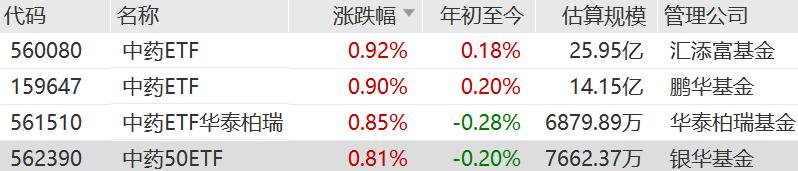
Core Viewpoint - The A-share market continues to decline, with major indices experiencing losses, while the traditional Chinese medicine (TCM) ETFs show resilience and growth amid a recovering market sentiment in the TCM sector [1][2]. Market Performance - The Shanghai Composite Index fell by 0.51% to 3878 points, the Shenzhen Component Index dropped by 0.78%, and the ChiNext Index decreased by 1.12% [1]. - The total market turnover reached 1.68 trillion yuan, an increase of 763 billion yuan compared to the previous trading day, with over 3800 stocks declining [1]. TCM ETFs - TCM ETFs, including the TCM ETF, TCM ETF Huatai-PB, and TCM 50 ETF, experienced gains, with respective increases of 0.92%, 0.90%, and 0.81% [2]. - The TCM ETF tracks the CSI Traditional Chinese Medicine Index, with key stocks including Yunnan Baiyao, Pien Tze Huang, and Tong Ren Tang [1][2]. TCM Market Trends - The TCM market is showing signs of recovery, with increased market activity and positive investment sentiment [2]. - The TCM sector benefits from both pharmaceutical and consumer attributes, with a high dividend yield of 2.69% over the past 12 months, placing it in the 90.91% historical percentile since its inception [2]. Price Governance in TCM - Multiple regions in China have initiated price governance for traditional Chinese medicine, aiming to create a unified and competitive drug market [3][4]. - The focus is on high-priced TCM products with significant clinical usage, particularly those sold primarily in the outpatient market [4]. Industry Dynamics - The ongoing price governance and centralized procurement are expected to lead to price convergence between hospital and outpatient markets, reshaping competitive factors in the industry [4]. - Companies with unique products, strong clinical value, and effective cost control are likely to gain competitive advantages [4]. Investment Themes - Three main investment themes are identified: 1. Price governance, focusing on price reductions and market share for competitive products [5]. 2. Consumption recovery, driven by macroeconomic improvement and aging population, benefiting TCM sales [6]. 3. State-owned enterprise reform, which is expected to enhance performance and create investment opportunities [6]. Recommended Investment Targets - Companies with strong R&D capabilities, unique products, and those less affected by centralized procurement are recommended for investment [6]. - Emphasis is placed on TCM brands with strong market presence and those benefiting from state-owned enterprise reforms [6].
美团-W(03690.HK):2025Q3业绩不及预期 待竞争格局企稳
Ge Long Hui· 2025-12-03 05:49
Core Insights - The company is increasing investments in user, rider, merchant subsidies, and ecosystem development to consolidate market share amid intensified competition in the instant delivery sector [1] - The company has revised its non-IFRS net profit forecasts for 2025-2027 to -19.9 billion, 32.2 billion, and 54.2 billion yuan, respectively, down from -2.6 billion, 35.8 billion, and 58.8 billion yuan [1] - The company anticipates a return to profitability in 2026 as the competitive landscape stabilizes, with a projected net profit growth rate of 68.4% in 2027 [1] Financial Performance - In Q3 2025, the company's revenue was 95.49 billion yuan, a year-on-year increase of 2.0%, but below Bloomberg's consensus estimate of 97.47 billion yuan [2] - The non-IFRS net loss for Q3 2025 was 16.01 billion yuan, worse than Bloomberg's consensus estimate of a loss of 13.96 billion yuan, primarily due to fierce competition in the food delivery sector [2] - Core business revenue declined by 2.8% year-on-year, with an operating loss of 14.1 billion yuan and an operating loss margin of 20.9% [2] Business Segments - The delivery service revenue fell by 17.1% year-on-year, attributed to increased subsidies and competitive pressures in the food delivery market [2] - New business revenue grew by 15.9% year-on-year, with an operating loss of 1.3 billion yuan, but the loss margin improved by 2.5 percentage points, mainly due to enhanced efficiency in the Hong Kong and Middle Eastern markets [2] - The company plans to pilot its new business, Keeta, in Brazil in late October 2025, expecting to continue significant investments during the initial phase [2]
