逆全球化

Search documents
关于商品长期叙事和大轮动的讨论
对冲研投· 2025-12-29 11:35
Core Viewpoint - The article emphasizes the importance of historical context in understanding current market dynamics, particularly in the commodity sector, where a potential recovery is anticipated due to a weakening dollar and macroeconomic factors [4][5]. Group 1: Historical Context and Current Market Dynamics - The current economic landscape is reminiscent of the 1980s "Reagan cycle," characterized by high inflation, supply chain restructuring, and geopolitical tensions, which are influencing commodity pricing [6]. - The Federal Reserve's aggressive interest rate hikes and capital repatriation echo the strategies of the Reagan era, but the sources of inflation and the nature of global competition have shifted [6][8]. - The article suggests that the commodity market is transitioning from being driven by economic cycles to being influenced by political logic, with a focus on geopolitically sensitive commodities [8]. Group 2: Commodity Market Insights - The article identifies two main themes in the commodity market: the demand for geopolitically sensitive metals and the structural expansion of new energy resources [8]. - The current bullish sentiment in the non-ferrous metals market may not effectively transmit to other sectors due to structural challenges and differing demand dynamics [10][12]. - The aluminum market is experiencing a supply-demand imbalance, with significant imports from Guinea and a potential oversupply situation, which could impact pricing [13][14]. Group 3: Currency and Economic Implications - The appreciation of the Renminbi is largely supported by a record trade surplus, but the stock market reflects underlying economic pressures, indicating a disconnect between currency strength and equity performance [20]. - The future trajectory of the Renminbi is expected to influence asset valuations, particularly in equity markets, as foreign capital may return based on currency outlook and asset attractiveness [20].


2026年金融市场的十大预测
表舅是养基大户· 2025-12-29 07:12
Core Insights - The article presents a forecast for the financial market in 2026, emphasizing the importance of adjusting investment strategies in light of ongoing market trends and economic conditions [2][4]. Group 1: Investment Philosophy - Emphasis on the unprecedented low interest rate environment and the importance of quality equity investments [3][4]. - Investors are advised to avoid the temptation of quick profits and to extend their investment horizons [5]. - The article highlights the cyclical nature of markets, suggesting that after a prolonged bull market, a period of consolidation or correction is likely [5]. Group 2: Key Trends for 2026 - The end of the global interest rate reduction cycle is anticipated, with varying impacts on stocks, bonds, and currencies [8][20]. - De-globalization remains a dominant trend, with fiscal policies being a common response to this phenomenon [9][30]. - The A-share market is expected to focus on relative value within asset classes, with a significant wave of fixed income products emerging [10][38]. - The Hong Kong stock market is projected to show increasing valuation advantages [11][60]. - The financial industry is expected to experience accelerated differentiation and consolidation [12][68]. - The wealth management sector is entering a new era of diversified asset allocation [13][71]. - The AI sector is entering a phase of significant differentiation, with a focus on who can build effective ecosystems [14][81]. - The trend of "anti-involution" is expected to continue, impacting investment strategies [15][90]. - A new era of outbound investment for Chinese companies is emerging, driven by global supply chain restructuring [16][94]. - Two significant trends are identified: accelerated asset securitization by local governments and societal K-shaped economic divergence [17][101]. Group 3: Market Implications - The anticipated end of the interest rate reduction cycle suggests that the valuation uplift from declining rates will slow, making profit-driven sectors more critical [26][25]. - The article discusses the expected impacts on various asset classes, including U.S. stocks, A-shares, and bonds, highlighting the need for strategic adjustments in investment positions [27][28][29]. - The A-share market is seen as a critical area for investment, with a focus on its relative value compared to other asset classes [43][48]. - The article emphasizes the importance of understanding the core role of the stock market in economic development and its potential as a wealth reservoir [49][50].

贵金属突发 “黑天鹅”?芝商所上调金属期货保证金
Jin Tou Wang· 2025-12-29 03:21
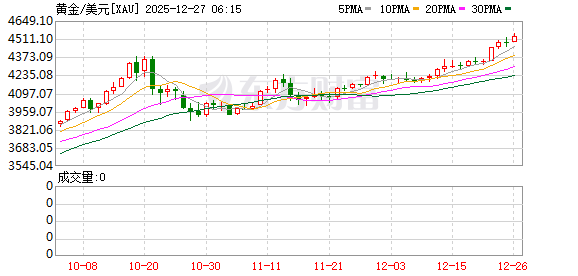
摘要周一(12月29日)亚市盘中,贵金属全线转跌,现货黄金跌破4500美元,现货白银抹去日内逾6%的涨 幅,跌幅达2.00%,现货钯金大跌6.8%,下破1800美元/盎司;现货铂金跌幅扩大至4%。一方面是因为 多头获利了结,一方面是因为市场对俄乌和平前景的预期有所升温,打压避险需求。 光大期货:短时间内银铂不断刷新历史新高,波动率快速上升,金银比和金铂比也快速下降,特别是金 银比已快速降至近四十年以来均值下方,这也就意味着风险正在积聚、后市可想象空间正在缩减。另 外,银铂钯也具有较强的商品属性,价格快速上行往往对实体需求造成潜在的抑制作用,因此当下行情 下要防止市场过热出现快速调整甚至多头获利了结下出现"踩踏"风险,追高宜谨慎。 金瑞期货:白银继续受到工业和金融双重属性影响,在供需缺口和现货偏紧的驱动下强势上涨。而中长 期来说,宏观上包括主权国家赤字问题、地缘风险以及去美元化驱动的央行购金等因素并未改变,新能 源需求驱动的白银供需矛盾也持续存在,金银价格的长期核心驱动因素仍保持稳健。 西南期货:当前全球贸易金融环境错综复杂,"逆全球化"和"去美元化"大趋势,利好黄金的配置价值和 避险价值。各国央行的购金行为对 ...
西南期货早间评论-20251229
Xi Nan Qi Huo· 2025-12-29 02:23
2025 年 12 月 29 日星期一 重庆市江北区金沙门路 32 号 23 层; 023-67071029 上海市浦东新区世纪大道 210 号 10 楼 1001; 021-61101854 地址: 电话: 1 市场有风险 投资需谨慎 | | | | 铅: | | 15 | | --- | --- | --- | | 锡: | | 16 | | 镍: | | 16 | | 豆油、豆粕: | | 17 | | 棕榈油: | | 17 | | 菜粕、菜油: | | 18 | | 棉花: | | 18 | | 白糖: | | 19 | | 苹果: | | 20 | | 生猪: | | 21 | | 鸡蛋: | | 22 | | 玉米&淀粉: | | 22 | | 免责声明 | | 24 | 国债: 上一交易日,国债期货收盘全线上涨,30 年期主力合约涨 0.36%报 112.960 元, 10 年期主力合约涨 0.10%报 108.300 元,5 年期主力合约涨 0.05%报 106.050 元,2 年 期主力合约涨 0.03%报 102.548 元。 公开市场方面,央行公告称,12 月 26 日以固定利率、数量 ...
金银狂飙!“牛市”,刚刚开始? | 破译金属新主线
Qi Huo Ri Bao· 2025-12-27 23:57
今年以来,贵金属市场上演了一场行情"接力赛":黄金领涨,白银后来居上。其中,纽约期金和伦敦金现货累计涨逾70%,沪金期货涨近65%;纽约期银 及伦敦银现货累计涨逾170%,沪银期货涨逾155%。 本轮贵金属"牛市"背后的深层逻辑 这场轰轰烈烈的行情背后,最大的催化因素究竟是什么?又折射出了怎样的深层逻辑?期货日报记者就此采访了多位市场人士,他们将催化因素归结为以 下几点:市场对美元信用的担忧引发全球"去美元化"趋势、美联储进入降息周期、美国财政政策扩张、美国关税政策多变及地缘政治风险上升。 首先是市场对美元信用的担忧,引发全球主要央行持续购金。海通期货研究所贵金属研究员顾佳男向记者表示,自2022年俄罗斯外汇储备遭遇"冻结"后, 黄金作为"非主权信用资产"的战略价值日益凸显。 在全球"去美元化"趋势与美国政府债务规模持续膨胀的背景下,各国央行基于外汇储备多元化与资产安全的长远考量,持续增持黄金并逐步减少在伦敦等 传统金融中心的托管规模。这一结构性、趋势性的央行"购金潮",为金价构筑了坚实的长期底部支撑。 其次是美国财政政策扩张与货币宽松的催化作用。五矿期货研究中心贵金属研究员钟俊轩表示,黄金和美债在资产配置中 ...

破译金属新主线:金银狂飙!“牛市”刚刚开始?
Qi Huo Ri Bao· 2025-12-27 23:56
今年以来,贵金属市场上演了一场行情"接力赛":黄金领涨,白银后来居上。其中,纽约期金和伦敦金 现货累计涨逾70%,沪金期货涨近65%;纽约期银及伦敦银现货累计涨逾170%,沪银期货涨逾155%。 本轮贵金属"牛市"背后的深层逻辑 这场轰轰烈烈的行情背后,最大的催化因素究竟是什么?又折射出了怎样的深层逻辑?期货日报记者就 此采访了多位市场人士,他们将催化因素归结为以下几点:市场对美元信用的担忧引发全球"去美元 化"趋势、美联储进入降息周期、美国财政政策扩张、美国关税政策多变及地缘政治风险上升。 首先是市场对美元信用的担忧,引发全球主要央行持续购金。海通期货研究所贵金属研究员顾佳男向记 者表示,自2022年俄罗斯外汇储备遭遇"冻结"后,黄金作为"非主权信用资产"的战略价值日益凸显。 在全球"去美元化"趋势与美国政府债务规模持续膨胀的背景下,各国央行基于外汇储备多元化与资产安 全的长远考量,持续增持黄金并逐步减少在伦敦等传统金融中心的托管规模。这一结构性、趋势性的央 行"购金潮",为金价构筑了坚实的长期底部支撑。 其次是美国财政政策扩张与货币宽松的催化作用。五矿期货研究中心贵金属研究员钟俊轩表示,黄金和 美债在资产 ...
金银狂飙!“牛市”,刚刚开始?
Qi Huo Ri Bao· 2025-12-27 23:51
今年以来,贵金属市场上演了一场行情"接力赛":黄金领涨,白银后来居上。其中,纽约期金和伦敦金现货累计涨逾70%,沪金期货涨近65%;纽约期银 及伦敦银现货累计涨逾170%,沪银期货涨逾155%。 编者按:今年以来,贵金属市场"牛气冲天"。2026年是"盛宴"尾声还是新周期的起点?期货日报即日起推出"破译金属新主线"栏目,全面梳理金属"牛 市"脉络,敬请关注。 点此追踪史诗级行情 本轮贵金属"牛市"背后的深层逻辑 这场轰轰烈烈的行情背后,最大的催化因素究竟是什么?又折射出了怎样的深层逻辑?期货日报记者就此采访了多位市场人士,他们将催化因素归结为以 下几点:市场对美元信用的担忧引发全球"去美元化"趋势、美联储进入降息周期、美国财政政策扩张、美国关税政策多变及地缘政治风险上升。 首先是市场对美元信用的担忧,引发全球主要央行持续购金。海通期货研究所贵金属研究员顾佳男向记者表示,自2022年俄罗斯外汇储备遭遇"冻结"后, 黄金作为"非主权信用资产"的战略价值日益凸显。 在全球"去美元化"趋势与美国政府债务规模持续膨胀的背景下,各国央行基于外汇储备多元化与资产安全的长远考量,持续增持黄金并逐步减少在伦敦等 传统金融中心的 ...

国际金、银价格再创历史新高!有色金属ETF(159871)飙涨近4%!
Jin Rong Jie· 2025-12-26 06:57
Core Viewpoint - The precious metals sector is experiencing a significant rally, driven by record-high prices for gold and silver, indicating strong demand and potential investment opportunities in this area [1]. Group 1: Precious Metals Market Performance - On December 26, the Shanghai and Shenzhen stock markets saw a strong upward trend, particularly in the precious metals sector, with the metal ETF (159871) rising by 3.92% [1]. - Notable stocks such as Yongxing Materials, Jiangxi Copper, and Guocheng Mining reached the daily limit of 10% increase, while Zhongmin Resources rose over 8% and Zijin Mining increased by more than 4% [1]. - International spot gold and silver prices reached historic highs, with gold touching $4,531.284 per ounce and silver peaking at $75.142 per ounce [1]. Group 2: Investment Strategy and Outlook - Huachuang Securities' 2026 investment strategy highlights that central bank gold purchases will support long-term demand for gold, with China's gold reserves having room for growth [1]. - The ongoing interest rate cut cycle is expected to boost investment demand for gold [1]. - For silver, a persistent supply-demand gap and low domestic inventory are expected to support price increases, indicating strong upside potential [1]. - The investment recommendation suggests a favorable long-term positioning in precious metals due to the weakening of dollar credit amid de-globalization trends [1]. Group 3: Long-term Trends in Non-ferrous Metals - The long-term positive trend in the non-ferrous metals sector is expected to continue, with a recommendation to focus on the non-ferrous metal ETF (159871) to capture structural opportunities [2].
西南期货早间评论-20251226
Xi Nan Qi Huo· 2025-12-26 02:14
Report Industry Investment Ratings There is no information provided regarding the report industry investment ratings in the given content. Core Views - **Treasury Bonds**: Expected to face some pressure, maintain a cautious stance [5][6]. - **Stock Index Futures**: The volatility center is expected to gradually move up, and investors can choose the right time to go long [8][9]. - **Precious Metals**: Market volatility will significantly increase, and investors can exit long positions and wait and see [10][11]. - **Rebar and Hot - Rolled Coils**: Prices may continue to oscillate weakly. Investors can pay attention to short - selling opportunities at high levels during rebounds and manage positions carefully [12][13]. - **Iron Ore**: The supply - demand pattern is weak. Investors can pay attention to short - selling opportunities at high levels and manage positions carefully [15]. - **Coking Coal and Coke**: May continue to oscillate in the short term. Investors can pay attention to buying opportunities at low levels and manage positions carefully [17]. - **Ferroalloys**: Overall surplus pressure persists. After a decline, investors can consider long positions at low levels when spot losses expand [20][21]. - **Crude Oil**: With high uncertainty in the market, it is advisable to watch more and trade less during the holiday season [24]. - **Fuel Oil**: The cost end is stable, but there is a large rebound space. It is recommended to wait and see [26][27][28]. - **Polyolefins**: The market is in a negative feedback stage, but the reduction of standard product supply may boost market sentiment. Investors can pay attention to long - buying opportunities [30][31]. - **Synthetic Rubber**: Expected to oscillate [32][34]. - **Natural Rubber**: Expected to oscillate with a multi - empty game [35][36]. - **PVC**: The supply exceeds demand, and the downward space is limited. Pay attention to changes in the supply side [37][38]. - **Urea**: The market is expected to fluctuate narrowly, and the downward space is limited [38][39]. - **PX**: May adjust in a slightly stronger oscillatory manner in the short term. Pay attention to opportunities to participate at low levels [40]. - **PTA**: The medium - and long - term supply - demand outlook is good. Investors can consider participating at low levels following the cost end and control risks [41]. - **Ethylene Glycol**: May maintain a bottom - oscillating pattern. Investors can participate within a range and be cautious about the upside [42][44]. - **Short - Fiber**: May oscillate following raw material prices. Pay attention to cost changes and macro - policy adjustments [45]. - **Bottle - Grade PET**: Expected to follow the cost end. The supply - demand structure has improved slightly [46]. - **Lithium Carbonate**: There is short - term support for prices due to the mismatch between supply and demand. Pay attention to the sustainability of consumption [47]. - **Copper**: Prices will remain at a high level, but be cautious about chasing the rise [48][49]. - **Aluminum**: Expected to oscillate at a high level [50][51]. - **Zinc**: Expected to oscillate and adjust [52][53]. - **Lead**: Expected to oscillate weakly within a range [54][55][56]. - **Tin**: Expected to oscillate in a slightly stronger manner [57]. - **Nickel**: The first - grade nickel is in an oversupply situation. Pay attention to relevant policies in Indonesia [58]. - **Soybean Oil and Soybean Meal**: Soybean meal can focus on long - buying opportunities in the low - cost support range, and soybean oil can consider long - buying opportunities for call options in the low - level range [59][60]. - **Palm Oil**: It is recommended to wait and see [61][63]. - **Rapeseed Meal and Rapeseed Oil**: It is recommended to wait and see [64][65]. - **Cotton**: Prices are expected to be strong [66][69][70]. - **Sugar**: After a significant rebound in the market, the upward space may be limited. It is recommended to wait and see [71][74][75]. - **Apples**: Prices are expected to be strong [76][77][78]. - **Hogs**: It is recommended to wait and see, and continue to track the large - weight hog slaughter rhythm and consumption changes [79][80]. - **Eggs**: Consider a positive spread strategy [81][82]. - **Corn and Starch**: Wait for the release of supply pressure. Corn starch may follow the corn market [83][84]. Summary by Related Catalogs Treasury Bonds - **Market Performance**: The main contracts of treasury bond futures closed down across the board. The 30 - year, 10 - year, 5 - year, and 2 - year main contracts fell by 0.24%, 0.02%, 0.03%, and 0.02% respectively [5]. - **Policy and Macroeconomic Situation**: The central bank carried out a 400 - billion - yuan 1 - year MLF operation, with 300 billion yuan of MLF maturing on the same day. The RMB against the US dollar has appreciated. The macro - economic recovery momentum needs to be strengthened, and monetary policy is expected to remain loose [5]. Stock Index Futures - **Market Performance**: The stock index futures showed mixed trends. The main contracts of IF, IH, IC, and IM rose by 0.32%, 0.27%, 0.97%, and 1.16% respectively [7]. - **Industry News**: In November 2025, domestic mobile phone shipments increased by 1.9% year - on - year, and 5G mobile phones accounted for 91.6%. From January to November, 2.58 million urban old - community renovation projects started nationwide, and 22 regions and the Xinjiang Production and Construction Corps completed the annual plan [7][8]. - **Market Analysis**: The domestic economy is stable, but the recovery momentum is weak, and corporate profit growth is low. However, asset valuations are low, and the economy has sufficient resilience. Market sentiment has warmed up, and incremental funds have entered the market. The uncertainty of Sino - US economic and trade relations has eased [8]. Precious Metals - **Market Performance**: The main contract of gold closed at 1,008.76, with a decline of 0.58%; the main contract of silver closed at 17,397, with a decline of 1.20% [10]. - **Market Analysis**: The complex global trade and financial environment and the trend of "de - globalization" and "de - dollarization" are beneficial to the allocation and hedging value of gold. Central bank gold - buying supports the price, but the recent sharp rise has led to a significant increase in speculative sentiment [10]. Rebar and Hot - Rolled Coils - **Market Performance**: Rebar and hot - rolled coil futures oscillated weakly. The price of Tangshan billet was 2,960 yuan/ton, Shanghai rebar was 3,180 - 3,310 yuan/ton, and Shanghai hot - rolled coil was 3,260 - 3,280 yuan/ton [12]. - **Market Analysis**: In the medium term, prices are dominated by industrial supply - demand logic. The real - estate industry's downward trend has not reversed, and demand is in a year - on - year decline. The market will enter the demand off - season. Supply pressure has eased, but inventory is higher than last year, and the inventory consumption speed is fast [12][13]. Iron Ore - **Market Performance**: Iron ore futures oscillated and consolidated. The port spot price of PB powder was 788 yuan/ton, and that of Super Special powder was 670 yuan/ton [15]. - **Market Analysis**: Since October, the daily output of hot metal has declined. The supply - demand pattern is weak, with imports increasing year - on - year, domestic production lower than last year, and port inventory at the highest level in the past five years [15]. Coking Coal and Coke - **Market Performance**: Coking coal and coke futures oscillated narrowly [17]. - **Market Analysis**: For coking coal, production has decreased in December, and downstream procurement has increased. For coke, the third - round price cut of spot procurement has started. Coking enterprises' operations are stable, but environmental protection has increased restrictions. Steel mills' demand for coke has weakened [17]. Ferroalloys - **Market Performance**: The main contract of manganese - silicon rose 0.48% to 5,846 yuan/ton, and the main contract of silicon - iron rose 0.85% to 5,692 yuan/ton. Tianjin manganese - silicon spot price fell 50 yuan/ton to 5,650 yuan/ton, and Inner Mongolia silicon - iron price remained flat at 5,270 yuan/ton [20]. - **Market Analysis**: The supply of manganese ore from Gabon has decreased, and the supply of Australian ore has returned to normal. The cost of ferroalloys has fluctuated narrowly at a low level. The production of ferroalloys has continued to decline, and demand is weak, but the overall surplus pressure persists [20][21]. Crude Oil - **Market News**: As of the week ending December 9, fund managers reduced their net short positions in US crude oil futures and options. The number of active oil and gas rigs in the US decreased for the second consecutive week. Barclays maintained its 2026 Brent crude oil price forecast at $65 per barrel, and the supply - demand imbalance is expected to widen [22][23]. - **Market Analysis**: The reduction of net short positions by US funds indicates short - covering. The US sanctions on Venezuelan oil tankers are beneficial to oil prices, but the Russia - Ukraine peace talks increase the uncertainty of oil prices. It is advisable to watch more and trade less during the holiday season [22][24]. Fuel Oil - **Market Performance**: Fuel oil oscillated upward and closed above the 20 - day moving average [26]. - **Market Analysis**: The Asian fuel - oil market is generally stable, and the spot price difference of high - sulfur fuel oil remains at a discount. The cost end is stable, and there is a large rebound space [26][27][28]. Polyolefins - **Market Performance**: The low - end prices in the Hangzhou PP market rebounded slightly, and the LLDPE price in the Yuyao market increased by 30 - 120 yuan/ton [30]. - **Market Analysis**: Polyolefin production enterprises are expected to be generally stable with minor fluctuations. The supply - side pressure of standard products is expected to slow down slightly. Downstream factory operating rates are expected to decline, and they mainly replenish inventory at low prices. Near the end of the month and the year, enterprises have the intention to reduce inventory by lowering prices [30]. Synthetic Rubber - **Market Performance**: The main contract of synthetic rubber rose 0.76%, and the mainstream price in Shandong was adjusted up to 11,750 yuan/ton, with the basis remaining stable [32]. - **Market Analysis**: The price of raw material butadiene has risen unexpectedly, providing strong cost support. The supply is abundant, but the demand from downstream tire enterprises is weak, and the inventory in mainstream warehouses has decreased, while the social inventory has continued to accumulate [32][33]. Natural Rubber - **Market Performance**: The main contract of natural rubber rose 1.91%, and the 20 - rubber main contract rose 1.48%. The Shanghai spot price was adjusted up to around 15,400 yuan/ton, with the basis remaining stable [35]. - **Market Analysis**: The domestic production area is accelerating the suspension of production, and the overseas raw - material price is high. The demand from tire enterprises is weak, and the inventory has continued to accumulate. The sales of heavy - duty trucks in November increased year - on - year [35]. PVC - **Market Performance**: The main contract of PVC rose 0.34%, and the spot price remained stable, with the basis remaining stable [37]. - **Market Analysis**: The supply exceeds demand, but the downward space is limited. The supply has decreased slightly due to temporary production cuts, and the demand from downstream enterprises has declined. The cost of raw materials is stable, and the profit of the chlor - alkali industry has increased. The social inventory has decreased slightly [37]. Urea - **Market Performance**: The main contract of urea rose 0.34%, and the price in Shandong Linyi remained stable, with the basis remaining stable [38]. - **Market Analysis**: The daily output of urea is expected to fluctuate narrowly. The demand from compound - fertilizer enterprises is expected to increase slightly. The coal price is stable, and the industry profit has rebounded slightly. The enterprise inventory is lower than expected, and the port inventory is in line with expectations [38]. PX - **Market Performance**: The main contract of PX2603 rose 0.46% during the day and 1.72% at night. The PXN spread was adjusted to $350 per ton [40]. - **Market Analysis**: The PX operating rate remained at 88.1%, and the spot liquidity was tight, and inventory was low. Zhejiang Petrochemical plans to reduce production by about 10% in January 2026. The short - term PXN spread has been repaired to a moderately high level, and the short - process profit has continued to improve. PX is expected to oscillate in a slightly stronger manner in the short term [40]. PTA - **Market Performance**: The main contract of PTA2605 rose 0.98% during the day and 1.64% at night [41]. - **Market Analysis**: The supply of PTA has increased, and the demand from the polyester industry has declined. The export of PTA in November increased significantly month - on - month. The processing fee has rebounded, and the inventory remains low. The medium - and long - term supply - demand outlook is good, and it is advisable to participate at low levels following the cost end [41]. Ethylene Glycol - **Market Performance**: The main contract of ethylene glycol rose 2.25% due to the planned maintenance of a Taiwanese device [42]. - **Market Analysis**: The overall operating rate of ethylene glycol has increased slightly. Two Taiwanese devices plan to shut down for maintenance, which will slightly relieve the supply pressure. However, the port inventory has continued to accumulate, and the expected arrival at the port has increased. It is expected to oscillate at the bottom in the short term [42][43][44]. Short - Fiber - **Market Performance**: The main contract of short - fiber 2602 rose 0.96% [45]. - **Market Analysis**: The production of short - fiber has decreased but remains at a relatively high level. The raw - material procurement of downstream factories has increased, and the cost - driving force has strengthened. Short - fiber is expected to oscillate following raw material prices [45]. Bottle - Grade PET - **Market Performance**: The main contract of bottle - grade PET 2603 rose 1.44%, and the processing fee rebounded to around 500 yuan/ton [46]. - **Market Analysis**: The production of bottle - grade PET has decreased slightly, and the export growth rate has increased. The supply - demand structure has improved slightly, and it is expected to follow the cost end [46]. Lithium Carbonate - **Market Performance**: The main contract rose 0.44% to 123,520 yuan/ton [47]. - **Market Analysis**: The production of lithium carbonate remains at a high level, and the supply - side profit is sufficient. The demand from the energy - storage and power - battery sectors has improved, and the social inventory has gradually decreased. There is short - term support for prices due to the mismatch between supply and demand [47]. Copper - **Market Performance**: The main contract of Shanghai copper closed at 97,680 yuan/ton, with a rise of 2.51% [48]. - **Market Analysis**: The macro - economic data in the US is mixed. The fundamentals remain in a tight balance, and the supply shortage risk remains unresolved. The demand has short - term pressure, and the actual available inventory of electrolytic copper is low. The upward movement of copper prices is mainly due to short - term speculative buying, and it is necessary to be cautious about chasing the rise [48]. Aluminum - **Market Performance**: The main contract of Shanghai aluminum closed at 22,305 yuan/ton, with a rise of 0.61%; the main contract of alumina closed at 2,635 yuan/ton, with a decline of 0.38% [50]. - **Market Analysis**: The alumina price has fallen below the average cash cost, and the supply surplus pressure remains unchanged. The supply of electrolytic aluminum is stable, and the demand is average. Aluminum prices are expected to oscillate at a high level [50][51]. Zinc - **Market Performance**: The main contract of Shanghai zinc closed at 23,105 yuan/ton, with a rise of 0.43% [52]. - **Market Analysis**: The processing fee of zinc concentrate is under pressure, and the production of refined zinc has continued to decline. The demand from downstream industries has decreased, and the LME zinc inventory has increased significantly. Zinc prices are expected to oscillate and adjust [52][53]. Lead - **Market Performance**: The main contract of Shanghai lead closed at 17,265 yuan/ton
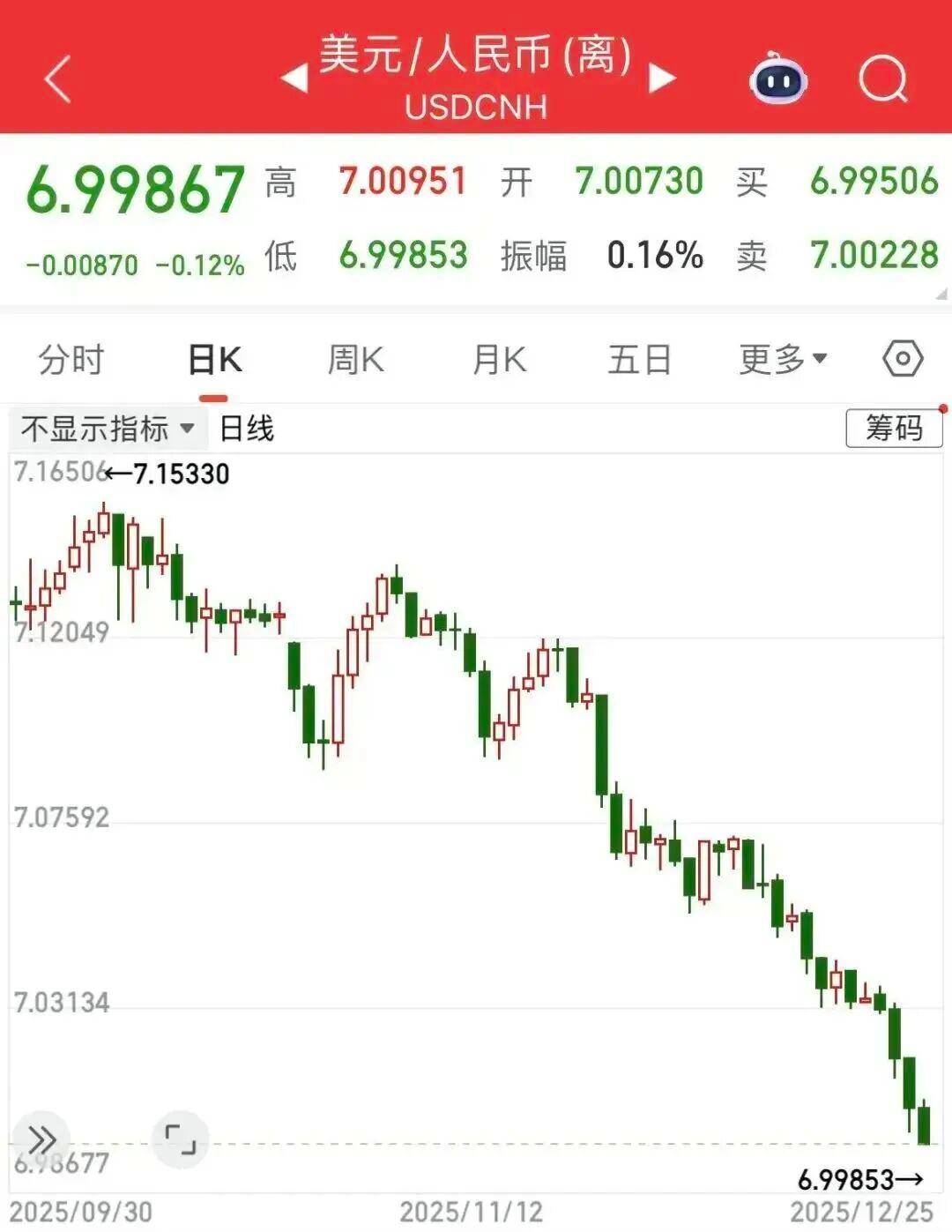
人民币汇率破7,可持续吗?
Sou Hu Cai Jing· 2025-12-25 14:08
Core Viewpoint - The offshore RMB has surpassed the 7.0 mark against the USD for the first time in 2024, reaching a high of 6.9985, while the onshore RMB also broke the 7.01 threshold, marking a new high since September 27, 2024 [1][2]. Group 1: Market Dynamics - The 7.0 level is a significant "watershed" for the RMB exchange rate, causing market participants to hold their breath as it approaches [2]. - The short-term probability of the RMB breaking 7 is high, but sustaining below this level in the long term faces multiple uncertainties [3]. - The recent RMB appreciation is attributed to a combination of factors that have been building up over time [4]. Group 2: External Influences - The weakening of the USD index has created favorable external conditions, with the Federal Reserve entering a rate-cutting cycle since September, reducing rates by a total of 75 basis points this year [5][8]. - The expectation of continued rate cuts by the Federal Reserve has led to a significant drop in the USD index, facilitating the appreciation of the RMB and other non-USD currencies [8]. Group 3: Domestic Factors - The People's Bank of China (PBOC) has adopted a relaxed stance towards the RMB's appreciation, allowing the currency to strengthen without intervention, as indicated by the adjustment of the counter-cyclical factor to a positive value [9][11]. - Year-end corporate foreign exchange settlements have contributed to the RMB's appreciation, as companies convert their foreign earnings into RMB [12][13]. Group 4: Economic Context - The current RMB appreciation reflects a broader struggle for "pricing power" and "game rules" in the global market, with the U.S. attempting to reverse its industrial hollowing through protectionist measures [16][17]. - China's response has been to avoid excessive competition and allow the RMB to appreciate, thereby shifting costs to Western economies [18][21]. - The recent trade surplus exceeding $1 trillion for the first 11 months of the year indicates China's strong export performance amid these dynamics [18]. Group 5: Strategic Implications - The current RMB appreciation is seen as a strategic move by the state to prepare for manufacturing upgrades, although there may be measures to control rapid appreciation in the short term [21][22].