
美元走势

Search documents
国际金价:“真摔”还是“假跌”?
Jin Rong Shi Bao· 2025-10-23 02:03
Core Viewpoint - The recent sharp decline in gold prices, dropping nearly $300 to $4,082 per ounce, is attributed to profit-taking after a significant increase of 66% this year and 170% since the end of 2022, raising concerns about whether this marks a healthy correction or the end of the current bull market [1][2]. Group 1: Market Dynamics - The gold price experienced a historic surge, reaching a peak of $4,381 per ounce before the recent drop, which is the largest single-day decline since 2013 [1]. - Silver prices also fell sharply, decreasing by 7.5% to $48.37 per ounce on the same day [1]. - The recent upward trend in gold prices was driven by geopolitical uncertainties, continuous purchases by global central banks, and strong expectations for Federal Reserve rate cuts [1]. Group 2: Factors Influencing Price Decline - Short-term weakening of safe-haven demand contributed to the price drop, influenced by optimistic signs in international trade and reduced geopolitical risk concerns [2]. - The ongoing U.S. government shutdown, now in its third week, has led to predictions of a potential resolution, further boosting market optimism [2]. - A stronger U.S. dollar, which rose by 0.34% to 98.98, also pressured gold prices, as a stronger dollar increases the cost of gold for investors holding other currencies [2]. Group 3: Analyst Perspectives - Most analysts believe that gold's status as a traditional safe-haven asset will persist, suggesting that gold prices may enter a consolidation phase in the short term [3]. - Key factors supporting gold prices, such as geopolitical uncertainties, economic slowdown risks, and central bank buying demand, have not fundamentally reversed [3]. - However, there are concerns about speculative trading influencing gold's volatility, indicating that significant price fluctuations may continue in the future [3].
美国CPI数据发布在即,美元显现看涨信号
Zhi Tong Cai Jing· 2025-10-23 01:51
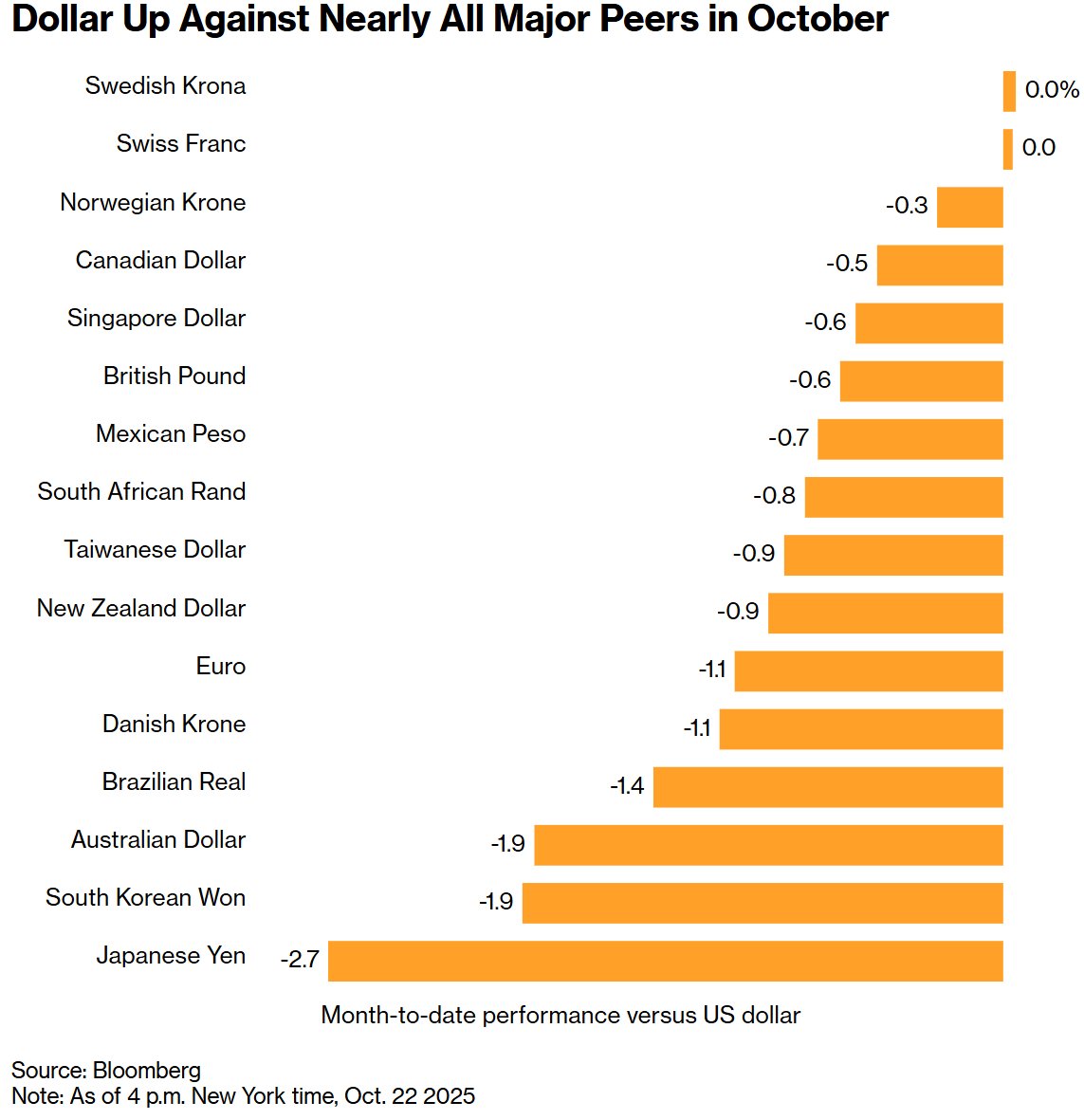
Group 1 - The dollar has strengthened against almost all major currencies at the beginning of the quarter, driven by safe-haven buying amid concerns over regional banks in the U.S. [1] - The upcoming release of the September Consumer Price Index (CPI) is highly anticipated, with economists expecting a year-on-year increase of 3.1%, the highest since May 2024 [1][5] - Market sentiment is leaning towards a bullish outlook for the dollar, with suggestions to buy the dollar in the coming weeks [1][5] Group 2 - The Bloomberg Dollar Spot Index has seen a slight increase of about 0.4% this week, but it is down approximately 7% for the year, potentially marking the worst annual performance since 2017 [6] - The dollar weakened significantly in the first half of the year due to market disruptions caused by tariffs, but there are signs of foreign investors still entering U.S. stocks and bonds [7] - Options traders have become more optimistic about the dollar, with a preference for call options betting on the dollar's strength over the next three months [7] Group 3 - Standard Chartered's Steven Englander predicts a comprehensive rebound of the dollar, forecasting the euro to drop from approximately 1.16 to 1.12 dollars by mid-next year [10] - Englander believes that the market is underestimating the risk of a dollar rebound, suggesting that the Fed's room for rate cuts is smaller than expected, which could support the dollar [10]

德国商业银行:美通胀数据或不影响美元,10 月或降息
Sou Hu Cai Jing· 2025-10-22 15:43
Group 1 - The core viewpoint is that the recently released US inflation data is unlikely to have a lasting impact on the dollar's trajectory or the Federal Reserve's decision-making [1][2] - Delayed data release can indicate whether tariff policies have driven inflation, but it is not expected to alter the Federal Reserve's meeting tone next week, as most members believe the impact of tariffs on inflation is temporary [1][2] - Even if inflation data exceeds expectations, the Federal Reserve may still consider a rate cut on October 29, focusing more on employment conditions, as recent labor market deterioration provides justification for a rate cut [1][2]

金晟富:10.20黄金回调修正注意延续力度!日内黄金分析参考
Sou Hu Cai Jing· 2025-10-20 02:50
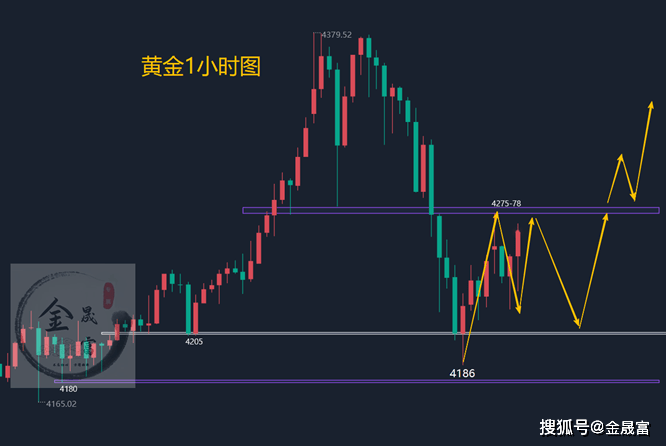
Core Viewpoint - The recent surge in gold prices is driven by geopolitical tensions and market dynamics, with a notable increase of over 64% this year, despite recent fluctuations and a potential for further upward movement in the future [1][2]. Group 1: Market Dynamics - Gold reached a high of $4,274.53 per ounce due to increased demand for safe-haven assets amid renewed conflict in the Middle East, but later retreated to around $4,247.30 [1]. - The gold market is currently characterized by a fierce tug-of-war between bullish and bearish forces, influenced by geopolitical risks, trade relations, and Federal Reserve interest rate expectations [2]. - The price of gold has seen a significant increase, touching a historical high of $4,379.38 before closing at $4,247.17, marking a weekly gain of 5.69% and a ninth consecutive week of increases [1][2]. Group 2: Technical Analysis - Key support for gold is identified at $4,200, with resistance at $4,280; maintaining above $4,200 is crucial for the upward trend [4]. - The recent high of $4,274.6 was followed by a drop to $4,218, indicating potential short-term volatility, but the overall bullish trend remains intact [4]. - Short-term trading strategies suggest buying on dips around $4,200-$4,205 and selling on rallies near $4,275-$4,280, with strict stop-loss measures recommended [5].
申万宏观·周度研究成果(10.11-10.17)
赵伟宏观探索· 2025-10-18 16:03
Group 1: High-Frequency Tracking - The uncertainty surrounding tariffs has increased again, impacting global risk assets, with a notable rise in safe-haven assets like gold and U.S. Treasuries [10][11]. - September exports exceeded expectations due to a combination of low base effects and improved external demand [12]. - Domestic industrial production has shown signs of decline, while infrastructure construction has weakened, although travel activity remains high [13]. Group 2: Data Commentary - Inflation has surpassed expectations, driven by rising prices in commodities, which have significantly influenced upstream PPI, and increases in gold and appliance prices affecting downstream CPI [14]. - The surge in M1 growth may be partially attributed to accelerated fiscal spending [15]. Group 3: Hot Topics - The article discusses the potential future direction of U.S. tariffs from an American perspective, providing a framework for understanding the implications of tariff strategies [9]. - The transition period between old and new economic forces is highlighted, raising questions about the impact of external factors on strong export performance and the evolving domestic demand pressures [8].

申万宏观·周度研究成果(10.11-10.17)
申万宏源宏观· 2025-10-18 11:38
Group 1 - The article discusses the rising uncertainty surrounding tariffs, particularly in the context of U.S.-China trade relations, highlighting recent developments and their implications for global markets [5][9]. - It emphasizes the strong performance of exports in September, attributing this to a combination of low base effects and improved external demand [11]. - The article notes a decline in industrial production and infrastructure investment, while mobility indicators show a continued high level of movement among the population [12]. Group 2 - The analysis of inflation reveals three key drivers: rising prices of commodities boosting upstream PPI, and increases in gold and appliance prices significantly impacting downstream CPI [13]. - The article points out that the surge in M1 growth may be partially due to accelerated fiscal spending [15]. - It provides insights into the potential future direction of U.S. tariff policies from an American perspective, offering a structured framework for understanding these developments [6][10].

价为啥一直涨?揭秘黄金价格背后的逻辑与原理
Sou Hu Cai Jing· 2025-10-18 06:07
Core Viewpoint - The recent rise in gold prices is attributed to various factors, including supply-demand dynamics, market sentiment, and external economic conditions, indicating both short-term fluctuations and long-term trends [2][5]. Group 1: Logic Behind Gold Price Increase - Gold prices are fundamentally driven by supply and demand, but are influenced by unique factors such as geopolitical tensions, economic instability, and inflation [2][3]. - Historical instances of significant gold price increases occurred during the 2008 financial crisis and the 2020 pandemic, suggesting that external shocks can lead to substantial price movements [2][3]. Group 2: Strategies for Individuals Facing Rising Gold Prices - Individuals can consider various investment methods in gold, including physical gold, gold ETFs, and gold mining stocks, each with different risk and return profiles [4]. - Gold is viewed as a safe-haven asset, particularly during times of economic uncertainty or geopolitical tensions, which drives demand and subsequently prices [3][4]. - The impact of inflation and central bank policies, particularly regarding currency valuation and interest rates, plays a crucial role in gold price dynamics [3][6]. Group 3: Future Gold Price Trends - Future gold price movements will depend on several key factors, including global economic conditions, Federal Reserve policies, geopolitical risks, and the potential impact of emerging technologies like digital currencies [5][6]. - A cautious approach is recommended for investors, suggesting that gold can be a part of a diversified asset allocation strategy, particularly for those seeking to hedge against inflation and economic uncertainty [5][6].
IMF:全球经济动荡不安 关税影响尚未完全显现
2 1 Shi Ji Jing Ji Bao Dao· 2025-10-14 15:25
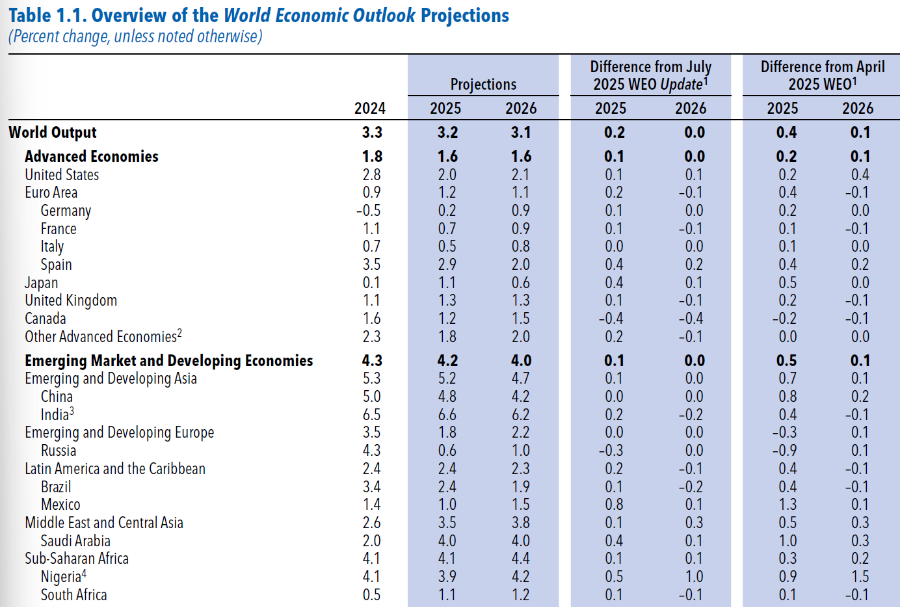
| | | | | Difference from July | | | Difference from April | | --- | --- | --- | --- | --- | --- | --- | --- | | | | Projections | | 2025 WEO Update1 | | | 2025 WEO1 | | | 2024 | 2025 | 2026 | 2025 | 2026 | 2025 | 2026 | | World Output | 3.3 | 3.2 | 3.1 | 0.2 | 0.0 | 0.4 | 0.1 | | Advanced Economies | 1.8 | 1.6 | 1.6 | 0.1 | 0.0 | 0.2 | 0.1 | | United States | 2.8 | 2.0 | 2.1 | 0.1 | 0.1 | 0.2 | 0.4 | | Euro Area | 0.9 | 1.2 | 1.1 | 0.2 | -0.1 | 0.4 | -0.1 | | Germany | -0.5 | 0.2 | 0.9 | 0.1 | 0.0 | 0.2 | ...
汇丰银行:预计美元明年初触底,很可能再度走弱
Sou Hu Cai Jing· 2025-10-14 07:13
Core Viewpoint - HSBC believes that the US dollar is likely to weaken again, with expectations of hitting a bottom in early next year [1] Group 1: Economic Indicators - HSBC's global foreign exchange research head states that the US dollar typically weakens when the Federal Reserve resumes a loose monetary policy and the US avoids recession [1]

汇丰银行:美元很可能还将再度走弱 或在明年初触底
Xin Hua Cai Jing· 2025-10-14 06:21
(文章来源:新华财经) 汇丰全球外汇研究主管保罗·梅克尔在报告中指出:"当美联储重启宽松周期,而美国经济又免于衰退 时,历史经验表明美元将会走弱,这一规律很难被打破。" 虽然关于美国经济重新加速的讨论,以及近期法国和日本的政治局势动荡,确实值得让人思考美元自7 月以来的横盘走势,但市场心态变幻莫测。相信美元走强的渴望固然诱人,但现在摒弃看跌观点为时尚 早。梅克尔预计美元将在明年初触底。 新华财经北京10月14日电关于美元是否已经触底,市场上争论激烈,但汇丰银行认为美元很可能还将再 度走弱。 ...