AI概念

Search documents
银行利好竟是烟雾弹?机构直言:下周反弹是逃命机会,不是抄底信号!
Sou Hu Cai Jing· 2025-10-19 00:41
Market Overview - Over 4,700 stocks declined with a trading volume of 19.5 trillion, indicating a significant capital outflow from major players, leading to a "mini stock disaster" in the A-share market [1] - Mysterious funds entered the market towards the end of trading, purchasing 230 million in stocks like BYD and Tom Cat, suggesting a potential setup for a rebound next week [1] Policy and External Factors - The central bank's sudden call to "attract foreign investment" combined with signals of tariff easing led to a surge in A50 and Hong Kong futures [3] - This policy shift appears to be a strategy by major players to create a false rebound to attract retail investors [3] Market Sentiment and Historical Context - Historical data indicates that over 80% of rebounds during periods of declining sentiment are opportunities for major players to offload stocks [5] - The "fishing" tactic of major players is likely to repeat next week, with retail investors warned to be cautious of three traps: high-tech stocks' rebounds, sudden late-session stock surges, and low-volume rebounds [6] Defensive Assets and Sector Performance - Defensive assets have become a safe haven, with the precious metals sector rising against the trend, and bank stocks attracting 200 billion from insurance funds due to dividend yields exceeding 4% [8] - The previously hot AI sector, despite favorable news, lacks performance support from the application end [8] Technical Analysis and Trading Strategies - Key technical levels to watch include the 3,885-point support for the Shanghai Composite Index and the 3,000-point level for the ChiNext Index [8] - Analysts suggest that if the index fails to break through the 5-day moving average during a rebound, selling is the best option [9] Market Dynamics and Trading Behavior - Quantitative trading has intensified market volatility, with a trading volume of 1.1 trillion being a "hunting zone" for quant funds [11] - The behavior of foreign capital, which tends to sell before buying back, contrasts sharply with domestic major players [8] Investment Opportunities and Risks - The innovative drug sector is gaining traction due to the ESMO annual meeting, while low-valuation blue chips are seen as defensive choices [13] - The upcoming third-quarter reports are expected to reveal underperforming stocks, particularly those that have seen significant price increases [14] Global Market Interconnections - Increased interconnectivity in global markets is noted, with the impact of the Federal Reserve's balance sheet reduction affecting foreign capital flows [15][16] - The A-share market's rebound on October 15 coincided with a rise in Hong Kong stocks, although such correlations are often short-lived [17]


美股“恐慌指数”飙升!动荡来袭,是危还是机?
Sou Hu Cai Jing· 2025-10-18 16:35
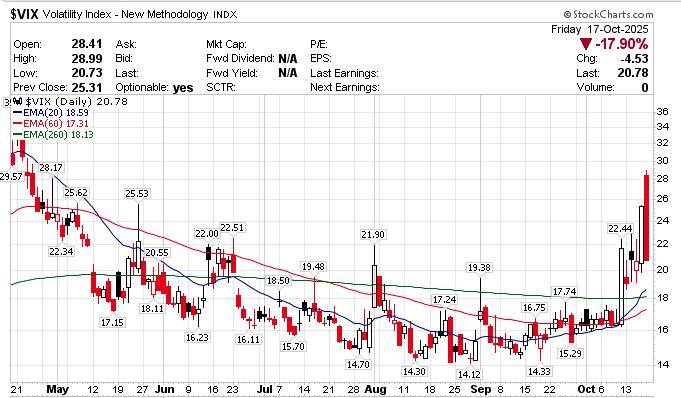
Core Viewpoint - The recent market turmoil signifies the end of a prolonged period of calm in the U.S. stock market, driven by multiple negative factors, indicating that market tranquility is often a precursor to volatility [1][4]. Group 1: Market Indicators - The VIX index, known as the "fear index," surged to 28.99, the highest level since late April, reflecting heightened investor anxiety and expectations of increased volatility [1]. - Investors are aggressively buying options that profit when the VIX reaches 47.5 and 50, showcasing collective anxiety about a looming market storm [2]. Group 2: Contributing Factors - The resurgence of trade war threats, particularly following Trump's social media announcement about potential new tariffs, triggered significant market declines, ending a 33-day period of minimal volatility for the S&P 500 [4]. - Regional bank failures, highlighted by Zions Bancorp's substantial bad debt losses, have intensified concerns about the banking system's fragility, reminiscent of earlier bankruptcies [4]. - The once-prominent AI stocks are now facing skepticism, with some investors questioning whether the AI hype has turned into a dangerous bubble, drawing parallels to the late 1990s internet bubble [5]. Group 3: Market Behavior - A notable shift in capital is occurring, with funds moving from high-risk assets to defensive sectors such as utilities, healthcare, and consumer staples, indicating a "flight to safety" behavior among investors [5]. - High-risk assets, including Bitcoin, have experienced significant declines, with Bitcoin dropping 8.7% in its worst weekly performance since February, reflecting a shift from a "greed" to a "fear" mode among investors [5]. Group 4: Analyst Perspectives - Analysts are divided, with optimists viewing the market adjustment as a healthy sign that prevents excessive overvaluation, while pessimists warn that the current high valuations, particularly in tech stocks, may indicate a dangerous bubble [6]. - Historical comparisons are being drawn to past market events, suggesting that while current conditions share similarities with previous bubbles, each market turmoil has unique contexts and causes [7].
“恐慌指数”飙升:美股平静期结束了?
财联社· 2025-10-18 10:20
Core Viewpoint - The U.S. stock market is experiencing significant volatility due to multiple uncertainties, including trade war threats, regional bank loan defaults, and skepticism surrounding the AI bubble, marking the most turbulent period since April [1][4]. Market Volatility - The Cboe Volatility Index (VIX) reached a peak of 28.99, the highest level since late April, indicating heightened market fear and expectations of continued volatility [2]. - Investors are increasingly buying options that profit when the VIX rises to 47.5 and 50, reflecting growing concerns about market stability [4]. Economic Concerns - Recent declines in regional bank stocks have raised fears about the credit market, suggesting that the U.S. economy may be weaker than it appears, compounded by renewed trade war threats that could lead to a recession [4][5]. - The market's reaction to former President Trump's threat of new tariffs resulted in the largest single-day drop since April, ending a record period of calm in the S&P 500 [5]. Sector Performance - Despite strong earnings reports from major banks like JPMorgan and Bank of America, the regional banking sector has faced sharp declines due to significant bad debt losses reported by Zions Bancorp [5]. - Defensive sectors such as utilities, healthcare, and consumer staples have recently outperformed, contrasting with the poor performance of banks and energy companies [5]. High-Risk Investments - High-risk assets, including Bitcoin, have seen substantial declines, with Bitcoin dropping approximately 8.7%, marking its worst weekly performance since February [6]. - Popular stocks like Opendoor Technologies have also experienced significant losses, down 5.4% [6]. Market Sentiment - Some industry insiders believe the recent market downturn does not indicate a long-term sell-off, viewing the adjustment as a healthy correction after a rapid market rise [7]. - Concerns persist regarding the market's vulnerability to shocks, as elevated valuations of large-cap stocks may mask underlying issues, reminiscent of the late 1990s tech bubble [8][9].

A股:不出意外,种种迹象表明,下午迎来最后的调整了
Sou Hu Cai Jing· 2025-10-18 00:36
三大指数全线大跌,我却发现一个被多数人忽略的关键信号 早上九点半,当看到自选股里一片惨绿时,我的手心开始冒汗。 短短两小时,账户缩水了整整五位数,那种感觉就像坐过山车冲到最高点突然断电。 群里 早就炸锅了,有人哀嚎割肉,有人发誓再也不碰股票,更有甚者已经开始计算这个月要啃多少天泡面。 但就在这一片恐慌中,我注意到一个反常现象:平 时跌得最狠的白酒、银行板块,今天居然稳得像块石头。 这让我想起一位资深投资人说过的话:"当科技股血流成河时,老登资产正在悄悄筑底。 " 这种分化不是偶然的。 回顾今年3月中下旬,市场也是类似场景。 当时银行股躺在谷底,科技股风光无限,结果到了6月,剧情完全反转——银行创新高,科技跌回起跑线。 现在 历史重演,十月份的盘面清楚显示,白酒、煤炭这些"过气"板块反而实现了正收益,银行保险更是逆势飘红。 这种轮动就像季节更替,明明还在穿短袖的 秋天,冬装已经悄悄挂进了商场橱窗。 最让人唏嘘的是科技股的遭遇。 那些追高AI概念的人,现在正经历着融资爆仓的煎熬。 我认识的一个程序员,上个月还炫耀重仓半导体赚了辆特斯拉,今天默默把微信头像换成了黑色。 市场的残酷就在于此:当你终于相信某个故事时,故 ...

永安期货有色早报-20251017
Yong An Qi Huo· 2025-10-17 02:12
1. Report Industry Investment Rating No relevant content provided. 2. Report's Core View - For copper, maintain a callback - buying strategy considering the continuous tightness of the ore end and the growth of infrastructure and power demand in Southeast Asia and the Middle East. Pay attention to the support around $10,300 for LME copper, and consider selling put options below $10,000 or gradually establishing virtual inventory [1]. - For aluminum, the short - term fundamentals are okay. Keep an eye on terminal demand, and hold long - term positions on dips [1]. - For zinc, due to the poor domestic fundamentals and the opening of the export window affected by export profits, it is recommended to wait and see. Consider gradually taking profits on domestic - foreign positive spreads and pay attention to the opportunity of reverse spreads in the far - month contracts. Also, pay attention to the positive spread opportunity between December and February contracts [2]. - For nickel, the short - term real - world fundamentals are weak. Although the geopolitical risks in Indonesia have eased, there are still disturbances at the mining end and the policy end has the motivation to support prices [4]. - For stainless steel, the fundamentals remain weak overall. There is increased uncertainty in trade frictions in the short - term macro - aspect, and the Indonesian policy end has a certain motivation to support prices [9]. - For lead, the lead price is expected to maintain a high - level shock between 17,000 and 17,400 next week, and the subsequent destocking strength in October remains to be verified, with a weak outlook [12]. - For tin, follow the macro - sentiment in the short - term and it is recommended to wait and see. In the medium - to - long - term, hold positions on dips close to the cost line [15]. - For industrial silicon, the supply and demand are in balance in Q4 with few potential contradictions in the short - term. In the long - term, the price is expected to fluctuate at the cycle bottom with the seasonal marginal cost as the anchor [16]. - For lithium carbonate, in the context of a strong "anti - involution" commodity sentiment, the price has high elasticity after the supply - side disturbance speculation is realized, and strong downward support before the disturbance is realized [16]. 3. Summary by Metal Copper - **Price and Inventory Data**: From October 10th to 16th, the spot premium of SHFE copper changed from 45 to 70, the scrap - refined copper spread decreased from 3197 to 2362, and the LME inventory decreased from 139,400 to 137,450 [1]. - **Market Situation**: Affected by the Trump's tariff announcement, LME copper dropped 4.5% on Friday. The impact of this tariff conflict is estimated to be lower than that during the Tomb - Sweeping Festival. The smelting end has over - expected production cuts and moderate inventory accumulation this week. After the sharp decline in copper price on Friday, the volume of pricing and receiving goods is expected to increase significantly next week, driving inventory destocking [1]. Aluminum - **Price and Inventory Data**: From October 10th to 16th, the Shanghai aluminum ingot price increased from 20,990 to 20,950, and the LME inventory decreased from 508,825 to 495,325 [1]. - **Market Situation**: The operating production capacity is increasing slightly. The production schedule of photovoltaic modules has stabilized, and the proportion of molten aluminum has rebounded significantly in September. Due to the holiday effect, there is seasonal inventory accumulation of aluminum ingots and bars. The global economic recovery is showing signs, but the Sino - US economic and trade relations are uncertain, leading to a certain divergence in the internal and external market trends [1]. Zinc - **Price and Inventory Data**: From October 10th to 16th, the Shanghai zinc ingot price decreased from 22,300 to 21,920, and the LME inventory decreased from 37,950 to 38,300 [2]. - **Market Situation**: This week, the domestic zinc price fluctuated and rose due to the US shutdown sentiment and the opening of the export window. The domestic TC decreased further, and the imported TC increased. The domestic zinc ore is expected to be tighter from the fourth quarter to the first quarter of next year, while the overseas zinc ore increased significantly in the second quarter. The demand is seasonally weak domestically, and the European demand is average overseas [2]. Nickel - **Price and Inventory Data**: From October 10th to 16th, the SHFE nickel spot price changed slightly, and the LME inventory decreased from 6894 to 6222 [3]. - **Market Situation**: The supply of pure nickel remains at a high level, the demand is weak overall, and the domestic inventory remains stable while the overseas inventory is continuously accumulating. The Indonesian mining end has continuous disturbances, and the policy end has the motivation to support prices [3][4]. Stainless Steel - **Price and Inventory Data**: From October 10th to 16th, the price of 304 cold - rolled coils remained unchanged at 13,550, and the price of 304 hot - rolled coils decreased from 12,700 to 12,450 [9]. - **Market Situation**: The steel mills' production schedule in October increased slightly compared to the previous month. The demand is mainly for rigid needs. The prices of ferronickel and ferrochrome remain stable. There is inventory accumulation during the holiday in Xijiao and Foshan, and the warehouse receipts remain stable [9]. Lead - **Price and Inventory Data**: From October 10th to 16th, the spot premium of lead changed from - 195 to - 210, and the LME inventory decreased from 237,000 to 252,000 [12]. - **Market Situation**: The lead price rose this week due to macro - factors. The supply of recycled lead is expected to increase by 30,000 tons in October. The demand may weaken after the National Day holiday. The refined - scrap price difference is - 25, and the LME registered warehouse receipts decreased by 100,000 tons. The lead price is expected to maintain a high - level shock next week [12]. Tin - **Price and Inventory Data**: From October 10th to 16th, the tin position decreased from 71,221 to 63,683, and the LME inventory remained at 2575 [15]. - **Market Situation**: The tin price moved up this week due to macro - factors. The domestic smelting plants have reduced production, and the overseas supply is expected to recover in October. The demand for solder has a slight recovery during the peak season. The domestic fundamentals are short - term in a situation of weak supply and demand [15]. Industrial Silicon - **Price and Inventory Data**: From October 10th to 16th, the 421 Yunnan basis changed from - 185 to - 105, and the warehouse receipt quantity decreased from 50,281 to 50,291 [16]. - **Market Situation**: A leading enterprise in Xinjiang resumed production this week. The start - up in Sichuan and Yunnan is stable, and there is a strong expectation of production reduction in November. The supply and demand of industrial silicon are in balance in Q4, and the price is expected to fluctuate at the cycle bottom in the long - term [16]. Lithium Carbonate - **Price and Inventory Data**: From October 10th to 16th, the SMM electric - grade lithium carbonate price remained at 73,000, and the warehouse receipt quantity decreased from 42,669 to 30,456 [16]. - **Market Situation**: The lithium carbonate price fluctuated this week. The overseas mines have a strong willingness to support prices, and the salt plants have a low acceptance of high - priced lithium ore. The pre - holiday inventory - building is coming to an end, and the spot basis is weakening. The supply is in an over - capacity cycle, but there is inventory destocking due to seasonal factors and demand growth [16].

永安期货有色早报-20251015
Yong An Qi Huo· 2025-10-15 01:45
Report Industry Investment Rating No relevant content provided. Core View of the Report The report provides a comprehensive analysis of various non - ferrous metals, each with its own market situation, influencing factors, and investment strategies. For copper, maintain a buy - on - dips approach; for aluminum, hold on dips in the long - term; for zinc, suggest waiting and seeing; for nickel, the short - term fundamentals are weak; for stainless steel, the fundamentals are weak; for lead, expect high - level oscillations; for tin, suggest waiting and seeing in the short - term and holding on dips in the long - term; for industrial silicon, expect price oscillations at the cycle bottom; for lithium carbonate, price elasticity is high after supply - side disturbances [1][2][4]. Summary by Metal Copper - **Market Data**: From September 30 - October 14, the spot price of Shanghai - copper decreased by 30, the spread between waste and refined copper remained unchanged, and the inventory of SHFE increased by 3405 [1]. - **Market Analysis**: Affected by Trump's tariff announcement, LME copper dropped 4.5% on Friday. The impact of this tariff conflict is expected to be less than that during the Tomb - Sweeping Festival. The smelting reduction exceeded expectations, and there was medium - level inventory accumulation this week. After the price drop on Friday, the volume of price - setting and receiving goods is expected to increase, driving inventory reduction. Copper cable and aluminum cable construction are diverging [1]. - **Investment Strategy**: Maintain a buy - on - dips approach, pay attention to the support around $10,300 for LME copper, consider selling put options below $10,000 or gradually establishing virtual inventory [1]. Aluminum - **Market Data**: From September 30 - October 14, the prices of Shanghai, Yangtze River, and Guangdong aluminum ingots increased by 90, the domestic alumina price decreased by 5, and the inventory of SHFE remained unchanged [1]. - **Market Analysis**: The operating capacity is increasing slightly, the production schedule of photovoltaic modules has stabilized, and the proportion of molten aluminum has rebounded significantly in September. Due to the holiday effect, there was seasonal inventory accumulation. The global economic recovery is showing signs, and the Fed's rate - cut expectation is strengthening, but Sino - US economic and trade relations are uncertain, leading to a divergence in domestic and foreign market trends [1]. - **Investment Strategy**: The short - term fundamentals are acceptable. Keep an eye on terminal demand and hold on dips in the long - term [1]. Zinc - **Market Data**: From September 30 - October 14, the spot price of Shanghai zinc increased by 10, and the social inventory remained unchanged. The LME zinc inventory decreased [2]. - **Market Analysis**: This week, the domestic zinc price fluctuated and rose. The domestic TC decreased, and the imported TC increased. In the fourth quarter to the first quarter of next year, domestic zinc ore will be tighter, while overseas ore production increased significantly in the second quarter. In October, smelting capacity recovered slightly. Domestic demand is seasonally weak, and overseas demand in Europe is average. The domestic social inventory is oscillating, and the LME inventory is decreasing [2]. - **Investment Strategy**: Due to the poor domestic fundamentals and the opening of the export window, it is recommended to wait and see. For the domestic - foreign spread, gradually take profits on the long - domestic - short - foreign spread and look for opportunities in the far - month reverse spread. For the inter - month spread, pay attention to the long - December - short - February spread [2]. Nickel - **Market Data**: From September 30 - October 14, the price of 1.5% Philippine nickel ore remained unchanged, and the price of Shanghai nickel decreased by 450 [3]. - **Market Analysis**: The supply of pure nickel remains at a high level, the demand is weak, and the domestic inventory is stable while the overseas inventory is increasing. The Indonesian parade has subsided, but there are still disturbances in the Indonesian ore market [4]. - **Investment Strategy**: No specific strategy provided in the report. Stainless Steel - **Market Data**: From September 30 - October 14, the prices of 304 cold - rolled and hot - rolled coils decreased by 100, and the price of waste stainless steel decreased by 50 [9]. - **Market Analysis**: In October, steel mill production increased slightly. Demand is mainly for rigid needs. The prices of nickel - iron and chromium - iron are stable. There was inventory accumulation during the holiday in Xijiao and Foshan, and the warehouse receipts remained unchanged [9]. - **Investment Strategy**: No specific strategy provided in the report. Lead - **Market Data**: From September 30 - October 14, the spot premium decreased by 5, and the LME registered warehouse receipts decreased by 100,000 tons [13][14]. - **Market Analysis**: This week, the lead price rose due to macro - factors. The scrap volume is weak year - on - year, and the recovery of scrap lead production is expected to increase by 30,000 tons in October. The demand for batteries may weaken after the National Day. The refined - scrap spread is - 25, and the lead ingot spot is at a discount of 10 [14]. - **Investment Strategy**: It is expected that the domestic and foreign lead prices will oscillate at a high level next week, in the range of 17,000 - 17,400 [14]. Tin - **Market Data**: From September 30 - October 14, the tin position decreased by 1121 [17]. - **Market Analysis**: This week, the tin price increased due to macro - factors. The domestic smelting capacity has been reduced, and the overseas supply is expected to recover in October. The demand for solder has slightly improved, and the domestic inventory has decreased slightly [17]. - **Investment Strategy**: In the short - term, follow the macro - sentiment and wait and see. In the long - term, hold on dips close to the cost line [17]. Industrial Silicon - **Market Data**: From September 30 - October 14, the 421 Yunnan and Sichuan basis increased by 285, and the 553 East China and Tianjin basis changed, with the warehouse receipts increasing by 343 [18]. - **Market Analysis**: Xinjiang's leading enterprises are resuming production, and Sichuan and Yunnan's production is stable. There is a strong expectation of production reduction in November. The supply and demand of industrial silicon will be balanced in Q4 [18]. - **Investment Strategy**: The price is expected to oscillate at the cycle bottom [18]. Lithium Carbonate - **Market Data**: From September 30 - October 14, the SMM electric and industrial lithium carbonate prices decreased by 100, and the warehouse receipts decreased by 1538 [18]. - **Market Analysis**: This week, the lithium carbonate price oscillated. Overseas mines are reluctant to sell at low prices, and traders are holding back supplies. The pre - holiday inventory replenishment is coming to an end, and the spot basis is weakening. The market is still in a stage of over - capacity [18]. - **Investment Strategy**: The price elasticity is high after supply - side disturbances, and there is strong downward price support before the disturbances [18].
永安期货有色早报-20251013
Yong An Qi Huo· 2025-10-13 02:37
Group 1: Copper - The LME copper price dropped 4.5% on Friday due to Trump's tariff announcement, closing above $10,300 per ton. The current tariff impact and market panic are estimated to be lower than the Tomb - Sweeping Festival disturbance [1]. - The smelting reduction exceeded expectations, and there was medium - level inventory accumulation this week. After the sharp decline in copper price on Friday, the volume of price - fixing and goods receiving is expected to increase significantly next week, driving inventory depletion [1]. - Maintain a callback - buying strategy for copper, pay attention to the support around $10,300 for LME copper, and consider selling put options below $10,000 or gradually building virtual inventory [1]. Group 2: Aluminum - The operating capacity is increasing slightly. The production schedule of photovoltaic modules has stabilized, and the proportion of molten aluminum in September has significantly rebounded. However, there is seasonal inventory accumulation of aluminum ingots and bars due to the holiday effect [1]. - The global economic recovery is showing signs, and the expectation of the Fed's interest - rate cut is strengthening. But the uncertainty of Sino - US economic and trade relations has deepened, leading to a certain divergence in the trends of domestic and foreign markets [1]. - The short - term fundamentals are acceptable. Keep an eye on terminal demand and hold at low prices in the long term [1]. Group 3: Zinc - The domestic zinc price fluctuated and rose this week due to the US government shutdown sentiment and the opening of the export window [2]. - The domestic TC of zinc is decreasing, and the imported TC is increasing. The domestic zinc ore supply will be tighter from the fourth quarter to the first quarter of next year, while the overseas zinc ore supply increased more than expected in the second quarter [2]. - The domestic fundamentals of zinc are poor, but the export window may open due to export profits. It is recommended to wait and see under the enhanced macro - uncertainty. Consider gradually taking profits on domestic - foreign positive spreads and pay attention to the opportunity of far - month reverse spreads. Also, focus on the positive spread opportunity between December and February contracts [2]. Group 4: Nickel - The supply of pure nickel remains at a high level, the demand is weak, and the inventory is stable in China and increasing overseas. The short - term fundamentals are weak [4]. - The Indonesian protests have subsided, but there are continuous disturbances in the Indonesian nickel ore sector, and the policy side still has the motivation to support prices [4]. Group 5: Stainless Steel - Steel mills' production schedules in October increased slightly compared to the previous month. The demand is mainly for rigid needs, the prices of nickel - iron and chrome - iron are stable, and there is inventory accumulation during the holiday in Xijia and Foshan, with the warehouse receipts remaining stable [9]. - The overall fundamentals are weak. The short - term macro - trade friction uncertainty increases, and the Indonesian policy side has a certain motivation to support prices [9]. Group 6: Lead - The lead price rose this week due to macro factors. The supply of recycled lead is expected to increase by 30,000 tons in October, and the primary lead concentrate is in short supply [13]. - The battery production rate increased this week, but the finished - product inventory is high. After the National Day, the demand may weaken. The refined - scrap price difference is - 25, and the LME registered warehouse receipts decreased by 100,000 tons [13]. - The lead price is expected to fluctuate at a high level next week, ranging from 17,000 to 17,400 [13]. Group 7: Tin - The tin price moved up this week due to macro factors. The domestic processing fee for tin ore is low, and some domestic smelters have reduced production. Overseas supply is expected to recover in October [16]. - The demand for solder has slightly improved during the peak season, mainly supported by rigid demand. The domestic inventory has slightly decreased, and the overseas LME inventory is fluctuating at a low level [16]. - The short - term domestic fundamentals are in a state of weak supply and demand. It is recommended to wait and see in the short term and hold at low prices close to the cost line in the long term [16]. Group 8: Industrial Silicon - A leading enterprise in Xinjiang resumed production this week. The start - up in Sichuan and Yunnan is stable, and there is a strong expectation of production reduction in November. The supply and demand of industrial silicon are balanced in Q4 [17]. - In the long term, the over - capacity of industrial silicon is still high, and the price is expected to fluctuate at the bottom of the cycle based on the seasonal marginal cost [17]. Group 9: Lithium Carbonate - The price of lithium carbonate fluctuated this week. Overseas mines have a strong willingness to support prices, and traders are reluctant to sell, but salt factories have a low acceptance of high - priced lithium ore [17]. - The pre - holiday inventory - building rhythm was strong first and then weak and is now approaching the end. The spot basis is stable and slightly weak, and some discounts have widened by 100 - 200 yuan [17]. - Lithium carbonate is still in the capacity expansion cycle, and the static supply - demand pattern is still in surplus. With the help of the seasonal peak season and the explosion of energy - storage demand, the monthly balance has turned to continuous inventory depletion, but the amplitude is average [17].
这个国庆,资本市场悄悄上演了哪些看点?
Sou Hu Cai Jing· 2025-10-13 02:05
【编者语】 国庆长假归来,资本市场已经悄悄换了一片天。黄金闪耀、A股起舞、全球央行政策转向......这个假期,资本市场的精彩程度丝毫不输热门景区。我们 梳理了六大值得关注的市场看点,带你快速读懂假期期间发生的那些"资本大戏"。你的持仓,准备好了吗? 【免责声明】 本文由北京明德蓝鹰投资咨询有限公司撰写,仅为行业研究与商业案例以及探讨市值管理问题之目的而分享,不构成任何投资建议。我们所采用的信 息均来自公开披露资料,但我们无法保证其完整性与准确性。文中所有对公司的提及均旨在进行技术、模式或竞争格局分析,绝非股票推荐。请您知 悉,所有投资决策均伴随风险。我们强烈建议您基于个人独立判断并寻求专业顾问的意见。请务必谨慎决策,风险自担。 朋友们,节后开盘是不是感觉错过了一个亿?这个国庆,资本市场可比景区热闹多了,从黄金冲破天际到A股节后发红包,从美联储的"鸽声嘹亮"到 原油价格的"跌跌不休"……今天咱们就来聊聊这些比你假期还"刺激"的资本大戏。 热点一:黄金破4000美元,闪闪发光 国际金价在假期期间突破每盎司4000美元大关,创下历史新高。节后A股开盘,黄金板块直接起飞,多只黄金股涨停。 点评:这金光闪闪的行情,比 ...

财经观察丨家用净水器市场调查
Xin Hua Wang· 2025-10-12 00:06
Core Insights - The water purifier market in China is transitioning from a non-essential appliance to a necessity for households, driven by increasing consumer health awareness [1] - The retail sales of water purifiers reached 14.08 billion yuan from January to August 2025, marking a 21.1% year-on-year growth, with sales volume and average product price increasing by 16.6% and 3.9% respectively [2] - The introduction of new government policies, including subsidies for water purifiers, is expected to accelerate market growth [2] Market Dynamics - The market is experiencing intense competition and marketing chaos, with many brands focusing on similar specifications and lacking true technological innovation [4] - There are significant consumer complaints regarding misleading advertising, unclear filter lifespan, and deceptive marketing practices targeting vulnerable groups [2][5] - The industry faces challenges such as inflated performance claims and a lack of standardized certifications, which complicate consumer decision-making [5] Regulatory and Standardization Efforts - New national standards for water treatment filters will be implemented in February 2025, prohibiting misleading claims about health benefits and requiring transparency in advertising [6] - Industry associations are working to promote traceability standards to combat counterfeit products and improve consumer trust [6] Industry Recommendations - Companies are encouraged to invest in R&D and establish stringent quality assurance systems while participating in the development of industry standards [7] - Collaboration among brands to unify performance standards and enhance consumer education is essential for breaking the cycle of low-level competition [7] - A focus on technological breakthroughs and user experience is necessary for sustainable market growth [8] Consumer Guidance - Consumers should prioritize filter performance over price, as the core component of water purifiers is the filter itself, which directly affects purification effectiveness and operating costs [9] - Awareness of key indicators beyond TDS values, such as residual chlorine and microbial content, is crucial for making informed purchasing decisions [9][10] - It is advised to choose reputable brands, verify health certifications, and consider local water quality when selecting water treatment devices [11] Conclusion - The water purifier industry in China requires a collaborative effort from government, industry associations, and companies to overcome current challenges and transition towards a focus on quality and consumer satisfaction [12]
22个巡查组,即将进驻!联系方式公布→
证券时报· 2025-10-09 10:12
Core Viewpoint - The article discusses the upcoming safety production assessment and inspection work scheduled for November 2023, involving 22 central inspection teams across various regions in China, aimed at addressing safety production issues and collecting feedback from the public and workers [1]. Group 1: Safety Production Assessment - In November 2023, 22 central safety production assessment teams will conduct inspections in 31 provinces, autonomous regions, municipalities, and the Xinjiang Production and Construction Corps as part of the 2025 safety production assessment plan [1]. - The assessment will focus on major safety production issues, illegal activities, and suggestions for improving safety production responsibilities from frontline workers [1]. Group 2: Public Participation - From October 9 to October 31, 2023, the State Council's Safety Production Committee Office will accept reports of safety production issues through internet, phone, and mail [1][2]. - The public is encouraged to provide objective and truthful feedback regarding safety production issues in their regions [2]. Group 3: Reporting Methods - The reporting methods include a dedicated website and a phone line available from October 9 to 31, 2023, daily from 8:00 AM to 6:00 PM [3][4]. - Mail submissions should be addressed to a specific postal box in Beijing, ensuring proper formatting [5].