货币宽松

Search documents
突然!降息100基点
Zhong Guo Ji Jin Bao· 2025-10-03 02:18
Core Viewpoint - The Central Bank of Egypt has cut interest rates by 100 basis points, marking the fourth rate cut this year, in response to a stronger local currency and declining inflation rates, which are at their lowest since 2022 [1][2][3] Monetary Policy Changes - The Central Bank's Monetary Policy Committee has reduced the overnight deposit rate to 21% and the overnight lending rate to 22% [1][6] - This decision is part of a broader strategy to ease the financial burden on the heavily indebted nation and stimulate local investment [2][3] Inflation Trends - Inflation has been decreasing for three consecutive months, with the consumer price index rising by only 12% in August, down from a peak of 38% in September 2023 [2][8] - The core inflation rate also fell to 10.7% in August, indicating a trend of easing price pressures [2][8] Economic Outlook - The Central Bank anticipates that inflation will continue to slow down, projecting an average inflation rate of around 14% for 2025, with a target of 7% (±2 percentage points) by the fourth quarter of 2026 [8] - The stronger Egyptian pound, bolstered by increased foreign investment and tourism, is expected to help alleviate price pressures in this import-dependent economy [3][5] Future Considerations - Economists predict that this may be the last rate cut in the short term, as the government plans to raise fuel prices later in October, which could introduce new inflationary pressures [2][5] - The Central Bank will continue to monitor economic conditions and adjust policies as necessary to maintain price stability [8]


推动货币政策措施落实落细,充分释放政策效应
2 1 Shi Ji Jing Ji Bao Dao· 2025-09-29 23:45
Group 1 - The Central Committee of the Communist Party of China is preparing for the 15th Five-Year Plan, with a meeting scheduled from October 20 to 23 [1] - The People's Bank of China (PBOC) has shifted its monetary policy focus from "implementing appropriate monetary easing" to "detailed implementation," indicating a shift towards execution rather than broad policy changes [1][2] - Economic indicators show that industrial added value increased by 6.2% year-on-year in the first eight months, while the service production index grew by 5.9%, suggesting that the economy is performing above the target growth rate of 5.0% [1] Group 2 - The narrowing net interest margin of commercial banks, which fell to a historical low of 1.42% in Q2, poses challenges for monetary easing as it may further compress banks' margins and increase operational pressures [2] - The PBOC emphasized the need to balance financial support for the real economy with maintaining the health of financial institutions, reflecting a cautious approach to monetary policy [2] - Recent adjustments in policy language indicate a focus on maintaining stability and predictability in monetary policy, with an emphasis on executing existing measures effectively [2][3] Group 3 - The PBOC is concentrating on maintaining ample liquidity in the market through various tools, including reverse repos and medium-term lending facilities [3] - Structural monetary policy tools are being utilized to support sectors such as technology innovation, consumption, small and micro enterprises, and foreign trade [3] - Coordination between fiscal and monetary policies is being strengthened, with discussions on government bond issuance and offshore RMB bond mechanisms, indicating a collaborative approach to economic management [3][4]
黄金白银,彻底涨疯了!
格隆汇APP· 2025-09-29 11:11
Core Viewpoint - The article highlights a significant surge in gold and silver prices, driven by various market factors, including inflation data, geopolitical tensions, and central bank policies, indicating a strong demand for these precious metals as safe-haven assets [2][3][8]. Group 1: Market Performance - On September 29, gold futures rose by 1.35% to 866.52 CNY per gram, reaching a historical high, while silver futures surged by 3.92% to 10,939 CNY per kilogram, also breaking new records [2]. - The A-share precious metals sector increased by 3.6%, with all related stocks showing strong performance, positively impacting the non-ferrous and minor metals sectors [2]. - The trading volume for gold futures reached 287.447 billion CNY, an increase of over 50 billion CNY from the previous day, while silver futures saw a trading volume of 248.196 billion CNY, up nearly 100 billion CNY, marking a 64% increase [4][7]. Group 2: Influencing Factors - Recent favorable news for precious metals includes the U.S. August core PCE price index year-on-year at 2.9%, which alleviated concerns about interest rate cuts, leading to accelerated price increases for gold and silver [8]. - Dovish statements from several Federal Reserve officials supporting potential interest rate cuts have reinforced market expectations for an accelerated easing cycle [8]. - Geopolitical tensions, particularly in regions like Ukraine and the Middle East, have heightened market anxiety, further driving demand for gold and silver as safe-haven assets [8]. Group 3: Central Bank Activities - Global central banks have significantly increased their gold reserves, with a total value of approximately 4.5 trillion USD, surpassing the 3.5 trillion USD in U.S. Treasury reserves [9]. - China's central bank reported a gold reserve of 74.02 million ounces as of August 2025, marking a continuous increase for ten months, with a total purchase of 36 tons from January to July 2025 [12]. Group 4: Price Trends and Predictions - Gold prices have risen nearly 45% year-to-date, making it the best-performing asset among major asset classes, while silver has seen an increase exceeding 60% [15]. - Institutions have raised their price targets for gold, with expectations of reaching 4,000 USD per ounce by the end of the year, and potential scenarios suggesting prices could rise to 4,500 USD or even 5,000 USD under certain conditions [18]. Group 5: Silver Market Dynamics - Silver futures have experienced a notable increase in trading volume, indicating heightened market interest compared to gold [20][21]. - The silver market is facing a significant supply-demand imbalance, with industrial demand driven by sectors like solar energy and electric vehicles, while supply constraints are exacerbated by environmental regulations and labor disputes in major producing countries [24][26]. - The current market dynamics reflect a structural phase where industrial demand and valuation recovery are driving silver prices, supported by the ongoing energy revolution and monetary easing [33].
利好,要来了?
大胡子说房· 2025-09-29 10:35
Core Viewpoint - The central theme of the article emphasizes the importance of the central bank's repeated commitment to maintaining capital market stability, particularly in the context of the current market conditions, which suggests potential for continued monetary easing and a prolonged bull market [4][8][11]. Group 1: Central Bank's Statements - The central bank has reiterated its stance on utilizing securities, funds, and insurance companies for stock repurchases and increased loans, indicating a proactive approach to stabilize the capital market [4][9]. - This is the third time this year that the central bank has made such a statement, highlighting its significance in the current market context [6][5]. - The current market level, with the index around 3800 points, suggests that the government does not view this position as overly high, signaling a more positive outlook for future market support [8][12]. Group 2: Market Dynamics - The article argues that the recent market stagnation is a necessary correction following a rapid increase in the index, which is seen as a strategy to allow for a more sustainable upward trend [15][16]. - A slow bull market is preferred to prevent quick profit-taking by major funds, which could lead to a short-lived market rally [17][20]. - The government aims to cultivate patient capital, encouraging a gradual market rise rather than a rapid surge, which would benefit ordinary investors by providing them with more time to enter the market [18][19][20]. Group 3: Investment Opportunities - The article suggests that many investors are looking for ways to participate in the current market rally but are uncertain about which sectors or assets to focus on [22]. - A live course is being offered to help investors identify current opportunities and understand market dynamics, which includes insights on asset allocation and investment strategies [23][26][28].

每周投资策略:机密文件内容只适用于专业投资者客户-20250929
citic securities· 2025-09-29 08:56
Group 1: Australia Market Focus - The short-term inflation rebound does not change the expectation of interest rate cuts in Q4, with the Australian CPI rising to 3.0% in August, up from 2.8% in July, exceeding market expectations of 2.9% [17] - The Australian economy showed a strong performance with Q2 GDP growth of 1.8%, surpassing the market consensus of 1.6%, driven by domestic demand and government spending [14] - The commodity upcycle opens further upside for the Australian materials sector, with a focus on companies like Northern Star and Lynas [19][24] Group 2: Northern Star and Lynas - Northern Star (NST AU) is expected to have strong production growth prospects, with a target price of AUD 24.7, supported by a robust balance sheet and a significant stock buyback plan [24] - Lynas (LYC AU) is positioned as a strategic player in the rare earths market, benefiting from high demand in high-end electronics and clean energy sectors, with a focus on ESG principles [24] Group 3: Thailand Market Focus - Thailand's GDP was boosted by pre-emptive shipments before tariff implementation, highlighting structural industry opportunities, particularly in companies like CP ALL and Bangkok Dusit Medical Services [39]
四季度有哪些增量政策可以期待?
Sou Hu Cai Jing· 2025-09-26 02:22
Economic Overview - The economic growth momentum in China has declined due to extreme weather, policy adjustments, and external factors since Q3 2023 [1] - Fixed asset investment growth for the first eight months of the year is at a record low of 0.5%, while retail sales growth has dropped to 3.4%, indicating a potential further slowdown in Q4 [1] - The impact of high U.S. tariffs on global trade and China's exports may become more pronounced in Q4, increasing the necessity for policies to stabilize growth and employment [1] Policy Measures - Analysts expect a new round of growth-stabilizing policies to be introduced in Q4, focusing on fiscal expansion, monetary easing, and boosting consumption and the real estate market [2][4] - The government has a relatively low debt ratio compared to other major economies, providing ample policy space for intervention [2] Fiscal Policy - Proposed fiscal measures include establishing new policy financial tools estimated at 500 billion yuan to support infrastructure investment, which could leverage around 6 trillion yuan in total investment [4][5] - The issuance of special government bonds and increasing funding for "two new" initiatives (equipment updates and consumption subsidies) are also anticipated to stimulate consumption [5] - Local government land use rights revenue has decreased by 4.7%, necessitating additional special bonds to support infrastructure and affordable housing projects [5][6] Monetary Policy - There is a possibility of new interest rate cuts and reserve requirement ratio reductions by the central bank in Q4 to enhance liquidity and stimulate lending [7] - The current low inflation environment allows for a more accommodative monetary policy without immediate concerns about high inflation [7] Real Estate and Consumption - The real estate sector is expected to see comprehensive support policies in Q4, including expedited loan approvals for key projects and potential tax reductions for transactions [8][9] - Consumption policies may expand to include a wider range of goods and services, with potential increases in "trade-in" subsidies to stabilize consumer spending [9]
恒指公司:恒生科指年初至今升42% 料货币宽松周期推动科技股普遍造好
智通财经网· 2025-09-25 11:46
Group 1 - The Hang Seng Tech Index has recorded a year-to-date increase of 41.8%, while the Hang Seng Composite Index has risen by 38.6% [1] - Over the past 12 months, the Tech Index has increased by 79.1%, compared to a 58.8% rise in the Composite Index, indicating higher volatility with an annualized volatility of 40.5% for the Tech Index versus 28.1% for the Composite Index [1] - The Federal Reserve lowered the federal funds rate by 25 basis points to 4% to 4.25% on September 17, marking the first rate cut of the year, which historically correlates with better performance of tech stocks during monetary easing periods [1] Group 2 - The Hang Seng Tech Index was launched in July 2020 to represent 30 of the largest Hong Kong-listed companies highly related to technology themes [2] - As of September 17, 2023, 15 of the 30 constituent stocks in the Tech Index come from the consumer discretionary sector, which holds the largest industry weight in the index [2] - The assets under management (AUM) for the ETP tracking the Tech Index reached $34.3 billion as of August 31, 2023, reflecting strong international recognition of the Hong Kong tech sector [2]
恒指公司:科指年初至今表现跑赢大市
Xin Lang Cai Jing· 2025-09-25 11:36
Group 1 - The Hang Seng Index Company reported that as of September 17, three industry indices of the Hang Seng Composite Index have increased by over 60% this year, with the Information Technology sector ranking third at a 60% increase, indicating strong market interest in digital and technology-related themes [1] - Year-to-date, the Technology Index has risen by 41.8%, while the Hang Seng Composite Index has increased by 38.6%. Over the past 12 months, the Technology Index has surged by 79.1%, compared to a 58.8% increase in the Hang Seng Composite Index [1] - The annualized volatility of the Technology Index over the past 12 months reached 40.5%, while the Hang Seng Composite Index recorded 28.1%, reflecting the typical characteristics of technology indices with higher gains and increased volatility [1] Group 2 - As of August 31, the assets under management (AUM) for exchange-traded products (ETPs) tracking the Technology Index reached $34.3 billion, the highest among its three flagship indices. From 2021 to 2025, the AUM for Technology Index ETPs is projected to increase by 362% [1] - There are currently 29 ETPs based on the Technology Index listed across 13 different exchanges in the US, Europe, and Asia. Among the 13 Hong Kong Stock Connect qualified ETFs tracking the Hang Seng Index series, 5 track the Technology Index, indicating ongoing capital inflow and international recognition of the Hong Kong technology sector [1] - The Hang Seng Index Company noted that the Federal Reserve lowered the federal funds rate by 25 basis points on September 17, marking the first rate cut of the year. Historical data shows that during the previous easing cycle (August 2023 to January 2025), the Technology Index rose by 39.6%, outperforming the 37.5% increase in the Hang Seng Composite Index [2]
双轮驱动黄金破位3700 长线上涨空间打开
Jin Tou Wang· 2025-09-23 07:17
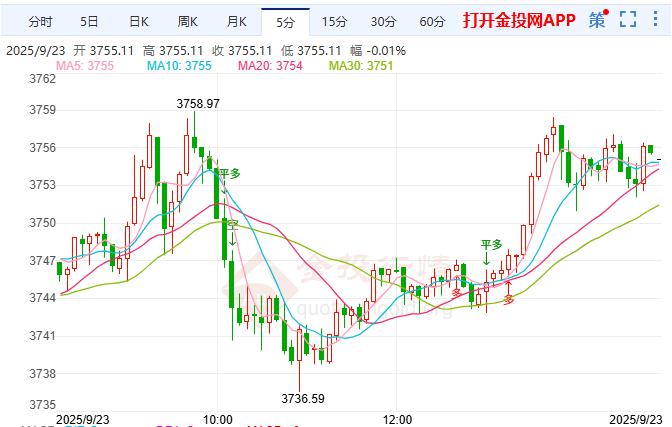
Core Viewpoint - The recent surge in gold prices, reaching a historic high of $3,759 per ounce, is primarily driven by the Federal Reserve's dovish policy stance and expectations of further monetary easing [1][3]. Group 1: Federal Reserve Influence - The Federal Reserve's recent decision to cut interest rates for the first time since December has reinforced market expectations for continued monetary easing [1][3]. - Fed Chairman Jerome Powell's comments regarding rate cuts as a "risk management" decision have further supported the outlook for future monetary loosening, putting pressure on the dollar [3][4]. Group 2: Geopolitical Factors - Rising geopolitical tensions, particularly between Ukraine and Russia, as well as ongoing conflicts in the Middle East, have heightened risk aversion among investors, driving them towards gold as a safe-haven asset [3][4]. - Analysts believe that the combination of the Fed's policies and geopolitical conflicts provides a solid rationale for gold's price increase [3]. Group 3: Market Sentiment and Technical Analysis - Market sentiment remains bullish, with traders speculating that U.S. short-term interest rates could fall below 3% by the end of 2026, enhancing gold's investment appeal [3]. - Technically, gold prices have broken through the $3,700 level, with short-term support at $3,725 and potential resistance at the recent high of $3,759 [5].
总裁选预测:小泉赢日元升、高市赢股价涨
日经中文网· 2025-09-23 02:58
Core Viewpoint - The Japanese Liberal Democratic Party (LDP) presidential election is drawing significant attention from financial and capital markets, with varying predictions on market impacts depending on the candidates' economic policies [2][4][5]. Group 1: Candidate Analysis - Among the candidates, Takashi Kawai is noted for his strong fiscal expansion and monetary easing stance, with predictions suggesting that if he wins, the Nikkei average could rise to around 48,000 points by year-end [2][5]. - Shunichi Suzuki, representing a continuation of the current government's fiscal tightening policies, is perceived as lacking the ability to drive overall market growth, leading to expectations of a slight market adjustment if he wins [4][7]. - Yoshihide Suga's policies are expected to maintain the status quo, with limited impact on market fluctuations if he is elected [7][8]. Group 2: Market Reactions - The market has reacted positively to the prospect of Kawai's victory, with short-term foreign capital inflows boosting related stocks, indicating a strong correlation between candidate selection and market performance [5][8]. - In the foreign exchange market, there is a consensus that Kawai's election would not hinder the Bank of Japan from raising interest rates, with expectations for the yen to appreciate towards 145 yen per dollar [4][7]. - Conversely, if Suzuki wins, the yen may depreciate by approximately 2 yen against the dollar, reflecting concerns over fiscal policy direction [7]. Group 3: Economic Policy Implications - Kawai's economic policies emphasize growth through advanced technologies and tax revenue increases, while also showing signs of pragmatic adjustments, such as reconsidering previous tax reduction proposals [7][8]. - Concerns about fiscal deterioration are prevalent, with predictions that the 30-year government bond yield could drop to around 3% from its current level of approximately 3.2% [4][7]. - The upcoming election is expected to be more dynamic than in 2024, with a smaller candidate pool allowing for more in-depth discussions, potentially exposing weaknesses in candidates like Suzuki [8].