
新消费

Search documents
景顺长城张欢:2026年新消费投资 更需要在理性中寻找结构机会
Xin Lang Cai Jing· 2025-12-26 08:17
Core Insights - The new consumption sector in 2025 has transitioned from "extreme enthusiasm" to "intense divergence," with pricing gradually returning to rationality [1][5] - Despite market fluctuations, demand for new consumption remains strong, leading to an optimistic outlook for the future [1][5] Group 1: Market Dynamics - The new consumption market has experienced a "roller coaster" of emotions and pricing, shifting from extreme enthusiasm for innovative models to significant divergence, resulting in substantial valuation fluctuations [2][7] - The market is now reassessing the quality and quantity of growth, focusing on management capabilities and potential changes in competitive dynamics due to significant capital influx [2][7] - The consumption market exhibits a clear "K-shaped recovery," where high-net-worth individuals drive high-end consumption recovery, while middle and low-income groups face slower recovery due to employment and income expectations [2][7] Group 2: Investment Opportunities - 2025 is characterized as a year of full pricing for innovation in the new consumption sector, emphasizing the importance of supply-demand "innovation" [3][8] - Companies that can proactively innovate and adapt to changes will gain a competitive edge, particularly those enhancing consumer experiences through supply chain empowerment and emotional value satisfaction [3][8] Group 3: Future Outlook - Looking ahead to 2026, attention should be paid to the "aftereffects" of high prosperity, as an increase in IPOs and active financing and mergers may lead to supply excess and intensified competition [4][9] - Three key areas to watch include: 1. Platform companies capable of navigating cycles, as single-brand models often face limitations [4][9] 2. Early participants in emerging trends, such as health-related products, which are expected to grow rapidly due to rising health awareness and social media-driven consumption [4][9] 3. Companies successfully expanding overseas, where manufacturing often scales more easily than branding, particularly in functional products [4][9] - The new consumption sector must continue to evolve, balancing innovation with an understanding of competitive dynamics and corporate capabilities [4][9]
100个死掉的品牌,背后站着同一个“老登味”的老板
新消费智库· 2025-12-25 16:00
Core Viewpoint - The article discusses the phenomenon of brand aging and the challenges faced by once-successful brands, emphasizing that the decline is often gradual and rooted in the founders' inability to adapt to changing market dynamics [2][24]. Group 1: Brand Aging and Challenges - Many once-prominent brands have rapidly fallen from grace, with founders transitioning from successful leaders to struggling individuals [2]. - The concept of "brand aging" is likened to a person aging, where superficial changes do not address the underlying issues [5]. - Founders often create a "comfort zone" that limits their exposure to diverse opinions and market realities, leading to poor decision-making [8][26]. Group 2: Entrepreneurial Mindset Shift - Entrepreneurs initially operate like "pirates," seizing opportunities and adapting quickly, but as they establish their businesses, they become more defensive and resistant to change [9]. - The shift from a growth-oriented mindset to a defensive one can hinder innovation and responsiveness to market trends [9]. Group 3: Understanding Market Realities - The reliance on curated data and reports creates a "second-hand reality," which can obscure true market sentiments and consumer feedback [10]. - Engaging directly with consumers and understanding their frustrations is crucial for maintaining relevance [10]. Group 4: Breaking Out of Comfort Zones - To rejuvenate their perspectives, founders should actively seek discomfort by engaging with unfamiliar concepts and diverse viewpoints [14]. - Encouraging open dialogue within teams and valuing honest feedback can help leaders avoid the pitfalls of complacency [15][16]. Group 5: Authenticity and Brand Values - Authenticity in brand messaging is essential; actions must align with stated values to build trust with consumers [18]. - Acknowledging weaknesses and failures can resonate more with consumers than projecting a perfect image [20][21]. - Brands should focus on translating their messages into relatable narratives for consumers, rather than attempting to educate them [22].


关照“心”需求,“陪伴经济”带火新增长
Sou Hu Cai Jing· 2025-12-25 03:11
Core Insights - The concept of "resilience" is highlighted as a key term for understanding China's economy in 2025, showcasing strong domestic demand through new consumption phenomena [1] - The "accompanying economy" is emerging as a new form of the gig economy, responding to societal changes and individual needs, with significant contributions to economic growth [2][3] Economic Growth Projections - China's economy is expected to grow by around 5% in 2025, with a total economic output projected to reach approximately 140 trillion yuan [2] - The "accompanying economy" is anticipated to play a substantial role in this growth, with market size predictions exceeding 50 billion yuan by 2025 [4] Characteristics of the Accompanying Economy - The "accompanying economy" is categorized into emotional and functional companionship, addressing both immediate emotional support and specialized services [2][3] - It is a response to demographic changes, such as an aging population and increasing numbers of single-person households, creating a demand for both emotional and practical support [3] Market Dynamics and Employment - The "accompanying economy" is expected to create numerous flexible job opportunities, acting as a buffer in the employment market [4] - It promotes service specialization and opens new consumption avenues, contributing to economic resilience and growth [4] Challenges and Development Needs - The industry faces challenges such as inconsistent service quality and varying qualifications among service providers, which could undermine consumer trust [4][5] - To ensure sustainable development, it is essential to establish industry standards, enhance platform responsibilities, and protect the rights of both consumers and service providers [5]

共绘“新消费”蓝图 激活“新丰台”动能
Xin Lang Cai Jing· 2025-12-24 20:49
Group 1 - The core viewpoint of the article emphasizes that consumption has become the main engine of economic growth in Beijing's Fengtai District, with a focus on new consumption trends and the transformation of local resources to boost regional consumption [1][2] - The "Miao Bi Sheng Hua Kan Fengtai" development forum has been held for seven years, attracting over a thousand experts and representatives to discuss key issues related to Fengtai's development [1] - The forum highlighted the shift in consumer behavior from mere availability to quality, with service consumption becoming a significant growth driver [2] Group 2 - Experts noted that Fengtai has unique resources such as parks, historical culture, and ecological spaces, which can be leveraged for differentiated consumption experiences [3] - The potential to create a traditional Chinese medicine-themed wellness destination was discussed, targeting younger consumers with a focus on "Guochao" health experiences [3] - The need for improved planning to address homogenization in cultural tourism projects was emphasized, with plans for major cultural projects like the new National Natural History Museum [3] Group 3 - The importance of understanding "potential demand" to stimulate consumption and drive domestic demand was highlighted, with a focus on emotional value in consumer behavior [4] - The forum addressed practical issues in promoting consumption upgrades, including the need to resolve systemic and environmental challenges [6] - Legal issues arising from new consumption forms, such as online disputes and prepaid consumption rights, were discussed, with courts working to clarify legal standards [6]
史杰君:“浮躁”二十年,我才读懂制造业的“土” | 我们的四分之一世纪
Jing Ji Guan Cha Wang· 2025-12-24 09:50
Core Insights - The article reflects on the journey of a veteran in China's manufacturing industry, highlighting the theme of "restlessness" over the past 20 years and the realization that sustainable success requires a focus on core values and long-term strategies rather than short-term gains [1][5]. Group 1: Industry Evolution - The manufacturing sector in China has experienced rapid growth since the country's entry into the WTO in 2001, with many entrepreneurs benefiting from the "opportunity grabber era" [2][10]. - The shift from a focus on quick profits to a more sustainable approach is emphasized, as the industry faces challenges in maintaining long-term viability [17][18]. Group 2: Company Transformation - The company, ICECO, founded in 2005, initially focused on OEM production for international brands and has since evolved into a leading brand in the automotive refrigerator market [8][13]. - After facing significant setbacks during the 2008 financial crisis, the company underwent a transformation to become a front-mounted manufacturer, securing contracts with major automotive brands [11][12]. Group 3: Marketing and Strategy - In 2018, the company invested over 200 million yuan in advertising, despite having only 300 million yuan in total revenue, reflecting a period of misguided marketing strategies driven by market trends [2][12]. - The realization that genuine value creation and customer focus are essential for long-term success led to a strategic pivot back to core manufacturing principles [17][18]. Group 4: Future Outlook - The article suggests that the future of China's manufacturing industry lies in a return to fundamental values, emphasizing quality, customer engagement, and innovation [17][18]. - The narrative concludes with a call for introspection among entrepreneurs to understand their origins and navigate future challenges effectively [18].

新经济“三剑客”告别估值狂热
Bei Jing Shang Bao· 2025-12-23 16:03
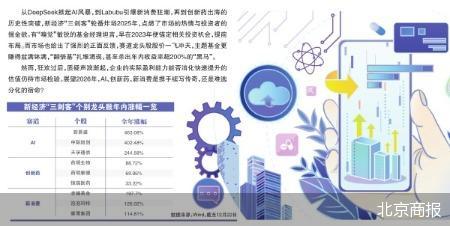
Core Insights - The new economy's "three swordsmen"—AI, innovative pharmaceuticals, and new consumption—have ignited market enthusiasm and investor interest, with significant stock price increases and high returns for thematic funds in 2025 [1][3][5] - Despite the initial euphoria, concerns are rising regarding the actual profitability of companies and their ability to sustain rapidly increasing valuations, leading to questions about the future of these sectors in 2026 [1][11] AI Sector - Fund managers like Li Jin recognized the potential of AI early, focusing on the sector as user growth for platforms like ChatGPT surged [3] - Companies such as DeepSeek have driven significant market changes, with leading stocks like Xin Yisheng and Zhongji Xuchuang seeing increases of 463.08% and 402.48% respectively by December 22 [3][5] - The AI sector is expected to transition from extreme market conditions in 2025 to a more balanced market in 2026, with ongoing advancements in technology and infrastructure [15][16] Innovative Pharmaceuticals - The Chinese innovative pharmaceutical sector has gained international attention due to its efficiency and cost-effectiveness, with companies like WuXi Biologics and Hengrui Medicine reporting annual increases of 88.72% and 33.22% respectively [5][6] - The sector is anticipated to maintain strong performance in 2026, although the selection of investment targets will become more challenging [15][16] - Fund managers emphasize the importance of innovation and the potential for long-term growth in the pharmaceutical industry, despite some companies still not being profitable [14][16] New Consumption - The new consumption sector has seen significant stock price increases, with companies like Pop Mart and Mijia Group experiencing annual gains of 197.7% and 114.81% respectively [6][11] - However, the sector has faced challenges, with some leading companies experiencing declines in stock prices in the latter half of the year, raising concerns about potential overvaluation and sustainability [11][13] - The investment sentiment in new consumption is shifting from short-term narratives to a focus on sustainable business models and profitability, with trends towards health, practicality, and emotional consumption expected to shape the market [16] Fund Performance - A total of 137 funds achieved over 100% returns in 2025, with the top-performing fund, Yongying Technology, reporting returns of 231.72% [7][9] - Funds that focused on AI, innovative pharmaceuticals, and new consumption have generally outperformed, with notable returns from funds managed by Chen Peng and Li Jin [9][10] - The performance of funds is closely tied to their investment strategies, with a focus on sectors showing high growth potential and market trends [8][10] Market Outlook - The market is expected to face a period of adjustment as valuations return to more reasonable levels, with performance metrics becoming the primary focus for investors [15][16] - The future of the "three swordsmen" will depend on their ability to deliver consistent performance and navigate the evolving market landscape, with a potential for divergence among the sectors [15][16]
情绪为尺,消费有度:2025新消费年度十幕大戏
Mei Ri Jing Ji Xin Wen· 2025-12-23 14:57
每经记者|孙宇婷 李雨冰 每经编辑|陈旭 消费市场,亦是情绪市场。每一个头条背后,都涌动 着复杂的大众情绪。这些情绪在消费者、品牌与资本之间 奔涌交织,共同谱写出十幕跌宕起伏的年度大戏。让我们 拉开帷幕,回到那些定义情绪、也定义市场的关键现场。 每经记者 | 孙宇婷 实习记者 | 李雨冰 | 娃哈哈宗氏财产纠纷 港股新消费"三姐妹" 信号 多品牌充电宝集中召回 4 4 影响 苏超赛事火爆 赞助商暴增 百亿外卖补贴大战 罗永浩掀西贝"预制菜"风波 3 5 % | 渡旗 智慧 3,7 8 [ 排易] 山姆会员店遭遇选品危机 中国区换帅谋变 镜头①:唏嘘 事件:娃哈哈宗氏财产纠纷 新闻:2025年7月,娃哈哈创始人宗庆后百亿元遗产引发股权纷争,时任董事长宗馥莉遭到"宗家三兄妹"联手起诉。 8 青浦 始祖鸟雪山烟花秀 引发生态争议 博裕入主星巴克中国 红◎ 憧憬 海南封关 98 观望 情绪解读:商业帝国的传承,从万众瞩目的佳话演变为一场关于亲情、权谋与契约的公开审视。公众的情绪在惋惜与审慎间摇摆——有对过往辉煌的怀 念,也有对现实难题的无奈。 弹幕:时代的注脚,写满了唏嘘。 镜头②:狂热 事件:港股新消费"三姐妹" ...

长城基金曲少杰:Z世代撬动新消费市场 六大领域增长势头强劲
Zheng Quan Shi Bao Wang· 2025-12-23 08:12
Core Viewpoint - The Z generation is leading a new wave of consumption in China, shifting the market from mass consumption to personalized and rational consumption [1] Group 1: Market Trends - China's consumer market is transitioning towards individualistic and rational consumption patterns, driven by a large young population and a complete domestic industrial chain [1] - The emerging consumption sectors are showing strong growth momentum, particularly in six key areas: pet economy, trendy toys, ready-to-drink beverages, health consumption, smart wearables, and smart driving vehicles [1]
洞察双循环消费新格局 锚定目标兼顾内外市场
Sou Hu Cai Jing· 2025-12-23 05:18
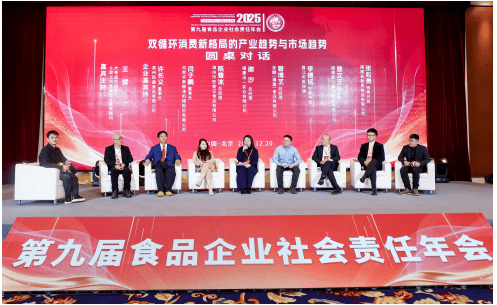
2025年中央经济工作会议将"坚持内需主导,建设强大国内市场""坚持对外开放,推动多领域合作共 赢"确定为2026年经济工作的重点任务。在双循环格局下,食品企业如何洞察新趋势、拥抱新消费,实 现高质量发展?在日前举办的第九届食品企业社会责任年会上,来自国内的8位食品企业代表以及地方 相关部门负责人以圆桌对话的形式,共同探讨"双循环消费新格局的产业趋势与市场趋势"。 圆桌对话现场 在布局国内市场方面,有企业代表认为需从"产品输出"转向"情感输出",从"传统售卖"向"共同创造价 值"转变,同时也要"加减法"并用。在开拓国外市场方面,有企业代表提出,出口企业应坚持科技创 新,推动产品由"中国制造"转向"中国创造",并在保证品质的前提下降低成本……一场围绕趋势洞察与 实践探索的深度交流,不仅为食品企业在双循环格局下锚定了发展目标,更凝聚起参会嘉宾共识——唯 有紧跟消费需求变化、兼顾内外市场布局,方能在高质量发展之路上行稳致远。 "国内食品市场'内卷'加剧,其本质是消费需求和消费方式的转变,而非需求萎缩,例如有的消费者愿 意驱车几十公里到大型超市消费,印证了优质产品的市场吸引力。"福建省新麦食品有限公司销售总监 张松景 ...
当前消费行业正值政策密集支持的战略机遇期,聚焦消费赛道布局机遇
Sou Hu Cai Jing· 2025-12-23 03:12
Group 1 - The consumer sector is experiencing a rebound after a period of absence, driven by policies aimed at expanding domestic demand and boosting consumption [1] - The food and beverage industry, as a core segment of essential consumption, is expected to benefit directly from the domestic demand enhancement strategy, with trends towards health, quality, and cost pressure relief [1] - Current consumer industry indicators suggest a bottoming out, with policy benefits and fundamental recovery creating a resonance that presents allocation value [1] Group 2 - The new consumption investment sentiment has shifted from enthusiasm to caution, with expectations that continued policy support in 2026 will boost consumer confidence [1] - Investment in the new consumption sector is anticipated to focus on companies with solid business models and sustainable profit patterns, moving away from short-term narratives [1] - The new consumption industry is expected to evolve towards three trends: health, new pragmatism, and emotional consumption, alongside two dimensions: intelligence and overseas consumption [1] Group 3 - Relevant ETFs include tourism ETF (562510) benefiting from holiday catalysts and ice and snow economy, food and beverage ETF (515170) focusing on undervalued sectors, and Hong Kong consumption ETF (513230) linked to e-commerce leaders and new consumption [2]