
股债跷跷板效应

Search documents
债市震幅加大 固收基金经理激辩布局时点
Zhong Guo Zheng Quan Bao· 2025-08-26 22:12
Core Viewpoint - The bond market is experiencing significant adjustments, with rising yields leading to a decline in bond prices, prompting various strategies among fixed-income fund managers to navigate the current environment [1][2][3]. Group 1: Market Dynamics - The bond market has shown a "see-saw" effect with the stock market, where bond yields have increased, leading to a notable decline in the net value of medium- and long-term pure bond funds [1][2]. - As of August 25, the Wind data indicates that the index for medium- and long-term pure bond funds has decreased by 0.17% since the beginning of August, with over 120 funds experiencing a drop of more than 0.7% [2]. - The 10-year government bond yield rose from approximately 1.65% in early July to around 1.8% by late August, reflecting the market's volatility [1][2]. Group 2: Fund Manager Strategies - Some fund managers are adopting aggressive strategies, viewing the current market conditions as a buying opportunity, with expectations that the 10-year government bond yield could return to around 1.65% by year-end [2][3]. - Other managers are taking a more cautious approach, suggesting that while some bond varieties are becoming more attractive, the timing for significant investments has not yet arrived [3]. - Fund managers are focusing on adjusting their portfolios, with some opting to reduce duration and enhance liquidity in response to market conditions [3][4]. Group 3: Future Outlook - Industry experts maintain a cautiously optimistic view on the bond market, anticipating that macroeconomic stability will persist into 2025, particularly in the fourth quarter [4]. - The expectation is that the People's Bank of China will continue to implement a loose monetary policy, which could support the bond market and lead to a gradual decline in long-term bond yields [4]. - Long-term trends suggest that the bond market will remain strong, with a likelihood of lower yield levels as the central bank engages in measures such as purchasing government bonds and adjusting reserve requirements [4].
公募基金资产净值突破35万亿元
Zheng Quan Ri Bao· 2025-08-26 16:42
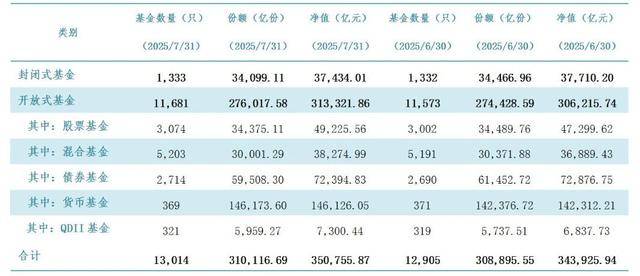
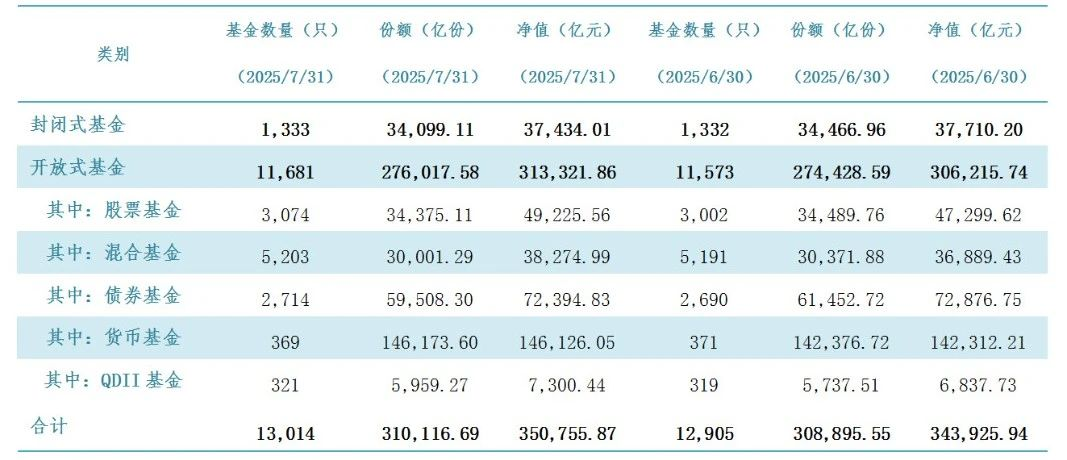
Group 1 - As of July 2025, the total net asset value of public funds in China reached 35.08 trillion yuan, marking a 2.01% increase from the end of June 2025, and setting a new historical record for the tenth consecutive month since 2024 [1] - Open-end funds are the primary driver of growth in public fund assets, with their net asset value totaling 31.33 trillion yuan as of July 2025, while closed-end funds accounted for 3.74 trillion yuan [1] - The growth in open-end funds includes increases in scale, shares, and number, with respective increases of 710.61 billion yuan, 158.90 billion shares, and 108 new funds compared to the end of June 2025 [1] Group 2 - Among various fund types, money market funds saw significant growth in July 2025, with an increase of 381.38 billion yuan in scale and 379.69 billion shares [2] - Equity funds and mixed funds also experienced notable growth, with stock funds increasing by 192.59 billion yuan and mixed funds by 138.56 billion yuan by the end of July 2025 [2] - Despite the growth in equity funds, their shares decreased, with stock funds down by 11.47 billion shares and mixed funds down by 3.71 billion shares compared to the end of June 2025 [2] Group 3 - Recent demand-side support policies in areas such as fertility, consumption, and infrastructure are expected to show positive effects in the medium to long term, with improvements in financial data indicating active policy implementation [3] - The market shows strong demand for high-return assets, driven by factors such as the ongoing "technology narrative" and the coexistence of high growth in household savings and "asset scarcity" [3]
债市拐点信号明确了吗?
Changjiang Securities· 2025-08-26 14:41
Group 1: Investment Rating - No investment rating for the report is provided [1][2][6] Group 2: Core Views - Since August, the bond market has undergone significant adjustments, especially in the long - end, with the overall bond market showing a bear - steepening trend, and the interest rate adjustment exceeding that of credit. The market is concerned about the end of the adjustment and the opportunity and scope for the subsequent recovery. The bond market adjustment inflection point requires two conditions: the full release of pessimistic expectations and the emergence of at least one widely - recognized bullish main line [2][6][15] - Currently, the pessimistic expectations in the bond market may have been basically released. Three possible bullish main lines are: the stock and bond markets moving independently, the central bank's potential interest rate cut from the third quarter to the fourth quarter, and the confirmation of the inflection point of the social financing growth rate. Among them, the first and the third scenarios are more likely, while the expectation of the central bank's interest rate cut needs further observation. The current bond market inflection point signal is clear, and the 10 - year Treasury yield may face strong resistance around 1.8%. It is recommended to seize the bond market opportunities arising from the adjustment [2][10][38] Group 3: Summary by Directory 8 - month Bond Market Adjustment - Since August, the bond market has adjusted significantly, with the long - end adjustment being more prominent. From August 1st to 22nd, the 30 - year Treasury yield rose by 13bps to 2.08%, and the 10 - year Treasury yield rose by 8bps to 1.78%, while the short - end 1 - year Treasury yield slightly declined. The adjustment of 5 - year and 10 - year secondary bonds exceeded 10bps, and the adjustment of other credit products was mostly within 5bps [15] Bond Market Pessimistic Expectations - A typical bond market adjustment process is: slow decline - sharp decline - slow decline - stabilization, corresponding to market expectations of doubt - wavering - panic selling - recovery. If public funds conduct large - scale continuous net selling and insurance allocation power significantly increases, it can be judged that the bond market has probably been fully adjusted [10][17] - During the recent bond market adjustment, from June 17th to July 22nd, the bond market declined slowly; from July 23rd to 29th, it declined sharply, with public funds selling large - scale long - term interest - rate bonds and insurance increasing positions; from July 30th to August 8th, the market recovered; from August 11th to 22nd, it adjusted again, with public funds selling long - term interest - rate bonds and insurance increasing positions. The adjustment may have basically ended [18] - The decline in the liability costs of banks and insurance companies has increased the attractiveness of the bond market to allocation investors after the adjustment. When the 10 - year Treasury yield approaches 1.80% and the 30 - year Treasury yield approaches 2.1%, the adjustment momentum weakens [19] Bullish Main Lines - The most likely main line is that the stock market ends its unilateral upward trend, or the bond market moves independently of the stock market. Recently, the bond market has gradually shown independent movements. The stock - bond seesaw effect may not last. The current PMI data indicates that the fundamentals may still be under pressure, and the central bank has maintained ample liquidity, which is conducive to the bond market's independent movement [10][25][26] - Another possible main line is the central bank's potential interest - rate cut from the third quarter to the fourth quarter. Although the Fed's interest - rate cut may open up space for domestic interest - rate cuts, considering the current deep inversion of the Sino - US interest - rate spread, the "domestic - oriented" monetary policy, and the possible "combination - punch" approach of the central bank, this main line needs further clarification [10][28][29] - The third possible main line is the confirmation of the inflection point of the social financing growth rate. Social financing growth has been declining since August and is expected to continue until the end of the year. The social financing growth rate is predicted to reach a peak of about 9.0% from July to August and then gradually decline to about 8.2% by the end of the year. Even if special refinancing bonds are issued, their impact on social financing is only temporary [10][35][38]
看股做债专题一:债市调整处于什么阶段?
China Post Securities· 2025-08-26 13:18
Report Overview - The report is a fixed - income research report released on August 26, 2025, aiming to analyze the bond market adjustment and provide investment suggestions through historical review, institutional cost assessment, and market sentiment analysis [1][10] Industry Investment Rating - No industry investment rating is provided in the report Core Viewpoints - During the equity bull market from 2014 - 2025, the performance of the bond market was not unilaterally opposed to the stock market but depended on the dynamic balance of risk preference and capital flow [3] - The current bond market correction is more like a "topping - out period" rather than a "peaking period". The upward space and time of interest rates are constrained by factors such as the return of allocation, policy soft constraints, and marginal improvement in supply and demand [4] - It is recommended to adhere to the "bottom - line thinking", focusing on the upper - bound constraint of interest rates and entry opportunities. If the risk preference is extremely priced and the 10Y - 1Y spread reaches 50 - 60BP, the corresponding 10 - year Treasury bond yield of 1.85% - 1.95% is the bottom - line range [4] Summary by Directory 1. 2014 - 2025, Review of Bond Market Trends in Previous Stock Bull Markets 1.1 2014–2015: Bull and Divergence of Stocks and Bonds Driven by Loose Pattern and Expectation Divergence - In the early stage (June - November 2014), with the promotion of reform expectations and loose signals, the stock and bond markets showed a short - term "double - bull" pattern [11] - From November to December 2014, after the central bank's interest rate cut and price mechanism reform, the stock market accelerated, while the bond market showed "profit - taking", presenting a "stock - up, bond - down" situation [11] - From December 2014 to February 2015, during the stock market consolidation period, the bond market had a repair opportunity, and the 10 - year Treasury bond yield dropped by more than 45bp [11] - From March to April 2015, with the reduction of reserve requirements and interest rates and the expansion of leveraged funds, the stock market accelerated, and the bond market showed an "N - shaped" shock [11] - From May to June 2015, with the influx of leveraged funds into the stock market, the bond market was under pressure, showing a typical "strong - stock, weak - bond" situation [11] 1.2 2016 - 2017: "First Bull, Then Bear" in the Bond Market under the Background of Supply - side Reform and De - leveraging - From June to August 2016, due to the supply - side reform and loose monetary policy, the stock and bond markets both rose [14] - From September 2016 to February 2017, the stock market continued to rise, while the bond market was under pressure due to the expectation of economic stabilization and inflation recovery, presenting a "stock - up, bond - down" situation [14] - From March to May 2017, due to domestic de - leveraging, tightened monetary policy, and external shocks, the stock and bond markets both declined [14] - From the second half of 2017 to the end of 2017, the stock market was strong, and the bond market was weak, with the 10 - year Treasury bond yield approaching 4.0% [14][16] 1.3 2019–2021: Deduction of the Stock - Bond Seesaw and Structural Bull Market - In 2019, during the GEM bull market, the stock market was strong, and the bond market was stable with a narrow - range fluctuation of the 10 - year Treasury bond yield around 3.1% - 3.2% [17] - In 2020, affected by the epidemic, the bond market first entered a bull market, and then the stock market became strong again after the economic recovery, showing a seesaw effect [19] - In 2021, with the weakening of growth momentum, the bond market returned to a bull market, and the stock market still had structural opportunities, showing a phased resonance [19] 2. In the Assumption of an Equity Bull Market, What Stage is the Current Bond Market Correction in? 2.1 In This Round of Bond Market Correction, the Interest Rates of Some Varieties are Close to the Holding - Cost Lines of Product Accounts - For wealth management products, as of the week of August 24, the 1 - year cost yield of inter - bank certificates of deposit was 3.28BP higher than the average interest rate of certificates of deposit, and the 1 - year cost yield of 0 - 1Y policy - financial bonds was 1.86BP lower than the 1 - year CDB bond yield [22] - For funds, as of the week of August 24, the 1.5 - year cost yield of 7 - 10Y policy - financial bonds was 16.14BP higher than the 10 - year CDB bond average, and the 1.5 - year cost yield of 10Y+ Treasury bonds was 23.36BP lower than the 30 - year Treasury bond yield [22] - In terms of institutional trading behavior, insurance institutions increased their net positions in ultra - long - term bonds, rural financial institutions adjusted their positions, and wealth management products shifted from the interest - rate style to the credit style [23] 2.2 Analyzing the Market's Deduction Space from Micro - sentiment Indicators - The stock - bond seesaw effect is still significant, but the upper bound of long - term yields may be gradually clear. The stock market is hot, while the bond market sentiment is controllable [30] - The stock - bond yield spread shows that the cost - performance of bond assets has increased, attracting the return of some allocation - type institutions [30] - The scale of wealth management products is under pressure, with an increase weaker than the seasonal level, but it remains relatively stable. There is no large - scale redemption of fixed - income funds [31] 2.3 Bond Market Outlook: Adjustment May Have Intervals. Pay Attention to the "Topping - out - Returning" Rhythm with Bottom - line Thinking - The current bond market correction is relatively moderate, and the upward space and time of interest rates are constrained. Wealth management products and bond funds still have safety cushions and profit margins [34] - The central bank has increased liquidity injection. If interest rates over - adjust, the probability of the central bank's intervention will increase [34] - The supply - demand relationship may improve marginally. The peak of bond issuance has passed, and the return of allocation demand will help balance supply and demand [35] - The economic growth and inflation are in a moderate range, and the bond market pricing will return to the center determined by the fundamentals and policy interest rates. It is recommended to use bottom - line thinking for long - term interest - rate bond allocation [36]
刚刚,见证历史!首破350000亿
中国基金报· 2025-08-26 13:12
Core Viewpoint - The total scale of public funds in China has surpassed 35 trillion yuan for the first time, reaching a historical high of 35.08 trillion yuan as of the end of July 2025, driven primarily by net asset value growth rather than an increase in fund shares [2][4][8]. Fund Scale and Growth - As of July 2025, the total number of public fund management institutions in China is 164, including 149 fund management companies and 15 asset management institutions with public qualifications [4]. - The overall fund scale increased by 1.99% from the end of June, while the total share of public funds saw a slight increase of 0.40% [5][12]. - The public fund market has shown a strong upward trend since April 2025, with continuous monthly records being set, including surpassing 33 trillion yuan in April, 34 trillion yuan in June, and 35 trillion yuan in July [8][6]. Fund Type Performance - In July, the share of closed-end funds decreased by 1.07%, while open-end funds saw a slight increase of 0.58% [11]. - Equity funds and mixed funds experienced a decline in shares, with equity fund shares down 0.33% and mixed fund shares down 1.22%, indicating a cautious sentiment among investors [12][13]. - Despite the decline in shares, the net asset values of equity funds increased, with equity fund scale growing by 1925.94 billion yuan (4.07%) to reach 4.92 trillion yuan, and mixed fund scale increasing by 1385.56 billion yuan (3.76%) [13]. Trends in Specific Fund Categories - The bond fund scale decreased by 481.92 billion yuan (0.66%) to 7.24 trillion yuan, while the money market fund scale increased by 3813.84 billion yuan (2.68%) to 14.61 trillion yuan [15]. - QDII funds also saw significant growth, with shares and scale increasing by 3.87% and 6.77%, respectively, reaching a total scale of 7300.44 billion yuan, marking a historical high [15].


公募总规模首破35万亿!股基、混合基份额却降了,曾经亏本的基民越涨越赎?
Sou Hu Cai Jing· 2025-08-26 12:42
智通财经8月26日讯(记者 李迪)股票市场回暖之际,公募基金总规模也再度实现突破。 7月底,我国公募基金总规模达35.08万亿元,首破35万亿元,并自2024年初以来第十次创历史新高。 分类型来看,货币基金在7月实现规模猛增3813.84亿元,QDII基金也增长超460亿。 股票基金和混合基金的规模在7月也分别增长1925.94亿、1385.56亿元,但份额却小幅下降。这意味着, 随着市场回暖和基金收益上行,一些回本或减亏的投资者正在赎回权益类产品。 值得注意的是,今年年初公募基金总规模曾短暂下行,1月底时跌破32万亿元大关。而随着经济持续复 苏和股市震荡上行,我国公募基金总规模迅速重拾升势,并且多次突破历史新高。展望未来,业内人士 预计,随着市场回暖、新型产品推出和被动投资迅速发展,我国公募基金规模有望继续稳健增长。 赎回压力导致股基、混合基份额微降 分类型来看,今年7月,股票基金和混合基金的规模分别增长1925.94亿元和1385.56亿元。 此外,其他类型基金实现规模增长时,债券基金总规模却在7月下降。这是因为,在"股债跷跷板"效应 的影响下,债券基金正面临一定的赎回压力。不过业内人士认为,债市未来仍有 ...
10年国债收益率逼近1.8%,债市“黄金坑”还是“半山腰”?
Zhong Guo Zheng Quan Bao· 2025-08-26 12:23
Group 1 - The bond market has experienced significant adjustments in August, leading to pressure on the net value of many medium- and long-term pure bond funds due to rising interest rates and fund redemptions [1][2] - Fund managers are adopting different strategies in response to the current market conditions, with some actively increasing positions, viewing current yields as a buying opportunity, while others are cautiously observing and prefer to shorten duration and enhance liquidity [1][2] - The 10-year government bond yield has fluctuated, dropping below 1.65% in early July and approaching 1.8% by late August, indicating a volatile bond market [2] Group 2 - Some fund managers believe that while the value of certain bond types is becoming more apparent, it is not yet the right time for a right-side layout, expecting short-term volatility in the bond market [3] - The outlook for the bond market remains cautiously optimistic, with expectations of a low interest rate environment and continued monetary policy support, which will help maintain liquidity in the market [3] - Strategies include gradually increasing positions in long bonds when the 10-year government bond yield exceeds 1.75%, as the foundation of the bond market remains intact despite short-term disturbances from commodities and equity markets [3]
公募总规模首破35万亿 曾经亏本的基民越涨越赎?
Feng Huang Wang· 2025-08-26 12:10
分类型来看,货币基金在7月实现规模猛增3813.84亿元,QDII基金也增长超460亿。 股票基金和混合基金的规模在7月也分别增长1925.94亿、1385.56亿元,但份额却小幅下降。这意味着,随着市场回暖和基金收益上行,一些回本或减亏 的投资者正在赎回权益类产品。 股票市场回暖之际,公募基金总规模也再度实现突破。 7月底,我国公募基金总规模达35.08万亿元,首破35万亿元,并自2024年初以来第十次创历史新高。 此外,其他类型基金实现规模增长时,债券基金总规模却在7月下降。这是因为,在"股债跷跷板"效应的影响下,债券基金 正面临一定的赎回压力。不 过业内人士认为,债市未来仍有中长期配置价值,且随着债市的配置价值愈发突出,权益行情对于债市的压制在持续减弱。 公募基金总规模首次突破35万亿元 中基协发布的最新公募基金市场数据显示,截至2025年7月底,我国境内公募基金管理机构共164家,其中基金管理公司149家,取得公募资格的资产管 理机构15家。 2024年,我国公募基金总规模分别在当年的2月底、4月底、5月底、7月底、9月底、12月底六次创下历史新高。 2025年,我国公募基金总规模在4月底达到33.1 ...
信用周报:调整后,如何抓住信用的机会?-20250826
China Post Securities· 2025-08-26 09:41
Report Industry Investment Rating - Not provided in the content Core Viewpoints of the Report - After two consecutive weeks of adjustment in the bond market since mid - August, the decline has exceeded the previous round in late July, resulting in a certain degree of cost - effectiveness. Currently, the strategy should prioritize liquidity. There are opportunities in 3 - 5 - year bank secondary capital bonds after adjustment, and it is also advisable to participate in the sinking of weak - quality urban investment bonds with a maturity of 1 - 3 years. However, the ultra - long - term strategy may not be a good choice due to high market uncertainty [3][36] Summary by Relevant Catalogs 1. Market Adjustment and Bond Performance - Since mid - August, the bond market has been continuously adjusting for two weeks, especially last week's adjustment exceeding expectations. Credit bonds declined synchronously, and the decline of major maturity varieties was higher than that of interest rates. The stock - bond "seesaw" effect continued, with the Shanghai Composite Index hitting a new high, and the bond market being insensitive to fundamental indicators, resulting in a continuous decline and rising yields [1][9] - From August 18 to 22, 2025, the yields of 1Y, 2Y, 3Y, 4Y, and 5Y treasury bonds increased by 0.4BP, 3.2BP, 9.7BP, 8.1BP, and 3.8BP respectively. The yields of AAA medium - and short - term notes with the same maturities increased by 4.9BP, 6.6BP, 5.8BP, 7.6BP, and 4.6BP respectively, and the yields of AA+ medium - and short - term notes increased by 4.9BP, 6.6BP, 7.8BP, 6.6BP, and 5.6BP respectively [9][10] - The market of ultra - long - term credit bonds weakened synchronously, with most of the declines exceeding those of the same - maturity interest - rate bonds. The decline of highly liquid ultra - long - term secondary and perpetual bonds was the lowest, while the decline of ultra - long - term urban investment bonds with the poorest liquidity was relatively large. The yields of AAA/AA+ 10Y medium - term notes increased by 6.00BP and 7.00BP respectively, and the yields of AAA/AA+ 10Y urban investment bonds increased by 13.01BP and 11.00BP respectively. The yield of AAA - 10Y bank secondary capital bonds increased by 6.69BP, while the yield of 10Y treasury bonds increased by 3.53BP [11][12] 2. Performance of Secondary and Perpetual Bonds - The market of secondary and perpetual bonds weakened synchronously, but the "volatility amplifier" feature was not obvious. The declines of 1Y - 5Y were similar to those of general credit bonds, and the decline gap in the ultra - long - term part was also close to that of ultra - long - term credit bonds. Currently, the part of the curve with a maturity of 3 years and above is still 25BP - 35BP away from the lowest yield point since 2025. Compared with the sharp decline at the end of July, the yield points of bonds with a maturity of over 3 years have reached new highs, and the adjustment amplitude is higher than that of the sharp decline at the end of July [2][16] - In terms of active trading, the sentiment was the most pessimistic in the second week of August. Although the market was still adjusting last week, the marginal sentiment of secondary and perpetual bonds improved. From August 11 to 15, the proportion of low - valuation transactions of secondary and perpetual bonds was 5.00%, 0.00%, 100.00%, 5.00%, and 0.00% respectively, and the average trading duration was 0.74 years, 1.02 years, 3.81 years, 1.53 years, and 1.12 years respectively. From August 18 to 22, the proportion of low - valuation transactions was 0.00%, 100.00%, 17.07%, 100.00%, and 100.00% respectively, and the average trading duration was 0.65 years, 4.73 years, 1.03 years, 5.66 years, and 3.30 years respectively [2][18] 3. Institutional Behavior - Public funds and other trading desks continued to sell, but it was more of a portfolio rebalancing rather than a full - scale reduction. At the same time, allocation desks such as wealth management and insurance institutions moderately bought during the adjustment. Public funds reduced their holdings of secondary bonds of national and joint - stock banks with a maturity of 3 - 5 years, with the total selling scale in the past two weeks approaching 20 billion, but they also increased their holdings of secondary capital bonds with a maturity of 1 - 3 years. Public funds were not very willing to sell their core assets such as weak - quality urban investment bonds [3][29] - Allocation desks such as bank wealth management and insurance institutions bought opportunistically after the sharp decline in the bond market, but they were also cautious about the maturity, mainly focusing on varieties with a maturity of 3 years and below. Since August, the increase in the liability side of wealth management products has been limited, and the demand is not strong, but it is not a full - scale redemption [3][29] 4. Performance of Credit Bond ETF Products - Credit bond ETF products performed poorly during the market adjustment in the past two weeks, with weak scale growth and net - value performance. In terms of scale change, the weekly scale of credit benchmark market - making ETF products has shrunk for two consecutive weeks since the market adjustment in the second week of August, and the weekly scale of science and technology innovation ETF products has been significantly weaker in August than in July. In terms of unit net - value change, the unit net values of the above two types of credit bond ETFs have suffered losses for two consecutive weeks, and the loss scale increased last week. In addition, the average turnover rate of the above two types of credit bond ETFs dropped to a new low last week [33]
博时宏观观点:近期A股加速上涨,海外降息预期升温
Xin Lang Ji Jin· 2025-08-26 08:38
Group 1: Global Market Insights - Powell's speech at the global central bank conference was overall dovish, increasing expectations for rate cuts in Q4, leading to weaker US Treasury yields and a weaker dollar, resulting in a rebound in US stocks and a significant rise in gold prices [1] - The expectation of financial conditions easing before the Fed's rate cut is temporarily beneficial for non-US markets [4][6] Group 2: Domestic Market Trends - The A-share market is experiencing a rapid upward trend with increased inflow of funds, particularly through margin trading, and a notable rise in trading volume [3] - The bond market continued its downward trend, influenced by risk appetite, despite underlying support from fundamentals and liquidity [2] - The current bond market levels present value for allocation, but short-term risk appetite fluctuations remain, suggesting a strategy of opportunistic allocation during adjustments [2] Group 3: Sector-Specific Developments - The oil market is facing weak demand projections for 2025, with ongoing supply releases putting downward pressure on oil prices, while geopolitical changes may cause short-term volatility [5] - The gold market is expected to perform well in the short term due to the anticipated easing of financial conditions before the Fed's rate cut [6]