
股债跷跷板

Search documents
五矿期货文字早评-20250820
Wu Kuang Qi Huo· 2025-08-20 02:11
Report Industry Investment Ratings - Not provided in the content Core Views - The stock market may experience intensified short - term volatility after continuous recent rises, but the overall strategy is to go long on dips. The bond market may return to a wide - range shock pattern in the short term, while the long - term interest rate trend is downward. For most commodities, prices are affected by various factors such as supply - demand fundamentals, policies, and macro - economic conditions, showing different trends and adjustment ranges [3][6]. Summary by Category Macro - financial Index - News includes a photovoltaic industry symposium, satellite internet application promotion, high trading volume in the stock market, and an "AI + manufacturing" development plan. The trading logic is that policies support the capital market, and the short - term market may be volatile, but the long - term strategy is to go long on dips [2][3]. - The basis ratios of different contracts of IF, IC, IM, and IH are provided [3]. Treasury Bonds - On Tuesday, the main contracts of TL, T, TF, and TS all rose. News includes fiscal revenue data and global hedge funds buying Chinese stocks. The central bank conducted a net injection of 4657 billion yuan. The strategy is that the interest rate may decline in the long - term, and the bond market may be in a wide - range shock pattern in the short term [4][6]. Precious Metals - Domestic precious metals prices generally declined, while international prices rose slightly. The US 10 - year Treasury yield and the US dollar index are reported. The short - term pressure on precious metals prices is due to the progress of Russia - Ukraine negotiations and the resilience of US economic data. Wait for Powell's speech to decide on silver long positions [7][8]. Non - ferrous Metals Copper - Copper prices may consolidate due to concerns about US tariffs and cooling "anti - involution" sentiment. The supply of copper raw materials is tight, and the overall price may wait for macro - economic drivers. The operating ranges of Shanghai copper and LME copper are provided [10]. Aluminum - Aluminum prices oscillated and adjusted due to the expansion of US aluminum tariffs and cooling "anti - involution" sentiment. The domestic aluminum ingot inventory is low, but the downstream consumption is weak. The short - term price may be in an oscillatory adjustment [11]. Zinc - Zinc prices have a large downward risk. The domestic zinc market is in an oversupply situation, and the LME market's structural disturbance is receding [12]. Lead - Lead prices are expected to be weak. The industry has a situation of weak supply and demand, and the social inventory of lead ingots is rising [13]. Nickel - Nickel prices may have a callback pressure in the short term, but there is support in the long term. If the price drops significantly, long positions can be established [14]. Tin - Tin prices are expected to oscillate. The supply is tight in the short term, and the demand is weak in the off - season [15][16]. Carbonate Lithium - The price of carbonate lithium has adjusted. The supply and demand pattern improvement depends on the reduction of the ore end. Speculative funds are advised to wait and see, and holders can choose opportunities to enter the market [17]. Alumina - Alumina prices may be shorted on rallies. The supply of ore is disturbed, but the over - capacity pattern remains [18]. Stainless Steel - Stainless steel prices are expected to oscillate. The market is weak, and the downstream procurement is cautious [19]. Casting Aluminum Alloy - Casting aluminum alloy prices face upward resistance. The downstream is in the off - season, and the supply and demand are both weak [20]. Black Building Materials Steel - Steel prices may decline if demand cannot be repaired. The demand for rebar has decreased, and the demand for hot - rolled coils has increased. The inventory of both is rising, and the demand is insufficient [22][23]. Iron Ore - Iron ore prices may adjust slightly. The supply is increasing, the demand is slightly weak, and the inventory is rising [24][25]. Glass and Soda Ash - Glass prices are expected to oscillate. The inventory is increasing, and the demand is not significantly improved. Soda ash prices are also expected to oscillate, with the price center expected to rise in the long - term, but the upward space is limited [26][27]. Manganese Silicon and Ferrosilicon - The prices of manganese silicon and ferrosilicon have declined. Investment positions are advised to wait and see, and hedging positions can be considered. The "anti - involution" policy has an impact on the market, and the final price will return to the fundamentals [28][29]. Industrial Silicon and Polysilicon - Industrial silicon prices are expected to oscillate weakly. The over - capacity and high inventory problems remain. Polysilicon prices are expected to oscillate widely, and the follow - up impact of warehouse receipts needs attention [31][33]. Energy and Chemicals Rubber - Rubber prices are expected to oscillate weakly. It is advisable to wait and see. The long and short sides have different views on rubber prices, and the industry's tire production and inventory data are provided [35][36]. Crude Oil - Crude oil has the potential to rise, but the upward space is limited in the short term. The target price of WTI is set at $70.4 per barrel, and short - term long positions can be taken on dips [39][40]. Methanol - Methanol prices are advised to wait and see. The supply pressure is large, and the demand is expected to improve in the peak season [41]. Urea - Urea prices can be considered for long positions on dips. The supply is loose, the demand is average, and the price may break through the oscillatory range with positive news [42]. Styrene - Styrene prices may rise with the cost. The cost support exists, the inventory is decreasing, and the demand is improving [43]. PVC - PVC prices are advised to wait and see. The supply is strong, the demand is weak, and the valuation is high [46]. Ethylene Glycol - Ethylene glycol prices may decline in the short term. The supply and demand situation is changing, and the inventory may accumulate [47]. PTA - PTA prices can be considered for long positions on dips with PX. The supply may accumulate, and the demand needs improvement [48]. p - Xylene - p - Xylene prices can be considered for long positions on dips with crude oil. The load is high, the inventory may decrease, and the valuation has support [49][50]. Polyethylene PE - Polyethylene prices are affected by cost and supply. The short - term contradiction has shifted, and short positions can be held [51]. Polypropylene PP - Polypropylene prices are expected to oscillate strongly with crude oil. The supply and demand are both weak in the off - season [52]. Agricultural Products Hogs - Hog prices may be in an oscillatory range. The short - term can focus on low - buying, the medium - term should pay attention to the upper pressure, and the far - month can use the reverse spread strategy [53]. Eggs - Egg prices may be stable or decline. The supply is large, and the short - term may fluctuate, while the medium - term can consider short positions after the price rebounds [54]. Soybean and Rapeseed Meal - Soybean meal prices follow the cost to oscillate. The import cost has a stable and slightly rising trend. Long positions can be tried on dips in the cost range [55][56]. Oils - Oil prices are expected to oscillate strongly. The fundamentals support the price center, but the upward space is limited [57][59]. Sugar - Sugar prices are likely to decline. The international and domestic supply is increasing, and the valuation is high [60]. Cotton - Cotton prices may oscillate at a high level. The USDA report is positive, but the downstream consumption is average [61].
A股“虹吸”效应加剧,债市一度大跌后压力仍不小
第一财经· 2025-08-19 23:58
Core Viewpoint - The A-share market has seen a surge in bullish sentiment, with the Shanghai Composite Index breaking through 3700 points, driven by increased market activity and significant capital inflows from foreign investors [3][7][12]. Group 1: Market Performance - On August 18, the Shanghai Composite Index closed at 3727.29 points, marking a significant increase in trading volume, with a total turnover of 2.75 trillion yuan, the third highest in history [3][7]. - The 10-year government bond yield rose by 3 basis points to 1.775%, while the 30-year yield reached approximately 2.1%, indicating a shift in market dynamics [3][5]. - High-frequency trading data showed that A-shares were the most net-bought market by foreign investors on August 18, with inflows nearly six times the average of the previous four weeks [7][12]. Group 2: Bond Market Dynamics - The bond market faced significant pressure, with the 30-year government bond ETF dropping over 1% on August 18, reflecting a tightening liquidity environment [5][10]. - The People's Bank of China (PBOC) conducted a substantial net injection of over 460 billion yuan on August 19, indicating a clear intention to support liquidity [5][10]. - Analysts noted that the current economic fundamentals do not justify the poor performance of the bond market, especially following the release of July's economic data, which showed signs of slowdown [16][17]. Group 3: Investment Trends - There is a notable shift of funds from the bond market to the A-share market, driven by low deposit rates and bond yields, making the opportunity cost of investing in stocks lower [12][14]. - The insurance sector is expected to increase its investments in equity assets, with estimates suggesting a net inflow of 1 trillion yuan into equity markets by 2025 [14]. - Recent data indicates that public and private equity funds have seen a significant increase in new issuance, suggesting a positive feedback loop as stock market performance improves [13][14].


股债跷跷板”效应显现 后续债市将“脱敏
Mei Ri Shang Bao· 2025-08-19 22:23
在分析人士看来,除了极其强势的股市表现外,资金变化、机构赎回等均为利率上行提供了推力。恰逢 税期走款时点,尽管8月并非常规大税期,但缴税走款带来的资金抽水现象仍为银行间流动性带来了一 定挑战。 商报讯(记者苗露)8月18日,A股市场迎来历史性时刻,上证指数盘中一度涨至3745.94点,创下2015年8 月以来近十年的高点。A股市值总和历史上首次突破100万亿元大关。而在"股债跷跷板"效应之下,债 券市场加速下跌。分析人士预计,债市短期仍将偏弱运行,但长期来看,债市对于股市涨跌或渐"脱 敏",更多回归基本面。 展望后续,债市怎么走?股市对债市的扰动还将持续多久?分析人士持乐观态度偏多。光大证券固收研 究分析师张旭认为,自2016年以来,10年期国债收益率与沪深300指数之间既有同向运行的时候,也有 不少逆向而驶的阶段。从中长期看,债市和股市的定价必然会回归基本面,而且债市对经济运行状况及 货币政策更为敏感。即便未来股市能长期持续涨上去,债券收益率也很难一直跟随其上涨,这将体现为 债市对于股市涨跌的"脱敏"。 8月19日,银行间主要利率债收益率盘初延续上行。日中,债市有所回暖。国债期货收盘全线上涨,30 年期主力 ...
债市“跌麻了”!基金经理直言“压力大”
中国基金报· 2025-08-19 16:12
Core Viewpoint - The bond market is experiencing significant adjustments, with fund managers expressing concerns about pressure and actively shortening duration and adjusting structures to cope with future steepening of the yield curve [1][2][4]. Group 1: Market Conditions - The bond market faced a severe downturn on August 18, with 10-year and 30-year government bond yields rising by 5 basis points and 6 basis points respectively, closing at 1.79% and 2.06% [1]. - Despite a brief recovery earlier in August, the bond market has been under pressure again due to increased market risk appetite, with the 10-year government bond yield surpassing the high point from July [1][4]. Group 2: Fund Manager Insights - Fund managers are facing redemption pressures, particularly in bond funds, but they believe that the bond market does not have a foundation for a long-term decline, as the 10-year government bond yield of 1.8% reflects current expectations [2][9]. - The performance of pure bond funds has been poor, with average returns for medium to long-term pure bond funds at -0.19% and short bond funds at -0.03% [7]. Group 3: Factors Influencing the Bond Market - The bond market's adjustment is driven more by expectations rather than changes in the funding environment, with a potential shift from deflation to a mild inflation scenario impacting long-term bonds negatively [4][5]. - There is a notable lack of configuration funds from small and medium-sized banks, with a significant decrease in bond investment balances reported [4]. Group 4: Future Outlook and Strategies - Fund managers are adjusting their strategies to focus on shorter durations and are maintaining a neutral to high duration stance while reducing exposure to long-term rates [9]. - The overall sentiment is that while the bond market may not see significant positive catalysts in the short term, it remains within a range of support and resistance, with a cautious approach recommended [9]. Group 5: Recommendations for Investors - Fund managers suggest that credit bond funds may yield over 2% in the coming year, and investors should consider gradually increasing their exposure to these funds [11]. - For individual investors, maintaining a long-term perspective and potentially increasing allocations during market adjustments is advised, while also considering a balanced portfolio with some equity exposure [11].

债市短期偏弱运行 中期或回归基本面与资金面
Xin Hua Cai Jing· 2025-08-19 15:20
Core Viewpoint - The bond market is experiencing a weak and volatile pattern influenced by high stock market sentiment and the "stock-bond seesaw" effect, with industry experts suggesting that the mid-term logic of a "slow bull" in the bond market remains intact despite recent economic data being weak [1][2][3] Market Sentiment - On August 18, the A-share market reached a historic moment with the Shanghai Composite Index hitting a nearly 10-year high, and the total market capitalization of A-shares surpassing 100 trillion yuan for the first time [2] - The bond market saw accelerated declines on the same day, with major interbank bond yields rising significantly, such as the 30-year government bond yield increasing by 5.5 basis points to 2.049% [2] - On August 19, the A-share market experienced a slight pullback, while bond yields showed mixed trends, with some long-term bonds declining slightly [2] Bond Market Outlook - Analysts predict two potential scenarios for future bond market interest rates: either a weak oscillation at high levels or a rapid rise followed by a quick drop [3] - The current economic data indicates a "weak demand + low inflation" scenario, suggesting that the risk of a significant trend reversal in the bond market is manageable [3][4] Support Factors for the Bond Market - Despite the "stock-bond seesaw" effect, the bond market is still supported by fundamental and monetary conditions that have not reversed, indicating an adjustment rather than a reversal [4] - As of August 15, bank wealth management products still provide a safety cushion, allowing for a potential upward shift in the yield curve [4] - Analysts highlight two main support factors for the bond market: continued liquidity and rigid demand for bonds [4][5] Investment Strategy - The bond market requires a flexible approach, focusing on changes in risk appetite for equities and commodities, as well as the impact of fiscal policies on private sector financing [6] - Institutions maintain a cautious stance, suggesting that the bond market may continue to experience weak sentiment due to a lack of positive drivers and potential government bond supply increases [6] - Recommendations include maintaining a slightly lower duration in investment portfolios and considering short-term trading opportunities in long-term government bonds if interest rates peak [6]
现在市场走到哪个阶段?
2025-08-19 14:44
Summary of Key Points from Conference Call Records Industry Overview - The current market is characterized by a seasonal pattern in the bond market, with a higher probability of interest rate declines from December to early February, followed by potential adjustments in late January or mid-February to March or late April [1][3][4] - The bond market is not in a bear market but is in a mid-bull market position, influenced by weak fundamentals and ample liquidity, despite increased volatility due to static yield insufficiency and dynamic duration issues [1][5][6] Economic Conditions - Domestic fundamentals have weakened, with retail sales and real estate investment data declining, while industrial production remains resilient, with July's industrial value-added growing by 5.7% year-on-year [1][10] - The GDP growth rate is approximately 4.9%, indicating economic pressure and the need for future policy adjustments [1][10] - Manufacturing investment has significantly declined due to tariffs and anti-involution policies, leading companies to focus more on cash flow and overseas production [1][12] Market Dynamics - The equity market has performed strongly since July, while the bond market has shown relative weakness, indicating a complex relationship rather than a simple "stock-bond seesaw" phenomenon [2][7] - The macroeconomic situation in 2025 resembles a combination of 2019 and 2020, with low coupon rates posing significant challenges [6][9] Policy Implications - The central bank's focus has shifted from total credit volume to maintaining the health and safety of the banking system, making interest rate cuts more challenging [16] - There is an expectation of increased fiscal or quasi-fiscal policy measures around late October, particularly in response to rising economic pressures [15][20] Investment Strategies - Investors are advised to focus on cyclical sectors such as non-bank financials, metals, and coal, while also monitoring the domestic capital expenditure (CAPEX) trends in the third quarter [19] - Caution is advised in sectors with poor performance and no signs of recovery, with a preference for sectors showing positive momentum [19] Consumer Market Trends - The consumer market is experiencing a slowdown in retail sales growth, particularly in durable goods, while service consumption remains resilient, with a 5.8% year-on-year growth in the service production index for July [10][14] - The shift in policy focus from goods to services is evident, as the government aims to support service consumption amid declining goods sales [13][14] Future Outlook - The bond market is expected to maintain interest rates below 2%, with significant resistance anticipated at the 1.5% level based on historical trends from the U.S. and Japan [28][29] - The current macroeconomic environment suggests that while there may be fluctuations, a significant downturn in the bond market is not expected [28][29] Conclusion - The overall sentiment in the market remains cautious yet optimistic, with a focus on structural policies aimed at enhancing domestic demand and addressing demographic challenges [20][25]
酷暑天债市遇冷“债牛”行情要降温?
Mei Ri Jing Ji Xin Wen· 2025-08-19 13:49
Core Viewpoint - The bond market is experiencing a downturn despite a bullish stock market, leading to questions about future trends in the bond market [1][4]. Group 1: Market Performance - On August 18, the Shanghai Composite Index rose above 3700 points, while bond yields increased, indicating a decline in bond prices [1]. - The 10-year government bond yield rose approximately 2.5 basis points to near 1.80%, and the 30-year bond yield surpassed 2.0%, increasing over 4 basis points [1]. Group 2: Factors Influencing Bond Market - The low coupon rates of bonds have diminished their attractiveness, especially after a rapid decline in interest rates earlier this year [2]. - Analysts suggest that the bond market's weakness is due to multiple factors, including increased risk appetite from a rising stock market and positive economic expectations [2]. - The crowded trading environment and lack of new capital inflows into bonds have contributed to the current market dynamics [2][3]. Group 3: Institutional Perspectives - Insurance companies are seeking higher returns, leading to a shift in investment towards equities and long-term equity investments, as bond yields have not kept pace with their return requirements [3]. - The configuration of funds from banks and insurance companies has not seen significant increases, limiting the capital available for bond investments [3]. Group 4: Future Outlook - The consensus on a "long bull market" for bonds appears to be weakening, with analysts suggesting that the bond market may not recover in the near term [4][5]. - Current market sentiment is more sensitive to negative factors, indicating a shift in focus from fundamental data to asset allocation strategies [5][6].
A股“虹吸”效应加剧,债市一度大跌后压力仍不小
Di Yi Cai Jing· 2025-08-19 13:15
Core Viewpoint - The bond market is currently facing pressure due to the strong performance of the A-share market, leading to a diversion of funds from bonds to stocks, which is expected to continue in the short term [1][9]. Group 1: Market Performance - On August 18, the Shanghai Composite Index broke through 3700 points, closing at 3727.29 points on August 19, with a slight decline of 0.02% [1]. - The trading volume in the A-share market reached 2.75 trillion yuan, marking the third-highest in history [6]. - Foreign institutional investors showed significant interest in A-shares, with net buying exceeding two times the average for the past four weeks [6]. Group 2: Bond Market Dynamics - The 30-year government bond ETF fell over 1% on August 18, with yields surpassing 2.1% [3]. - Goldman Sachs predicts that the 30-year bond yield could rise to between 2.2% and 2.3% due to the speculative nature of current bondholders [1][9]. - The bond market is experiencing redemption pressure, with significant trading stress reported on August 18 [1][9]. Group 3: Economic Indicators - Recent economic data indicates a slowdown, with fixed asset investment growth dropping to 1.6% from 2.8% [12]. - The real estate sector is showing negative growth in sales, new starts, and investment, contributing to the overall economic slowdown [12]. - Despite the economic challenges, the central bank maintains a stance of moderate liquidity, focusing on structural economic optimization rather than total policy adjustments [12]. Group 4: Investment Trends - There is a notable shift of funds from bonds to equities, driven by low deposit rates and bond yields, making the opportunity cost of investing in stocks lower [9]. - The insurance sector is increasingly entering the equity market, with significant inflows expected in the coming years [10][11]. - Public and private equity funds are seeing new issuance levels higher than last year's average, indicating a potential positive cycle in the equity market [10].

【笔记20250819— 房价新低,物价便宜,股市新高】
债券笔记· 2025-08-19 13:04
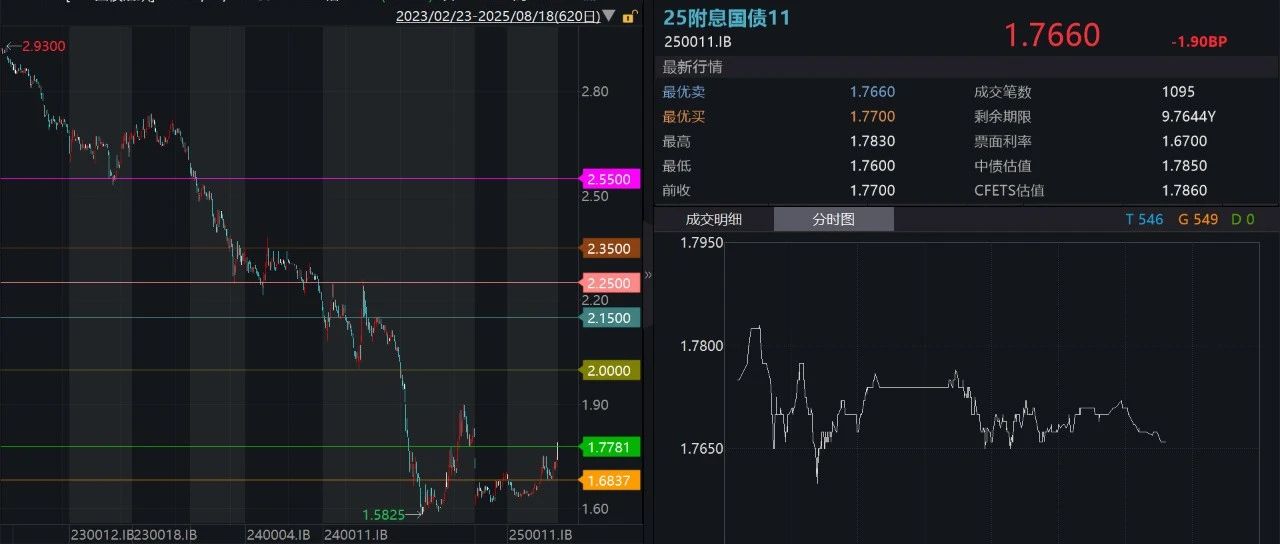
Core Viewpoint - The article discusses the current financial landscape, highlighting a tight funding environment, a slight decline in long-term bond yields, and the impact of central bank actions on the stock and bond markets [2][4]. Group 1: Monetary Policy and Market Reactions - The central bank conducted a net injection of 3,457 billion yuan through reverse repos, with a total of 5,803 billion yuan in 7-day reverse repos initiated [2][4]. - The funding rates showed an upward trend due to a tight funding environment, with DR001 around 1.47% and DR007 at approximately 1.55% [2][4]. - The stock market experienced slight declines amidst these monetary policy adjustments, reflecting a "stock-bond seesaw" effect [4]. Group 2: Economic Indicators - The youth unemployment rate reached 17.8% in July, the highest in 11 months, compared to 14.5% in June, indicating growing economic challenges for younger demographics [4]. - The article notes that while housing prices are at new lows and consumer prices are low, the stock market is at new highs, suggesting a complex economic environment [4]. Group 3: Bond Market Performance - The bond market showed cautious sentiment, with the 10-year government bond yield peaking at 1.783% before retreating to around 1.766% [4]. - The article highlights a specific bond (250210) with a high borrowing concentration of 44%, making it susceptible to being "squeezed" in the market [4].
利率专题:利率的“顶”在哪?
Tianfeng Securities· 2025-08-19 10:43
1. Report Industry Investment Rating There is no information provided about the industry investment rating in the given report. 2. Core View of the Report Since July, the stock - bond "seesaw" effect has become more prominent, with the equity market rising and the bond market weakening. The current market is mainly driven by policy expectations, market sentiment, and institutional behavior, and there is a certain deviation from the fundamentals. In the short - term, the appropriate support from the central bank, the coordination of fiscal and monetary policies, and the buying behavior of allocation disks at key points may form the potential boundary for interest rate hikes. In the long - term, asset pricing will return to the fundamental logic. It is expected that 1.80% may be the temporary ceiling for the 10 - year Treasury bond interest rate, and currently, the interest rate may be in the ceiling - building stage. The interest rate does not have the risk of a trend - upward increase [2][27][47]. 3. Summary According to the Directory 3.1 From the Stock - Bond "Seesaw" - Since July, the stock - bond and commodity - bond "seesaw" effects have been significant. In early August, there was a short - term "stock - bond double - bull" situation, which then returned to the "seesaw" pattern. On August 18, the Shanghai Composite Index closed above 3700 points, and the 10 - year Treasury bond yield rose by 2.5BP to 1.77% [10]. - The reasons for the more prominent "seesaw" effect recently are: the low and stable capital interest rate restricts the bond - buying power; the domestic economy is stable with progress, and the policy has a certain tolerance for capital - market fluctuations; incremental policies boost market risk appetite, and the bond market is more sensitive to negative news [13]. - Historically, in the short - term, the stock market rise is based on policy expectations, driving asset re - allocation and changes in bond - market institutional behavior. In the long - term, both stock and bond pricing return to the fundamental logic. The two long - lasting "seesaw" periods (2016 - 2018, 2020) were accompanied by fundamental improvements, while the shorter ones (2022 end, 2024 Q3) were more about policy expectations and "strong expectations" of fundamental repair [14][17]. 3.2 Interest Rate "Has a Floor" The market generally believes that the downward space for the bond market is limited. The reasons are: the expectation of marginal improvement in the fundamentals is strong, reducing the urgency for monetary policy to strengthen, and the probability of the capital interest rate breaking through downward is low; the buying power of allocation disks has weakened compared to last year. Some rural commercial banks may have floating losses in their OCI accounts, and insurance companies may reduce bond allocation and increase equity investment [3][20]. 3.3 Where is the Temporary "Ceiling" of the Interest Rate? - **"Negative Feedback" Concerns and the Central Bank's Timely Support**: This year, the bond market has experienced several rounds of rising concerns about redemption "negative feedback". Whenever the bond interest rate reaches a temporary high or the selling power of trading disks such as funds increases, the central bank will increase its open - market operations within 1 - 4 days. For example, in mid - March and late July, the central bank increased reverse - repurchase operations to support the bond market [28]. - **Enhanced Coordination between Monetary and Fiscal Policies**: In the short - term, it is mainly reflected in coordinating with the concentrated issuance of government bonds. For example, on August 8, the central bank carried out a 7000 - billion - yuan 3 - month term repurchase operation to maintain liquidity. In the long - term, considering the balance and sustainability of fiscal interest payments and revenues, the coordination of the two policies is reasonable [36]. - **Support from the Buying Power of Allocation Disks at Key Points**: Although the strength of allocation disks has weakened this year, when the bond market rises to key points, the buying power of allocation disks such as insurance and rural commercial banks will increase, suppressing the adjustment space. It is expected that the reduction of insurance's predetermined interest rate in September may increase the bond - allocation space [43]. - **The Interest Rate May Have Reached a Temporary Ceiling**: On August 18, the bond - market adjustment intensified. The yields of 1Y, 5Y, 10Y, and 30Y Treasury bonds rose to 1.39%, 1.64%, 1.79%, and 2.11% respectively. It is expected that 1.80% may be the temporary ceiling for the 10 - year Treasury bond interest rate. In the short - term, the entry of allocation disks and the central bank's support will limit the bond - market adjustment. In the long - term, due to the structural repair pressure on the fundamentals, the interest rate does not have the risk of a trend - upward increase [47].