口行债

Search documents
每日债市速递 | 主要利率债收益率普遍下行
Wind万得· 2026-03-29 23:09
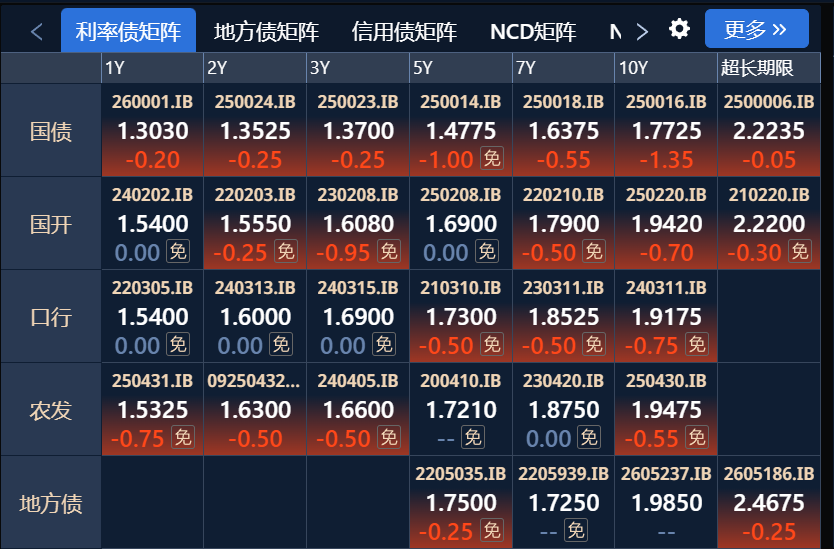
Group 1 - The central bank conducted a reverse repurchase operation of 146.2 billion yuan for 7 days at a fixed rate of 1.40%, resulting in a net injection of 125.7 billion yuan after accounting for 20.5 billion yuan maturing that day [1][3] - The interbank market remains loose, with the weighted average rate of DR001 slightly declining to around 1.31%, indicating ample liquidity [3] - The yield on major interbank bonds has decreased across the board, with the latest transaction for one-year interbank certificates of deposit at approximately 1.531% [8][10] Group 2 - The People's Bank of China emphasized the need to enhance the systemic financial risk prevention and resolution framework, focusing on technology empowerment and financial risk monitoring [14] - The Ministry of Commerce announced investigations into trade barriers imposed by the U.S. regarding global supply chains and green product trade, aiming to protect China's legitimate rights [14] - Recent bond market events include Sunshine City having overdue debt principal totaling 65.336 billion yuan, while other companies like Jinju Jidong and Hejing Group reported changes in their financial statuses [19]


民生证券债券策略周报-20260323
Guolian Minsheng Securities· 2026-03-23 05:05
Group 1 - The bond market has shown a preference for high coupon credit and mid-term rates with riding value, while the yield curve has steepened significantly due to strong short-term interest rates and weak long-term performance [7][11] - Two strategic approaches are recommended: gradually focusing on a barbell strategy and maintaining a spread compression strategy, as the short-end interest rates have limited downward space [11][39] - The current 1-year deposit rate is around 1.52%, with a potential optimistic scenario suggesting it could drop to approximately 1.5%, indicating limited room for further declines [7][11] Group 2 - The report suggests monitoring three types of spreads: the spread between government bonds and policy bank bonds, the new and old bond spreads for 30-year government bonds, and the spreads between 30-10Y and 50-30Y [11][39] - The 10-year government bond is expected to fluctuate within a range of 1.8% to 1.85% in the short term, reflecting concerns over inflation and economic growth [12][40] - The report highlights six bond selection strategies, including focusing on high-frequency trading and specific long-term and mid-term bonds [15][39] Group 3 - The bond market has experienced a recent shift with mid-term bonds performing better due to a loose funding environment and expectations of lower interbank deposit rates [18] - The current yield for 30-year government bonds is approximately 2.39%, reflecting a slight increase from the previous week [19] - The report indicates that the valuation of bonds is not high compared to other asset classes, suggesting potential investment opportunities [29][30]
等待利空钝化
HUAXI Securities· 2026-03-15 14:28
1. Report Industry Investment Rating - The document does not mention the industry investment rating [1] 2. Core Viewpoints - Inflation expectations are rising, and long - term interest rates are increasing. The bond market is facing challenges with unclear main positive factors and many negative side factors. The stability of the capital side is crucial for the bond market trend. It is advisable to wait for the long - term interest rates to rise and the negative factors to be dulled before making allocations. Currently, 3 - year treasury bonds and government - backed financial bonds, 1 - year policy - bank bonds, and 1 - year certificates of deposit can be considered as defensive options [1][2][3] 3. Summary by Directory 3.1 Inflation Expectations Rise, and Long - Term Interest Rates Increase - From March 9 - 13, inflation concerns affected bond market pricing. Long - term bond yields generally rose (e.g., 10 - year treasury bond active bond yield rose 3.2bp to 1.82%), while short - term yields showed mixed trends (1 - year treasury bond active bond yield fell 1.0bp to 1.26%). The continuous blockade of the Strait of Hormuz led to a sharp increase in oil prices, and inflation data exceeded expectations, causing concentrated release of bearish sentiment in the domestic bond market [8][10][11] - The central bank's continuous net withdrawal of funds led to a decline in the reverse repurchase balance, but the capital side remained in a self - balancing state. The interest rate curve steepened, with long - term varieties rising under the drive of inflation expectations and short - term varieties showing a downward trend. The performance of credit bonds was similar to that of interest - rate bonds [12] 3.2 Bond Market Challenges: Unclear Main Positive Factors, Many Negative Side Factors - Fundamental improvement: Recent economic data such as 1 - 2 month exports, February inflation, and financial data were stronger than market expectations. However, the Spring Festival effect was the main factor for the short - term improvement. The marginal improvement of data may weaken the market's "loose money" expectation to some extent [2][19][20] - Inflation concerns are difficult to ease: Since the fermentation of the Middle East geopolitical conflict at the end of February, the price increases of various commodities have spread. The price increases of oil, shipping, chemical products, and agricultural products have made the market always concerned about inflation shocks, which are difficult to disprove in the short term [21][23] - The instability of institutional behavior has increased: Institutions' tolerance for short - term losses has decreased significantly. Once potential risks appear, trading desks such as funds and securities firms will reduce their positions consistently, which may amplify interest rate fluctuations [26] 3.3 As the Quarter - End Approaches, the Scale of Wealth Management Products Declines 3.3.1 Weekly Scale: A Month - on - Month Decrease of 44.5 billion yuan - In the first week of March, the scale of wealth management products rebounded, but the increase was weaker than the historical average. As the quarter - end assessment approached, the scale decreased by 44.5 billion yuan to 33.45 trillion yuan from March 9 - 13. It is expected that the scale will continue to shrink seasonally in the next two weeks [34] 3.3.2 Wealth Management Risks: The Retracement of Equity - Linked Products Narrows, and the Proportion of Products with Negative Yields Decreases - The retracement of equity - linked products narrowed, driving down the proportion of products with negative yields. The overall negative yield proportion of wealth management products decreased by 3.70pct to 5.59% this week. The rolling negative yield proportion in the past three months was 0.31%, slightly rising by 0.02pct from the previous week [41] - The proportion of wealth management products breaking the net value and those with unmet performance both decreased. The overall product break - even rate decreased by 0.20pct to 0.34%, and the overall performance non - compliance rate decreased by 0.3pct to 24.8% [50] 3.4 Leverage Ratios: Both Inter - Bank and Exchange Markets Decline - From March 9 - 13, the central bank continuously withdrew funds, and the capital interest rate fluctuated slightly. The average daily trading volume of inter - bank pledged repurchase decreased, and the average overnight proportion also declined slightly [56] - The inter - bank leverage ratio decreased slightly from 107.63% to 107.44%, the exchange leverage ratio decreased from 122.22% to 121.74%, and the non - bank institution leverage ratio decreased from 113.52% to 112.79% [60] 3.5 Interest - Rate Medium - and Long - Term Bond Funds Compress Duration - From March 9 - 13, the duration of interest - rate medium - and long - term bond funds was compressed, with the weekly average duration decreasing from 3.43 years to 3.34 years. The duration of credit - type medium - and long - term bond funds increased slightly, with the weekly average duration rising from 2.05 years to 2.20 years [67][68] - The duration of medium - and short - term bond funds and short - term bond funds showed different trends. The duration of medium - and short - term bond funds decreased from 1.41 years to 1.38 years, while the duration of short - term bond funds increased from 0.71 years to 0.76 years [73] 3.6 The Issuance of Government Bonds Accelerates - From March 9 - 13, the planned issuance of government bonds was 85.72 billion yuan, significantly higher than the previous week. The actual issuance scale may reach 92.72 billion yuan. The net payment scale of government bonds from March 16 - 20 is expected to expand [75] - In terms of local bonds, the issuance plan of 77.3 billion yuan of special bonds for debt resolution in 2026 was disclosed this week. From January 1 to March 20, the cumulative net issuance of local bonds was 2.3395 trillion yuan, a year - on - year increase of 293.9 billion yuan [77][78] - In terms of treasury bonds, the planned issuance from March 16 - 20 is 51.5 billion yuan, with a net issuance of 45.5 billion yuan. From January 1 to March 20, the cumulative net issuance of treasury bonds was 931.9 billion yuan, a year - on - year decrease of 291.2 billion yuan [79] - In terms of policy - bank financial bonds, 2.7 billion yuan will be issued on March 16, with a net issuance of - 2.53 billion yuan. From January 1 to March 16, the cumulative net issuance of policy - bank financial bonds was - 530 million yuan, a year - on - year decrease of 42.65 billion yuan [80]
债市观点及组合策略推荐:债市还有什么投资机会-20260309
Guolian Minsheng Securities· 2026-03-09 03:28
Group 1 - The report indicates that short-term interest rates are continuously declining, leading to a reduced arbitrage space, with current deposit rates around 1.55% being at a historically low spread compared to DR001 [8][12][41] - It is expected that the momentum for further decline in short-term rates will gradually weaken, although there is a possibility of a reserve requirement ratio cut due to a loose monetary policy stance [12][41] - Long-term interest rates are likely to experience low volatility due to risk aversion and concerns about domestic demand recovery, with the 10-year government bond yield projected to fluctuate between 1.75% and 1.85% [12][41][42] Group 2 - The report suggests that there are still attractive trading positions in the bond market, particularly in 10-year government bonds, 30-year active government bonds, and 50-year government bonds, which are expected to perform well if there is no significant adjustment pressure in the bond market [13][42] - Six strategies for bond selection are proposed, including focusing on high-frequency trading opportunities and considering long-end government bonds with good liquidity and value [17][42] - The report emphasizes the importance of monitoring the issuance of special government bonds and central bank support, as there may be significant relative downward opportunities for ultra-long bonds [13][42] Group 3 - The bond market has seen a downward trend in yields, with short-term products performing well due to maintained liquidity and expectations of a reserve requirement ratio cut [20][38] - The report highlights that the yield curve has steepened, with the yield spread between 10-year and 1-year government bonds increasing by 4 basis points to around 50 basis points [38] - The valuation of bonds is considered not expensive compared to other asset classes, with the current bond yield relative to the stock market indicating that bonds are not overvalued [31][38]
债市节前暖意回归:收益率下破1.8%后企稳,大行成买入主力
2 1 Shi Ji Jing Ji Bao Dao· 2026-02-12 10:05
Group 1 - The bond market is experiencing a bullish trend supported by ample liquidity and institutional demand, with yields dropping below the critical 1.8% level as investors prefer bonds over other assets ahead of the holiday [1][3] - Major banks have become the primary buyers in the bond market, driven by a "deposit-loan mismatch" phenomenon, which has led to increased bond allocations since December [2][6] - The central bank's recent actions, including a net injection of 448 billion yuan into the market, have contributed to a favorable environment for bonds, with interbank liquidity remaining abundant [3][6] Group 2 - As of February 12, 2026, the yield on the 10-year government bond has decreased to around 1.77%, reflecting a broader trend of declining yields across various maturities [3][4] - A significant majority of bond funds have delivered positive returns since the beginning of 2026, with 3523 out of 3574 medium to long-term pure bond funds achieving positive returns [4][5] - The current market sentiment is optimistic, with expectations for a relatively mild bond market environment in 2026, as banks are likely to continue favoring long-term bonds due to improved cost structures and ample liquidity [7][8]
每日债市速递 | 央行14天逆回购呵护跨节流动性
Wind万得· 2026-02-08 22:43
Group 1: Open Market Operations - The central bank conducted a 315 billion yuan 7-day reverse repurchase operation at a fixed rate of 1.40%, with a total bid and winning amount of 315 billion yuan [1] - Additionally, a 3000 billion yuan 14-day reverse repurchase operation was carried out, with a total of 6000 billion yuan in 14-day reverse repos conducted over two days to support the liquidity during the Spring Festival [1] Group 2: Funding Conditions - The interbank market is experiencing a more relaxed funding environment, with the weighted average rate of DR001 dropping over 4 basis points to around 1.27% [3] - Overnight quotes in the anonymous click (X-repo) system fell to 1.25%, indicating ample supply, while non-bank institutions borrowed overnight against credit bonds at rates below 1.5% [3] - The latest overnight financing rate in the U.S. stands at 3.65% [3] Group 3: Interbank Certificates of Deposit - The latest transaction for one-year interbank certificates of deposit in the secondary market is around 1.590% [7] Group 4: Bond Market Overview - The yields on major interbank rate bonds have mostly decreased, with specific yields for various maturities showing declines, such as the 1-year government bond yield at 1.3125% and the 10-year yield at 1.8010% [10] - The data indicates a general downward trend in yields across different types of bonds, including government bonds and policy bank bonds [10] Group 5: Recent Economic Indicators - The Asian Manufacturing Purchasing Managers' Index (PMI) for January 2026 is reported at 51%, a slight decrease of 0.1 percentage points from the previous month, indicating continued expansion in the manufacturing sector [14] - The global manufacturing PMI increased by 1.5 percentage points to 51% in January [14] Group 6: Global Monetary Policy - The European Central Bank has maintained its benchmark interest rate, marking the fifth consecutive pause in rate cuts since June of the previous year, with officials closely monitoring the impact of euro appreciation on export competitiveness and inflation [16]

债券策略周报 20260202:2月债券投资策略-20260202
Guolian Minsheng Securities· 2026-02-02 08:01
Group 1 - The report highlights two key questions for the bond market in February: identifying investment opportunities and whether to hold bonds over the holiday period [12][43] - The 10-year government bond yield is currently at 1.8%, and the 1-year deposit rate is at 1.6%, indicating a low level that requires strong positive stimuli for any significant breakthroughs [12][43] - The report suggests that the bond market may remain volatile until strong positive factors emerge, with a focus on the trading value of 30-year government bonds and TL [12][43] Group 2 - From a credit bond perspective, the report recommends reducing focus on 3-year subordinated capital bonds due to limited arbitrage space of around 30 basis points [12][44] - It suggests paying attention to 1-2 year low-grade credit bonds and 3-5 year high-grade credit bonds based on demand preferences [12][44] - The report notes that since the beginning of January, the performance of the certificate bonds has been weaker than expected, primarily due to low demand for bond funds [12][44] Group 3 - The report discusses the strategy of holding bonds over the holiday, indicating that the current yield on 10-year government bonds is low, limiting further downside potential [12][45] - It suggests that if the yield rises above 1.85%, it may be worth considering holding bonds over the holiday [12][45] - The report emphasizes the need to monitor economic data and market conditions post-holiday, as these could influence the likelihood of interest rate cuts [12][45] Group 4 - The report outlines four bond selection strategies: focusing on TL and slightly higher yield next-active bonds for high-frequency trading, considering ultra-long bonds for odds, and monitoring specific long-end and mid-term bonds [12][17] - It highlights the potential for the 30-year government bond's trading value and the relative value of certificate bonds as key areas of interest [12][17] - The report also notes that the current pricing of floating rate bonds appears expensive, suggesting a focus on 2-3 year floating rate certificate bonds [12][17] Group 5 - The report indicates that the current pricing of government bond futures is reasonable relative to cash bonds, with limited relative value for futures arbitrage [12][18] - It suggests that if there are concerns about low bond yields leading to adjustment risks, short-term hedging strategies in futures could be considered [12][18] - The report recommends continuing to select T contracts for participation in strong relative government bond markets, despite potential short-term price adjustments [12][18] Group 6 - The report provides a weekly review of the bond market, noting that the overall performance has been volatile, with long-end certificate bonds and ultra-long government bonds showing weaker performance [21] - It highlights that the strong willingness of banks to allocate funds and the slight decline in overnight funding rates have positively impacted the performance of government bonds and deposits [21] - The report includes specific yield changes for various government bonds, indicating fluctuations in the market [22][24]
超长债的买点和机会在哪里
Guolian Minsheng Securities· 2026-01-18 13:18
Group 1 - The report suggests that the recent peak for the 10-year government bond is around 1.9%, with potential upward movement if equity and commodity markets rise again. However, the upward space for long-term bond rates is limited, recommending a neutral duration strategy for portfolios [7][11][39] - Potential bullish factors for bonds include a period of rate stabilization after reaching high levels and expectations for interest rate cuts around the Lunar New Year, particularly if the central bank lowers relending and rediscount rates [7][39][40] - The report highlights that medium to long-term government bonds have performed well due to better-than-expected redemption regulations and a preference for government bonds in the secondary market, suggesting continued attention to their relative value [12][40] Group 2 - The report outlines four strategies for bond selection: focusing on high-frequency trading opportunities, considering long-term bonds with favorable odds, identifying trading opportunities in medium-term government bonds, and assessing the value of specific bonds [15][36] - In the context of 30-year government bonds, the current spread between 30-year and 10-year bonds is around 46 basis points, with expectations for this spread to widen due to supply concerns and nominal growth expectations [14][36] - The report indicates that the current yield levels for various bonds are not high compared to historical averages, suggesting that bonds may be undervalued relative to equities [28][36]
每日债市速递 | 央行1月15日将开展9000亿买断式逆回购操作
Wind万得· 2026-01-14 22:47
Group 1: Open Market Operations - The central bank announced a 240.8 billion yuan reverse repurchase operation with a fixed interest rate of 1.40% on January 14, resulting in a net injection of 212.2 billion yuan after accounting for 28.6 billion yuan in reverse repos maturing on the same day [1]. Group 2: Funding Conditions - The interbank market continues to show a tightening trend, with the D R001 weighted average interest rate slightly rising to 1.39%. Overnight rates in the anonymous click (X-repo) system reached as high as 1.6% [3][5]. - The latest overnight financing rate in the U.S. stands at 3.64% [3]. Group 3: Interbank Certificates of Deposit - The latest transaction for one-year interbank certificates of deposit among major banks is at 1.64%, unchanged from the previous day [7]. Group 4: Bond Market Overview - Most yields on interbank major interest rate bonds have decreased, with specific yields for government bonds showing various declines [11]. - The 30-year main contract for government bonds fell by 0.04%, while the 10-year main contract rose by 0.08% [14]. Group 5: Recent News and Developments - The central bank plans to conduct a 900 billion yuan reverse repurchase operation on January 15, with a term of 181 days [15]. - The Ministry of Finance announced a tax refund policy for individuals selling and repurchasing housing, effective from January 1, 2026, to December 31, 2027 [15]. - The China Securities Regulatory Commission approved an adjustment to the financing margin ratio for new financing contracts, raising the minimum margin from 80% to 100% [16]. - China's foreign trade reached 45.47 trillion yuan in 2025, marking a 3.8% year-on-year increase, with exports at 26.99 trillion yuan (up 6.1%) and imports at 18.48 trillion yuan (up 0.5%) [16].

每日债市速递 | 本周央行公开市场将有13236亿元逆回购到期
Wind万得· 2026-01-04 22:34
Group 1: Open Market Operations - The central bank conducted a 365 billion yuan 7-day reverse repurchase operation on January 4, with a fixed interest rate of 1.40%, and the full bid amount was accepted [1] - On the same day, 4,701 billion yuan in reverse repos matured, resulting in a net withdrawal of 4,336 billion yuan [1] Group 2: Funding Conditions - The scale of the central bank's reverse repurchase operations significantly decreased on the first trading day of 2026, indicating a relaxed interbank market liquidity [3] - After the year-end, the weighted average rate for overnight repos dropped by over 8 basis points to around 1.25% [3] - The latest overnight financing rate in the U.S. is reported at 3.87% [3] Group 3: Interbank Certificates of Deposit - The latest transaction for one-year interbank certificates of deposit in the secondary market is around 1.625% [7] Group 4: Key News and Information - The State Council's report on urban-rural integration development suggests a significant reduction or elimination of household registration restrictions in most Chinese cities [13] - The central bank is set to have 13,236 billion yuan in reverse repos maturing this week, with specific amounts maturing from Monday to Wednesday [13] Group 5: Global Macro - The U.S. has reportedly captured Venezuelan President Maduro, leading to international condemnation and calls for adherence to international law [15] Group 6: Bond Market Events - Vanke will hold a bondholder meeting on January 16, 2026, to discuss adjustments to the repayment arrangements [17] - E-House Holdings disclosed progress on offshore debt restructuring, aiming for completion by 2026 [17] - The Trading Association issued a severe warning to Yunnan Trust for facilitating unauthorized trading in the interbank bond market [17]