
国产化替代

Search documents
人工智能重构全球能源秩序底层逻辑
Zhong Guo Dian Li Bao· 2025-12-22 06:28
Core Insights - The rapid evolution of artificial intelligence (AI) is reshaping the global energy landscape, transitioning from a resource-based order to one centered on data, algorithms, and computing power [2][4] - AI's capabilities are significantly enhancing operational efficiency in the energy sector, with examples such as improved forecasting accuracy and reduced exploration times [2][4] Group 1: AI's Impact on Energy - AI's iteration cycle has accelerated, with parameter scales increasing tenfold every nine months, leading to cognitive abilities that surpass human capabilities in certain areas [1] - AI is enabling real-time predictions for renewable energy sources, drastically reducing operational inefficiencies, such as lowering wind power curtailment rates to below 3% [2] - Major energy companies are developing large-scale AI models to enhance system efficiency and transform operational paradigms [2] Group 2: Economic Implications of Computing Power - Computing power is becoming synonymous with economic output, with a return of 3 to 4 times for every unit invested in computing power [3] - The competition in the energy sector is shifting from asset-heavy investments to a focus on algorithmic efficiency and density [3] Group 3: Global Power Dynamics - The control of AI algorithms is concentrated, with the U.S. holding 85% of global AI frameworks, while Europe and China dominate in specific energy technologies and manufacturing capacities [4] - The future energy order will be defined by those who can integrate energy and computing power effectively, potentially relegating traditional energy producers to mere "energy subcontractors" [4] Group 4: Challenges in AI Adoption - The energy sector faces significant challenges in harnessing AI, including high computing power demands leading to increased energy consumption and carbon emissions [4] - Data silos hinder the training and effectiveness of AI models, with less than 30% data sharing across the energy system [5] - Supply chain security is a concern, particularly regarding reliance on foreign technology for AI hardware and software [6] Group 5: Strategic Pathways for Advancement - To overcome existing challenges, the industry must focus on creating a unified data and computing ecosystem, enhancing collaboration between computing resources and renewable energy [7] - Establishing a secure and trustworthy energy data-sharing environment is crucial, necessitating standardized data protocols and advanced technologies for data privacy [8] - Strengthening domestic capabilities in AI technology and reducing dependency on foreign systems is essential for long-term sustainability [8]
AI需求爆发存储产品持续涨价,半导体设备ETF基金(159327)盘中涨超2%
Xin Lang Cai Jing· 2025-12-22 02:32
Group 1 - The semiconductor sector is experiencing significant growth, with the China Securities Semiconductor Materials and Equipment Theme Index rising by 2.68% as of December 22, 2025, driven by strong performances from stocks like Kema Technology and Liang Microelectronics [1] - The demand for storage products has surged due to the explosion of AI demand, leading to continuous price increases, with storage chips expected to maintain double-digit growth in Q4 2025 [1] - China has become the largest market for photolithography machine procurement globally in 2024, contributing 41% to ASML's revenue, highlighting the urgent need for domestic production capabilities in high-end photolithography machines [1] Group 2 - The top ten weighted stocks in the China Securities Semiconductor Materials and Equipment Theme Index account for 64.75% of the index, indicating a concentrated investment landscape [2] - The semiconductor equipment ETF (159327) closely tracks the index and is characterized by high growth and elasticity, providing investment opportunities for external investors through linked funds [2]
国产GPU第一股,周末大动作!
Jin Rong Shi Bao· 2025-12-21 02:19
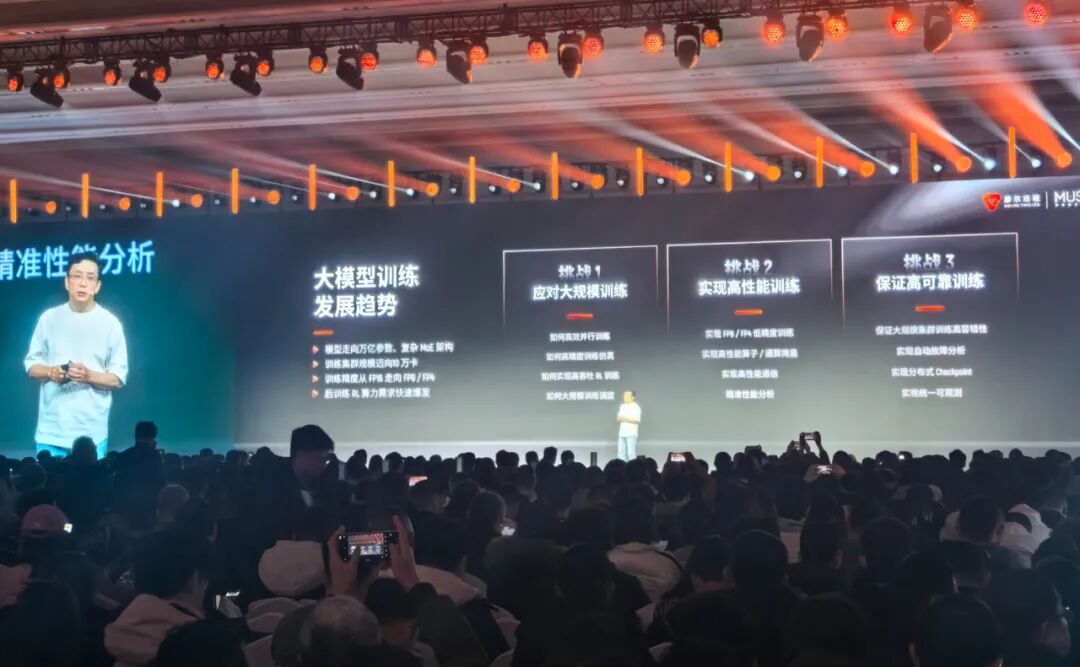
Core Insights - The focus on "Mole Thread," the first domestic GPU stock, is shifting from its high valuation to its technological advancements, product iterations, and operational performance following its debut on the Sci-Tech Innovation Board [1] Group 1: Technological Developments - Mole Thread held its first MUSA Developer Conference on December 20, showcasing its full-function GPU technology roadmap and announcing a series of technological and product advancements, including the new GPU architecture "Huagang" [1] - The new architecture boasts a 50% increase in density and a 10-fold improvement in efficiency, supporting intelligent computing clusters of over 100,000 cards [1] - Future products based on this architecture will include the high-performance AI training and inference chip "Huashan" and the graphics rendering-focused chip "Lushan" [1] - The company also introduced the AI computing power notebook "Changjiang," equipped with an intelligent SoC chip, serving as a core entry point for developers into the MUSA ecosystem [1] Group 2: Industry Context - The development of "sovereign AI" is deemed crucial for enhancing national competitiveness, focusing on achieving a complete system of "autonomous computing power, self-reliant algorithms, and independent ecosystems [2] - The performance gap between domestic graphics cards and foreign mainstream products is narrowing, although building ultra-large-scale intelligent computing systems remains a significant challenge [2] - The current Chinese GPU industry is in the early stages of constructing a core technology stack and a complete ecosystem, facing challenges such as high R&D difficulty and the construction of computing ecological barriers [2] Group 3: Market Performance - Mole Thread's stock has seen recent adjustments, with a 5.9% drop on December 19, closing at 664.10 yuan per share, marking a cumulative decline of 29.4% from its peak of 941.08 yuan on December 11 [2] - Despite the recent decline, the stock remains over 480% higher than its issue price, with a total market capitalization exceeding 300 billion yuan [2]

四川九洲拟7.57亿收购集团射频业务资产
Ju Chao Zi Xun· 2025-12-21 01:21
Core Viewpoint - Sichuan Jiuzhou is strategically upgrading its core RF business through an associated transaction, marking a significant step towards providing subsystem-level solutions [1][2] Group 1: Transaction Details - The company plans to establish a wholly-owned subsidiary to acquire the RF business asset group from its controlling shareholder, Sichuan Jiuzhou Electric Group, for a transaction price of 757.10 million yuan [1] - The asset group includes assets, liabilities, business, and personnel related to RF, primarily engaged in the R&D, production, and sales of microwave RF and power systems [1][2] - The asset group has a strong technical foundation with 66 authorized patents, including 28 invention patents, and has previously supported projects that won significant awards [1] Group 2: Financial Performance - As of September 30, 2025, the net assets of the target asset group are 487.17 million yuan, with projected revenues of 592.87 million yuan and 518.14 million yuan for 2024 and the first nine months of 2025, respectively [2] - The net profits for the same periods are expected to be 15.47 million yuan and 42.96 million yuan, with a performance commitment from the seller to achieve a total net profit of no less than 208.57 million yuan from 2026 to 2028 [2] Group 3: Industry Context and Strategy - The RF industry has a large market size but low concentration, with a CR10 of only 8.2%, indicating a period of professional consolidation [2] - The company's strategy focuses on "chip," "module," and "array" products, aiming to build integrated capabilities in electronic systems and RF front-end solutions, positioning itself as a leader in the domestic microwave RF industry [2] - The acquisition is seen as a core move in this strategy, extending the company's reach into the downstream RF subsystem field and enhancing its competitive edge [2][4] Group 4: Market Implications - The asset group, previously an internal supplier for Jiuzhou Electric, is expected to operate independently in the market, potentially unlocking its technical and R&D capabilities [3] - Following the transaction, the company's related sales are projected to increase from approximately 470 million yuan to about 992 million yuan, raising the proportion of related sales in total revenue from 11.26% to 20.81% [3] - The acquisition reflects a broader trend in the RF microwave industry towards consolidation driven by domestic substitution, supply chain security, and cost control pressures [3][4]

创业板第三套上市标准添新军 这家企业获受理
Zhong Guo Zheng Quan Bao· 2025-12-20 13:32
Core Viewpoint - The Shenzhen Stock Exchange has accepted the IPO application of Guangdong Yuxin Semiconductor Technology Co., Ltd. (referred to as "Yuxin Semiconductor") for the ChiNext board, aiming to raise funds to support its main business in the semiconductor industry [1][2]. Group 1: Company Overview - Yuxin Semiconductor is the first 12-inch wafer manufacturing enterprise in Guangdong Province to achieve mass production, focusing on analog chip manufacturing to support the national integrated circuit industry strategy [1]. - The company has obtained a total of 681 authorized patents, including 312 invention patents, as of June 30, 2025 [1]. Group 2: Financial Performance - The company's revenue for the years 2022, 2023, 2024, and the first half of 2025 was reported as 1.545 billion, 1.044 billion, 1.681 billion, and 1.053 billion respectively, with a significant revenue growth of over 61% in 2024 compared to 2023 [1]. - The company has demonstrated a notable enhancement in its operational capabilities [1]. Group 3: Fundraising and Future Plans - Yuxin Semiconductor plans to raise 7.5 billion for projects focused on its core business, including the production line for 12-inch integrated circuit analog specialty processes and technology platform development [2]. - The company currently operates two 12-inch wafer factories with a combined planned capacity of 80,000 wafers per month, having achieved a capacity of 52,000 wafers per month by mid-2025 [2]. - Future plans include the construction of a third factory with a planned capacity of 40,000 wafers per month, aiming to reach a total capacity of 120,000 wafers per month [2].

研判2025!中国存储服务器行业政策、产业链全景、发展现状、企业布局及未来发展趋势分析:算力基建提速扩容,存储服务器赛道前景广阔[图]
Chan Ye Xin Xi Wang· 2025-12-20 03:31
Core Insights - The storage server industry is driven by multiple favorable factors, including supportive policies, technological breakthroughs in storage chips, and increasing demand across various sectors such as public services, internet, and finance [1][6][9] Industry Overview - Storage servers are specialized servers focused on data storage management, integrating hardware and software to provide high reliability and scalability for massive structured and unstructured data [2][6] - Compared to general servers, storage servers prioritize storage functionality, featuring more hard drive slots and supporting large-capacity storage media [3][4] Market Size and Growth - The overall server market in China is projected to reach 249.21 billion yuan in 2024, with the storage server market expected to reach 43.87 billion yuan, showing steady growth into 2025 [1][9] - The storage server market is anticipated to grow to 52.19 billion yuan by 2025, driven by AI demand and digital transformation [10] Policy Support - A series of significant policies have been introduced to support the storage server industry, focusing on technology standards, infrastructure development, and green transformation [6][9] Industry Chain - The storage server industry chain in China is tightly integrated, covering core components to end applications, with upstream focusing on key components and software supply [7][9] - Domestic companies are gradually breaking into high-end fields, supported by competitive pricing and customization services [7] Competitive Landscape - The industry features a competitive landscape characterized by leading companies dominating the market, ODM manufacturers providing customized solutions, and niche players focusing on specific segments [10][12] - Major players like Huawei and Inspur hold over 60% of the market share, while companies like Yihualu and Jiangbolong are carving out niches with differentiated technologies [10][12] Development Trends - The storage server industry is expected to evolve towards high performance and green technology, with distributed storage and NVMeoF protocols becoming mainstream [12][13] - The market will see a shift from single product competition to integrated solution offerings, with a focus on customized products for specific scenarios [14]





政企同频,赛美特上海研发中心加速落地
Guan Cha Zhe Wang· 2025-12-19 11:17
2022-2024年三年间,企业营收复合增速达66%,已获哈勃、比亚迪、中信证券、中芯聚源等十余家机构投资,投后估值超60亿元人民币。 而在国产化替代目标之外,目前PlantU已在新加坡SilTerra、马来西亚Amkor等海外晶圆与封测基地上线,成为国内首家批量出口半导体CIM软件的厂商。 按照赛美特今年9月递交的IPO申报材料,公司在冲刺"国产半导体工业软件第一股"之余,目标是三年内把海外收入占比从7%提升至30%,"用中国软件帮全 球工厂提效"。 在制造业转型升级与国产化替代推进的双重驱动下,工业软件作为智能制造的核心支撑,正迎来政策扶持与产业需求的双重红利。 12月18日,上海市闵行区七宝镇党委书记率队走进赛美特集团总部,把新一轮产业调研的首站留给这家本土CIM(计算机集成制造)厂商——政企双方聚焦 的一个重要议题是,如何让国产软件真正"顶得上、替得掉",为高端制造守住数据与生产的"神经中枢"。 深耕工业软件与智能制造领域多年,赛美特聚焦半导体等先进制造行业的核心需求,以自主技术研发为核心竞争力,提升工业软件平台化服务能力与行业解 决方案适配性。 在展厅现场,赛美特董事长李钢江向调研团队详细介绍了企业 ...

宏华数科:在书刊数码印刷设备方面,公司将在产品与市场两端同步发力
Zheng Quan Ri Bao Zhi Sheng· 2025-12-19 08:43
Core Viewpoint - The company, Honghua Digital Technology, is expanding its product offerings and market reach in various sectors, including digital printing, automatic sewing equipment, and digital spray printing technology [1]. Group 1: Digital Printing Equipment - The company plans to enhance its digital printing equipment for books and periodicals by expanding its product matrix to meet diverse customer needs, including high-end color printing and entry-level black-and-white devices [1]. - There will be a focus on broadening sales channels, including the development of domestic and international sales agencies and increasing the number of service engineers to provide comprehensive support [1]. Group 2: Automatic Sewing Equipment - The company aims to accelerate the collaboration between its German subsidiary Texpa GmbH and its domestic automatic equipment division to promote localized production and reduce manufacturing costs [1]. - There will be an emphasis on the research and development of standardized and universal automatic sewing equipment to enhance production efficiency and support the economic feasibility of automation for downstream customers [1]. Group 3: Spray Printing Technology - The company has completed the development of core components and equipment for spray printing and will focus on connecting these products with major target customers across various fields to convert them into orders [1]. - In the decorative materials digital spray printing sector, the company plans to launch equipment for printing various patterns, such as decorative textures and marble designs, aiming for significant sales breakthroughs and new business growth opportunities [1].

配套行业巨头“小巨人”拿下全球曳引轮1/7市场
Feng Huang Wang Cai Jing· 2025-12-19 07:16
Core Viewpoint - China dominates over 60% of the global elevator installation market, making it the largest producer and seller of elevators. The country's urbanization, high-rise residential construction, renovation of old neighborhoods, and expansion of public transport networks are driving this growth. By 2025, the total number of elevators in China is expected to exceed 12 million, facilitating billions of vertical trips daily [1]. Group 1: Company Background and Transformation - Hebei Fengwei Machinery Manufacturing Co., Ltd. (Fengwei Machinery) has become a key supplier to international giants like Otis Elevator Company, capturing over 15% of the global market share in traction wheels, a critical component of elevators [1]. - Originally a county-operated agricultural machinery factory, Fengwei Machinery faced bankruptcy but successfully transformed into a manufacturer of elevator core components, marking a significant shift in its business model [2][3]. Group 2: Technical Challenges and Innovations - The company faced significant technical challenges in producing traction wheels, particularly in achieving domestic production of high-quality materials like 40M low-alloy wear-resistant cast iron, which was previously dominated by foreign companies [6][8]. - After extensive research and collaboration with experts, Fengwei Machinery successfully developed the 40M material, overcoming initial failures and establishing itself as a competitive player in the elevator industry [6][7]. Group 3: Collaboration with Industry Giants - Fengwei Machinery's partnership with Otis has been pivotal in enhancing its management and technical capabilities, leading to certifications in various international quality management systems [10][11]. - The company has expanded its client base beyond Otis, supplying components to other major firms like Komatsu and Wacker Neuson, thus diversifying its product offerings and embedding itself in the global high-end manufacturing supply chain [11]. Group 4: Future Directions and Innovations - Fengwei Machinery is focusing on technological innovation and collaboration with domestic experts to develop new materials, such as aluminum-based composite materials, which align with national trends towards lightweight and energy-efficient products [12]. - The company has invested in advanced manufacturing technologies and equipment, enhancing its production capabilities and positioning itself for future growth in the elevator and broader manufacturing sectors [12].
宏华数科:公司致力于在保证质量的前提下,进一步降低生产成本,从而提升产品销售
Zheng Quan Ri Bao Wang· 2025-12-18 13:20
Core Viewpoint - The company is focusing on the localization of production for automatic sewing equipment through its German subsidiary Texpa GmbH and domestic automatic equipment division, aiming to enhance product standardization and reduce production costs while maintaining quality [1] Group 1 - The collaboration in automatic sewing equipment is primarily aimed at promoting localization and replacement of products [1] - The company is developing more universal and standardized automatic sewing equipment [1] - The goal is to lower production costs to enhance product sales while ensuring quality [1]