降准降息

Search documents
谈降准降息、人民币汇率、物价水平……央行、外汇局发布会,信息量满满
证券时报· 2026-01-15 09:41
Core Viewpoint - The People's Bank of China (PBOC) is committed to supporting the high-quality development of the real economy through monetary policy adjustments, including a 0.25 percentage point reduction in various structural monetary policy tool rates, indicating that there is still room for further rate cuts and reserve requirement ratio (RRR) reductions [2][6]. Group 1: Monetary Policy Adjustments - The PBOC has lowered the rates of various structural monetary policy tools by 0.25 percentage points [2]. - There is still potential for further RRR and interest rate cuts [2]. - The PBOC emphasizes the importance of maintaining a stable RMB exchange rate, which is influenced by multiple factors including economic growth and geopolitical risks [2][3]. Group 2: Foreign Exchange Market Outlook - The State Administration of Foreign Exchange (SAFE) anticipates a stable operation of the foreign exchange market in 2026, with cross-border capital flows remaining orderly [4]. - The trading volume in China's foreign exchange market has reached historical highs, indicating a resilient market capable of absorbing external changes [4]. - The proportion of trade settled in RMB has increased to nearly 30%, reflecting a growing trend towards using RMB in international trade [4][9]. Group 3: Economic Indicators and Support Measures - Recent positive changes in China's price levels are noted, with the PBOC focusing on aligning monetary policy to support stable economic growth and reasonable price recovery [5][6]. - The PBOC plans to include medium-sized private enterprises in the re-lending support program, allocating a total of 1 trillion yuan for this purpose [7]. - The PBOC will also expand support for the health industry under the service consumption and elderly care re-lending program [8]. Group 4: Financial Market Developments - By the end of 2025, the total assets of asset management products are expected to reach 119.9 trillion yuan, with a year-on-year growth of 13.1% [12]. - The increase in funding for asset management products from households and non-financial enterprises is significant, with an additional 4 trillion yuan and 1 trillion yuan respectively compared to 2024 [13]. - Approximately 60% of import and export trade is minimally affected by exchange rate fluctuations, with ongoing improvements in financial services expected to enhance this resilience [9].

央行邹澜:降准降息从今年看还有一定空间|快讯
Hua Xia Shi Bao· 2026-01-15 09:33
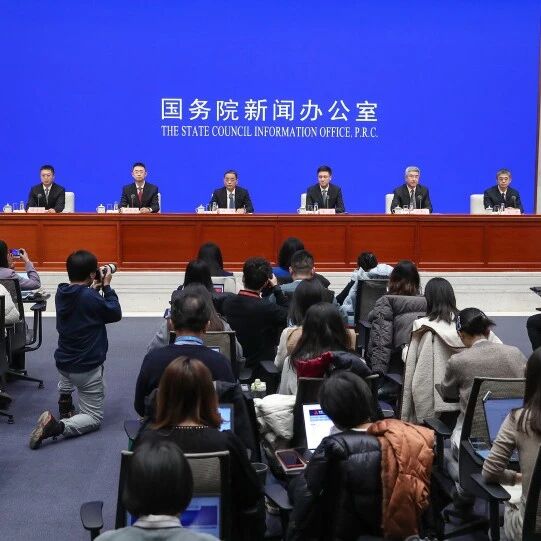
文/刘佳 1月15日,在国新办新闻发布会上,中国人民银行新闻发言人、副行长邹澜表示,关于降准降息,从今 年看还有一定的空间。 四是做好预期引导,持续健全可置信、常态化、制度化的政策沟通机制,多元化多渠道做好政策解读与 信息公布,不断提升货币政策的透明度。 编辑:冯樱子 谈及2026年人民银行在落实中央经济工作会议的决策部署上,邹澜表示,继续实施适度宽松的货币政 策,发挥存量政策和增量政策的集成效应,加大逆周期和跨周期调节力度,为经济稳定增长和高质量发 展创造适宜的货币金融环境。具体来讲: 一是根据国内外经济金融形势和金融市场运行情况,把促进经济稳定增长、物价合理回升作为货币政策 的重要考量,灵活高效运用包括降准降息在内的多种政策工具,保持流动性充裕,保持社会融资条件相 对宽松,引导金融总量合理增长、信贷均衡投放,使社会融资规模、货币供应量增长同经济增长和价格 总水平预期目标相匹配。 二是发挥好货币政策总量和结构双重功能,加快落地近期推出的一系列结构性货币政策工具,引导金融 机构加力支持扩大内需、科技创新、中小微企业等重点领域,扎实做好金融"五篇大文章"。同时,加强 与财政政策协同发力,放大政策激励效能。 三是 ...
中国央行下调结构性工具利率0.25个百分点
Sou Hu Cai Jing· 2026-01-15 09:28
Group 1: Monetary Policy Changes - The People's Bank of China announced a 0.25 percentage point reduction in the structural monetary policy tool rate, effective January 19, lowering the one-year re-lending and re-discount rates to 1.25% [2] - The re-lending quota for technological innovation was increased from 800 billion to 1.2 trillion yuan, with a separate quota of 1 trillion yuan for private enterprises [2] - The minimum down payment ratio for commercial property loans was reduced to 30%, while residential mortgage rates remained unchanged [3] Group 2: Market Reactions - The A-share market reacted positively to the policy, with brokerages and technology sectors seeing a boost, although there were concerns about funds not flowing into infrastructure and real estate [5] - Precious metals surged, with gold surpassing $4,630 per ounce and silver reaching a historical high of $92, driven by global rate cut expectations and increased demand from the photovoltaic and AI industries [5] Group 3: Impact on Individuals and Enterprises - For individuals, the pressure on existing mortgage holders may ease, but the downward trend in deposit rates could reduce annual interest on a 100,000 yuan fixed deposit by approximately 200 yuan [8] - Technology and manufacturing sectors are expected to benefit from low-cost financing, while demand for silver in the photovoltaic and new energy vehicle sectors is driving up industrial metal prices [10] - Export-oriented companies face pressure due to the appreciation of the yuan, which is squeezing profits in industries like textiles and home appliances [11] Group 4: International Dynamics - The political pressure on the Federal Reserve has intensified, with former President Trump calling for rate cuts and initiating a criminal investigation against Powell, which raises concerns about the independence of the central bank [7] - If the Federal Reserve implements rate cuts, a weaker dollar could lead to capital inflows into emerging markets, benefiting A-shares and RMB assets [13] - Japan's plan to raise interest rates to 0.75% may create risks associated with carry trade unwinding due to diverging policies from the US and Europe [13]
利好来了!商业购房贷款首付降至30%,降准降息还有空间!央行发声,还将推出8大措施
2 1 Shi Ji Jing Ji Bao Dao· 2026-01-15 09:20
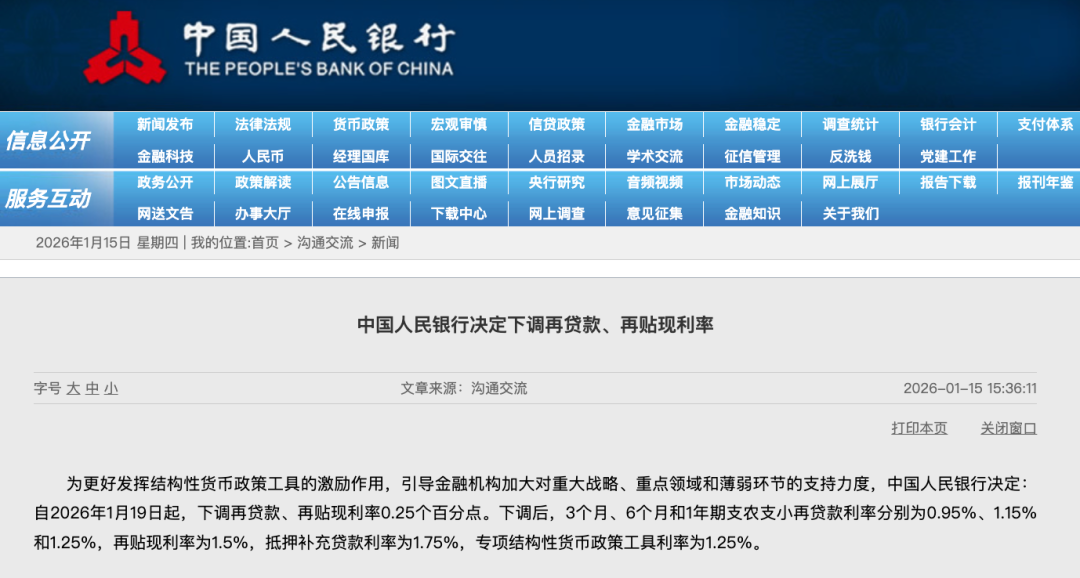
央行表示,为更好发挥结构性货币政策工具的激励作用,引导金融机构加大对重大战略、重点领域和薄弱环节的支持力度,中国人民银行决定:自2026年 1月19日起,下调再贷款、再贴现利率0.25个百分点。下调后,3个月、6个月和1年期支农支小再贷款利率分别为0.95%、1.15%和1.25%,再贴现利率为 1.5%,抵押补充贷款利率为1.75%,专项结构性货币政策工具利率为1.25%。 | | | | 中国人民银行 | | | | | | | | | --- | --- | --- | --- | --- | --- | --- | --- | --- | --- | --- | | | R | | THE PEOPLE'S BANK OF CHINA | | | | | | | | | 信息公开 | 新闻发布 | 法律法规 | 货币政策 | 宏观审慎 | 信贷政策 | 金融市场 | 金融稳定 | 调查统计 | 银行会计 | 支付体系 | | | 金融科技 | 人民币 | 经理国库 | 国际交往 | 人员招录 | 学术交流 | 征信管理 | 反洗钱 | 党建工作 | | | 服务互动 | 政务公开 | 政策解读 | 公 ...
降息!央行:今年降准降息还有一定空间
Xin Lang Cai Jing· 2026-01-15 09:10
Core Viewpoint - The People's Bank of China (PBOC) announced eight new financial policies aimed at supporting high-quality development of the real economy, including interest rate cuts and increased loan quotas for specific sectors [1][3]. Group 1: Interest Rate Adjustments - The PBOC will lower the interest rates of various structural monetary policy tools by 0.25 percentage points, with the one-year re-lending rate decreasing from 1.5% to 1.25% [1][3]. - This adjustment is expected to enhance the willingness of banks to lend in key areas [1][3]. Group 2: Loan Quotas and Support for Specific Sectors - The PBOC will merge the quotas for agricultural and small enterprise re-lending and re-discounting, increasing the re-lending quota for these sectors by 500 billion yuan, with a total quota of 1 trillion yuan specifically for private enterprises [1][3]. - The re-lending quota for technological innovation and technological transformation will be raised from 800 billion yuan to 1.2 trillion yuan, including support for private small and medium-sized enterprises with high R&D investment [1][3]. - The PBOC will also consolidate existing financing support tools for private enterprises and technological innovation, maintaining a total re-lending quota of 200 billion yuan [1][3]. Group 3: Expansion of Support Areas - The PBOC has expanded the support areas for two tools, including energy-saving renovations, green upgrades, and low-carbon energy transition projects under the carbon reduction support tool [1][3]. - The health industry has been included in the support areas for service consumption and elderly care re-lending [1][3]. Group 4: Commercial Property Loan Adjustments - The minimum down payment ratio for commercial property loans has been reduced to 30% to support the destocking of the commercial property market [2][4]. - The PBOC indicated that there is still room for further reductions in reserve requirements and interest rates, given the current average reserve requirement ratio of 6.3% [2][4].
央行回应降准降息:今年还有降准空间,帮企业减轻融资成本
Sou Hu Cai Jing· 2026-01-15 09:08
南都讯记者潘珊菊 发自北京 关于今年降准降息空间还有多大?中国人民银行新闻发言人、副行长邹澜1月15日在 国新办发布会上回应,从今年看还有一定的空间。从法定存款准备金率看,目前金融机构的法定存款准备金率平 均为6.3%,降准仍然有空间。 他还透露,央行还将继续综合施策,促进社会综合融资成本低位运行。比如,推动明示贷款综合融资成本,组织 银行会同企业填写"贷款明白纸",详细明示企业获得贷款需要承担的利息和非利息成本,促进降低评估、担保等 融资中间费用,减轻企业费用支出,优化融资环境。与此同时,强化利率政策执行和监督,发挥好利率自律机制 作用,畅通利率政策传导。 从政策利率来看,外部约束方面,目前人民币汇率比较稳定,美元处于降息通道,总体来看汇率不构成很强的约 束;内部约束方面,2025年以来银行净息差已经出现企稳的迹象,连续两个季度保持在1.42%,2026年还有规模 较大的三年期及五年期等长期存款到期重定价,这次人民银行也下调了各项再贷款利率,这些都有助于降低银行 付息成本、稳定净息差,为降息创造一定空间。 ...
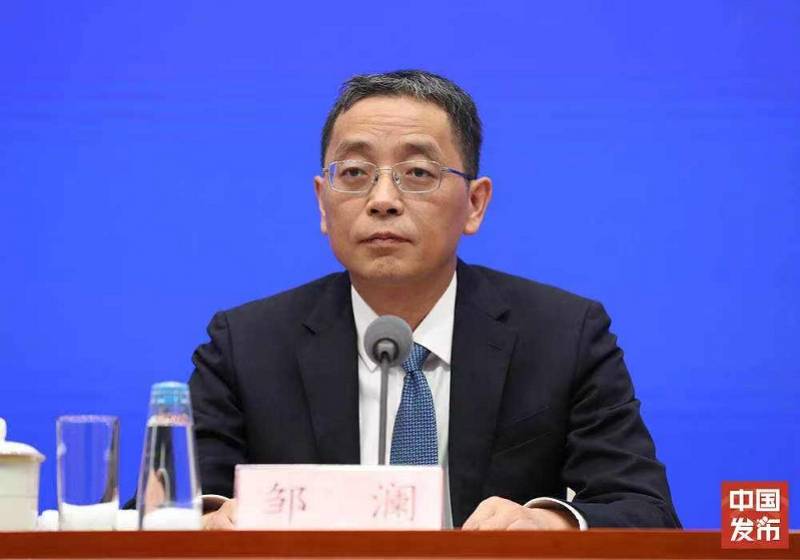
央行副行长:今年降准降息还有一定空间
Sou Hu Cai Jing· 2026-01-15 08:57
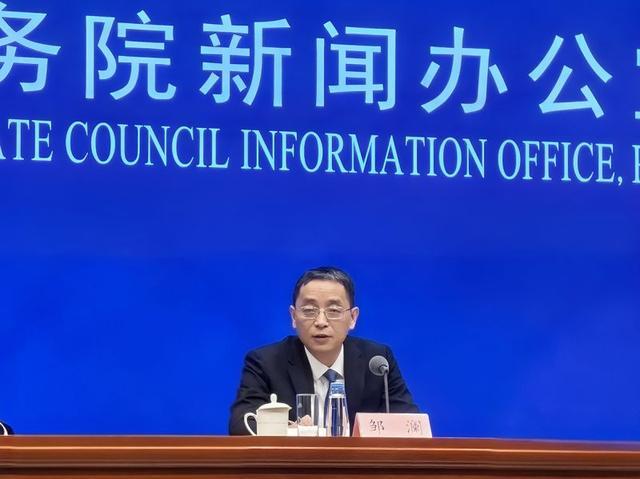
中国人民银行新闻发言人、副行长邹澜。图片来源:国新网 他介绍,从法定存款准备金率看,目前金融机构的法定存款准备金率平均为6.3%,降准仍然有空间。 封面新闻记者 张馨心 1月15日,国新办举行新闻发布会,介绍货币金融政策支持实体经济高质量发展成效。中国人民银行新闻发言人、副行长邹澜表示,今年降准降息还有一 定空间。 内部约束方面,2025年以来银行净息差已经出现企稳的迹象,连续两个季度保持在1.42%,2026年还有规模较大的三年期及五年期等长期存款到期重定 价,此次人民银行也下调了各项再贷款利率。 "这些都有助于降低银行付息成本、稳定净息差,为降息创造一定空间。" 他表示,人民银行还将继续综合施策,促进社会综合融资成本低位运行。比如,推动明示贷款综合融资成本,组织银行会同企业填写"贷款明白纸",详细 明示企业获得贷款需要承担的利息和非利息成本,促进降低评估、担保等融资中间费用,减轻企业费用支出,优化融资环境。强化利率政策执行和监督, 发挥好利率自律机制作用,畅通利率政策传导。 从政策利率来看,外部约束方面,目前人民币汇率比较稳定,美元处于降息通道,总体来看汇率不构成很强的约束。 ...
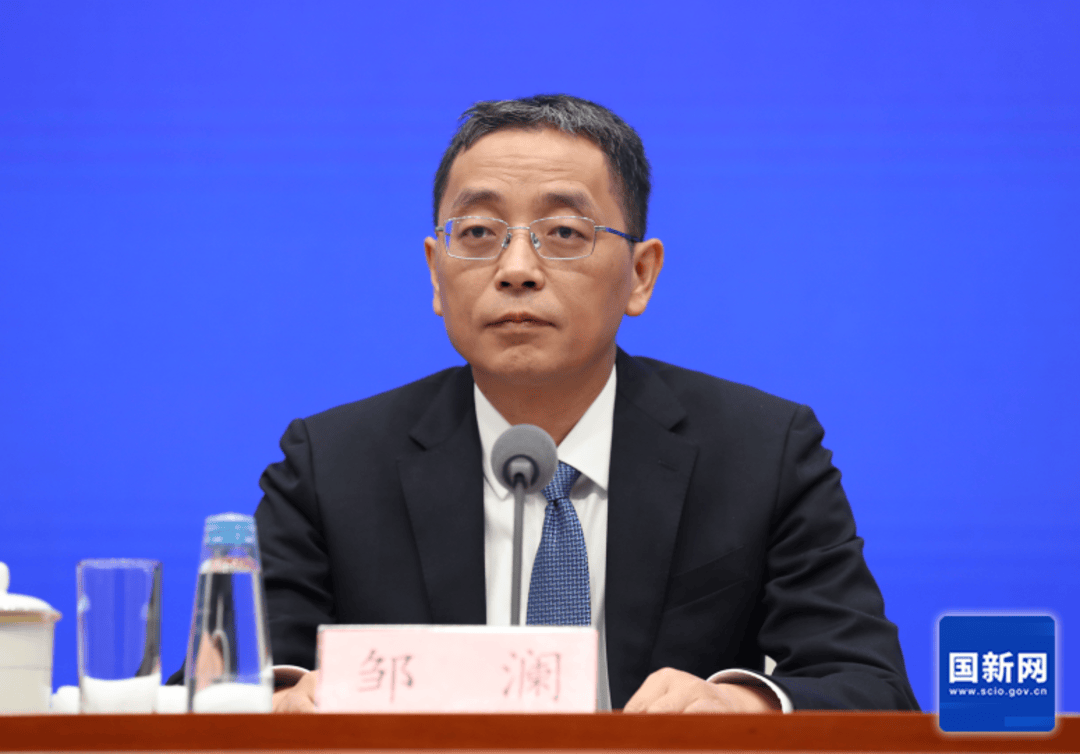
央行表态:今年降准降息还有一定空间
Nan Fang Du Shi Bao· 2026-01-15 08:44
"我们还将继续综合施策,促进社会综合融资成本低位运行。"比如,推动明示贷款综合融资成本,组织 银行会同企业填写"贷款明白纸",详细明示企业获得贷款需要承担的利息和非利息成本,促进降低评 估、担保等融资中间费用,减轻企业费用支出,优化融资环境。强化利率政策执行和监督,发挥好利率 自律机制作用,畅通利率政策传导。这些都有助于社会综合融资成本保持低位运行。 今天(1月15日)下午,国务院新闻办公室举行新闻发布会,介绍货币金融政策支持实体经济高质量发 展成效。 邹澜表示,关于降准降息,从今年看还有一定的空间。从法定存款准备金率看,目前金融机构的法定存 款准备金率平均为6.3%,降准仍然有空间。从政策利率来看,外部约束方面,目前人民币汇率比较稳 定,美元处于降息通道,总体来看汇率不构成很强的约束;内部约束方面,2025年以来银行净息差已经 出现企稳的迹象,连续两个季度保持在1.42%,2026年还有规模较大的三年期及五年期等长期存款到期 重定价,这次人民银行也下调了各项再贷款利率,这些都有助于降低银行付息成本、稳定净息差,为降 息创造一定空间。 中国人民银行新闻发言人、副行长邹澜在回答记者提问时表示,2026年人民银行 ...
央行副行长邹澜:今年降准降息还有一定空间
Xin Jing Bao· 2026-01-15 08:44
邹澜表示,目前,金融机构的法定存款准备金率平均为6.3%,降准仍然有空间。利率方面,从外部来 看,目前人民币汇率比较稳定,美元处于降息通道,总体来看汇率不构成很强的约束;从内部来看, 2025年以来银行净息差已经出现企稳迹象,连续两个季度保持在1.42%,2026年还有规模较大的三年期 及五年期等长期存款到期重定价,人民银行也下调了各项再贷款利率,这些都有助于降低银行付息成 本、稳定净息差,为降息创造一定空间。 新京报讯(记者姜慧梓)在1月15日举行的国新办新闻发布会上,中国人民银行新闻发言人、副行长邹 澜表示,从今年情况来看,降准降息还有一定空间。 同时,人民银行还将继续综合施策,促进社会综合融资成本低位运行。比如,推动明示贷款综合融资成 本,组织银行会同企业填写"贷款明白纸",详细明示企业获得贷款需要承担的利息和非利息成本,促进 降低评估、担保等融资中间费用,减轻企业费用支出,优化融资环境。强化利率政策执行和监督,发挥 好利率自律机制作用,畅通利率政策传导。 ...
官方定调!降准降息还有空间!盘后,央行接连出手!
券商中国· 2026-01-15 08:39
与此同时, 2 026年1月15日(星期四)下午3时,国务院新闻办公室举行新闻发布会,中国人民银行新闻发言人、副行长邹澜,国家外汇局新闻发言人、副 局长李斌介绍货币金融政策支持实体经济高质量发展成效,并答记者问。 刚刚,央行接连发声! 1月15日盘后, 中国人民银行官网 发布《 中国人民银行决定下调再贷款、再贴现利率 》公告。 央行表示, 为更好发挥结构性货币政策工具的激励作用,引导金融机构加大对重大战略、重点领域和薄弱环节的支持力度,中国人民银行决定:自2026年1月19日 起,下调再贷款、再贴现利率0.25个百分点。下调后,3个月、6个月和1年期支农支小再贷款利率分别为0.95%、1.15%和1.25%,再贴现利率为1.5%,抵押补充贷款 利率为1.75%,专项结构性货币政策工具利率为1.25%。 | | | | 中国人民银行 | | | | | | | | | --- | --- | --- | --- | --- | --- | --- | --- | --- | --- | --- | | | લ્વિત્ત | | THE PEOPLE'S BANK OF CHINA | | | | | | | ...