具身AI

Search documents
贝索斯携AI初创公司“普罗米修斯”高调回归硅谷 聚焦太空、机器人以及硬核物理
智通财经网· 2025-11-18 07:19
Group 1 - Jeff Bezos is establishing an AI startup named Project Prometheus, aiming to compete with OpenAI and Elon Musk's xAI, and will serve as co-CEO [1][2] - Project Prometheus has secured $6.2 billion in funding, primarily from Bezos himself, making it one of the best-funded early-stage AI startups [1][2] - The startup focuses on AI applications in various fields, including aerospace, automotive, and advanced manufacturing, aligning with Bezos's interest in sending humanity into space [2][3] Group 2 - Vik Bajaj, a top physicist and chemist, is co-founding and co-leading Project Prometheus, having previously worked at Google X and co-founded Verily [2][3] - The ultimate goal of Project Prometheus is to develop a "super AI model" capable of deep learning in more complex ways than existing AI chatbots like ChatGPT [3] - The company has recruited nearly 100 employees, including senior AI researchers from leading tech firms such as OpenAI, DeepMind, and Meta Platforms [3] Group 3 - The concept of "Physical AI" is emphasized, which involves enabling robots and autonomous systems to perceive, reason, and act in the real world [4] - NVIDIA is focusing on providing the computational power and platforms for "embodied AI," contrasting with the approaches of Tesla and Project Prometheus [4]

李飞飞站队LeCun,AGI全是炒作,80分钟重磅爆料出炉
3 6 Ke· 2025-11-17 09:52
Core Insights - The interview with Fei-Fei Li highlights the emergence of "world models" as the next frontier in AI over the next decade, emphasizing the importance of spatial intelligence in AI development [1][28]. Group 1: Historical Context of AI - Two decades ago, AI was in a "winter" phase, with limited public interest and funding, often referred to as "machine learning" [10][14]. - Fei-Fei Li entered the AI field during this period, focusing on visual intelligence and the need for large datasets to train models effectively [11][20]. - The creation of ImageNet, which involved collecting 15 million images across 22,000 categories, marked a pivotal moment in AI, leading to the rise of deep learning [23][24]. Group 2: The Concept of World Models - "World models" are defined as systems that can generate an infinite 3D world based on input, allowing for reasoning and interaction [37]. - The Marble platform exemplifies this concept, significantly reducing production time in various industries, including film and gaming, by allowing creators to generate navigable worlds from simple descriptions [40][43]. - The integration of spatial intelligence into AI is seen as crucial for enhancing both robotic capabilities and human understanding [39][32]. Group 3: Challenges in Robotics - The primary challenge in robotics lies in data acquisition, as robots require extensive real-world interaction data, which is difficult to obtain [44][45]. - Unlike language models that operate on text, robots must navigate and interact within a 3D environment, complicating their training [45]. - The historical context of autonomous vehicles illustrates the complexities involved in developing effective robotic systems [46]. Group 4: Fei-Fei Li's Career and Vision - Fei-Fei Li's career trajectory reflects a commitment to addressing significant problems in AI, transitioning from academia to industry and now to entrepreneurship with World Labs [47]. - Her focus on collaboration and team dynamics underscores the importance of human roles in the evolving landscape of AI [47]. - Li emphasizes that every individual has a vital role in the future of AI, regardless of their profession [47].

大摩:市场低估了xAI对特斯拉的意义,FSD 14.3或将成为自动驾驶的“蒸汽机时刻”
华尔街见闻· 2025-11-11 05:59
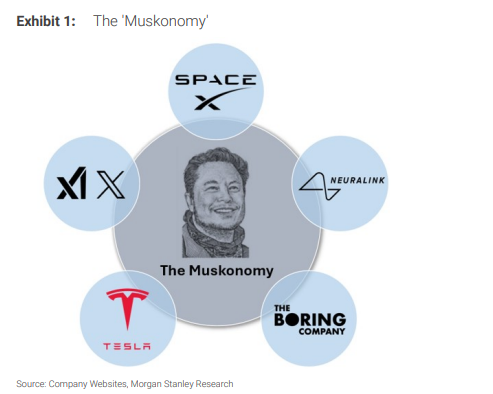
Core Insights - The approval of Elon Musk's compensation plan by shareholders is seen as noise, while the real value of the report lies in revealing key signals that will profoundly impact Tesla's stock price in the next 6-12 months [1] - Morgan Stanley emphasizes that Tesla's relationship with xAI, advancements in Full Self-Driving (FSD), vertical integration of chips, distributed inference cloud networks, space AI satellites, and the revolutionary production method of Cybercab will reshape Tesla's long-term value, pointing towards an AI-driven "Muskonomy" [1] Group 1: Tesla and xAI Relationship - The market seems to overlook the symbiotic relationship between Tesla and xAI, which is crucial for Tesla's long-term success [6] - The report highlights that the financial and strategic relationship between the two companies will become increasingly evident as Tesla enters the next phase of physical AI and autonomous driving [7] - A recursive loop in data, hardware, and manufacturing between Tesla and xAI is established, with their value systems stemming from the same creator, which is critical for the future success of Tesla's physical AI and autonomous driving [8] Group 2: Full Self-Driving (FSD) and Technological Breakthroughs - Musk's confidence in FSD V14.3 achieving "texting while driving" garnered significant applause, indicating the market may underestimate the importance of this moment [10] - Transitioning driving responsibility from humans to pure visual algorithms represents a historic technological breakthrough in the transportation sector, akin to the "steam engine moment" [11] Group 3: Distributed Inference Cloud and AI Satellites - Musk proposed a "massive" distributed inference cloud, offering $100 or $200 monthly to car owners for allowing Tesla to perform AI inference calculations when their vehicles are not in use, potentially creating an unprecedented edge computing network [12] - The concept of "solar AI satellites" suggests a strategic collaboration between Tesla and SpaceX in the realm of space computing, addressing the growing demand for computational power and energy [14] Group 4: Revolutionary Manufacturing Techniques - The production goal for Cybercab is set at "one vehicle every 10 seconds," significantly surpassing the traditional automotive manufacturing pace of 60-90 seconds, indicating a major leap in mass production methods since Henry Ford [16] - Tesla aims to implement a "non-box" production line with minimalist design and nearly zero customization, utilizing pre-coated plastic composite materials for vehicle panels, potentially eliminating the need for paint shops [16]

大摩:市场低估了xAI对特斯拉的意义,FSD 14.3或将成为自动驾驶的“蒸汽机时刻”
Hua Er Jie Jian Wen· 2025-11-11 02:48
Core Insights - The market has focused on Elon Musk's high compensation, but Morgan Stanley emphasizes that the strategic points from Tesla's shareholder meeting are being overlooked [1] - Key signals that will profoundly impact Tesla's stock price in the next 6-12 months include the relationship with xAI, advancements in Full Self-Driving (FSD), vertical integration of chips, distributed inference cloud networks, space AI satellites, and revolutionary production methods for Cybercab [1] Group 1: Tesla and xAI Relationship - The relationship between Tesla and xAI is crucial for Tesla's long-term success, with both companies forming a recursive loop in data, hardware, and manufacturing [4] - Tesla may build a "gigantic chip factory" to support its ambitious plans for billions of robots, ensuring supply and innovation in reasoning chips [4] - The market has underestimated the significance of Musk's confidence in FSD V14.3, which will allow texting while driving [4] Group 2: Technological Breakthroughs - Transitioning driving responsibility from humans to pure visual algorithms represents a historic technological breakthrough in transportation [5] - Musk proposed a "massive" distributed inference cloud, offering $100 or $200 monthly to car owners for AI processing when their vehicles are idle, potentially creating an unprecedented edge computing network [5] Group 3: Future Innovations - The report highlights two future-oriented concepts: solar AI satellites and the production target for Cybercab [6] - The collaboration between Tesla and SpaceX in space computing is underscored by the potential of solar AI satellites, which could address human demands for computing and power [6] - Tesla aims for a production rate of "one vehicle every 10 seconds" for Cybercab, significantly faster than traditional automotive manufacturing, indicating a major leap in mass production methods [6]
阿里下场,通义千问牵头组建机器人AI团队
Xuan Gu Bao· 2025-10-09 00:14
Core Insights - Alibaba Group has established an internal robotics team, marking its entry into the competitive AI hardware market alongside global tech giants [1][3] - The formation of the "Robotics and Embodied AI Group" signifies a strategic shift from AI software to hardware applications [1][3] - Alibaba Cloud has made its first investment in embodied intelligence by leading a $140 million funding round for the startup X Square Robot [1][4] Group 1: Company Developments - Alibaba's CEO stated that global AI investment is expected to accelerate to $4 trillion over the next five years, necessitating Alibaba's alignment with this growth [1] - The company plans to invest an additional $58 billion in cloud and AI hardware infrastructure over the next three years [1] - The newly formed robotics team aims to leverage Alibaba's strengths in large models and AI technology to capture a share of the rapidly growing embodied AI market [3] Group 2: Market Context - The establishment of Alibaba's robotics team coincides with significant investments in the robotics sector by other tech giants, including SoftBank's $5.4 billion acquisition of ABB's industrial robotics business [1][6] - The global robotics market is projected to reach $7 trillion by 2050, attracting substantial capital from various investors [6] - NVIDIA's CEO highlighted AI and robotics as major growth opportunities, with autonomous vehicles expected to be a primary commercial application of robotics technology [6] Group 3: Startup Investment - Alibaba's investment in X Square Robot represents its first foray into the embodied intelligence sector, with the startup having raised a total of approximately $280 million in less than two years [4] - X Square Robot has developed a humanoid robot capable of 360-degree cleaning and is currently targeting institutional clients such as schools and hotels [5] - The company plans to prepare for an IPO next year, with expectations that its "robot butler" will become a reality within five years [5]

阿里巴巴通义千问技术负责人组建内部机器人AI团队
Xin Lang Cai Jing· 2025-10-08 15:57
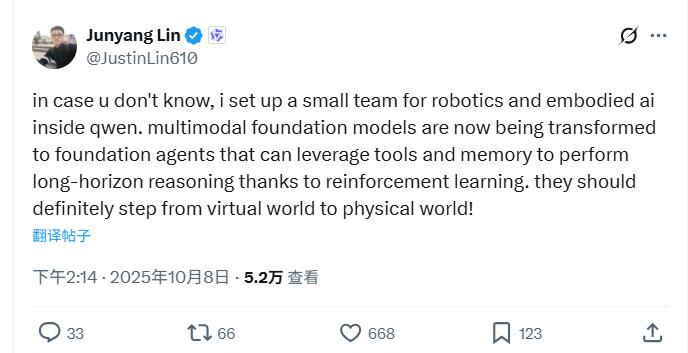
Core Insights - Alibaba has established a "Robotics and Embodied AI Group" to enhance its AI capabilities [1] - The new team is part of the Tongyi Qianwen initiative, which focuses on developing flagship AI foundational models [1] - Lin Junyang, the technical head of Tongyi Qianwen, is involved in the development of multimodal models that can process voice, image, and text inputs [1] - These multimodal models are being transformed into foundational agents capable of executing long-sequence reasoning tasks, with applications expected to transition from the virtual world to the real world [1]
具身AI开启4020亿美元市场机遇!瑞银详解“Beyond AI”投资策略
智通财经网· 2025-09-29 08:28
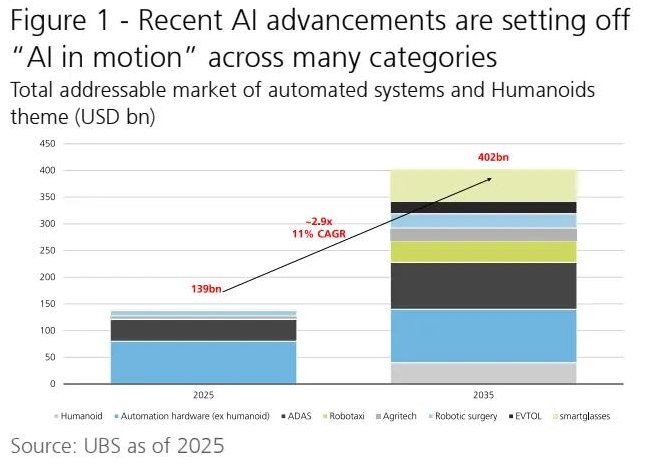
Core Insights - UBS reports that artificial intelligence (AI) is driving significant advancements in autonomous systems, including humanoid robots, advanced driver-assistance systems (ADAS), and robotaxis, transforming traditional industries such as aerospace, agriculture, smart glasses, and healthcare [1][17] - The emergence of visual-language-action (VLA) models represents a transformative turning point for robots and ADAS, enabling systems to convert sensory inputs and natural language commands directly into actions [1][17] Market Opportunities - UBS estimates that market opportunities driven by embodied AI verticals will reach $402 billion, with the highest growth potential in humanoid robots, ADAS, robotaxis, industrial automation, agricultural technology, smart glasses, robotic surgery, and drones [2][19] - The total addressable market (TAM) for humanoid robots is projected to reach $40 billion by 2035, while the TAM for automation hardware is expected to hit $100 billion, and ADAS (including fully autonomous driving) is forecasted to reach $88 billion [2][6] Growth Projections - The global TAM for robot taxis is estimated at $40 billion, with a compound annual growth rate (CAGR) of 11% over the next decade [2] - The agricultural technology, robotic surgery, electric vertical takeoff and landing (EVTOL), and smart glasses sectors are expected to grow at a CAGR of 23%, reaching a TAM of $134 billion by 2035 [2] Technological Advancements - AI advancements are catalyzing the development of autonomous systems, with significant breakthroughs in processing power and AI capabilities [5] - The integration of electrification is driving the revenue pool for private car ADAS, projected to reach $88 billion by 2035, primarily fueled by China's 50% penetration rate of electric vehicles [6] Humanoid Robots - By 2035, the number of humanoid robots is expected to exceed 2 million units, with a corresponding TAM of $40 billion, and by 2050, this could grow to over 300 million units, with a TAM of $1.4 to $1.7 trillion [7] - Humanoid robots are anticipated to operate independently and will be utilized in various sectors, including manufacturing, logistics, and healthcare [7] Supply Chain Dynamics - The supply chain for autonomous systems is characterized by overlapping hardware and software dependencies, necessitating a regulatory framework to maximize commercialization [5][8] - The demand for high-performance chips, power management chips, motion control chips, and communication ICs is expected to rise due to the application of VLA technology in ADAS and humanoid robots [8][9] Semiconductor Opportunities - The semiconductor industry is poised to benefit significantly from the computational demands of humanoid robots, with each high-end humanoid robot requiring approximately $1,400 worth of semiconductors [9] Smart Glasses Market - The smart glasses market is expected to enter a new phase by 2025, with an estimated market size of $1 billion, projected to grow to $60 billion by 2035, driven by technological maturity and increased consumer interest [12] Agricultural Innovations - AI and autonomous machinery are essential for increasing agricultural productivity, with the need to boost food production by 60% by 2050 to meet global demand [13] Robotic Surgery Advancements - The use of robotic surgery is expanding across various medical fields, with a projected shipment of 6,200 new medical robots in 2024, reflecting a 36% year-on-year growth [14]
“人形态”机器人遭遇梦醒时分? iRobot创始人预言:最终的机器人赢家或许“不像人类”
Zhi Tong Cai Jing· 2025-09-29 04:21
Group 1 - Rodney Brooks, co-founder of iRobot, expresses skepticism about humanoid robots fulfilling transformative promises in the industry, predicting that significant investment will vanish as these robots are quickly forgotten [1][4] - Brooks argues that current humanoid robots cannot match the dexterity of human hands, which have approximately 17,000 specialized tactile sensors, making it unlikely for them to achieve similar operational capabilities [1][4] - He emphasizes that humanoid robots rely on high energy input to maintain stability, making them dangerous when they fall, and suggests that successful robots will likely have wheels, multiple arms, and specialized sensors rather than resembling humans [2][5] Group 2 - Brooks warns that substantial funding is being wasted on trying to extract performance from current humanoid robots, which he believes will ultimately be forgotten [3][4] - He predicts that in 15 years, successful robots will likely feature wheels and specialized forms to match tasks and safety costs, rather than attempting to replicate human form [5][6] - Brooks advocates for a focus on specific tasks and safety-compliant non-humanoid forms, along with advanced sensors and materials, rather than the current trend of investing in humanoid robots [6][7] Group 3 - The robotics industry remains a high-growth sector, with Brooks supporting the idea that funding should be directed towards practical robot forms and foundational capabilities rather than humanoid designs [7][8] - Jensen Huang of NVIDIA highlights the potential of robotics and embodied AI as significant growth markets, estimating the overall market size could reach trillions of dollars [7][8] - NVIDIA is positioning itself as a provider of computational power and platforms for embodied AI, focusing on training and simulation tools for the robotics industry [8]


人形态”机器人遭遇梦醒时分? iRobot创始人预言:最终的机器人赢家或许“不像人类
Zhi Tong Cai Jing· 2025-09-29 04:20
Group 1 - Rodney Brooks, co-founder of iRobot, expresses skepticism about humanoid robots fulfilling their transformative promises, predicting that significant investment will be wasted on these robots that are unlikely to achieve mass production [1][4][5] - Brooks argues that humanoid robots cannot match the dexterity of human hands, which have approximately 17,000 specialized tactile sensors, making it difficult for robots to replicate human-like manipulation and grasping skills [1][4][6] - Current humanoid robots rely on high-energy control systems to maintain balance, which leads to high energy consumption and instability, making them unsafe in real-world environments [2][4] Group 2 - Brooks believes that successful robots in the future will likely have wheels, multiple arms, and specialized sensors, rather than resembling humans, indicating a potential misallocation of billions in investment towards humanoid forms [2][5][7] - The focus should shift towards practical robotic forms that can be scaled and meet safety requirements, rather than pursuing humanoid designs that may not be viable [6][7] - The robotics industry remains a high-growth sector, with significant opportunities in embodied AI and practical robotic applications, as highlighted by Nvidia's focus on providing the computational power and platforms for robot development [7][8]
基于移动设备采集的3DGS实现个性化Real-to-Sim-to-Real导航
具身智能之心· 2025-09-25 00:04
Group 1 - The core issue of embodied AI is the sim-to-real dilemma, where high fidelity in simulation conflicts with cost, leading to challenges in transferring successful strategies from simulation to real-world applications [2] - The potential of 3D Gaussian Splatting (GS) technology has been underexplored, with recent advancements enabling high-fidelity 3D representations from standard devices, addressing the gap between low-cost real scene reconstruction and embodied navigation [3][4] - The proposed method, EmbodiedSplat, consists of a four-stage pipeline that captures real scenes using low-cost mobile devices and reconstructs them in high fidelity for effective training and deployment [4][6] Group 2 - The first stage involves capturing RGB-D data using an iPhone 13 Pro Max and the Polycam app, which simplifies the process and reduces operational barriers [11] - The second stage focuses on mesh reconstruction, utilizing DN-Splatter for 3D GS training, ensuring geometric consistency and minimizing reconstruction errors [11][12] - The third stage includes simulation training with a composite reward function to balance success, path efficiency, and collision avoidance, employing a two-layer LSTM for decision-making [10][13] Group 3 - The fourth stage is real-world deployment, where the Stretch robot connects to a remote server for strategy inference, allowing real-time navigation based on observed images [14][17] - Experiments validate the zero-shot performance of pre-trained strategies in new environments, revealing that scene scale significantly impacts performance [20][22] - Fine-tuning pre-trained strategies leads to substantial performance improvements across various environments, demonstrating the effectiveness of personalized adjustments [25][28] Group 4 - The study highlights the limited success of zero-shot transfer from simulation to real-world scenarios, with significant performance gaps observed [32] - Fine-tuning enhances the transferability of strategies, with success rates increasing significantly after adjustments [32][35] - The necessity of large-scale pre-training is emphasized, as it provides foundational knowledge that aids in adapting to new environments and overcoming real-world challenges [35][44]