利率比价关系

Search documents
央行报告释放明确信号
第一财经· 2025-11-13 00:46
Core Viewpoint - The article discusses the evolution of the People's Bank of China's (PBOC) monetary policy framework, emphasizing the importance of maintaining reasonable interest rate relationships to ensure effective monetary policy transmission [2][3]. Group 1: Key Interest Rate Relationships - The report identifies five core interest rate relationships: the relationship between central bank policy rates and market rates, the relationship between commercial banks' asset and liability rates, the relationship between different asset yields, the relationship between interest rates of different maturities, and the relationship between different risk rates [5][6]. - The relationship between central bank policy rates and market rates is crucial, as market rates should ideally fluctuate around the policy rate. Any significant deviation can hinder effective interest rate transmission [5][6]. - The relationship between commercial banks' asset and liability rates indicates that while loan and deposit rates generally move in the same direction, discrepancies due to competition and repricing cycles can compress banks' net interest margins, affecting their ability to support the real economy [5][6]. Group 2: Importance of Interest Rate Coordination - The article highlights the need for coordination among different asset yields, noting that the interest rates for bonds and loans should not diverge excessively for the same entity. This coordination is essential as financial products diversify [6][7]. - The report also discusses the significance of aligning short-term and long-term interest rates, as well as ensuring that corporate financing rates do not fall below government bond yields, which would contradict risk pricing principles [6][7]. - Experts suggest that addressing these interest rate imbalances is vital for enhancing the market-oriented formation and transmission of interest rates, thereby improving the effectiveness of monetary policy [6][7]. Group 3: Future Monetary Policy Directions - The article indicates that the PBOC aims to continue transforming its monetary policy framework, focusing on price-based regulation and enhancing the role of interest rates in resource allocation [10][11]. - The PBOC's future approach will involve not only adjusting policy rates but also addressing transmission "bottlenecks" across various financial markets to ensure synchronized movements of policy and market rates [7][10]. - The report suggests that the interest rate corridor may narrow, leading to more precise and synchronized transmission of policy rates to market rates [11].


2025Q3 货政报告解读:重视货币政策传导,平衡利率比价关系
Huachuang Securities· 2025-11-12 15:20
Report Title - "Bond Daily Report: Emphasize the Transmission of Monetary Policy and Balance the Interest Rate Parity Relationship - Interpretation of the 2025 Q3 Monetary Policy Report" [1] Report Summary - On November 12, 2025, the central bank released the Q3 2025 Monetary Policy Implementation Report. The overall tone has changed, with liquidity, entity financing, cost reduction, exchange rate, and interest rate policies all showing corresponding adjustments [6]. Industry Investment Rating - Not provided in the report. Core Viewpoints - The report sends a strong signal for steady growth, is more cautious about the external situation, and strengthens the demand for steady growth led by domestic demand. The policy tone has been adjusted, and the possibility of front - loaded monetary policy next year cannot be ruled out. Although the statement of "preventing capital idling" is removed, the space for significant easing is limited. It also guides the market to rationally view the credit growth rate affected by factors such as debt replacement and proposes to maintain a "reasonable interest rate parity relationship" [3][32]. Summaries According to the Table of Contents 1. Focus on Steady Growth and Acknowledge the Improvement in Price Operation - Be cautious about the external situation and have a strong demand for domestic steady growth and stable expectations. The description of the external environment has become more cautious, and more emphasis is placed on expanding domestic demand in the internal environment. The report describes price operation more positively, acknowledging the marginal changes in CPI and PPI and also emphasizing long - term supply - demand contradictions [3][7][8] 2. Change from "Implementing in Detail" to "Implementing Well", and from "Counter - cyclical" to "Counter - cyclical and Cross - cyclical" - "Implementing in detail" is changed to "implementing well", and "counter - cyclical adjustment" is adjusted to "counter - cyclical and cross - cyclical adjustment". This does not mean that the window for aggregate easing is completely closed [3][11] 3. Do Not Mention "Preventing Capital Idling", but Still Pay Attention to Overnight Fund Operation - The statement of "preventing capital idling" is not mentioned, but the control over the money market is strengthened, and it is difficult to expect a significant loosening of capital prices. The operation time of outright repurchase and MLF is clearly defined [3][14][15] 4. Maintain a Reasonable Growth of Financial Aggregates and Pay More Attention to Social Financing and Money Supply - Emphasize maintaining a reasonable growth of financial aggregates, mainly focusing on social financing scale and money supply. The credit growth rate has declined due to the crowding - out effect of replacement bonds. Continue to promote the reduction of the comprehensive social financing cost and pay attention to stabilizing the net interest margin of banks [3][19][20] 5. Exchange Rate Pressure Eases, and the Statement of "Three Resolves" Fades - In the exchange rate statement, the emphasis is on preventing exchange rate over - adjustment risks, and the statement of "three resolves" is faded, indicating that the pressure on the RMB exchange rate has eased [3][23] 6. Do Not Directly Mention "Pay Attention to the Trend of Long - term Interest Rates", but Emphasize Maintaining a Reasonable Interest Rate Parity - The text does not directly mention "pay attention to the trend of long - term yields", but proposes to balance the interest rate parity relationship of each group to smooth the transmission of monetary policy, and lists several key interest rate relationships [3][27]
看懂利率调控新逻辑,央行报告释放明确信号
Di Yi Cai Jing· 2025-11-12 12:25
Core Viewpoint - The People's Bank of China (PBOC) emphasizes the importance of maintaining reasonable interest rate relationships to ensure effective monetary policy transmission, as highlighted in the Q3 2025 monetary policy execution report [1][2]. Group 1: Interest Rate Relationships - The report identifies five key interest rate relationships: the relationship between central bank policy rates and market rates, the relationship between asset and liability rates of commercial banks, the relationship between different asset yields, the relationship between short-term and long-term rates, and the relationship between different risk rates [3][4]. - The relationship between central bank policy rates and market rates is crucial; market rates should ideally fluctuate in sync with policy rates to ensure effective transmission of monetary policy [3][4]. - The relationship between commercial banks' asset and liability rates indicates that while deposit and loan rates generally move in the same direction, discrepancies due to factors like competition can compress banks' net interest margins, affecting their ability to support the real economy [3][4]. Group 2: Implications of Interest Rate Discrepancies - Discrepancies in interest rates, such as loans being priced lower than government bond yields, violate risk pricing principles and are unsustainable [4][5]. - The report suggests that the PBOC's focus on these interest rate relationships is not merely definitional but aims to enhance execution, as imbalances can hinder the formation and transmission of market-based interest rates [4][5]. Group 3: Future Monetary Policy Directions - The PBOC plans to continue transforming its monetary policy framework, emphasizing price-based regulation and the importance of interest rate marketization reforms to improve the transmission of interest rates across different financial markets [6][7]. - The expectation is that the interest rate corridor will narrow, leading to more precise and synchronized transmission of policy rates to market rates [7][8]. - The trend of lowering deposit rates is expected to continue, with larger state-owned banks typically leading the way, followed by smaller banks [8].
三季度货币政策执行报告,强化货币政策的执行和传导
Xiangcai Securities· 2025-11-12 09:20
Group 1: Monetary Policy Insights - The central bank emphasizes maintaining relatively loose social financing conditions and improving the execution and transmission of monetary policy[2] - The report highlights the need for counter-cyclical and cross-cyclical adjustments to strengthen economic recovery[3] - The central bank aims to optimize monetary policy intermediate variables and gradually reduce focus on quantitative targets, suggesting that loan growth may be slightly lower than nominal economic growth[4] Group 2: External Economic Factors - The report expresses caution regarding external uncertainties, noting challenges in international economic and trade order, and concerns about the diminishing effects of "export grabbing" and "import grabbing"[3] - High tariffs are expected to increase trade costs and create policy uncertainties that may suppress long-term investment and supply chain decisions, indicating a structural shift in global trade growth trends[3][12] Group 3: Interest Rate Management - The central bank stresses the importance of maintaining reasonable interest rate relationships across various dimensions, transitioning from setting a single price to managing a system[7][18] - The report identifies five key interest rate relationships that are crucial for effective monetary policy transmission, including the relationship between central bank policy rates and market rates[18][20] Group 4: Investment Recommendations - The central bank's commitment to a moderately loose monetary policy is expected to support interest-sensitive assets and sectors backed by clear policy support, such as technology innovation and green industries[21] - The likelihood of significant policy easing measures, such as rate cuts, is low for the remainder of the year, with more substantial easing expected to be deferred until early 2026[21][22] Group 5: Risk Considerations - Potential risks include slower-than-expected economic recovery, unexpected policy changes, and disturbances in the global economy[23]
怎么理解三季度货币政策执行报告?
Nan Hua Qi Huo· 2025-11-12 06:41
Group 1: Main Views - The content that needs attention in the main body of this monetary policy report is relatively limited, and the report emphasizes internal certainty and focuses more on domestic demand. The probability of an increase in the aggregate policy has increased [1]. - The column content is the focus of this report. Columns 1, 2, and 4 are logically related, aiming to stabilize market sentiment and reduce asset price fluctuations. Multiple perspectives for observing interest - rate comparisons are proposed, continuing the central bank's work direction in recent years [1]. - The stability of the net interest margin (banking system) is a prerequisite for the monetary policy to intensify and benefit the real economy, and the stability of liabilities needs to be considered. After the capital market expectations stabilize, there may be a new round of aggregate policy intensification accompanied by further adjustments to the deposit rates of large - scale banks, and interest rate cuts may occur [2]. - As the spread between the policy rate and the money market stabilizes and the interest - rate corridor compresses, the interest - rate market will gradually find its "anchor" [2]. Group 2: More Positive Tone Macroeconomic Outlook - The summary of the overseas situation in the third - quarter monetary policy report is weaker than that in the second - quarter report. The report points out that "global economic growth momentum is insufficient" in the third quarter, mainly due to the decline in GDP growth rates in the eurozone and the UK, and the decline in exports in the Asia - Pacific region despite the improvement in Japan's GDP. Geopolitical conflicts are emphasized as a potential risk to the stability of the political and financial system [3]. - Domestically, there are some structural improvements in investment, but the overall economic data has shown a weakening trend since the third quarter. The third - quarter report has a marginal change in the description of the aggregate policy, indicating that the foundation for the domestic economic recovery needs to be strengthened [3][4]. Next - Stage Monetary Policy Main Ideas - The monetary policy will continue to maintain a moderately loose environment, with almost no new content in this part. The description of the monetary policy in the third - quarter report has been reduced by a paragraph compared with previous reports, possibly because there is little change in the current monetary policy tone and implementation, and the aggregate policy may be announced after the year - end important meeting [4]. Group 3: Column In - Depth Reading Column 1: Scientific View of Aggregate Financial Indicators - Social financing scale and money supply are more comprehensive and reasonable than bank loans for observing financial aggregates. This column aims to manage expectations, urging the market to look at total financing data and smooth the impact of data on the market [10][11]. - The emphasis on aggregate financial data is reasonable because the economic growth engine has shifted. Advanced manufacturing and other industries are mainly supported by government financing, so focusing only on credit data may lead to a more pessimistic view of the economy [11]. - If credit improves significantly and continuously in the future, it may mean a transformation of the economic engine from structural industries to overall demand recovery. However, the growth of new social financing this year mainly relies on government bond financing, and the comparative advantage will disappear in 2026 [12]. Column 2: The Relationship between Base Money and Money - This column explains the difference between high - powered money and broad money and points out that the expansion of broad money mainly depends on the credit expansion of banks. It supplements Column 1 by emphasizing the importance of aggregate financial data such as money supply [16][17]. Column 4: Maintaining a Reasonable Interest - Rate Comparison Relationship - The column focuses on several aspects of interest - rate comparisons, including the linkage between policy rates and other rates, deposit and loan rates, the comparison effect of bank assets, term spreads, and credit risk [20]. - The stability of the net interest margin is a key factor for policy space. The trend of deposit - rate adjustment continues, and the actions of large - scale banks need to be monitored. Future deposit - rate adjustment analysis should consider the performance of the capital market [21]. - The central bank pays close attention to the shape of the treasury bond yield curve. When the term spread deviates significantly from the central level, the monetary policy may use structural means to guide market correction [22]. - Since the Lujiazui Forum in June 2024, the central bank has taken measures to strengthen the importance of policy rates and the smoothness of the interest - rate transmission mechanism. The spread between the policy rate and the market rate is becoming more stable, and the interest - rate market is gradually finding its "anchor" [22].
赵伟:保持社会融资条件相对宽松
Sou Hu Cai Jing· 2025-11-12 04:24
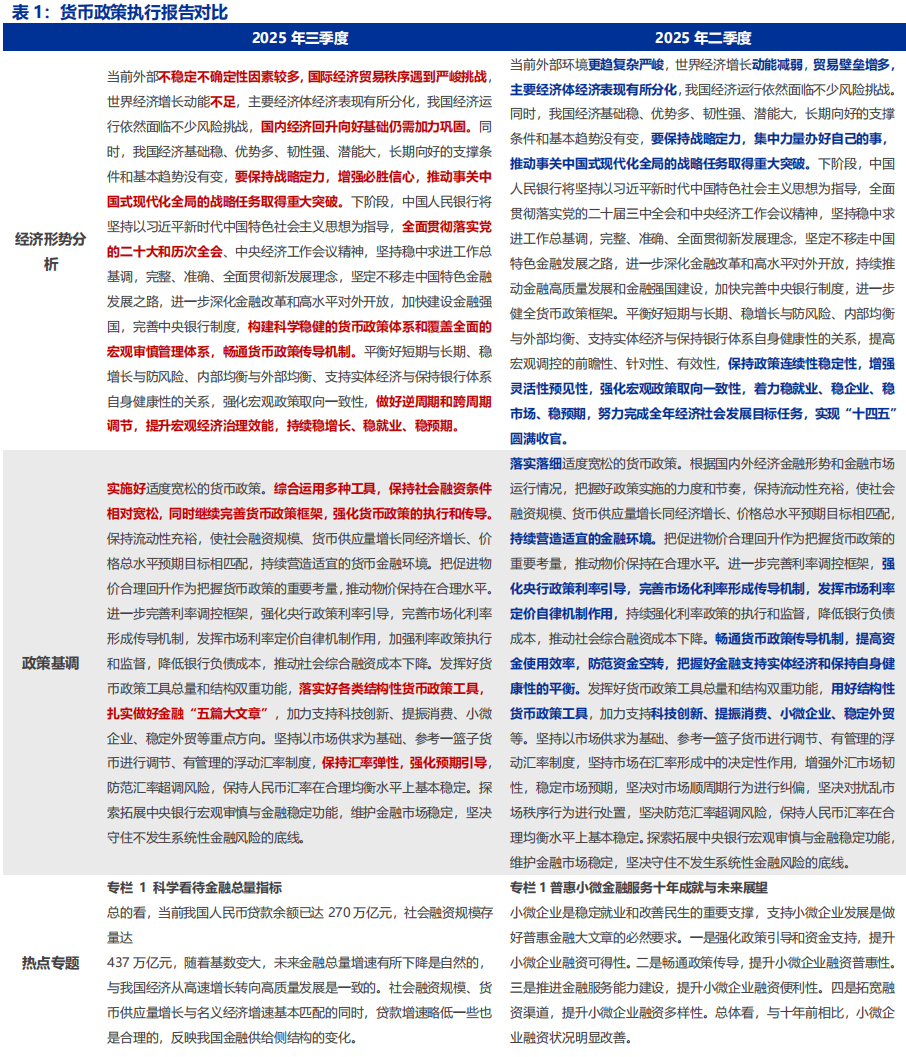
Core Viewpoint - The People's Bank of China (PBOC) emphasizes the need for strategic determination and confidence in the face of external uncertainties and challenges to the international economic order, while also highlighting the importance of consolidating the foundation for domestic economic recovery [2][5]. Economic Situation Analysis - The report indicates that external uncertainties are significant, with the international economic growth momentum described as "insufficient" compared to the previous quarter's "weakened" assessment, reflecting heightened concerns about global economic prospects [2][5]. - Domestically, while risks and challenges remain, there is a new emphasis on the need to strengthen the foundation for economic recovery, indicating a commitment to achieving annual growth targets [2][5]. Policy Tone - The PBOC's monetary policy has shifted from "implementing detailed moderate easing" to "implementing good moderate easing," focusing on the effectiveness of policies rather than just their execution [3]. - The report stresses the use of various tools to maintain relatively loose social financing conditions, highlighting the coordination between monetary and fiscal policies [3][6]. - The report reiterates the importance of maintaining exchange rate flexibility and has removed previous warnings about preventing fund misallocation, suggesting that related risks may have been controlled [3][6]. Hot Topics - The report discusses the importance of understanding financial aggregate indicators, noting that the current RMB loan balance has reached 270 trillion yuan and the social financing scale is at 437 trillion yuan, with a natural decline in growth rates expected as the economy transitions to high-quality development [7]. - It emphasizes the need for a reasonable interest rate relationship to support banks' net interest margins and enhance the counter-cyclical adjustment space for monetary policy [4][7]. Future Outlook - The PBOC plans to develop a financial technology development plan for the 14th Five-Year Plan period, focusing on the orderly advancement of AI applications in finance to support high-quality economic development [4]. - The report outlines a commitment to balancing short-term and long-term goals, ensuring macroeconomic governance effectiveness, and maintaining stability in growth, employment, and expectations [5][6].
银行视角看政策:25Q3 货币政策报告的 4 点关注
CMS· 2025-11-12 02:43
Investment Rating - The industry rating is maintained as "Recommended" indicating a positive outlook for the industry fundamentals and an expectation that the industry index will outperform the benchmark index [6]. Core Insights - The report highlights four key points from the 2025 Q3 monetary policy report released by the central bank, focusing on loan interest rates, the shift in monetary policy language, the relationship between monetary aggregates, and the importance of maintaining reasonable interest rate relationships [1][2][3][4]. Summary by Sections Loan Interest Rates - As of September 2025, the weighted average loan interest rate is 3.24%, down 5 basis points from the previous month. The average interest rate for general loans is 3.67%, down 2 basis points, while the personal housing loan rate remains stable at 3.06%. The corporate loan rate is 3.14%, down 8 basis points. The excess reserve ratio is 1.4%, down 0.4 percentage points year-on-year [1][12]. Monetary Policy Language - The monetary policy language has shifted from "strengthening counter-cyclical adjustments" to "doing a good job in both counter-cyclical and cross-cyclical adjustments." The outlook does not mention the likelihood of reserve requirement ratio cuts or interest rate reductions, indicating a stable capital market and improving inflation trends [2]. Financial Aggregates - The report emphasizes that the current high level of financial data means future monetary policy effects will focus more on "price" rather than "quantity." Without real demand and fiscal policy support, the expansion of base money may not effectively translate into broad money supply growth [3]. Interest Rate Relationships - The central bank aims to ensure that banks do not issue loans at post-tax rates lower than the yields of government bonds of the same maturity. This is to maintain a reasonable interest rate relationship and support banks in stabilizing their net interest margins, thereby expanding the space for counter-cyclical monetary policy adjustments [4][5].
存款在“蚂蚁搬家”?央行报告详解资产配置调整原因
Bei Ke Cai Jing· 2025-11-12 02:37
Core Viewpoint - The recent slowdown in deposit growth is interpreted as a shift of funds from deposits to the stock market, influenced by changes in interest rates and their relationships, as explained in the People's Bank of China's (PBOC) third-quarter monetary policy report [1][2]. Group 1: Interest Rate Dynamics - The PBOC emphasizes that interest rates are essentially the return on funds, and various financial instruments exhibit different characteristics, leading to a diverse range of interest rates and a specific pricing relationship [2][3]. - The report highlights that in a market-oriented interest rate system, changes in the return rates of different assets lead to a reallocation of funds towards higher returns, impacting banking deposits, loans, bonds, stocks, and insurance markets [2][6]. - The PBOC notes that maintaining a reasonable interest rate relationship is crucial for effective monetary policy transmission, which helps in adjusting the supply and demand of funds and resource allocation [6][9]. Group 2: Asset Allocation and Market Behavior - Experts argue that the notion of deposits "moving" is misleading; rather, it reflects a redistribution of deposits among different entities, with overall deposit levels remaining relatively stable [2][3]. - The report indicates that the recent increase in non-bank deposits and the slowdown in household deposits are linked to prior regulations on interbank demand deposit rates, leading to a preference for term deposits and interbank certificates [4][6]. - The PBOC's report also discusses the importance of maintaining a reasonable yield spread between different types of deposits and loans, as well as between various financial products, to ensure efficient financial resource allocation [7][8].
货政报告解读|保持社会融资条件相对宽松(申万宏观·赵伟团队)
申万宏源研究· 2025-11-12 01:12
Core Viewpoint - The central theme of the report emphasizes the need for strategic determination and confidence in the face of external uncertainties and challenges to the international economic and trade order, while also highlighting the importance of consolidating the foundation for domestic economic recovery [2][20]. Economic Situation Analysis - The report indicates that external uncertainties have increased, with the international economic growth momentum described as "insufficient" compared to the previous quarter's "weakened" assessment, reflecting heightened concerns about global economic prospects [2][20]. - Domestically, while risks and challenges remain, there is a new emphasis on the need to strengthen the foundation for economic recovery, indicating a commitment to achieving annual economic growth targets despite some slowing in economic indicators [20][21]. Policy Tone - The monetary policy tone has shifted from "implementing detailed and appropriate monetary policy" to "implementing effective monetary policy," focusing on the ultimate effectiveness of policies rather than just their execution [3][21]. - The report introduces a comprehensive approach to maintaining relatively loose social financing conditions, emphasizing the coordination between monetary and fiscal policies, particularly in the context of government bond issuance [3][21]. Monetary Policy Operations - The report highlights the need to maintain liquidity and ensure that the growth of social financing and money supply aligns with economic growth and price level expectations [7][21]. - It stresses the importance of structural monetary policy tools to support key areas such as technological innovation, consumption, small and micro enterprises, and stabilizing foreign trade [7][21]. Exchange Rate and Risk Prevention - The report reiterates the importance of maintaining exchange rate flexibility and has removed previous mentions of preventing fund circularity, suggesting that related risks may have been controlled [3][22]. - The focus has shifted to strengthening expectations guidance and maintaining a stable RMB exchange rate at a reasonable equilibrium level [7][22]. Hot Topics - The report discusses the importance of understanding financial aggregate indicators, noting that the growth of social financing and money supply is generally aligned with nominal economic growth, while also acknowledging the natural decline in financial aggregate growth due to the larger base [8][23]. - It emphasizes maintaining reasonable interest rate relationships to support banks' net interest margins and enhance the counter-cyclical adjustment space for monetary policy [23].

货政报告解读|保持社会融资条件相对宽松(申万宏观·赵伟团队)
赵伟宏观探索· 2025-11-12 00:40
Economic Analysis - The report emphasizes the increasing external instability and uncertainty, highlighting severe challenges to the international economic and trade order [2][20] - The global economic growth momentum has been adjusted from "weak" to "insufficient," indicating heightened concerns about the global economic outlook [2][20] - Domestically, while risks and challenges remain, there is a focus on reinforcing the foundation for economic recovery, with a call to maintain strategic determination and confidence [2][20] Policy Framework - The monetary policy stance has shifted from "implementing detailed moderate easing" to "implementing effective moderate easing," focusing on the effectiveness of policies [3][21] - The report introduces the use of various tools to maintain relatively loose social financing conditions, emphasizing coordination with fiscal policy [3][21] - Structural monetary policy tools will be effectively implemented to support key areas such as technological innovation and small and micro enterprises [3][7] Exchange Rate and Risk Management - The report reiterates the importance of maintaining exchange rate flexibility and enhancing expectation guidance [3][22] - The omission of previous warnings about preventing fund circularity suggests that related risks may have been controlled to some extent [3][22] Financial Indicators - The analysis of financial total indicators indicates that the growth of social financing and money supply is generally aligned with nominal economic growth, with a slight lag in loan growth being reasonable [4][8] - The report discusses the long-term impacts of financial market development and structural changes on monetary total and financial regulation [4][8] Digital Economy Support - The report outlines plans for the next phase of financial support for the digital economy, including the development of a financial technology plan for the 15th Five-Year Plan period [4][23] Interest Rate Relationships - The report highlights the importance of maintaining reasonable interest rate relationships across various dimensions, including central bank policy rates and market rates [4][23]