容量电价

Search documents
中国电力何时见底系列i:中美电价剪刀差:大国的相同与不同
HTSC· 2026-01-21 07:25
Investment Rating - The report maintains an "Overweight" rating for the public utility sector and the power generation sector [2]. Core Viewpoints - The report argues that the core logic determining the valuation of power stocks has changed in the new energy era, with expectations of a rebound in electricity prices and stock valuations as coal prices stabilize [4][6]. - It highlights that the most challenging phase for electricity supply and demand in China has passed, with expectations of a recovery in demand starting in 2026 [4][7]. - The report emphasizes that the valuation gap between U.S. and Chinese power stocks has widened significantly, with U.S. power stocks trading at 2-4 times the price-to-book (PB) ratio of their Chinese counterparts [4][6][7]. Summary by Sections Investment Recommendations - The report recommends several undervalued power operators, including Huaneng International, Guodian Power, and China Power [3][8]. - It suggests that the capacity price increase in 2026 will benefit thermal power, while the stabilization of energy prices will favor nuclear, green, and hydropower [8]. Market Dynamics - The report notes that both China and the U.S. are experiencing similar electricity shortages due to a slowdown in the growth of base-load power sources, with structural demand exceeding expectations potentially leading to supply crises [5][26]. - It discusses the significant differences in electricity pricing structures between the two countries, with U.S. electricity prices being significantly higher due to various systemic costs [56][58]. Price Trends and Projections - The report predicts that by 2026, the industrial electricity prices in China will be significantly lower than those in the U.S., enhancing the competitiveness of Chinese manufacturing [6][11]. - It highlights that the electricity price gap between the two countries is expected to continue to widen, benefiting China's manufacturing sector [6][8]. Supply and Demand Outlook - The report indicates that the most severe supply-demand imbalance in China has passed, with expectations of a recovery in electricity demand driven by increased manufacturing investment [7][8]. - It also notes that the U.S. is facing a similar situation, with a projected decline in gas-fired electricity generation and a potential increase in coal-fired generation [5][30].





中国神华20260116
2026-01-19 02:29
Summary of China Shenhua's Conference Call Company Overview - **Company**: China Shenhua Energy Company Limited - **Industry**: Coal and Power Generation Key Points Pricing Mechanism and Sales Strategy - In 2026, the coal pricing mechanism is flexible, allowing for negotiated pricing to reflect price fluctuations. The company uses a method of back-calculating port prices from pit prices, with a cap on prices if they exceed a certain limit. January pricing is primarily determined through negotiations, with some reference to the national coal trading center's guidance price [2][3] - The average transportation cost for coal sales is between 80-120 RMB per ton, but actual full transportation costs may be higher [2][5] - Coal sales are categorized based on unified scheduling and pit sales, divided into annual long-term contracts, monthly long-term contracts, and spot sales, without distinguishing between coal types or sales locations [2][5] Production and Sales Performance - As of November, the company achieved 90.9% of its coal production target and 84% of its sales target, with sales slightly below expectations due to market demand. Power generation completed approximately 7.5%, correlating with electricity demand [2][6] - The company expects to maximize external coal procurement in 2026, contingent on not incurring losses, with plans dependent on downstream customer demand and pricing conditions [2][7] Financial Outlook and Capital Expenditure - The capacity electricity price compensation ratio is expected to increase to 50-70% in 2026, significantly impacting revenue diversification. Auxiliary service income is also anticipated to rise due to improved mechanisms and increased new installations [2][4][7] - Capital expenditure for 2026-2027 is projected to be between 30 billion to 50 billion RMB, covering maintenance and new projects, including coal mines and power stations [4][10] Market Conditions and Profitability - Long-term electricity prices are expected to decline by about 1-2 cents in most provinces in 2026, with capacity price increases offsetting some of the decline. Fuel cost changes are critical for profitability, with further budget assessments needed for 2027 [4][7] - The company is actively pursuing auxiliary service revenues to mitigate profit decline risks due to falling long-term electricity prices [7] New Energy and Coal Chemical Projects - As of the third quarter, the company's installed capacity for new energy projects is approximately 3.5 GW, with plans to adjust based on market demand and policy direction. However, the company does not prioritize new energy development, focusing instead on coal-based operations [8] - The company is upgrading its coal-to-olefins project in Baotou, increasing capacity from 600,000 tons to 1.35 million tons, expected to be completed by 2027 [8][9] Strategic Partnerships and Cost Management - The company signed a long-term contract for over 200 million tons of coking coal with Mongolia's ETT, managed by the State Energy Group, indicating strategic procurement considerations [12] - Cost reductions in 2025 were attributed to adjustments in safety production fee standards, with ongoing measures planned for 2026 to maintain cost control despite profit stability pressures [12] Transportation and Supply Chain - Most coal from Xinjiang is consumed locally, with annual external transport volumes between 10 million to 20 million tons. The company is exploring various transportation routes to optimize costs and efficiency [13][14] Dividend Policy - The company commits to a dividend payout ratio of no less than 65% of the net profit attributable to shareholders for 2025-2027, with the recent acquisition not expected to impact this policy [15] Import Strategy - The State Energy Group's coal import strategy is flexible and adjusts based on market conditions and operational needs, rather than adhering to a fixed annual plan [16]

天津容量电价调整略超预期,各地代购电价表现分化
Changjiang Securities· 2026-01-11 23:30
Investment Rating - The report maintains a "Positive" investment rating for the utility sector [8] Core Insights - The adjustment of coal power capacity prices in Tianjin exceeds expectations, with the fixed cost recovery ratio increasing to 70% from January 1, 2026, which is higher than the previously planned minimum of 50% [2][11] - The January 2026 proxy purchase electricity prices show a general decline across most provinces, with significant regional disparities; northern inland areas exhibit more resilience compared to coastal regions facing greater pressure [2][11] Summary by Sections Capacity Price Adjustment - Tianjin's coal power capacity price will rise from 100 yuan per kilowatt per year to 231 yuan, enhancing the fixed cost recovery ratio to 70% [2][11] - The adjustment is expected to yield an increase of approximately 0.035 yuan per kilowatt-hour in electricity pricing, although actual capacity fees may rise more significantly due to declining coal power utilization hours [11] Proxy Purchase Electricity Prices - January 2026 proxy purchase prices show a decline, with Guangdong and Jiangsu reporting average transaction prices of 372.14 yuan per megawatt-hour and 344.19 yuan per megawatt-hour, respectively, reflecting year-on-year decreases of 19.72 yuan and 68.26 yuan [11] - Northern inland regions, such as Inner Mongolia, show a year-on-year increase in proxy purchase prices, while coastal provinces like Guangdong and Jiangsu face declines exceeding 5 fen per kilowatt-hour [11] Investment Recommendations - The report recommends focusing on quality coal power operators such as Huaneng International, Datang Power, and Guodian Power, as well as hydropower companies like Yangtze Power and State Power Investment Corporation [11][16][17] - It also highlights the potential of new energy companies like Longyuan Power and China Nuclear Power, suggesting a favorable long-term outlook for the sector [11][20]



内蒙华电20260108
2026-01-08 16:02
Summary of Inner Mongolia Huadian Conference Call Company Overview - Inner Mongolia Huadian is a key player in the northern thermal power sector, benefiting from a recent stock price correction that has increased expected returns, presenting a secondary investment opportunity [2][3]. Key Points and Arguments Investment Potential - The company is recommended as a top pick in the thermal power sector due to the market's reassessment of the value of such companies [2]. - The integration of coal and electricity operations provides stronger profitability stability and competitiveness, especially in fluctuating coal price environments [2][4]. Capacity Price Increase - A tiered increase in capacity prices is expected in 2026, with most regions seeing prices rise from 100 RMB/kW per year to 165 RMB/kW per year, positively impacting cash flow and dividend predictability for thermal power companies [2][8]. Dividend Policy - Inner Mongolia Huadian commits to distributing no less than 70% of its distributable profits as dividends, with a minimum payout of 0.1 RMB per share, enhancing investor confidence [2][9]. Coal Supply and Cost Management - The company produces nearly 45% of its coal needs internally, which helps reduce costs and mitigate risks associated with coal price fluctuations [2][10]. Competitive Advantages - Inner Mongolia Huadian's coal power generation capacity is 11 GW, with 6 GW serving the Inner Mongolia region and 5 GW serving the North China grid, benefiting from stable electricity prices in North China [10][12]. Market Valuation - Traditional market valuations for thermal power are considered simplistic; a reevaluation based on the company's self-sufficiency in fuel supply could yield a more competitive market valuation [11]. Additional Insights Renewable Energy Initiatives - The company is actively expanding its renewable energy portfolio, with approximately 1.8 GW of wind and solar capacity, aligning with national green development strategies [4][13]. - Recent asset injections from major shareholders into wind projects indicate strong support for the company's growth [17][18]. Future Market Dynamics - The renewable energy sector is viewed as nearing a bottom in the market cycle, with long-term potential driven by policy improvements and increased demand for green certificates [14][16]. Overall Recommendation - Inner Mongolia Huadian is recommended as a key investment target due to its stable asset profitability, reasonable valuations, high dividend yield, and ongoing expansion in renewable energy, which could provide further market value growth [19].

锂电大变局
虎嗅APP· 2026-01-08 09:39
Core Viewpoint - The article discusses the geopolitical implications of the U.S. interest in Venezuela's oil resources under the guise of anti-drug efforts, highlighting the potential shifts in global commodity pricing and supply chains due to U.S. actions in South America [4]. Group 1: Lithium Market Overview - South America, particularly the "Lithium Triangle" of Argentina, Chile, and Bolivia, holds over half of the world's lithium reserves, with Chile currently being the core producer [7]. - Argentina is expected to see a significant increase in lithium production, with projections of over 700,000 tons of lithium carbonate equivalent by 2030 [8]. - China's lithium carbonate imports heavily rely on South American salt lake lithium, with 49% of imports coming from Chile and 36% from Argentina as of November 2025 [10]. Group 2: Price Dynamics and Market Trends - The price of lithium carbonate has seen a remarkable recovery, stabilizing around 80,000 yuan/ton in October 2025 and peaking at over 120,000 yuan/ton by December, reflecting a doubling from mid-year lows [10]. - The supply-demand balance in the lithium market is tight, influenced by production cuts from upstream companies, which have led to a significant price increase [12]. - Major lithium producers have seen substantial stock price increases, with companies like Dazhong Mining and Cangge Mining rising over 200% in 2025 [12]. Group 3: Midstream and Downstream Implications - The demand for lithium battery materials is shifting from solely electric vehicles to a dual-driven model including energy storage, with energy storage demand growing rapidly [14]. - By the end of 2024, China's new energy storage capacity is projected to reach 84.53 million kilowatts, requiring a compound annual growth rate of 30% from 2025 to 2027 [17]. - The price of lithium hexafluorophosphate, a key component in battery electrolytes, surged to over 120,000 yuan/ton by November 2025, reflecting strong downstream demand [18]. Group 4: Competitive Landscape - Companies like CATL face challenges due to their lack of control over salt lake resources, which are crucial for lithium extraction, while competition intensifies with other players in the market [24]. - The relationship between battery manufacturers and automotive companies is becoming more complex, with competition heating up in the lithium iron phosphate segment [27]. - The upcoming changes in tax policies and subsidy structures for new energy vehicles are expected to impact sales and production strategies in the industry [28].



长协落地电价触底,关注板块红利价值
GF SECURITIES· 2026-01-04 14:05
Investment Rating - The industry investment rating is "Buy" [2] Core Insights - The annual long-term contract electricity prices are reaching a bottom, with a focus on the dividend value of the sector. The electricity price in Guangdong is 0.372 CNY/kWh, down 0.02 CNY/kWh year-on-year, reflecting a 20% decrease from the benchmark. In Jiangsu, the price is 0.344 CNY/kWh, down 0.07 CNY/kWh year-on-year, a 12% drop from the benchmark. The market has reacted negatively to these price drops, but the long-term outlook suggests limited further declines as supply and demand improve [6][17][24]. Summary by Sections 1. Annual Long-term Contract Electricity Results - The annual electricity trading results for 2026 show significant price reductions in Guangdong and Jiangsu, with declines of 20% and 12% respectively. The transition from annual to monthly contracts is noted, with a high proportion of medium to long-term market electricity remaining stable [17][24]. 2. Weekly Review - The report highlights the recent implementation of local electricity pricing mechanisms, with a focus on the impact of coal prices and the stability of natural gas prices compared to previous years [10][18]. 3. Industry High-frequency Data Tracking - The report tracks the rapid decline in spot coal prices and the decrease in coal inventories at northern ports. The domestic natural gas prices are lower than the previous year, while overseas prices are fluctuating upwards [10][18]. 4. Key Company Announcements and Sector Performance Tracking - The report emphasizes the acquisition by Guiguan Electric Power of assets from its parent group, which is expected to enhance its growth potential. The company plans to lead the development of hydropower and new energy in Tibet, which could significantly boost profits in the coming quarters [6][10][18]. 5. Focus on Investment Opportunities - The report identifies several companies with strong dividend yields and market management strategies, including Huaneng International, Huadian International, and Guiguan Electric Power. The focus is on high dividend stocks and companies with robust market management practices, which are expected to enhance their valuation [6][10][18]. 6. Valuation and Financial Analysis of Key Companies - The report provides a detailed valuation analysis of key companies in the sector, indicating potential upside in their stock prices based on projected earnings and dividend increases. For instance, Guiguan Electric Power's acquisition is valued at 2.025 billion CNY, with a price-to-book ratio of 1.06 [7][10]. 7. Market Positioning and Future Outlook - The report concludes with a positive outlook for the public utility sector, suggesting that the current valuation levels are attractive for new investments, especially as the market begins to stabilize and recover from recent price declines [6][10][18].



超2亿!浙江等地储能重大利好
行家说储能· 2026-01-04 12:56
Core Insights - The article discusses the transition of China's energy market from local "capacity compensation" trials to a nationwide standardized "capacity pricing" mechanism, with recent policies promoting market-oriented revenue mechanisms for energy storage [2] Group 1: Capacity Compensation Policies - Zhejiang Province has announced capacity compensation for 17 new energy storage projects, totaling 1.164 GW, with a first-year compensation amount of 232.8 million yuan [3] - Hubei Province will implement a capacity compensation mechanism starting February 1, 2026, with an annual capacity price set at 165 yuan per kW per year [8] - Gansu Province has established a reliable capacity compensation mechanism with a standard of 330 yuan per kW per year, effective January 1, 2026 [9] Group 2: Project Details - The compensation projects in Zhejiang include various energy storage facilities, such as an 80 MW/160 MWh storage station in Hangzhou and a 200 MW/400 MWh grid-side storage project in Wuyi [6][7] - Yunnan Province has released a list of 8.955 GW/20.36 GWh of energy storage projects, aiming to enhance the integration of renewable energy and storage [11] Group 3: Market Mechanisms - The article highlights the establishment of a market price mechanism for energy storage, with a price range set between 0.04 yuan and 0.5 yuan per kWh, effective January 1, 2026 [10] - Yunnan's plan includes promoting energy storage to participate in the energy market and optimizing mechanisms for frequency regulation and auxiliary services [11]

锂电行业2026年度策略报告:供需拐点已现,出海+固态共舞(附下载)
Xin Lang Cai Jing· 2026-01-04 01:18
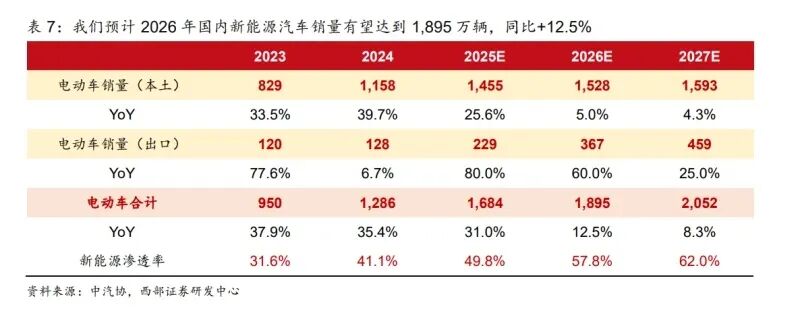
Domestic New Energy Vehicles - Domestic new energy vehicle sales are expected to reach 16.56 million units by 2026, representing a year-on-year increase of 13.8% [1] - In October 2025, domestic new energy vehicle sales were 1.715 million units, with a month-on-month increase of 20.0% and a year-on-year increase of 32.7% for the cumulative sales from January to October [1][2] - The penetration rate of new energy vehicles reached 51.6% in October 2025, up 3.9 percentage points year-on-year [1] Export of New Energy Vehicles - In October 2025, new energy vehicle exports reached 256,000 units, a year-on-year increase of 99.9% [2] - Cumulative exports from January to October 2025 totaled 2.014 million units, reflecting a year-on-year increase of 90.4% [2][10] - The overall automobile export volume in October 2025 was 666,000 units, with a month-on-month increase of 22.9% [2] Trends in Hybrid Models - Hybrid models are trending towards "large battery + small fuel tank," with increased battery capacity per vehicle [3] - The new D19 range-extended model from Leap Motor features an 80.3 kWh battery, achieving a pure electric range of over 500 km and a comprehensive range of 1,300 km [3] - The "old-for-new" vehicle replacement policy has led to significant growth in new energy vehicle sales, with an expected increase of 12.5% in 2026 [3] Global New Energy Vehicle Market - Global new energy vehicle sales are projected to reach 8.14 million units in 2026, with a year-on-year growth of 21.0% [12] - European electric vehicle sales are expected to continue growing due to stringent carbon emission policies, with an anticipated total of 4.87 million units sold in 2026, up 30.0% year-on-year [12] - The U.S. market may face challenges due to the cancellation of electric vehicle tax credits, with a projected decline in sales to 1.6 million units in 2026, down 4.5% year-on-year [13] Battery Production - Global battery production is expected to reach 1,510 GWh in 2026, representing a year-on-year increase of 17.33% [15] - Chinese battery manufacturers hold a 60% share of the global market, with CATL maintaining a leading position [15] - The global installed capacity of lithium batteries reached 811.7 GWh in the first nine months of 2025, up 34.7% year-on-year [15] Energy Storage Demand - Domestic energy storage demand is expected to grow significantly due to market-driven factors and capacity pricing policies [16] - The transition from policy-driven to market-driven demand for energy storage is anticipated to enhance internal project returns and stimulate installation [16] - In 2026, the favorable economic conditions for energy storage in Europe and emerging markets are expected to continue [17]
储能2026年度策略:全球开花,开启两年持续高增新周期
Soochow Securities· 2025-12-14 04:35
Group 1: Core Insights - The report highlights a new growth cycle for energy storage, projecting significant increases in installed capacity and demand in both domestic and international markets [2][5][32] - Domestic energy storage demand is driven by capacity pricing and innovative business models, with a projected installed capacity of 163 GWh in 2025, a 47% year-on-year increase, and 265 GWh in 2026, a 60% increase [2][32] - Internationally, the U.S. is experiencing a surge in demand due to AI data centers, while Europe and emerging markets are also showing strong growth potential [2][34] Group 2: Domestic Market Dynamics - In the domestic market, the introduction of capacity pricing subsidies by local governments has significantly boosted the internal rate of return (IRR) for energy storage projects, with IRR rates ranging from 6% to 12% [2][13] - The report notes that from January to November 2025, domestic energy storage bidding reached 190 GWh, a 138% increase year-on-year, with a total of 175 GWh awarded [2][27] - The cumulative installed capacity of domestic energy storage reached 72 GWh from January to October 2025, marking a 42% increase year-on-year [2][27] Group 3: International Market Trends - The U.S. is expected to see a demand for approximately 53 GWh of new energy storage installations in 2025, driven by AI data centers and peak load shortages [2][34] - In Europe, the energy storage market is projected to grow significantly, with an expected installation of 20 GWh in 2025, a 131% increase year-on-year, and 42 GWh in 2026, a 109% increase [2][34] - Emerging markets, particularly in the Middle East, Australia, Southeast Asia, and South America, are anticipated to contribute to a combined installation of 34 GWh in 2025, a 220% increase year-on-year [2][34] Group 4: Industry Chain and Competitive Landscape - The global demand for energy storage batteries is projected to reach 628 GWh in 2025, a 91% increase, and 663 GWh in 2026, a 61% increase [2][6] - The report indicates that leading companies in the energy storage sector, such as Tesla and BYD, are expected to strengthen their market positions as battery prices stabilize and production capacity increases [2][6] - The integration of large battery cells is expected to reduce system costs by 10-15%, enhancing the competitive advantage of leading firms [2][6] Group 5: Investment Recommendations - The report recommends strong investment in large-scale energy storage companies, including Sungrow Power Supply, CATL, and BYD, as they are positioned to benefit from the anticipated growth in the market [2][6] - It also highlights the potential for growth in residential and commercial energy storage sectors, suggesting companies like DeYe and Airo Energy as promising investment opportunities [2][6]





公用事业行业周报(2025.12.08-2025.12.12):云南容量电价提升,各省政策有望加速-20251214
Orient Securities· 2025-12-14 02:12
Investment Rating - The report maintains a "Positive" investment rating for the utility sector [4] Core Views - The increase in coal power capacity price compensation in Yunnan province is expected to accelerate the development of provincial capacity pricing policies across various regions [7] - The decline in port coal prices and high inventory levels are influencing market dynamics, with expectations of a gradual narrowing of price declines in the future [7] - The utility sector is viewed as a defensive asset, with low-priced utility assets becoming increasingly attractive for investors [7] - The report emphasizes the need for further market-oriented pricing reforms to support the evolving power system as renewable energy consumption increases [7] Summary by Sections Investment Suggestions and Targets - The report expresses optimism for the utility sector, highlighting the advantages of dividend assets in a low-interest-rate environment [7] - Specific stock recommendations include Huadian International (600027), Guodian Power (600795), Huaneng International (600011), Anhui Energy (000543), and Jiantou Energy (000600) for thermal power [7] - For hydropower, it suggests focusing on quality large hydropower companies such as Yangtze Power (600900) and Sichuan Investment Energy (600674) [7] - Nuclear power is noted for its long-term growth certainty, with China General Nuclear Power (003816) recommended [7] - Wind and solar sectors are expected to see growth, with a focus on companies with high wind power ratios [7] Industry Dynamics - Yunnan province's coal power capacity price compensation has increased to 100% of fixed costs, which is expected to alleviate operational pressures on coal power plants [7] - Port coal prices have continued to decline, with the Qinhuangdao port price for Shanxi Q5500 coal at 745 RMB/ton, reflecting a week-on-week decrease of 5.1% [13] - The report notes that coal inventory levels are high, with Qinhuangdao port coal inventory at 7.22 million tons, a week-on-week increase of 1.5% [21] - The average electricity price in Guangdong has decreased by 13.0% year-on-year, while Shanxi has seen a significant drop of 57.9% [10] Hydrology and Water Levels - The Three Gorges Reservoir's water level is currently at 172 meters, showing a year-on-year increase of 2.7% [29] - The average inflow to the Three Gorges Reservoir has decreased by 2.4% year-on-year, while the outflow has increased by 93% since Q4 2025 [29]