市场不确定性

Search documents
灵狐CEO解读品效销一体化:从双11增长成果,洞见营销确定性
Sou Hu Cai Jing· 2025-11-27 02:57
Core Insights - The 2025 Double 11 event marks a shift from a "traffic-driven" business model to a "value-driven" mindset, emphasizing the need for integrated marketing strategies to navigate market uncertainties [2] - The CEO of Linghu, Jin Yu Zhong, highlights that the changes observed during this year's Double 11 will significantly impact the market for the next few years [2] Group 1: Key Capabilities for Growth - The first core capability is to embrace change through cognitive innovation and enhance market insight capabilities, allowing marketing companies to view uncertainty as an opportunity for growth [3] - The second core capability is the integration of brand effectiveness and sales, which maximizes marketing efficiency and collaborative value, ensuring smoother execution across the marketing chain [4] Group 2: Essential Skills for Implementation - Companies need to enhance three core capabilities: - Data insight capability, which is crucial for decision-making in a complex consumer market [5] - AI tool application capability, which serves as both an internal optimization tool and an external user engagement channel [5] - High-quality content creation capability, which is essential for connecting brands with consumers and gaining platform traffic [6] Group 3: Marketing Efficiency Focus - The essence of marketing is to efficiently solve supply-demand matching issues, ensuring that quality brands and products reach consumers effectively [8] - The integration of brand effectiveness and sales is seen as an inevitable trend in the marketing industry, with the choice of execution partner being secondary to the need for efficiency [8] Group 4: Key Operational Focus Areas - Companies should solidify foundational operations, including e-commerce platform management, traffic management, and supply chain collaboration, to ensure overall efficiency [9] - Staying attuned to new traffic dynamics is crucial, as traffic flows change with user preferences and platform tools [9] - Emphasizing the emotional and cultural resonance in consumer needs is vital for effective brand marketing [9] Group 5: Linghu's Strategic Positioning - Linghu possesses a combination of systematic capabilities and marketing experience, allowing it to adapt to market changes and support brands in achieving stable growth [10] - The future of marketing will see increased consolidation within the industry, necessitating companies to strengthen their core capabilities to remain competitive [11] - Linghu aims to deepen its focus on integrated marketing and core capability development to adapt to the evolving competitive landscape [11]


Geospace Technologies (GEOS) - 2025 Q4 - Earnings Call Transcript
2025-11-21 16:00
Financial Data and Key Metrics Changes - For Q4 2025, the company reported revenue of $30.7 million, down from $35.4 million in Q4 2024, representing a decrease of 19.7% [10] - The net loss for Q4 2025 was $9.1 million, or $0.71 per diluted share, compared to a net loss of $12.9 million, or $1 per diluted share in the same quarter last year [10] - For the full fiscal year 2025, revenue totaled $110.8 million, down from $135.6 million in fiscal year 2024, a decrease of 18.3% [10] - The net loss for the full year was $9.7 million, or $0.76 per diluted share, compared to a net loss of $6.6 million, or $0.50 per diluted share in the previous year [10] Business Line Data and Key Metrics Changes - Smart Water segment revenue for Q4 2025 was $8.5 million, down 28% from $11.9 million in Q4 2024; however, for the full year, it increased by 10% to $35.8 million from $32.4 million [11] - Energy Solutions segment revenue for Q4 2025 was $15.7 million, a decrease of 11% from $17.6 million in Q4 2024, and for the full year, it decreased by 35% to $50.7 million from $78 million [12] - Intelligent Industrial segment revenue for Q4 2025 was $6.4 million, up 9% from $5.8 million in Q4 2024, but for the full year, it decreased by 4% to $24 million from $24.9 million [12][13] Market Data and Key Metrics Changes - The company noted a mixed fiscal year performance across market segments, with the smart water segment showing strong growth while energy solutions faced challenges due to lower offshore exploration activity and oil price volatility [5][6] - The company is focusing on international markets, particularly addressing water scarcity and environmental changes, while also enhancing its municipal water management model in the U.S. [5] Company Strategy and Development Direction - The company aims to diversify and innovate, with a strong focus on the smart water and intelligent industrial segments, leveraging technology and manufacturing capabilities [9] - The acquisition of Geovox Security is part of the strategy to enhance recurring revenue through new solutions [8] - The company plans to continue pursuing growth through acquisitions that are immediately accretive to top-line revenue [9] Management's Comments on Operating Environment and Future Outlook - Management acknowledged ongoing trade disputes and tariffs impacting material costs, with expectations of similar impacts in fiscal year 2026 [17] - The company anticipates continued market demand for Hydrocon and Aquana solutions, despite short-term uncertainties in the exploration market due to low oil prices [6][9] - Long-term demand forecasts are expected to drive more favorable market conditions in future periods [7] Other Important Information - The company has a strong backlog going into the next fiscal year, which positions it well for future growth [9] - Cash investments for the rental fleet and property plant and equipment totaled $9.1 million, with an additional $1.8 million invested in the Heartbeat Detector product line [13][14] Q&A Session Summary Question: Can you elaborate on the margin pressure in the energy solutions segment? - Management indicated that margin pressure was due to ongoing price pressure and higher manufacturing costs, but they expect improved margins going forward as manufacturing inefficiencies are resolved [19][28] Question: How much of the margin impact is expected to be transitional? - Management did not provide specific percentages but noted that they are monitoring the situation closely and expect some improvements in margins [21][22] Question: What updates can you provide on government initiatives? - Management mentioned that feedback from Customs and Border Protection is anticipated early next year, while Navy projects are expected to be delayed until mid-next year [32] Question: Have the large projects announced earlier been shipped? - Management confirmed that shipments for the Petrobras project and the Mariner contract have not yet occurred, with expected revenue recognition in fiscal year 2027 [35][36]

ZIM Integrated Shipping Services .(ZIM) - 2025 Q3 - Earnings Call Transcript
2025-11-20 14:00
Financial Data and Key Metrics Changes - In Q3 2025, the company generated revenue of $1.8 billion, a decrease of 36% year-over-year, primarily due to lower freight rates and volumes [12][13] - Net income for Q3 was $123 million, down from $1.1 billion in the same quarter last year [18] - Adjusted EBITDA was $593 million with a margin of 33%, and adjusted EBIT was $260 million with a margin of 15%, compared to 55% and 45% respectively in Q3 2024 [18] - Total liquidity remained strong at $3 billion as of September 30, 2025 [4] Business Line Data and Key Metrics Changes - The company carried 926,000 TEUs in Q3, a 4.5% decline year-over-year, but a 3.5% increase sequentially [18] - Average freight rate per TEU in Q3 was $1,602, down from $2,480 in Q3 2024 [13] - Revenues from non-containerized cargo totaled $78 million, down from $145 million in Q3 2024, attributed to lower volumes and rates [13] Market Data and Key Metrics Changes - Trans-Pacific volume decreased by 1.5% year-over-year but increased by 17% sequentially [19] - Latin America trade volumes grew by 2.4% year-over-year, indicating ongoing opportunities in that region [19] Company Strategy and Development Direction - The company is focusing on diversifying its network, particularly in Southeast Asia and Latin America, to capture new trade opportunities as global trade patterns evolve [7][8] - A strategic emphasis is placed on maintaining a modern fleet, with approximately 60% of capacity being new builds and 40% LNG-powered vessels [10] - The company is preparing for a potential return to the Suez Canal, which could improve fleet efficiency but also increase supply pressure on freight rates [12] Management's Comments on Operating Environment and Future Outlook - Management acknowledged ongoing geopolitical and trade tensions impacting the shipping industry, emphasizing the need for agility [4] - The fourth quarter is expected to trend weaker than originally projected, but the company has refined its full-year guidance based on year-to-date performance [6][20] - The outlook for container shipping remains cautious, with supply growth expected to outpace demand in the near future [22] Other Important Information - The Board of Directors declared a dividend of $0.31 per share, totaling approximately $37 million, consistent with the company's dividend policy [5] - The company has distributed a total of approximately $1.1 billion in dividends throughout 2024 and 2025 [5] Q&A Session Summary Question: Management buyout discussions and board changes - The board is managing the process of board member changes, with two resignations and two new appointments [25] Question: Return to the Red Sea and market share opportunities - The company is awaiting insurance approval to return to the Red Sea and Suez Canal, viewing it as an opportunity to capture market share [26] Question: Dividend policy in light of potential negative net income - The company maintains a policy of distributing 30% of net profit quarterly, with the potential for special dividends [30] Question: Cost expectations for 2026 - The company anticipates continued redelivery of vessels due to elevated charter market costs and a downward trend in operated tonnage [27] Question: Route profitability and capacity adjustments - The company is diversifying routes but profitability varies based on market conditions, with a focus on maintaining reliable service [43][45] Question: Future rate recovery and supply-demand dynamics - The company expects pressure on rates due to new capacities entering the market, with potential stabilization linked to vessel retirements [46][47]

印尼央行行长:由于美联储的利率政策不再那么鸽派,市场不确定性也在上升。
Sou Hu Cai Jing· 2025-11-19 07:16
Core Viewpoint - The central bank governor of Indonesia indicates that the Federal Reserve's less dovish interest rate policy is contributing to increased market uncertainty [1] Group 1 - The shift in the Federal Reserve's interest rate policy is noted as a significant factor affecting market conditions [1] - Increased market uncertainty is highlighted as a consequence of the Federal Reserve's policy changes [1]
离任前出现大分裂!美联储“共识时代”终结,鲍威尔迎终极考验
Jin Shi Shu Ju· 2025-11-05 05:59
Core Viewpoint - The Federal Reserve is experiencing increasing internal divisions among its 19-member monetary policy committee, which poses a significant challenge for Chairman Powell in building consensus [1] Group 1: Interest Rate Decisions - The recent decision to cut interest rates by 25 basis points was not unexpected, but the voting outcome of 10 in favor and 2 against marks a historic moment, reflecting a split between tightening and loosening monetary policy [1] - The upcoming December decision on whether to cut rates again or maintain the current rate is uncertain, with opinions among officials varying widely [1] Group 2: Divergence Between Hawks and Doves - There is a clear divide between "doves" (more inclined towards easing) and "hawks" (more cautious about further rate cuts), with board members generally favoring easing and regional Fed presidents showing caution [3] - Several regional Fed presidents have expressed concerns about further rate cuts, while some board members openly support the recent decision and advocate for additional easing [3] Group 3: Leadership Challenges - Powell's leadership and ability to foster consensus are under severe scrutiny, especially as the internal divisions become more pronounced [4] - The historical context of dissenting votes and the influence of non-voting regional Fed presidents highlight the challenges Powell faces in maintaining a unified approach [4] Group 4: Market Implications - Increased policy uncertainty is likely to lead to greater market volatility and risk aversion, although this has not yet been reflected in rising risk premiums or widening spreads [5] - The anticipated "noisy and disorderly" process of decision-making may create a more unpredictable environment for investors compared to the previously consensus-driven approach [5]
周其仁:没本事的企业家早晚被淘汰,有本事的才实现“剩者为王”
和讯· 2025-11-03 09:35
Group 1 - The article discusses the significant changes in the global landscape, emphasizing the uncertainty and unpredictability of future events, particularly in the context of geopolitical tensions and economic shifts [5][6][13] - It highlights the historical context of major geopolitical conflicts and their impact on economic centers, noting that such conflicts can lead to new markets and opportunities for growth [7][8] - The article stresses the importance of companies adapting their strategies to global changes, with examples of successful businesses that have diversified their operations internationally to mitigate risks [9][10] Group 2 - Companies are encouraged to focus on customer needs rather than merely competing with rivals, suggesting that understanding and addressing customer demands can lead to a competitive advantage [11][12] - The article provides examples of companies that have successfully navigated challenges by innovating and aligning their products with customer expectations, such as IKEA and ASML [10][11] - It emphasizes the necessity for businesses to establish research and development centers globally to better understand diverse customer bases and foster innovation [12] Group 3 - The article categorizes events into three types: certain events, predictable events based on past experiences, and completely unpredictable events, stressing the need for companies to prepare for uncertainty [13][14] - It discusses the concept of "capital" in business, defining it as both financial resources and the capabilities of entrepreneurs to manage and utilize those resources effectively [21][20] - The importance of having a solid financial foundation and skilled management is highlighted as essential for companies to survive and thrive in uncertain environments [21][19]

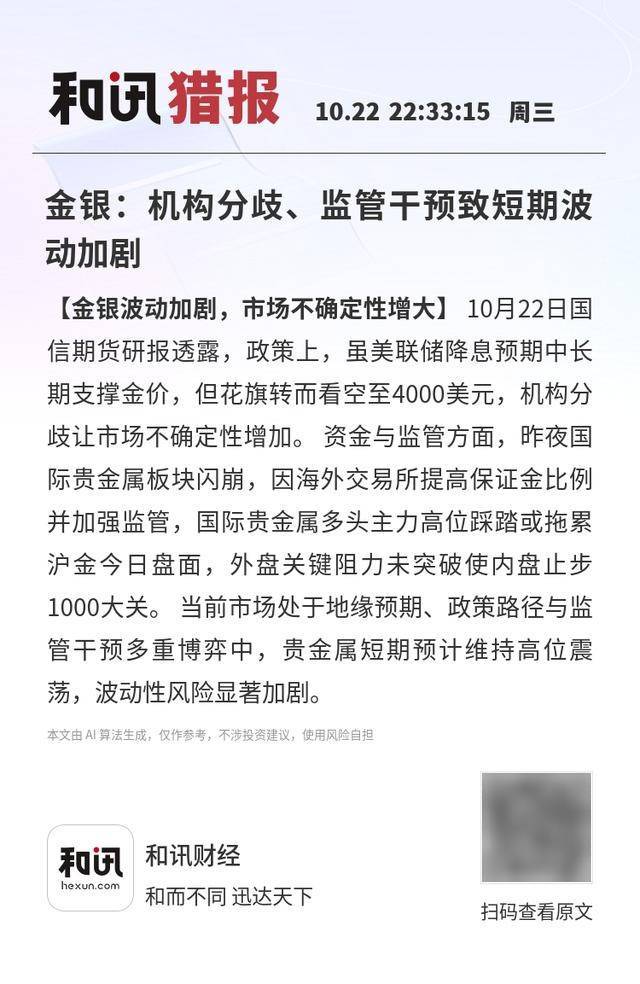
金银:机构分歧、监管干预致短期波动加剧
Sou Hu Cai Jing· 2025-10-22 15:41
Core Insights - The report indicates that while the long-term expectation of interest rate cuts by the Federal Reserve supports gold prices, Citigroup has turned bearish, projecting a price drop to $4,000, which increases market uncertainty due to institutional divergence [1][2] Market Dynamics - Recent regulatory actions have led to a sharp decline in the international precious metals sector, as overseas exchanges raised margin requirements and intensified oversight, causing significant selling pressure among long positions [1][2] - The failure to break through key resistance levels in the international market has resulted in domestic gold prices stagnating around the 1,000 mark [1][2] Short-term Outlook - The current market is characterized by a complex interplay of geopolitical expectations, policy directions, and regulatory interventions, leading to an anticipated period of high volatility and price fluctuations in precious metals [1][2]
吐血整理!anzocapital教你打造完整交易系统,告别投资焦虑
Sou Hu Cai Jing· 2025-10-14 00:19
Core Insights - A complete trading system is essential for investors, encompassing various critical elements beyond just buying and selling methods [1][5] - The trading process is fundamentally a probability game, requiring investors to manage uncertainty effectively [1][3] Trading Model Analysis - Once a trading model is selected, its logic remains relatively fixed, but adjustments may be necessary to align with market uncertainties, such as profit targets and entry/exit rules [3][5] - Rigid adherence to a single trading logic can hinder success; flexibility is crucial to adapt to changing market conditions [3] Risk Management and Capital Management - Capital management serves as a fault tolerance mechanism, allowing trading models to better adapt to market uncertainties [5] - Risk control is central to addressing market uncertainties, enabling traders to respond effectively to market changes [5] Technical Analysis - Technical tools are supportive means to enhance trading accuracy; however, excessive focus on technical analysis can be counterproductive for long-term profitability [5] - Successful traders integrate technical analysis into their routine without overemphasizing it [5] Psychological Factors - Ordinary investors often make the mistake of overly pursuing market predictions; having a strategy for unexpected market movements is crucial [7] - A positive mindset is vital for trading success, complementing the material foundations of trading models, capital management, and risk control [7] - A complete trading system should consist of trading strategies, capital management, risk control, and psychological resilience to navigate the market effectively [7]

集体暴跌!超160万人爆仓 网友哀叹:我的交易生涯结束了
Mei Ri Jing Ji Xin Wen· 2025-10-11 07:51
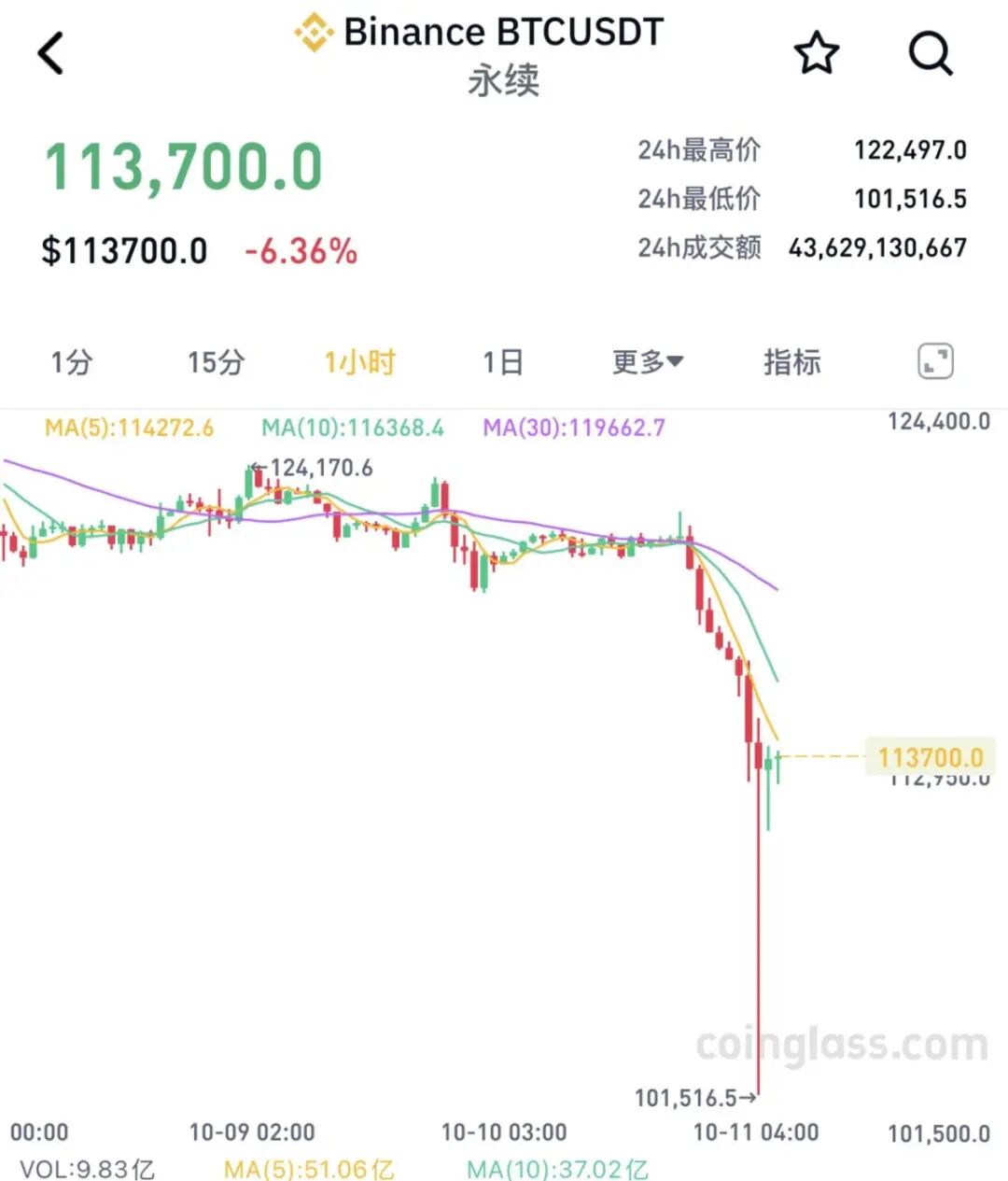
Market Overview - Smaller and less liquid tokens experienced significant declines, with Ethereum dropping over 17% and both Ripple and Dogecoin falling more than 30% [2] - The total liquidation across the market reached a record high of $19.141 billion, affecting 1.62 million traders, marking the largest forced liquidation wave since early April [3][4] Liquidation Details - Bitcoin saw liquidations of $5.317 billion, Ethereum $4.378 billion, and Solana $1.995 billion, among others [4] - The largest single liquidation occurred on the Hyperliquid platform for the ETH-USDT trading pair, valued at $203 million [3] Bitcoin Price Trends - Bitcoin's price has fluctuated significantly since 2025, with a peak near $95,000 at the beginning of the year and a drop below $80,000 in April, followed by a series of new highs [4] - The price surge has been attributed to institutional investor inflows and the increasing correlation of Bitcoin with the global financial system [4] Future Predictions - Deutsche Bank predicts that by 2030, Bitcoin and gold may become significant components of central bank reserve assets amid accelerating de-dollarization and rising safe-haven demand [5] - Bitwise forecasts a price target of $1.3 million for Bitcoin by 2035, driven by institutional demand and limited supply, with an expected annual growth rate of 28.3% over the next decade [5]
美股全线暴跌,发生了什么?
Jing Ji Wang· 2025-10-11 02:47
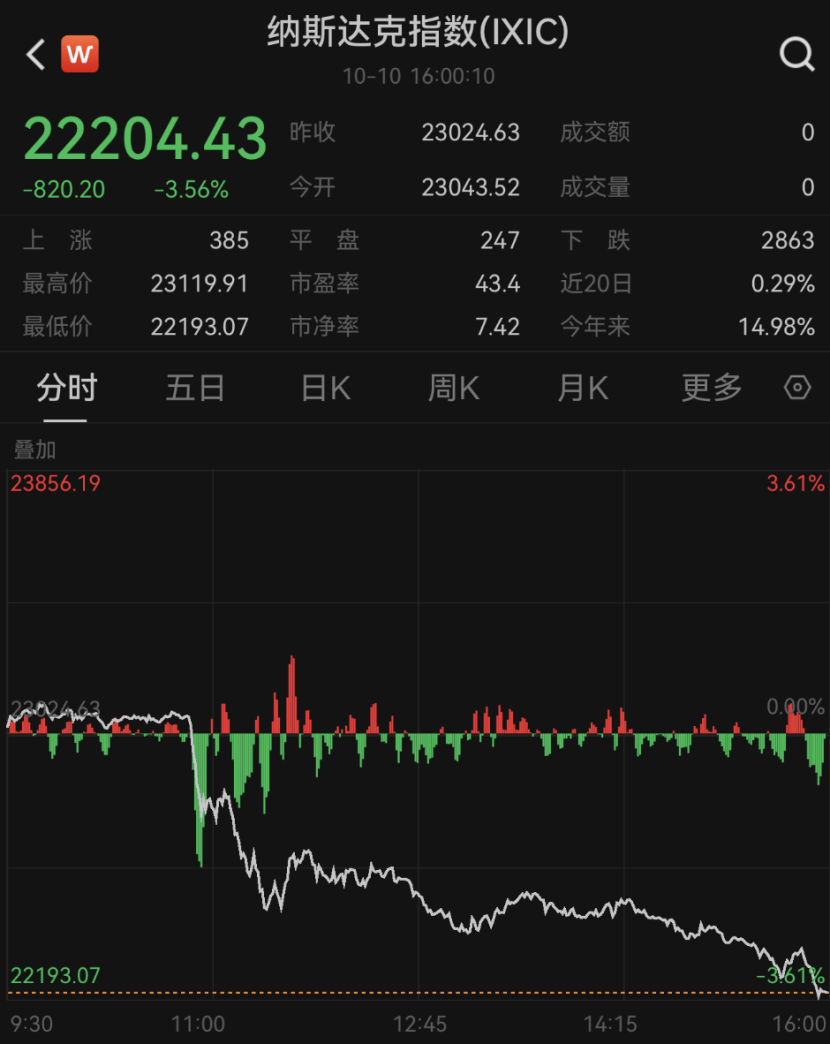
Group 1 - The U.S. stock market experienced a significant decline, with major indices falling sharply, including the Nasdaq dropping over 3%, marking its largest single-day decline since April [1][2] - Large-cap tech stocks were heavily impacted, with notable declines in companies such as TSMC ADR down over 6%, and Tesla, Nvidia, and Amazon all falling more than 4% [4] - Chinese concept stocks also suffered, with the Nasdaq Golden Dragon China Index dropping over 6%, and companies like Futu Holdings and NIO seeing declines exceeding 10% [5] Group 2 - The global financial markets faced widespread sell-offs, with the Dow Jones Industrial Average plunging over 880 points at one point, closing down 1.9% [2] - European markets also experienced declines, with the Euro Stoxx 50 Index falling 1.75% and major indices in Germany, France, and Italy dropping over 1% [5] - Commodities such as oil and cryptocurrencies were severely affected, with WTI crude oil falling over 4% and Bitcoin experiencing a drop of over 13% [5] Group 3 - The uncertainty in the market has led to increased demand for protective derivatives, with investors shifting towards safe-haven assets like gold and U.S. Treasuries [6] - Gold prices rose over 1%, surpassing $4000 per ounce, while the yield on the 10-year U.S. Treasury fell to 4.034% [6] Group 4 - Analysts noted that the market had built up significant profit-taking potential due to a strong performance since April, leading to expectations of a correction [7] - The U.S. government shutdown has escalated, with the Trump administration implementing large-scale permanent layoffs of federal employees, affecting thousands across multiple departments [7][8] - The Michigan Consumer Sentiment Index for October was reported at 55, the lowest since May, indicating stagnant consumer confidence amid expectations of rising unemployment and inflation [9]