数字经济

Search documents
数字经济周报(2026年第7期):GTC2026亮点:AI从芯片竞争迈向系统竞争-20260323
Yin He Zheng Quan· 2026-03-23 11:40
Core Insights - The GTC 2026 conference marks a shift in AI competition from chip-based to system-based, establishing a trend towards platformization of computing infrastructure [2][4] - The AI industry is entering a high-growth expansion phase, driven by increasing demand for computing power and capital investment [2][3] - The digital economy in China is fostering collaborative growth across the industrial chain, with a deepening integration of data elements and industries [2][4] - Global competition in AI is accelerating towards a systematic evolution, with parallel expansion of AI standards and computing infrastructure [2][4] Section Summaries Focus of the Report: GTC 2026 Driving AI Infrastructure Competition Upgrade - The GTC 2026 conference emphasizes the transition from chip upgrades to system upgrades in AI infrastructure, confirming the trend towards platformization [4] - The demand structure for AI is shifting from training-dominated to inference-driven, indicating a change in the nature of AI requirements [4] - The concept of physical AI is gaining traction, with accelerated implementation in real-world systems [4] AI Industry and Representative Company Dynamics - The global AI model token usage has reached a record high of 18.2 trillion calls, indicating explosive growth in demand [17] - The competitive landscape is solidifying around a dual-engine model driven by the US and China, with a significant shift in competitive focus [17] - Major AI companies are experiencing a surge in performance, infrastructure investment, and strategic positioning within the ecosystem [23] China Dynamics: Digital Economy Driving Collaborative Growth - The digital economy is enhancing collaborative growth across various sectors, with a focus on integrating data elements into industrial processes [2][4] Overseas Dynamics: US Launches "AI Export Plan" - The US is initiating an "AI export plan," which is expected to influence global AI standards and infrastructure development [2][4] Technological Frontiers: Breakthroughs in Intelligent Agents and Multimodal Models - Significant advancements are being made in intelligent agents and multimodal foundational models, which are crucial for the future of AI applications [2][4] Think Tank Perspectives: Data Governance in the Era of AI Agents - The increasing penetration of AI applications in educational contexts is prompting a reevaluation of cognitive capabilities and governance models [2][4]
铁矿日报:短期扰动因素较多,基本面压力仍存-20260323
Guan Tong Qi Huo· 2026-03-23 11:31
1. Report Industry Investment Rating - Not provided in the content 2. Core View of the Report - Iron ore fundamentals are still weak, with a loose supply and rising hot metal production on the demand side. Attention should be paid to the support of peak - season demand. Under the dual disturbances of supply and geopolitics, it's difficult to trade based on fundamental logic. The iron ore futures and spot show a positive basis and the BACK structure continues, with limited short - term downside space and a high - level oscillation pattern. Focus on further tests near the upper pressure [4] 3. Summary by Relevant Catalogs Market行情态势回顾 - Futures price: The main contract of iron ore futures oscillated slightly stronger during the day, closing at 819 yuan/ton, up 3.5 yuan/ton or 0.43% from the previous trading day's closing price. The trading volume was 263,000 lots, the open interest was 442,000 lots, and the settled funds were 7.963 billion yuan. The short - term support is around 795 and the short - term pressure is around 825 [1] - Spot price: The mainstream port spot varieties, Qingdao Port PB powder, remained unchanged at 798 yuan, and Super Special powder remained unchanged at 675 yuan. The main swap contract was 108.25 (+0) US dollars/ton. The swap was in high - level oscillation and the spot price remained unchanged [1] - Basis and spread: The converted futures price of Qingdao Port PB powder was 829.1 yuan/ton, with a basis of 10.1 yuan/ton, and the basis slightly shrank. The iron ore 5 - 9 spread was 32.5 yuan, and the 9 - 1 spread was 24 yuan [1] Fundamental Analysis - Supply: Iron ore shipments increased month - on - month, while arrivals decreased. The shipping plans of mines were affected by the US - Iran conflict, and some cargo ships changed their destinations. Although the overall supply was still relatively loose, the shipment and arrival rhythm was affected, and the liquidity of some spot varieties was limited [2] - Demand: Hot metal production significantly rebounded, and the profitability rate of steel mills increased. After the Two Sessions ended, the environmental protection restrictions in Hebei were lifted, and the blast furnaces under maintenance resumed production. There was still room for the recovery of hot metal production, depending on the support of peak - season demand [2] - Inventory: Port inventory and berthing decreased slightly, while steel mill inventory increased. Without significant disturbances, it was difficult for the total inventory to show obvious destocking [2] Macro - level - Domestic: The "15th Five - Year Plan" outline was announced, raising the target of the added value ratio of the core digital economy industries, adding indicators related to people's livelihood, childcare, elderly care, and green non - fossil energy. The current domestic macro - economy is generally stable and has entered the verification period of fundamental reality. Domestic port container throughput and the CRB index are at seasonal highs, and the strong exports of South Korea in early March confirm the resilience of external demand [3] - Overseas: The US - Iran geopolitical conflict continues, and the expected reduction in crude oil supply continues to push up oil prices. The Fed's interest rate decision in March was hawkish, increasing the market's expectation of "stagflation" in the US economy in the second quarter, and the overseas economic operation logic will gradually shift from trading "inflation" to "stagflation" [3]
北交所定期报告20260321:市场波动加剧,聚焦低估值优质个股
Soochow Securities· 2026-03-22 07:45
Market Performance - As of March 20, 2026, the North Exchange 50 Index fell by 5.76% compared to the previous week, while the Shanghai and Shenzhen 300 Index decreased by 2.19%[18] - The average market capitalization of North Exchange A-share component stocks is 2.799 billion yuan, with a daily average trading volume of approximately 15.907 billion yuan, down 19.37% from the previous week[18] - The turnover rate for North Exchange A-shares is 3.97%, a decrease of 0.2 percentage points from the previous week, indicating better liquidity compared to other major markets[18] Investment Recommendations - The price-to-earnings (PE) ratios for North Exchange A-shares, ChiNext, Shanghai Main Board, Shenzhen Main Board, and Sci-Tech Innovation Board are 51.51, 71.44, 13.87, 41.19, and 216.33 respectively as of March 20, 2026[28] - Investors are advised to focus on stocks with better-than-expected performance and those with significant technological barriers and alignment with industrial policies in innovative growth sectors[28] Economic Insights - The National Bureau of Statistics reported a 14.2% year-on-year increase in the value added of the computer, communication, and other electronic equipment manufacturing industries for January and February 2026[10] - The Ministry of Industry and Information Technology aims for the number of fuel cell vehicles in China to reach 100,000 by 2030, with hydrogen prices targeted to drop below 25 yuan per kilogram[11] New Listings - Zuxing New Materials (stock code: 920078.BJ) was listed on March 18, 2026, focusing on aluminum pigments and fine spherical aluminum powder[25] - Xinhengtai (stock code: 920028.BJ) was listed on March 20, 2026, specializing in functional polymer foaming materials[26]
中金• 全球研究 | 跨国公司成长启示录上篇(二):美欧日跨国公司观察
中金点睛· 2026-03-19 23:55
Core Insights - The article summarizes the successful experiences of multinational corporations (MNCs) from the US, Europe, and Japan, providing insights for Chinese companies in their globalization efforts. It highlights the common motivations for going global, such as overcoming growth ceilings, avoiding trade barriers, and optimizing cost structures, while also noting the distinct paths taken by different economies based on their unique resources and institutional frameworks [3]. Group 1: United States - US companies focus on high value-added sectors and technological leadership, driven by the need to counter domestic antitrust regulations and optimize production factors. The emphasis on supply chain security has become increasingly important in overseas investment decisions [3][4]. - The US has established a strong technological moat in high value-added fields, particularly in the tech industry, characterized by leading advantages, global tech discourse control, and a shift towards digital economy-driven globalization [3][4][18]. - As of 2022, US MNCs had nearly 40,000 foreign affiliates, generating over $27 trillion in revenue and $3 trillion in net profit, with significant contributions from Europe and the Asia-Pacific region [10][12]. Group 2: Europe - European companies expand overseas primarily due to limited domestic resources and high production costs, necessitating global resource integration to maintain competitiveness [4][42]. - The technological foundation of European firms is characterized by comprehensive capabilities that span from basic research to industrial application, creating significant barriers across the value chain [4][44]. - As of 2023, EU MNCs had over 200,000 foreign affiliates, generating nearly €20 trillion in revenue, with a significant portion coming from intra-European markets [45][49]. Group 3: Japan - Japanese companies transitioned from a "trade nation" to an "investment nation," driven by internal market saturation and external pressures such as trade friction and currency appreciation, prompting a shift towards overseas production [5][65]. - The localization of production has been crucial for Japanese firms, particularly in the automotive sector, achieving an 80% localization rate in overseas production [5][66]. - Japan's unique globalization path emphasizes capital and knowledge-intensive industries, with a focus on lean manufacturing and integrated support from trading companies [5][66].







全球最大电子级玻纤生产线点火,占全球产能9%
第一财经· 2026-03-19 12:58
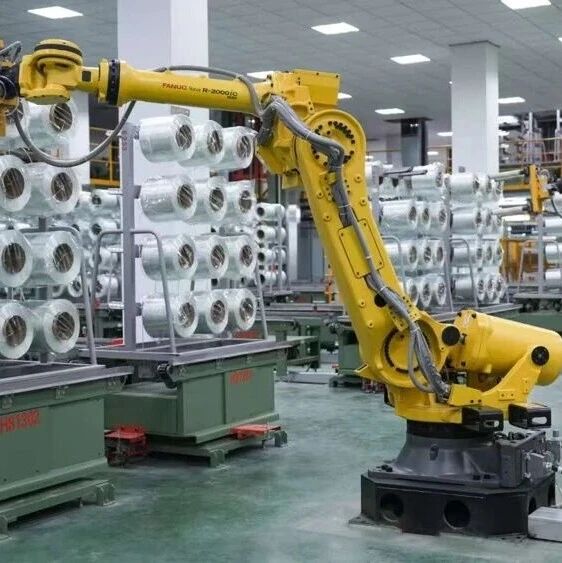
Core Viewpoint - The successful ignition of China's Jushi's 100,000-ton electronic-grade fiberglass production line in Huai'an marks a significant advancement in the global electronic fiberglass market, with the production line accounting for 9% of the global market and being the largest of its kind worldwide [3][4]. Group 1: Production and Market Impact - The new production line will increase Jushi's market share in electronic fiberglass to approximately 28%, enhancing its position in the global market [4]. - This production line is part of the world's first zero-carbon intelligent manufacturing base for fiberglass, aimed at supporting emerging industries such as consumer electronics, 5G communications, and industrial control [3]. Group 2: Technological Advancements - The project integrates advanced technologies including proprietary high-performance glass formulations, large-scale melting furnaces, and smart manufacturing, achieving 100% independent intellectual property rights [5]. - The use of industrial internet, AI quality inspection, and digital twin technologies enables full-process intelligence, significantly improving production efficiency and reducing energy consumption [5]. Group 3: Strategic Importance - Electronic-grade fiberglass is a critical strategic material for printed circuit boards (PCBs), which serve as the physical and electrical connection for all electronic components [5]. - The performance of electronic-grade fiberglass directly influences the dielectric properties, thermal expansion coefficients, and reliability of PCBs, making it essential for the digital economy [5]. Group 4: Future Directions - The company aims to focus on breakthroughs in next-generation electronic fabric core technologies during the 14th Five-Year Plan, collaborating with downstream customers and research institutions to enhance the safety and autonomy of China's electronic information industry chain [5].

习近平会见土库曼斯坦民族领袖、人民委员会主席别尔德穆哈梅多夫
国家能源局· 2026-03-19 00:33
Group 1 - The core viewpoint of the article emphasizes the strengthening of the comprehensive strategic partnership between China and Turkmenistan, highlighting mutual support as a key principle [4][5] - The article discusses the successful convening of China's National People's Congress and the approval of the "14th Five-Year Plan," which is expected to benefit both China and the world [3] - It mentions the commitment to enhance cooperation in various sectors, including energy, trade, digital economy, and clean energy, as part of the Belt and Road Initiative and the revival of the Silk Road strategy [4] Group 2 - The article notes that Turkmenistan has maintained its independence and sovereignty while pursuing a development path that aligns with its national conditions, celebrating 35 years of independence [3] - It highlights Turkmenistan's commitment to the One China principle and its willingness to strengthen strategic alignment with China, particularly in energy and trade [5] - The article underscores the importance of multilateral cooperation, with both countries expressing a desire to work together within platforms like the United Nations to maintain regional and global peace [5]

英伟达GTC大会释放算力升级信号,数字经济ETF鹏扬(560800)早盘涨0.51%
Xin Lang Cai Jing· 2026-03-18 02:13
Group 1 - The core viewpoint of the news highlights the positive performance of the digital economy theme index and its constituent stocks, with notable increases in stocks like Zhaoyi Innovation and Lanke Technology [1] - As of March 17, the digital economy ETF Pengyang has seen an average daily trading volume of 18.13 million yuan over the past year, indicating strong market interest [1] - The digital economy ETF Pengyang has experienced a significant increase in shares, growing by 6 million shares in the past week [1] Group 2 - Nvidia's GTC 2026 conference has signaled an upgrade in AI inference computing power, introducing the Groq 3 LPU architecture and emphasizing low latency and high throughput capabilities [1] - The shift in AI computing construction from training-intensive to inference-intensive is expected to raise demands for domestic computing hardware, high-speed interconnect PCBs, liquid cooling systems, and AI foundational software [1] - Citic Securities forecasts a high certainty in computing power development for 2026, identifying a pivotal opportunity for supernode technology and an increase in competitiveness among domestic computing manufacturers [2] - The CSI Digital Economy Theme Index tracks companies involved in digital economy infrastructure and high digitalization applications, reflecting the overall performance of digital economy-related securities [2] - As of February 27, 2026, the top ten weighted stocks in the CSI Digital Economy Theme Index account for 51.76% of the index, with companies like Dongfang Wealth and Cambricon leading the list [2]

瞄准Z世代,巨头欧莱雅“淘金”广州美妆产业
2 1 Shi Ji Jing Ji Bao Dao· 2026-03-17 11:52
Core Viewpoint - The article highlights the launch of L'Oréal China's "Beauty Career, Beautiful Life" beauty training program in Guangzhou, focusing on integrating Cosplay makeup skills with local industry needs, particularly for women in challenging situations [2][5]. Group 1: Program Overview - The program aims to address the growing demand for Cosplay makeup professionals, creating new job opportunities such as "makeup artists" and "costume designers" in the booming second-dimensional culture [2][3]. - The training will include not only traditional beauty skills but also e-commerce operations and artificial intelligence courses, aligning with the local industry's talent requirements [2][3]. - The initiative is part of a broader effort to empower women and enhance their employability in emerging cultural economies [2][4]. Group 2: Community and Employment Impact - The "Beauty Station" established in Guangzhou serves as an incubator for accelerating employment, fostering a community network for mutual support [4][7]. - The program has already benefited over 14,600 women in the past decade, providing free beauty and hairdressing skills training [5][6]. - The employment rate for graduates of the program has reached over 80%, with ongoing support provided to ensure their career growth [7]. Group 3: Industry Context - The "14th Five-Year Plan" emphasizes the development of new cultural formats such as digital animation and immersive performances, positioning Guangzhou as a hub for the animation and gaming industry [2][3]. - The local government is enhancing support for the digital economy and beauty industry, creating a solid foundation for women's employment and career development [7].

每日市场观察-20260317
Caida Securities· 2026-03-17 05:11
Market Overview - On March 16, the Shanghai Composite Index fell by 0.26%, while the Shenzhen Component Index rose by 0.19% and the ChiNext Index increased by 1.41%[4] - The total trading volume on March 16 was 2.34 trillion yuan, a decrease of approximately 80 billion yuan from the previous trading day[1] Sector Performance - The semiconductor sector, particularly power semiconductors, showed strong performance, with price increases expected from major foundries starting in April[2] - The food and beverage, electronics, and social services sectors saw gains, while steel, non-ferrous metals, construction, chemicals, and coal sectors experienced declines[1] Geopolitical Impact - The geopolitical situation in the Strait of Hormuz is affecting global energy markets and suppressing risk appetite in financial markets[1] - Despite short-term impacts, China's assets are expected to become a safe haven due to strong manufacturing supply chains and ample market liquidity[1] Fund Flows - On March 16, net outflow from the Shanghai Stock Exchange was 4.645 billion yuan, while the Shenzhen Stock Exchange saw a net inflow of 11.407 billion yuan[5] - The semiconductor, components, and communication equipment sectors attracted the most capital inflows, while power, infrastructure, and photovoltaic equipment sectors faced the largest outflows[5] Economic Indicators - In January-February 2026, the manufacturing value added in the computer, communication, and other electronic equipment sectors grew by 14.2% year-on-year[9] - The electricity and heat production and supply sector's value added increased by 5.1% year-on-year, accelerating by 4 percentage points compared to December 2025[10] Real Estate Market - In February 2026, the sales prices of new residential properties in 70 large and medium-sized cities continued to narrow their month-on-month decline, with first-tier cities showing signs of stabilization[12][13] Hydrogen Energy Development - By 2030, the number of fuel cell vehicles in China is expected to double compared to 2025, aiming to reach 100,000 vehicles[14] Fund Management Trends - Public funds have purchased over 1 billion yuan of their own funds this year, with equity funds accounting for nearly 90% of the total[16]
经济开门红——全面解读1-2月经济数据
泽平宏观· 2026-03-16 16:06
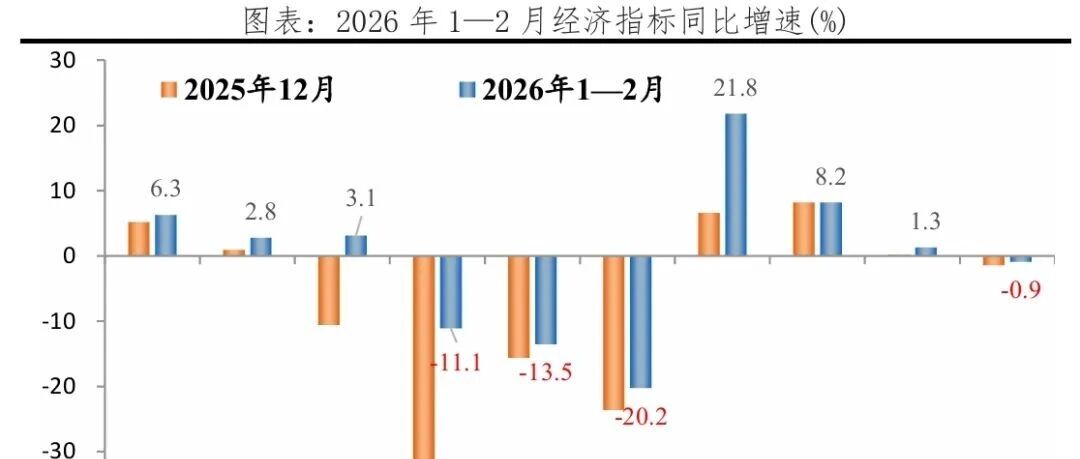
Economic Overview - The national economy showed a "new strong, old weak, external strong, internal stable" trend in the first two months of 2026, with high-tech manufacturing and equipment manufacturing leading the growth [2][3] - Industrial production accelerated, with a year-on-year increase of 6.3% in industrial added value, up 1.1 percentage points from December [2][8] - Fixed asset investment turned positive, growing by 1.8% year-on-year, a significant recovery of 16.9 percentage points from December [2][12] Industrial Production - High-tech manufacturing and equipment manufacturing sectors experienced significant growth, with high-tech manufacturing value-added increasing by 13.1% year-on-year [6][9] - The production of upstream raw materials improved due to rising international oil prices, while midstream machinery and equipment sectors benefited from policy effects [9][10] Investment Trends - Fixed asset investment (excluding rural households) showed a year-on-year increase of 1.8%, with high-tech industry investment growing by 5.1% [12][20] - Infrastructure investment surged by 11.4% year-on-year, driven by the acceleration of major projects and statistical adjustments [17][18] Real Estate Market - The decline in real estate investment narrowed, with sales area and sales amount decreasing by 13.5% and 20.2% respectively, but showing improvement from December [15][16] - Real estate companies are still cautious in land acquisition, with a significant drop in land transaction volume [16] Export Performance - Exports exceeded expectations, with a year-on-year growth of 21.8%, driven by global manufacturing recovery and enhanced competitiveness [25][26] - Exports to countries along the Belt and Road increased by 28.5%, accounting for over 50% of total exports [25][26] Consumer Spending - Social retail sales increased by 2.8% year-on-year, with service consumption performing well due to the long Spring Festival holiday [23][24] - Traditional consumer goods saw a significant demand boost during the holiday period, with restaurant income rising by 4.8% [23] Financial Data - Social financing maintained a stable growth rate of 8.2%, supported by government bonds and bank loans [28][29] - M2 growth remained at 9.0%, while M1 increased by 5.9%, indicating a shift in deposit trends towards non-bank institutions [29] Price Trends - CPI rose by 1.3% year-on-year, the highest in nearly three years, influenced by the timing of the Spring Festival [31][32] - PPI decline narrowed, reflecting input inflation and strong demand in certain technology sectors [31][32]