
逆周期因子

Search documents
美弱就业与关税缓和支撑人民币
Hua Tai Qi Huo· 2025-08-15 02:20
Report Industry Investment Rating No relevant content provided. Core Views of the Report - The short - term exchange rate of the US dollar against the RMB is expected to fluctuate within the range of 7.15 - 7.25. The counter - cyclical factor has been activated, and with the regulatory's expectation management, the RMB's short - term buffer against external shocks has increased [36][39]. Summary by Related Catalogs Quantity and Price Observation - The implied volatility curve of the 3 - month US dollar against the RMB option shows an appreciation trend of the RMB, with the put - end volatility higher than the call - end. The volatility of the US dollar against the RMB option has continued to decline, and the market's expectation of the future volatility of the US dollar against the RMB has weakened [4]. - The term structure shows the changes in the premium and discount of the Singapore Exchange's US dollar against the RMB futures, bank forward premium and discount, and the US - China interest rate spread in different time periods [7][8]. Policy Observation - The policy counter - cyclical factor has been activated, and there are fluctuations in the three - month CNH HIBOR - SHIBOR spread [11]. Macroeconomic Analysis US Economy - There is a differentiation in the pricing of interest rate cuts between the US and Europe. As of August 6, the TGA account was 464.3 billion, and the Fed's reverse repurchase balance was 9.196 billion US dollars. Fed Chairman Powell did not give guidance on a September interest rate cut [19]. - The economic expectation has been revised upwards. In July, non - farm data was significantly revised downwards, inflation rebounded, fiscal spending increased significantly, and the economic situation showed marginal support [21]. - Fiscal spending has rebounded, especially in defense, medical insurance, and healthcare [22]. - The employment market in July was significantly revised downwards. The employment performance of the service sector was better than that of the commodity and government sectors, and the hourly wage in July increased by 0.3% month - on - month [28]. Chinese Economy - There is a situation of strong expectation and weak reality. In July, exports and consumption showed resilience, but inflation has not recovered, and there is pressure on fixed - asset investment [29]. - Exports in July exceeded expectations. Financial data was better than expected, with changes in exports to different regions and products [31]. European Economy - The downside risks have been cleared. Economic data is oscillating at the bottom, with the manufacturing and service PMIs in Europe rebounding in July. Inflation is stable, with the eurozone's CPI in July increasing by 2% year - on - year and the core CPI increasing by 2.3% year - on - year [34]. Scenario Deduction - There are different time - based scenarios including the Fed's policy window period, the destocking cycle, tariff impacts, and domestic policy windows [40][41]. Risk Assessment - The range of basis fluctuations: From the historical data from January 2022 to the present, the range of the premium and discount of the futures main contract is between - 1100 and 900 [45].
汇率:中间价释放升值信号、资金押注补涨
Soochow Securities· 2025-07-28 15:26
Exchange Rate Trends - The RMB central parity rate has shown a gradual appreciation since July, with the rate breaking 7.14, indicating a strong upward signal[2] - The USD/CNY exchange rate has fluctuated around 7.17, reflecting a "strong central rate, weak spot rate" dynamic[7] - The central parity rate has increased by 0.23% since July 1, 2025, reaching a low of 7.1385, the lowest since November 2024[7] Cross-Border Capital Flows - In the first half of 2025, the net inflow of foreign exchange was $30.89 billion, with a trade surplus of $43.57 billion from January to June[24] - The average active settlement rate for export enterprises was 47.13% in the first half of 2025, down from 48.37% in the same period of 2024[26] - The forward settlement scale increased by $44.33 billion from April to June 2025, indicating expectations of RMB appreciation[28] Foreign Investment and Market Sentiment - Foreign investment in domestic stocks and funds reached a net increase of $10.1 billion in the first half of 2025, reversing a two-year trend of net selling[34] - The net inflow from securities investment projects was $18.06 billion in the first half of 2025, with a surplus of $7.736 billion in June alone[38] Risk Factors - Potential risks include fluctuating U.S. tariff policies, unclear Federal Reserve interest rate paths, and the impact of non-U.S. currency movements on the RMB[40] - The average holding cost of the "waiting for settlement" funds is approximately 7.05, with a total scale of about $400 billion as of June 2025[32]
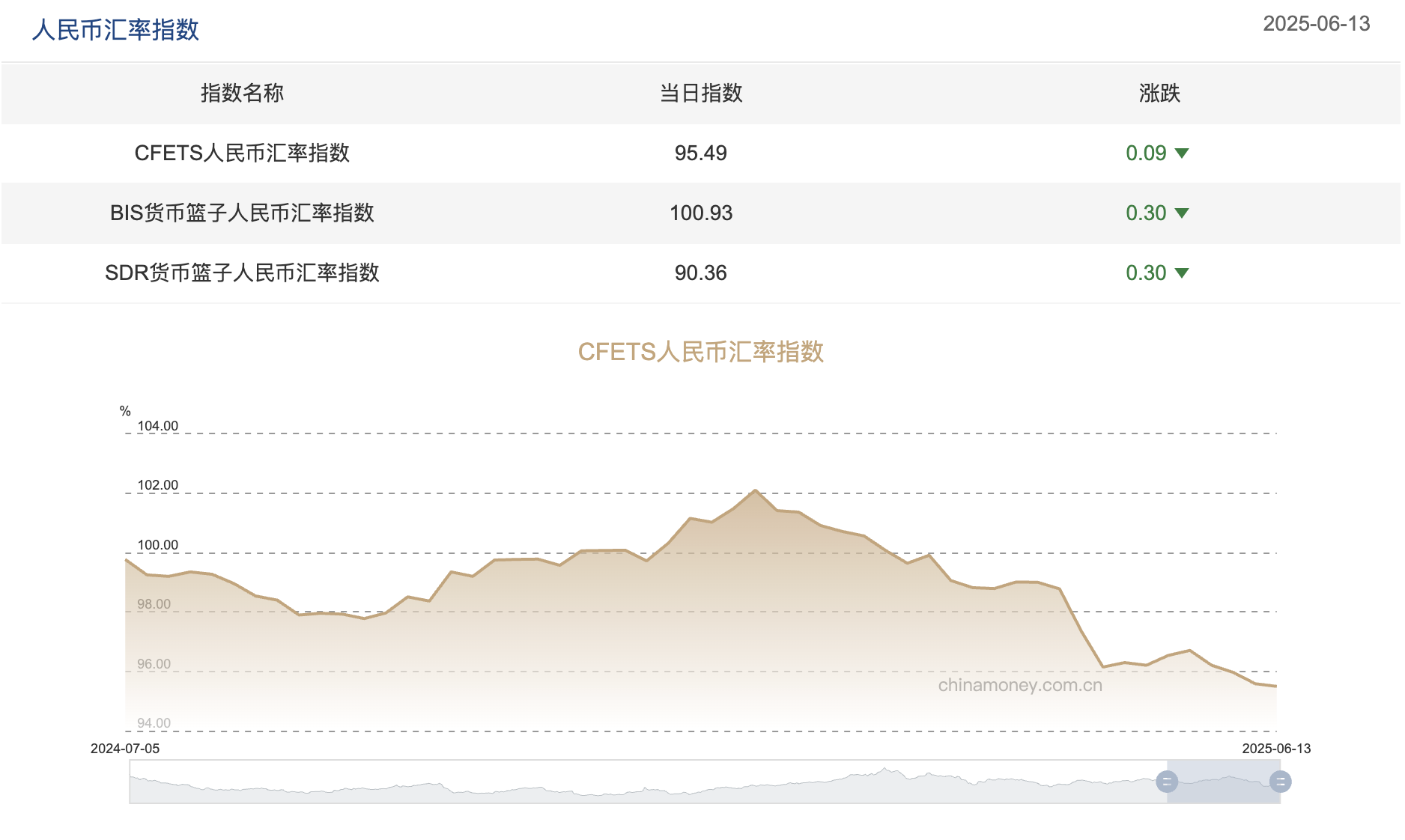
三大人民币汇率指数全线下跌,CFETS按周跌0.09
Xin Hua Cai Jing· 2025-06-16 03:36
Core Points - The three major RMB exchange rate indices all declined in the week of June 13, with the CFETS index at 95.49, the BIS index at 100.93, and the SDR index at 90.36, marking their lowest levels since December 2020, July 2023, and August 2020 respectively [1][2] Exchange Rate Trends - The USD briefly fell below its annual low but recovered due to escalating tensions in the Middle East, ending the week down over 1% at 98.15. Non-USD currencies rose, with the Swiss franc and Japanese yen gaining 1.34% and 0.54% respectively, and the euro rising 1.33% [5] - The RMB against the USD showed a middle price of 7.1772, up 73 points for the week, while the onshore and offshore RMB closed at 7.1813 and 7.18955, with slight fluctuations [5] Analyst Insights - Analysts express optimism for the RMB's future, suggesting that the policy to maintain exchange rate "resilience" will likely keep the RMB's volatility low in the second half of the year. The RMB's nominal exchange rate remains competitive due to adjustments through low inflation [6][7] - Predictions for the USD/RMB exchange rate by the end of 2025 are set at 6.98, with expectations of structural opportunities for RMB assets and offshore RMB capital markets amid a trend of de-dollarization [7] Domestic Economic Indicators - In May, the Consumer Price Index (CPI) fell by 0.2% month-on-month and 0.1% year-on-year, primarily due to a 1.7% drop in energy prices [8] - The Producer Price Index (PPI) also decreased by 0.4% month-on-month and 3.3% year-on-year, influenced by international factors and domestic energy price declines [8] - As of the end of May, the broad money supply (M2) was 325.78 trillion yuan, growing by 7.9% year-on-year, while the narrow money supply (M1) was 108.91 trillion yuan, up 2.3% year-on-year [8]

扰动钝化下的双向试探
Hua Tai Qi Huo· 2025-06-13 03:25
Market Observations - The implied volatility of USD/CNY options has been declining, indicating reduced market expectations for future volatility[4] - The current three-month USD/CNY implied volatility is at 0%[6] Policy Insights - The counter-cyclical factor is hovering around 0%, suggesting limited intervention in the currency market[10] - The three-month CNH HIBOR-SHIBOR differential shows a fluctuating trend with no clear direction[14] Macroeconomic Trends - The Federal Reserve is pricing in a 43.5 basis point rate cut by 2025, reflecting a slight decrease in expectations for rate cuts[18] - The U.S. economy is showing signs of marginal decline, with recent economic activity slightly down and concerns over consumer spending and labor market stability[21] Employment Data - The U.S. non-farm payrolls showed a moderate decline in May, with the unemployment rate holding steady at 4.2%[22] - Average hourly earnings increased by 0.4% month-on-month, contributing to inflationary pressures[22] Fiscal Developments - The U.S. Congressional Budget Office estimates a $2.4 trillion increase in deficits from 2025 to 2034 due to new legislation[23] - The proposed legislation includes significant tax reforms and spending cuts, which may impact economic growth and federal revenue[24]
人民币缓升!美元进入熊市?
第一财经· 2025-06-09 15:08
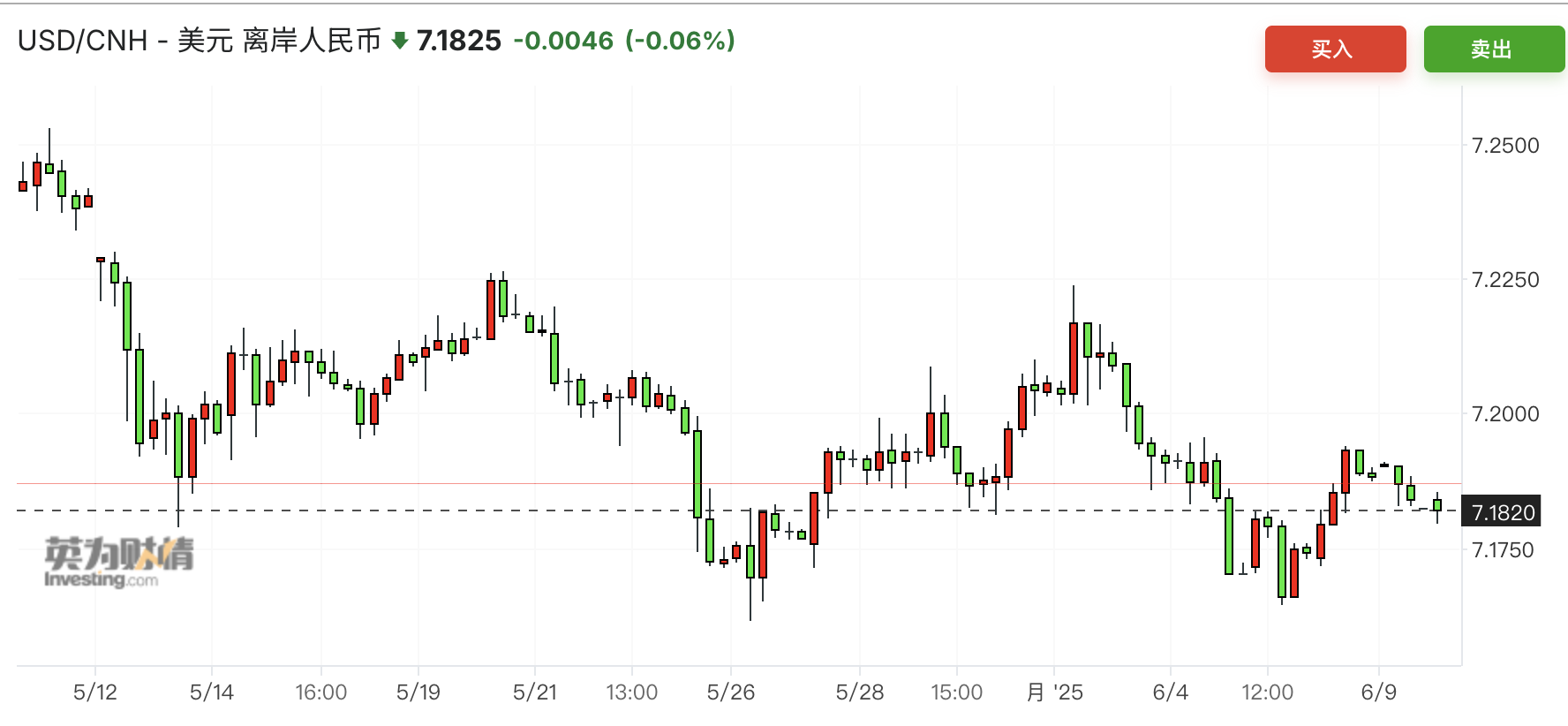
Core Viewpoint - The article discusses the recent strengthening of the Chinese yuan against the US dollar, attributing it to a weaker dollar and a shift in market expectations regarding the yuan's value. The article highlights that the counter-cyclical factor's influence on the yuan's midpoint has nearly diminished, indicating less need for regulatory intervention in currency management [1][3][5]. Group 1: Currency Dynamics - As of June 9, the USD/CNY exchange rate was reported at 7.1831, with the dollar index at 98.8, reflecting a nearly 10% decline from its peak [1]. - The counter-cyclical factor's shadow variable was reported at -37 points, a significant reduction from over -100 points the previous week, indicating a decrease in regulatory influence on the yuan's midpoint [1][5]. - Goldman Sachs projects a 3% appreciation of the yuan to 7.0 within the next 12 months, alongside expectations of a 10 basis point interest rate cut in China [5]. Group 2: Trade and Economic Indicators - China's exports in May grew by 4.8% year-on-year, below the expected 6.0%, while imports fell by 3.4%, indicating a shift in trade dynamics [7]. - The decline in exports to the US has intensified, with a year-on-year drop of 35.2% in May compared to a 20.9% decline in April, suggesting a pivot towards other developed markets [7]. - The upcoming trade negotiations between China and the US remain uncertain, with potential impacts on the yuan's valuation [8]. Group 3: Market Sentiment and Investment Trends - There is a growing interest from foreign investors in the Chinese stock market, particularly in sectors like new consumption, AI, and innovative pharmaceuticals, indicating a potential for increased capital inflow [8]. - Current global active long-term funds are underweight in China by 2.4 percentage points compared to the MSCI EM benchmark, suggesting significant room for reallocation towards Chinese assets [8]. - The article notes that while the dollar is expected to weaken further, the pace of this decline may not be immediate, with potential fluctuations influenced by trade negotiations and economic conditions [9][12].

时隔两年逆周期因子归零!人民币缓升,美元进入长期熊市?
Di Yi Cai Jing· 2025-06-09 12:34
Core Viewpoint - The recent strengthening of the Renminbi (RMB) is primarily driven by market supply and demand, coinciding with a period of weakness for the US dollar, with expectations for the RMB to follow fluctuations in the dollar index [1][5]. Exchange Rate Dynamics - As of June 9, the USD/RMB exchange rate was reported at 7.1831, with the dollar index at 98.8, reflecting a nearly 10% decline from its recent peak [1]. - The RMB's central parity rate was reported at 7.1855, with the counter-cyclical factor's influence diminishing significantly, indicating a shift towards a more market-driven exchange rate [3]. Market Sentiment and Predictions - Analysts express a consensus that the US dollar is likely to remain weak, with potential further declines if the Federal Reserve lowers interest rates [1][5]. - Goldman Sachs projects a 3% appreciation of the RMB over the next 12 months, targeting an exchange rate of 7.0 [5]. Trade and Economic Indicators - China's exports in May grew by 4.8% year-on-year, below the expected 6.0%, while imports fell by 3.4%, indicating a shift in trade dynamics [8]. - The decline in exports to the US has intensified, with a year-on-year drop of 35.2% in May, compared to a 20.9% decline in April [8]. Investment Trends - There is a growing interest from foreign investors in the Chinese stock market, particularly in sectors like new consumption, AI, and innovative pharmaceuticals [9]. - Current allocations to China from global active long-term funds are underweight compared to the MSCI Emerging Markets benchmark, suggesting significant potential for increased investment [9]. Future Considerations - The future trajectory of the USD index, China's economic fundamentals, and capital inflows will be critical in determining the RMB's performance [8]. - The ongoing trade negotiations and their outcomes remain uncertain, which could impact market sentiment and currency valuations [8].
2025年Q2
Hua Tai Qi Huo· 2025-05-14 11:06
1. Report Industry Investment Rating - Not provided in the content 2. Core Viewpoints of the Report - China's foreign exchange reform has gradually established a dynamic equilibrium exchange rate system that emphasizes both market - led pricing and macro - prudential management through a series of reforms from 2015 to 2022 [14] - The RMB exchange rate is affected by international payments, interest rate parity, and relative economic strength. When these three factors are in the same direction, it is more likely to form a trend of appreciation [194] - The offshore RMB market's liquidity is supported by cross - border trade settlement for long - term growth and central bank support and market financing for short - term stability [87] 3. Summary by Relevant Catalogs 3.1 Foreign Exchange Reform - China's foreign exchange reform includes the improvement of the mid - price mechanism in 2015, the introduction of the counter - cyclical factor in 2017, the dynamic adjustment of cross - border financing macro - prudential parameters in 2019, and the strengthening of the foreign exchange risk reserve system in 2022 [14] - The mid - price mechanism combines the previous day's closing price and the change of a basket of currencies, which makes the mid - price close to the market and takes into account external stability [21] - The counter - cyclical factor guides market rational expectations, weakens the self - reinforcement mechanism of pro - cyclical behavior, and enhances the resilience and stability of the exchange rate mechanism [24] - Since the launch of the LPR reform in August 2019, the loan quotation mechanism has become more market - oriented, breaking the "implicit lower limit" of loan interest rates [27] - The adjustment of cross - border financing macro - prudential parameters aims to increase cross - border financing quotas, relieve RMB depreciation pressure, and optimize the asset - liability structure of domestic entities [32] 3.2 Domestic RMB Foreign Exchange Market - The RMB foreign exchange market is divided into the bank - to - customer market and the inter - bank market. The inter - bank market has high liquidity and large trading volume [41] - The inter - bank foreign exchange derivatives market has developed since 2005, with swap transactions being the most important trading method [62] - In the spot market, the willingness of enterprises to settle foreign exchange has weakened, and the demand for purchasing foreign exchange has increased. In the forward market, enterprises tend to lock in the cost of purchasing foreign exchange in advance [66] - Short - term foreign exchange derivatives dominate the market, mainly meeting the short - term foreign exchange capital allocation and risk management needs of banks and enterprises [81] 3.3 Offshore RMB Market - The long - term liquidity of the offshore RMB market is mainly supplied by cross - border trade settlement, and the short - term liquidity is obtained through market financing and official support [87] - The offshore RMB market has various products, including CNH spot, RMB offshore non - deliverable forward, RMB offshore deliverable forward, RMB futures, and RMB futures options [94] - The participants in the offshore RMB market are diversified, and the proportion of non - financial institutional investors has increased, narrowing the gap between the offshore and onshore exchange rates [101] 3.4 QFII, RQFII, and QDII - QFII and RQFII systems have been gradually liberalized, allowing foreign institutional investors to invest in the Chinese domestic capital market. The two systems have been unified [106] - The QDII system allows domestic institutional investors to invest overseas, and its investment scope and scale have been gradually expanded [108] 3.5 RMB Internationalization - RMB internationalization has gone through three stages: using trade settlement as a breakthrough, accelerating investment and financial opening, and enhancing global influence [112] - To promote RMB internationalization, China has promoted RMB pricing in commodities, expanded the opening of the domestic financial market, and strengthened RMB settlement in neighboring and "Belt and Road" countries [122] 3.6 SWIFT and CIPS - SWIFT is the most important cross - border payment system globally, but the increasing use of financial sanctions by the US has made the international community aware of the risks of the US - dollar - dominated system. CIPS is playing an increasingly important role in RMB cross - border settlement [127] - In 2024, CIPS handled a large number of RMB cross - border payment transactions, and the RMB's share in global payments has increased, ranking fourth [132] 3.7 RMB Exchange Rate Analysis - Short - term RMB exchange rate trends are determined by capital supply and demand, market expectations, and policy and external environments [140] - The issuance of offshore central bank bills affects the supply and demand of offshore RMB, and the swap point reflects market expectations for the RMB [169] - The RMB exchange rate is affected by international payments, interest rate parity, and relative economic strength. When these factors are in the same direction, it is beneficial for the RMB exchange rate [194] - The international balance of payments affects the RMB exchange rate. Trade surpluses lead to RMB appreciation, and capital outflows lead to RMB depreciation [195] - Interest rate parity affects capital flow. When the RMB interest rate is higher than the US dollar interest rate, it supports the RMB; otherwise, the RMB is under pressure [195] - Relative economic strength affects market expectations. When China's economic prospects are better than the US, the RMB has the potential to appreciate [197]
三大人民币汇率指数全线上行,CFETS按周涨0.33
Xin Hua Cai Jing· 2025-05-12 05:39
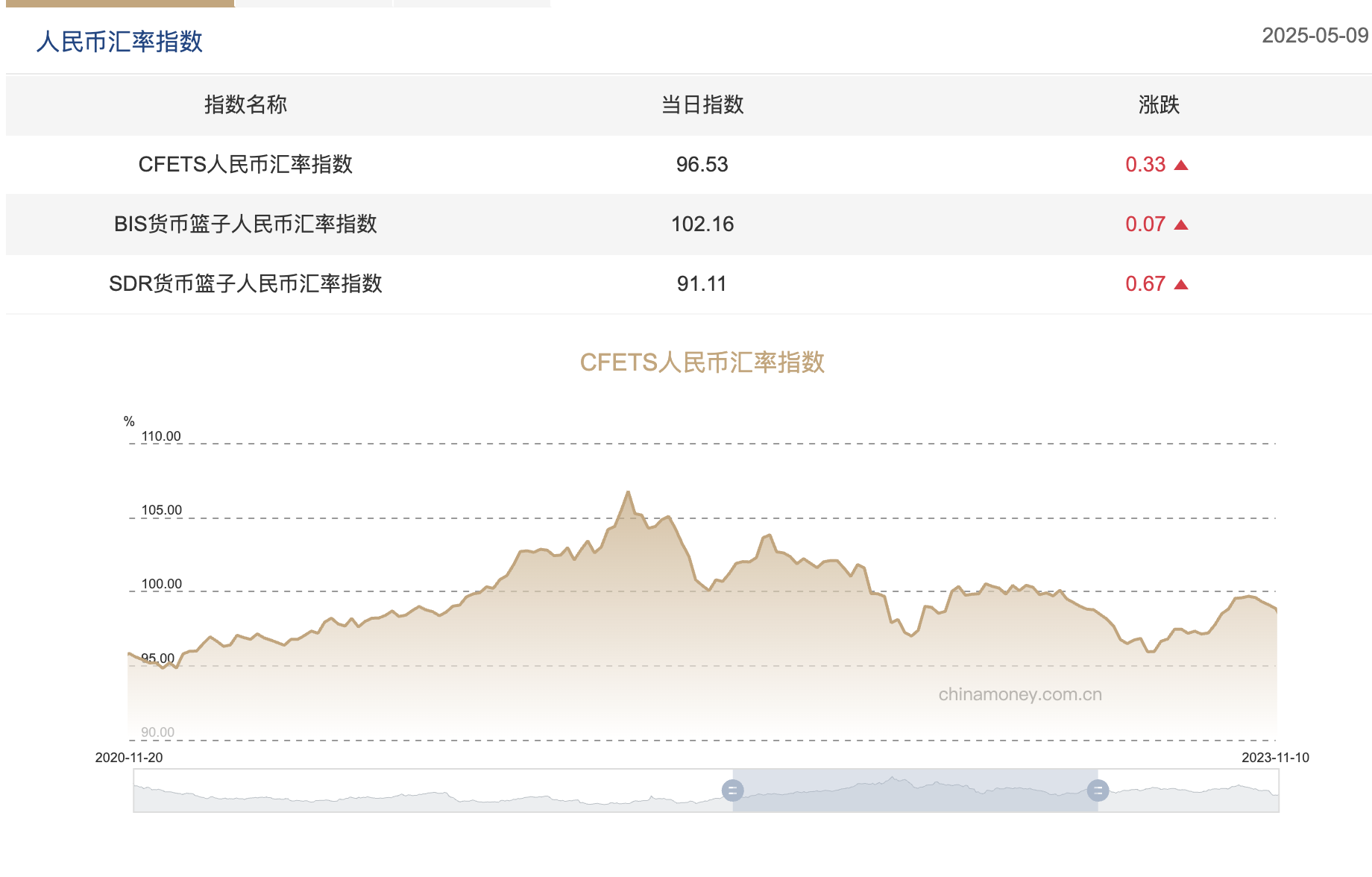
Core Viewpoint - The Chinese yuan exchange rate indices showed an overall increase in the week of May 9, with the CFETS index at 96.53, the BIS index at 102.16, and the SDR index at 91.11, indicating a strengthening of the yuan against a backdrop of fluctuating global currencies [1][2]. Exchange Rate Indices - CFETS RMB exchange rate index reported at 96.53, up 0.33% week-on-week [1][2] - BIS currency basket RMB exchange rate index reported at 102.16, up 0.07% week-on-week [1][2] - SDR currency basket RMB exchange rate index reported at 91.11, up 0.67% week-on-week [1][2] External Factors - The US dollar index increased by 0.38% to 100.4218, marking its first recovery above the 100 level since early April [6] - Despite the dollar's strength, external pressures on the yuan were limited due to easing tariff expectations and a general appreciation of Asian currencies [6] - The expectation of a weaker dollar has led to increased foreign exchange hedging demand in some Asian countries, providing support for the yuan [6] Internal Factors - The People's Bank of China announced a 0.5 percentage point reduction in the reserve requirement ratio effective May 15, which may exert some pressure on the yuan [7] - The yuan's central parity maintained above 7.20 against the dollar, with adjustments being less than market expectations, indicating a moderate weakening trend against a basket of currencies [7] Economic Insights - Experts suggest that maintaining stability in the yuan's exchange rate against the dollar is crucial for managing cross-border capital flows and supporting exports [8] - The divergence in economic cycles and monetary policies between China and the US may provide a foundation for the yuan's dual-directional fluctuations [8] Domestic Economic Measures - The People's Bank of China introduced measures to lower the reserve requirement ratio and support financial institutions in key sectors such as service consumption and elderly care, with a total loan quota of 500 billion yuan at a 1.5% interest rate [11] - The China Securities Regulatory Commission released a plan to promote high-quality development in public funds, including measures to reduce investor costs and enhance fund performance evaluation [11]
华泰期货-外汇策略周报:短期扰动频现-20250411
Hua Tai Qi Huo· 2025-04-11 05:09
Report Industry Investment Rating - Not provided in the content Core Viewpoints - The volatility of the USD/CNY exchange rate will intensify in the short term due to trade policy uncertainties. In the medium term, with the Fed's policy shift and the narrowing of the interest rate spread, the RMB has a chance to stabilize periodically [55]. - The Trump administration's "reciprocal tariffs" policy will push up the price level in the US, increasing the short - term upward pressure on inflation. The US economy will face a more severe "stagflation" risk, and the narrative of recession or stagflation may continue [25]. Summary by Directory Quantity - Price and Policy Signals Quantity - Price Observation - The implied volatility curve of the 3 - month USD/CNY option shows an appreciation trend of the US dollar, with the call - end volatility significantly higher than the put - end, and the volatility rising significantly. The market's expectation of the future volatility of the USD/CNY exchange rate has increased [5]. - The term structure data of the Singapore Exchange's USD/CNY futures and bank forward premiums and discounts, as well as the US - China interest rate spread, are presented, but specific trends are not clearly summarized in the text [8][10][11]. Policy Observation - The policy counter - cyclical factor has been activated, but the overall willingness to stabilize the exchange rate is lower than in the previous round. The policy counter - cyclical factor shows a continuous upward trend, and the US - China interest rate spread shows an upward trend. The three - month CNH HIBOR - SHIBOR spread has narrowed [16]. Fundamentals and Views Macro - The Fed is expected to cut interest rates by 95bp by 2025, and the pricing of US interest rate cuts continues to rise. Short - term interest rates are rising, the TGA account balance was 301.6 billion on April 2, and the Fed's reverse repurchase balance was 233.4 billion US dollars [20]. - The US economy has a rising downside risk. Employment data is mixed, with the February non - farm payrolls falling short of expectations and the unemployment rate rising; inflation is rebounding; the economy maintains resilience, with retail sales and fiscal spending falling, the manufacturing industry falling in March, and the service industry rebounding [22]. Events - On April 2, Trump's "reciprocal tariffs" policy was implemented, including a 10% "benchmark tariff" on all countries and personalized higher "reciprocal tariffs" on countries with large trade deficits with the US. The tariff scale considers value - added tax, trade deficits, "exchange - rate manipulation, and non - tariff barriers". There are exempted goods and countries, and the policy contains a "modification right" [24][25]. - Many countries have taken counter - measures against the US tariffs, including condemnation, negotiation, and counter - tariffs [26]. - The "reciprocal tariffs" policy is beyond market expectations. From the perspective of tariff rate comparison, most of the top 15 trading partners of the US in 2024 had higher most - favored - nation tariff rates than the US in 2022. From the perspective of trade surplus, countries/regions such as China, the EU, Mexico, and Vietnam have large trade surpluses with the US [27]. - The US may further increase tariffs on China. A review of the previous round of Trump's tariff increases shows that the RMB and A - shares were under pressure, and the RMB depreciated by about 8% at most during the three - round tariff increases. Among commodities, iron ore and non - ferrous metals were most directly affected [33]. 3 - Month Data - The US non - farm payrolls in March exceeded expectations, with consumption - related industries (retail), trade, and the government contributing to the increase. The hourly wage in March increased by 0.25% month - on - month and 3.6% year - on - year, which may intensify long - term inflation. The impact of the March non - farm payrolls was small, and the market was dominated by tariff concerns in the short term [37]. - In March, the US "rush to export" ended. The US manufacturing PMI was 49.8 (52.7), the service industry PMI was 54.3 (51), and the composite PMI was 53.5 (51.6). The service industry offset the decline in manufacturing. In Europe, the manufacturing PMI was 48.7 (47.6), the service industry PMI was 50.4 (50.6), and the composite PMI was 50.4 (50.2) [38]. - China's economic structure is differentiated. From January to February, industrial production, infrastructure investment, and manufacturing investment maintained high growth rates, while consumption and real - estate investment improved month - on - month, and the decline in real - estate sales narrowed significantly. Import and export growth rates declined, and the credit structure did not improve significantly. The economic sentiment rebounded in March [41]. - In March, China's PMI improved month - on - month but was weaker than the seasonal average year - on - year. Production increased less than new orders. The "rush to export" continued in March, imports decreased by 2% month - on - month, and finished - product inventories decreased. The industry sentiment was transmitted from upstream to downstream [43]. Overall View - The current situation shows a neutral economic expectation gap between China and the US, a neutral Sino - US interest rate spread, and trade policy uncertainties that are favorable to the US dollar. In the short term, the USD/CNY exchange rate will fluctuate more due to trade policy uncertainties. In the medium term, the RMB may stabilize periodically [55]. Risk Assessment - The range of the basis fluctuation of the futures main contract from April 2022 to the present (nearly 3 years) is between - 1100 and 900 [56].