
间接融资

Search documents
【首席观察】“以债补贷”下的中国货币新信用结构
Jing Ji Guan Cha Wang· 2025-11-17 11:47
Core Viewpoint - The article discusses the shift in China's monetary structure from "credit-driven" to a new model characterized by "debt supplementing loans" and a focus on direct financing, despite the overall monetary conditions appearing loose [2][3][4]. Monetary and Financial Data - As of the end of October, M2 balance reached 335.13 trillion yuan, growing by 8.2% year-on-year, while the total social financing scale stood at 437.72 trillion yuan, with an 8.5% year-on-year increase [3]. - The balance of RMB loans was 270.61 trillion yuan, with a year-on-year growth of only 6.5%, marking a historical low [3][4]. - Government bonds saw a significant increase, with a year-on-year growth of 19.2%, raising their share in the total social financing scale to 21.3% [3][4]. Structural Changes in Financing - The proportion of RMB loans in the total social financing scale decreased by 1.3 percentage points, while direct financing, including government bonds and corporate bonds, increased its share to 44.4% [5][6]. - The shift towards direct financing is a policy choice reflecting the transition from high-speed growth to high-quality development, indicating a need for structural adjustments in the financial system [6][7]. Market Dynamics - The article notes that while the stock market indices have reached new highs, the underlying effective financing demand in the real economy remains weak, suggesting a disconnect between market performance and economic fundamentals [9][10]. - The emphasis on direct financing and the adjustment of interest rate relationships are seen as efforts to enhance the role of capital markets in the financial system [9][10]. Future Considerations - The article highlights three critical factors that will determine the success of this structural transition: the sustainability of corporate profitability, the alignment of institutional frameworks with higher direct financing ratios, and changes in household asset allocation behavior [12]. - The ongoing structural transition is viewed as a complex process that requires time and confidence to fully materialize, with the potential for a more balanced relationship between monetary policy, fiscal measures, and capital market dynamics [13][14].


扩大有效需求,关键仍在提高收入丨宏观月报
2 1 Shi Ji Jing Ji Bao Dao· 2025-11-17 11:21
Economic Overview - The economic and financial data for October requires a structural perspective for careful observation, with a focus on ensuring stable growth in total demand through counter-cyclical adjustment policies targeting both investment and consumption [1] - The upcoming Central Economic Work Conference will be closely watched for next year's economic work arrangements [1] Financial Data Analysis - In October, the new social financing scale increased by 815 billion yuan, a year-on-year decrease of 597 billion yuan, indicating a need for appropriate responses to the weakening financial data [2] - New RMB loans in October amounted to 220 billion yuan, a year-on-year decrease of 280 billion yuan, with a notable decline in short-term and medium-term loans for residents due to ongoing adjustments in the real estate market [2][3] - Government bond financing contributed 489.3 billion yuan in October, down 560.2 billion yuan year-on-year, reflecting a reduction in supply due to previous high bases [3] Industrial Production and Investment - The industrial added value for October grew by 4.9% year-on-year, with production slowing due to seasonal factors, but overall economic supply remains stronger than demand [4] - Cumulative investment decreased by 1.7% in the first ten months, with manufacturing investment showing a growth of only 2.7%, indicating a need for stable growth during the "14th Five-Year Plan" period [4] Private Investment and Consumption - The National Development and Reform Commission introduced measures to promote private investment, which remains positive when excluding real estate investments, indicating significant potential [5] - In October, the total retail sales of consumer goods reached 4.629 trillion yuan, growing by 2.9% year-on-year, with a notable decline in household appliances and audio-visual equipment sales [6] Export Performance - October exports showed resilience, with exports to the EU at 43.89 billion USD (0.9% growth), ASEAN at 53.29 billion USD (11.0% growth), and Japan at 13.01 billion USD (-5.7% growth), highlighting the need for supportive financial policies for exports [7] Price Trends - The Consumer Price Index (CPI) rose by 0.2% year-on-year in October, with core CPI increasing by 1.2%, indicating a warming trend in prices [7] - The Producer Price Index (PPI) saw a slight increase of 0.1% month-on-month, marking the first rise of the year, with key industries like photovoltaics and semiconductors experiencing price recoveries [7]
昨天这个信号出乎意料,货币放水迎来风云突变
Sou Hu Cai Jing· 2025-11-12 07:24
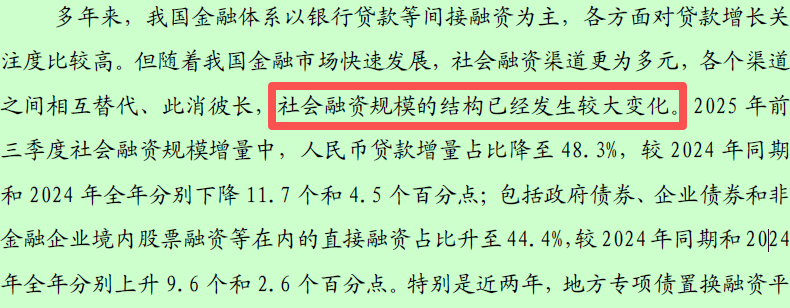
Core Viewpoint - The People's Bank of China (PBOC) has indicated a significant change in the structure of financing in its third-quarter monetary policy report, which is crucial for understanding the dynamics of the housing market and investment strategies. Group 1: Financing Structure Changes - The financing structure in China is shifting from primarily loan-based financing to direct financing through bonds, with loans now accounting for less than 50% of new financing in the third quarter of 2023 [9][14]. - This change implies that the traditional view of using M2 growth as an indicator for housing prices is no longer valid, as the increase in M2 may not correlate with housing market dynamics [13][14]. Group 2: Implications for Housing Market - The report emphasizes that the increase in M2 is largely driven by bond issuance, which does not directly contribute to housing market liquidity, leading to a potential scenario where M2 can grow while housing prices decline [14][18]. - The only reliable indicator for predicting housing market trends remains the growth in household loans, as these directly translate into purchasing power for the housing market [15][18]. Group 3: Economic and Stock Market Analysis - For broader economic and stock market analysis, the focus should be on social financing (社融) and M2, as these metrics provide a comprehensive view of the financial landscape [11]. - The report suggests that the shift towards direct financing will primarily affect economic indicators and stock market performance, rather than the housing market [18].
基础货币≠货币
Jin Rong Shi Bao· 2025-11-12 01:01
Core Viewpoint - The People's Bank of China (PBOC) released the "Monetary Policy Implementation Report for the Third Quarter of 2025," highlighting the relationship between base money and broader money supply, emphasizing that base money is the source of money creation and the foundation of the banking system's asset-liability activities [1] Group 1: Base Money and Broad Money - Base money, also known as "high-powered money," includes cash in circulation and commercial banks' reserves at the central bank, totaling 38.6 trillion yuan as of Q3 2025, while the broad money supply (M2) exceeded 335 trillion yuan [1] - Base money and broader money are distinct concepts; base money is a liability of the central bank, while broader money reflects the disposable funds of residents, enterprises, and governments, primarily representing commercial bank liabilities [1] Group 2: Money Creation Process - The money creation process involves central banks, commercial banks, and the real economy, where commercial banks derive deposits through asset expansion, forming broad money [2] - The ability of commercial banks to create money is influenced by the effective financing demand from the real economy, meaning that money creation occurs when there is a willingness and capacity to lend [2] Group 3: Diversification of Financing Channels - The traditional dominance of bank loans in China's financial system is evolving, with direct financing rapidly developing, allowing banks to diversify their asset expansion methods, including purchasing bonds [3][4] - As of now, bank loans account for approximately 60% of total bank assets, while the proportion of bonds held has increased from about 20% at the end of 2019 to around 25% [4] Group 4: Structural Changes in Monetary Policy - The PBOC is adapting its base money injection methods to support the evolving financing structure, utilizing structural monetary policy tools, with these tools accounting for about 13% of base money as of Q3 2025 [4] - The central bank's re-lending serves as a crucial channel for regulating base money, reflecting the borrowing relationship between the central bank and commercial banks, rather than direct loans to enterprises [4] Group 5: Long-term Financial Market Development - The development of direct financing and changes in the financing structure are expected to have profound impacts on the total money supply and financial regulation [5] - Future monetary policy will focus on transforming the regulatory framework to emphasize price-based controls, enhancing the effectiveness of interest rate adjustments in resource allocation [5]
基础货币≠货币,发放贷款并不是商业银行货币派生的唯一途径!
Jin Rong Shi Bao· 2025-11-11 11:22
Core Viewpoint - The People's Bank of China (PBOC) released the "Monetary Policy Implementation Report for the Third Quarter of 2025," highlighting the relationship between base money and broader money supply, emphasizing that base money is the source of money creation and affects the banking system's asset-liability activities [1] Group 1: Base Money and Broad Money - Base money, also known as "high-powered money," is a liability of the central bank and includes cash in circulation, required reserves, and excess reserves held by commercial banks [1] - As of the end of Q3 2025, China's base money balance reached 38.6 trillion yuan, while the broad money supply (M2) exceeded 335 trillion yuan [1] Group 2: Money Creation Process - The money creation process involves the central bank, commercial banks, and the real economy, where commercial banks derive deposits through asset expansion, forming broad money [2] - The ability of commercial banks to create money is fundamentally influenced by the effective financing demand from the real economy [2] Group 3: Diversification of Financing Channels - The traditional reliance on bank loans for money creation is evolving, with commercial banks increasingly engaging in direct financing through bond purchases, which also generates deposits [3] - The proportion of bank loans in total bank assets remains around 60%, while the share of bonds has increased from approximately 20% at the end of 2019 to about 25% currently [4] Group 4: Structural Changes in Financing - The rapid development of direct financing and changes in the financing structure are leading to a more diversified money creation channel for banks [4] - The PBOC is innovating its base money injection methods and utilizing structural monetary policy tools to guide financial institutions in optimizing credit allocation [4] Group 5: Future Monetary Policy Directions - The development of the financial market and changes in financing structure will have profound impacts on the total money supply and financial regulation [5] - There is a need to continue transforming the monetary policy framework to emphasize price-based regulation and deepen interest rate marketization reforms [5]
郭田勇:构建同科技创新相适应的科技金融体制
Jing Ji Ri Bao· 2025-10-10 00:03
Core Insights - The article emphasizes the critical role of technology finance in enhancing national competitiveness and supporting economic transformation through innovation [1][2][3] Group 1: Importance of Technology Finance - Technology finance serves as a vital bridge connecting financial capital with technological innovation, increasingly recognized as essential in the current global economic restructuring [2] - The Chinese government prioritizes technology finance as a key area for development, alongside green finance, inclusive finance, pension finance, and digital finance [2] - Financial capital acts as a catalyst for transforming technological innovations into practical applications, thereby enhancing the innovation ecosystem [2][3] Group 2: Achievements and Policies in Technology Finance - Significant progress has been made in technology finance in China, with enhanced policy support and a diversified financial service system for technology enterprises [4] - The People's Bank of China and other departments have issued policies to improve the service capabilities of financial institutions in supporting technology innovation [4] - The total balance of technology loans reached 44.1 trillion yuan, with a year-on-year growth of 12.5%, indicating a strong preference for technology financing [5] Group 3: Challenges in Technology Finance - The current financing structure is predominantly indirect, with banks favoring established companies over startups, which often struggle to meet traditional credit requirements [6] - The vitality of the venture capital market needs enhancement, and the participation of private capital remains low [6] Group 4: Recommendations for Improvement - A unique technology finance system should be developed that aligns with China's financial structure and industrial ecosystem, leveraging the strengths of the banking sector [7] - Banks should enhance their service capabilities for technology innovation by developing products tailored to the needs of high-growth, asset-light enterprises [8] - A mechanism for linking investment and loans should be established to support technology enterprises through various stages of development [8] - Government investment funds should be managed more effectively to support strategic innovation projects and improve post-investment management [9] - Direct financing channels for technology enterprises should be streamlined, encouraging private capital participation and enhancing market transparency [9]
管涛:低利率时代更加呼唤资本市场高质量发展 |国庆大咖谈
Di Yi Cai Jing· 2025-10-01 02:21
Group 1 - The current monetary policy in China is supportive and relatively loose, with major interest rates at historical lows, and low interest rates are expected to persist for some time [1] - The imbalance in China's financing structure, characterized by high debt and low equity, is a significant issue, and increasing the proportion of direct financing, especially equity financing, has been a key goal of financial reform [2][4] - Recent policies, such as the "New National Nine Articles" and the "1+N" policy framework, aim to enhance the quality of listed companies, encourage dividend returns to investors, and promote the development of public funds [4][6] Group 2 - The capital market plays a crucial role in fostering a virtuous cycle among industry, technology, and capital, supporting both the growth of emerging industries and the transformation of traditional industries [3] - The need to enhance domestic demand, particularly final consumption, is emphasized as a pathway to economic growth, with property income being a significant source of household income [4] - The current challenges in China's financial system include a lack of effective financing demand from the real economy and low lending enthusiasm from banks, which necessitates the development of a diversified financing structure [6][7] Group 3 - The construction of a financial powerhouse is essential for the overall economic strength of the nation, with a strong currency being a key component of this vision [6][7] - The internationalization of the Renminbi is highlighted as a critical aspect of achieving a strong currency, which requires high-level financial openness and the reform of capital market systems [6][7] - The emphasis on institutional openness in the capital market includes aligning domestic regulations with international standards to better support and attract foreign investment [7]
芦哲:M2增速或见顶——2025年8月金融数据点评
Sou Hu Cai Jing· 2025-09-14 08:07
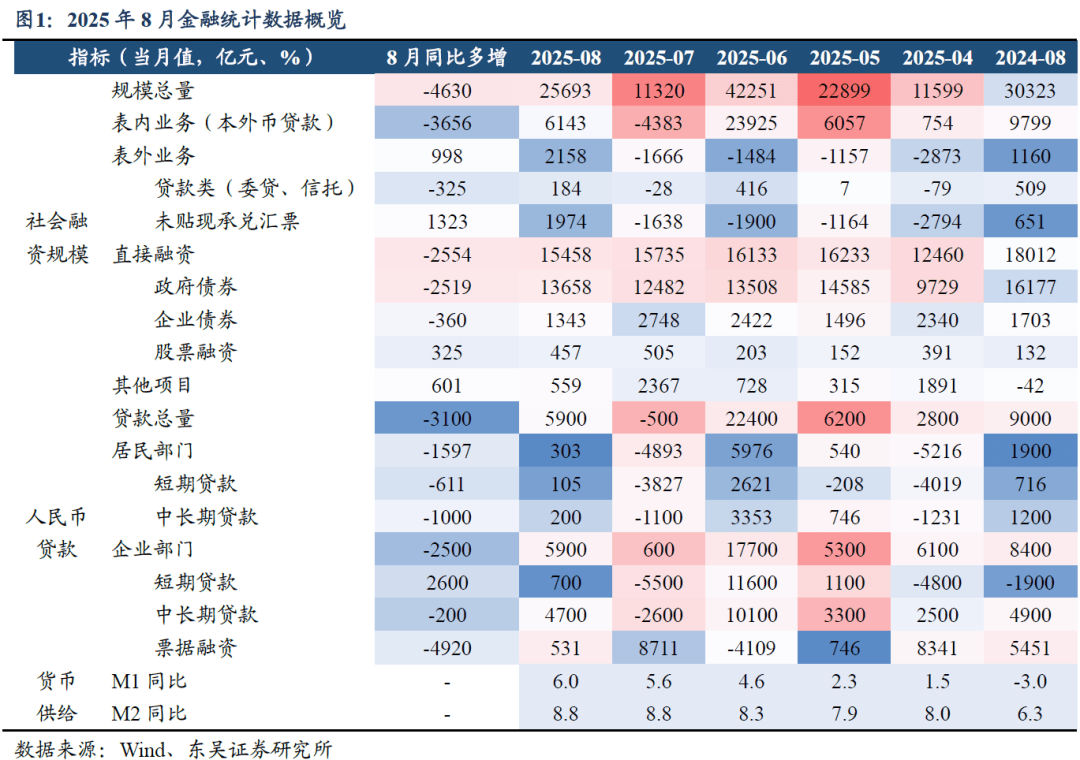
Core Viewpoint - In August 2025, the People's Bank of China reported a new social financing scale of 2.57 trillion yuan, a year-on-year decrease of 463 billion yuan, with the total social financing stock growth rate falling to 8.8% [1][2] Social Financing - The new social financing in August 2025 was 2.57 trillion yuan, which is 463 billion yuan less than the same month last year, marking a decline in growth rate [1] - Government bond financing in August was 1.37 trillion yuan, down 251.9 billion yuan year-on-year, indicating a seasonal decrease in government bond issuance [5] - The total amount of new loans from financial institutions was 590 billion yuan, a decrease of 310 billion yuan year-on-year, reflecting weak effective demand [4][6] Loan Issuance - The new RMB loans in August amounted to 590 billion yuan, which is 310 billion yuan less than the previous year, with a year-on-year growth rate of 6.80% [4][6] - Short-term loans for enterprises increased by 700 billion yuan, showing a recovery in short-term financing demand [6] - The issuance of corporate bonds was 1.34 trillion yuan, down 360 billion yuan year-on-year, while stock financing increased by 457 billion yuan, indicating a rise in market activity [4][5] Monetary Supply - As of the end of August 2025, M2 growth rate remained stable at 8.8%, while M1 grew by 6.0%, reflecting a narrowing gap between M2 and M1 [2][7] - The total new RMB deposits in August were 2.06 trillion yuan, a decrease of 1.6 trillion yuan year-on-year, with significant shifts in deposit structures [2][7] - The government bond financing is a key factor in maintaining the synchronization of M2 and social financing growth rates, but a slowdown in government bond issuance may lead to a peak in M2 growth [7][8] Financial Data Outlook - The next four months may see an improvement in direct financing due to an active stock market, with policies aimed at boosting consumer loans and corporate financing potentially leading to a seasonal increase in loan financing [8]
存款搬家是好事
Bei Jing Shang Bao· 2025-08-24 16:29
Group 1 - The core point of the article highlights a significant shift in household savings from bank deposits to non-bank financial products, indicating a movement towards capital markets due to low interest rates and a recovering stock market [1][2] - In July, household deposits decreased by 780 billion yuan year-on-year, while non-bank deposits increased by 1.39 trillion yuan, reflecting a trend where residents are reallocating their savings into investment vehicles such as bank wealth management, funds, and insurance [1] - The decline in deposit interest rates, with major banks' one-year fixed deposit rates falling below 1%, has diminished the attractiveness of traditional savings accounts, prompting a shift towards more lucrative investment options [1][2] Group 2 - The movement of deposits to capital markets signifies a transition from indirect financing to direct financing, which broadens the financing channels for the financial market and supports the development of innovative enterprises, aligning with national economic transformation strategies [2] - Increased efficiency in fund utilization is expected as the central bank injects liquidity into the financial system, aiming for these funds to reach businesses and consumers to stimulate economic growth [2] - The trend of deposit migration is likely to continue, with excess savings expected to accelerate towards equity markets, becoming a major source of new funds for the A-share market [2]
【西街观察】存款搬家是好事
Bei Jing Shang Bao· 2025-08-24 15:17
Group 1 - The core point of the article is that household deposits are decreasing while non-bank deposits are increasing, indicating a shift of funds from savings to capital markets due to low interest rates and a recovering stock market [1][2] - The decrease in household deposits by 780 billion yuan year-on-year in July contrasts with a 1.39 trillion yuan increase in non-bank deposits, suggesting a movement of savings into investment products like bank wealth management, funds, and insurance [1] - The decline in deposit interest rates, with major banks offering rates below 1% for one-year fixed deposits, has diminished the attractiveness of traditional savings accounts [1][2] Group 2 - The shift of deposits to capital markets signifies a transition from indirect financing to direct financing, which supports the development of innovative enterprises and aligns with national economic restructuring strategies [2] - Increased efficiency in fund utilization is expected as the central bank injects liquidity into the financial system, aiming for these funds to stimulate investment and consumption, thereby promoting economic growth [2] - The trend of deposit migration may continue, with excess savings likely to accelerate towards equity markets, becoming a significant source of new funds for the A-share market [2]