
风险资产

Search documents
亿汇:比特币回调与市场风险
Sou Hu Cai Jing· 2026-01-30 13:03
MONETA M A R K E T S OFFICIAL REGIONAL PARTNER OF ATLÉTICO DE MADRID - MONETA 佛派 MONETA 4 2 只開合日 新户三重好礼 限时狂送! MONETA 集酒 壓获殊荣集锦 完成指定步骤 立即赢得 (0 注册即领礼: ay「最先进网页差价合约交易 台」大陵 扫码开户送 ¥30 ess 服裝扫码注册开使用服名 即可促銷 ¥30 取金貿易! 1997 EED 登录再升级: 下载并登录APP 福利再加码 ¥100 成功安装并首次登录 APP, 即可参与申追独买, 并且赚 ¥50 股金好补 Moneta对您最便1慰助入金, 再追送 ¥50, 多重奖励等怎么! 飞天茅台酒 MONETA 2 8 2 4 - 1 MOUTA 40UTA d f OUTAI re MONETA - OFFICIAL REGIONAL PARTNER OF ATLÉTICO DE MADRID MONETA 传播 M 获殊荣集锦 Moneta Markets 荣获 M&A Today 「最先进网页差价合约交易平台」大奖, 井在 CV Magazine 企业卓越奖中 ...


黄金vs.“数字黄金”:特朗普2.0时代比特币的市场定位
Sou Hu Cai Jing· 2026-01-20 08:02
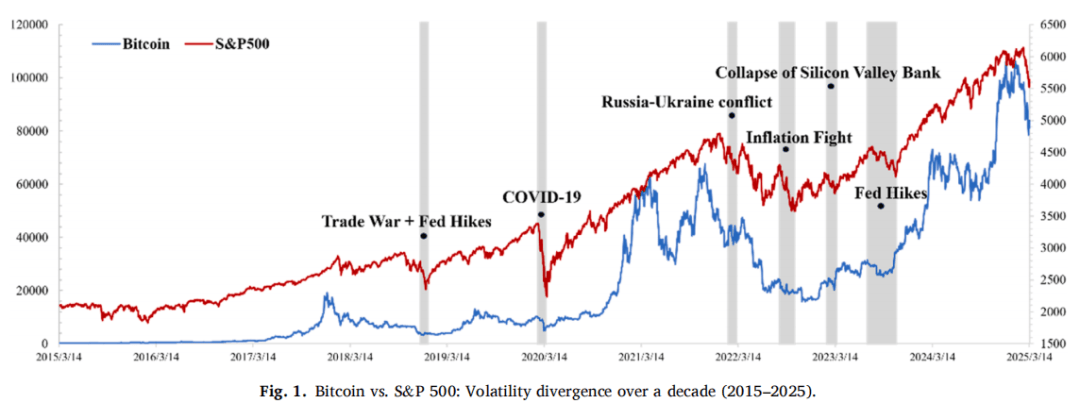
Core Viewpoint - The approval of Bitcoin spot ETFs in 2024 and Trump's proposal for a Bitcoin reserve have transformed Bitcoin from a speculative asset into a mainstream recognized asset class, referred to as "digital gold" by the Federal Reserve Chairman Powell [1][2][4]. Group 1: Bitcoin's Evolution and Market Positioning - The Trump administration is accelerating Bitcoin's transition from a retail-driven speculative tool to an institutionally recognized asset class, altering its hedging characteristics [2][4]. - The study examines Bitcoin's hedging properties compared to gold during different crisis periods, particularly focusing on the evolution of Bitcoin's hedging features in the Trump 2.0 era [5][6]. - Prior to Trump 2.0, Bitcoin and gold exhibited similar hedging characteristics primarily during mid-term crises, but this similarity has diminished in the Trump 2.0 period, with Bitcoin showing increased correlation with the market [6][21]. Group 2: Methodology and Data Analysis - The research utilizes frequency domain decomposition and quantile Granger causality tests to analyze Bitcoin's hedging properties over time, providing new empirical evidence on its behavior under different market conditions [6][12][13]. - Data from March 2015 to May 2025 was collected, focusing on the significant growth and stability of the cryptocurrency market post-2015, ensuring reliability in comparisons with traditional financial assets [12][13]. Group 3: Risk Transmission and Hedging Properties - The results indicate that Bitcoin has the lowest risk transmission levels among various assets, suggesting its potential as a diversification investment [19][20]. - In the Trump 2.0 era, the risk transmission structure has changed significantly, with an overall increase in sensitivity to policy and geopolitical shocks, indicating a shift towards institutional participation in the cryptocurrency market [21][22]. - Bitcoin's hedging properties are context-dependent, showing potential as a hedging asset during specific crises, such as the COVID-19 pandemic and the 2022 Silicon Valley Bank collapse [24][26]. Group 4: Implications for Investors and Policymakers - The findings suggest that Bitcoin is transitioning from a quasi-hedging asset to a high-risk growth asset, indicating that it may no longer be suitable for long-term hedging against traditional risk assets [31][34]. - For investors, it is crucial to recognize the dynamic changes in Bitcoin's hedging attributes and adjust portfolio allocations accordingly, especially in the context of increasing correlation with mainstream assets [34]. - Policymakers should enhance monitoring and regulation of the interconnectedness between cryptocurrencies and traditional financial markets, given the increased risk transmission observed in the Trump 2.0 era [23][34].
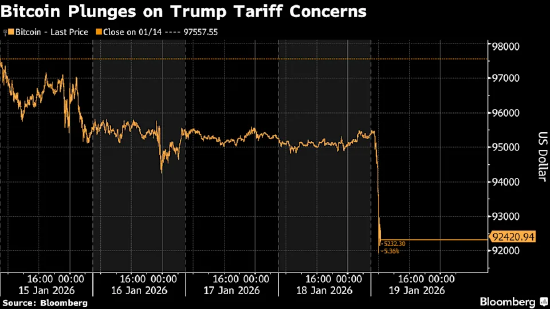
对关税的担忧压制风险资产 比特币价格跌破92000美元关口
Xin Lang Cai Jing· 2026-01-19 07:08
Group 1 - President Trump's proposal to impose new import taxes on eight European countries has led to a widespread decline in risk asset prices and an increase in demand for safe-haven assets [1][5] - Bitcoin's price dropped by 3.6%, falling below the $92,000 mark, while Ethereum and Solana experienced declines of 4.9% and 8.6%, respectively, resulting in a total market cap loss of approximately $100 billion in the cryptocurrency market [1][4] - Following Trump's announcement, U.S. stock index futures saw a significant drop, while gold and silver prices surged to historical highs [5] Group 2 - European leaders have condemned Trump's remarks and are preparing to suspend the approval process of a previously reached trade agreement [3][7] - The cryptocurrency market has struggled throughout 2025, failing to recover from a severe drop in October, although it began the year with a positive trend, with Bitcoin reaching just below $98,000 on January 14 [3][7] - Richard Galvin, co-founder of hedge fund DACM, noted that the recent market movements were influenced by a combination of year-end tax loss selling and investor stop-loss actions, with the latest import tax concerns hindering the market rebound [3][7] - Approximately $790 million in long positions in the cryptocurrency market were liquidated in the past 24 hours, with analysts suggesting that if current support levels are breached, Bitcoin could target $90,000 [7]
金工策略周报-20260118
Dong Zheng Qi Huo· 2026-01-18 13:24
Report Industry Investment Rating No relevant content provided. Core Views - Last week, all Treasury bond futures contracts closed higher, with the 30-year, 10-year, 5-year, and 2-year main contracts rising by 0.26%, 0.27%, 0.22%, and 0.05% respectively. The basis of each variety was differentiated, and the overall market sentiment remained bearish. T was close to the upper edge of the shock range, with limited room for further increase, while TL was more likely to continue to be under pressure [6]. - Last week, the domestic commodity market was relatively balanced in terms of the number of rising and falling varieties. Silver and tin led the gains, with increases of over 20%, while caustic soda and glass led the declines. Except for the relatively poor returns of the basis and warehouse receipt factors, other types of commodity factors had varying degrees of increase. The volatility of commodity factor returns was rising, and investors were advised to pay attention to several types of commodity factors with long-term expected return capabilities and adopt a balanced allocation method to prevent risks [24][27]. Summary by Relevant Catalogs Treasury Bond Futures Market Review - Last week, all Treasury bond futures contracts closed higher, with the 30-year, 10-year, 5-year, and 2-year main contracts rising by 0.26%, 0.27%, 0.22%, and 0.05% respectively [6]. - The basis of each variety was differentiated. The CTD bond of the 10-year Treasury bond was 250018, and the basis on the 16th was about 0.05 yuan, slightly lower than the seasonal level; the CTD bond of the 30-year Treasury bond was 210005, and the basis on the 16th was 0.22 yuan, lower than the seasonal level [6]. - The overall market sentiment remained bearish. The slight warming of sentiment drove the strength of varieties such as T, TF, and TS, but T was close to the upper edge of the shock range, with limited room for further increase; TL was more likely to continue to be under pressure [6]. Treasury Bond Futures Factor Analysis - For the 10-year Treasury bond, ranked by Sharpe ratio, the factors were the basis factor, risk assets, and member positions, with Sharpe ratios in 2025 of 1.68, 1.93, and 0.59 respectively [6][17]. - For the 5-year Treasury bond, ranked by Sharpe ratio, the factors were high-frequency capital flow, intraday volume-price, risk assets, member positions, and the basis factor, with Sharpe ratios in 2025 of 2.51, 2.27, 1.71, 1.33, and 0.78 respectively [6][18]. - For the 2-year Treasury bond, ranked by Sharpe ratio, the factors were high-frequency capital flow, the basis factor, intraday volume-price, and member positions, with Sharpe ratios in 2025 of 2.45, 1.82, 1.59, and 0.82 respectively [6][19]. Commodity Factor Performance - Last week, the domestic commodity market was relatively balanced in terms of the number of rising and falling varieties. Silver and tin led the gains, with increases of over 20%, while caustic soda and glass led the declines [24][27]. - Except for the relatively poor returns of the basis and warehouse receipt factors, other types of commodity factors had varying degrees of increase. The volume-price trend factors rose by an average of about 2.0%, and the term structure factors also had an increase of over 0.5% [24][27]. - The volatility of commodity factor returns was rising, and investors were advised to pay attention to several types of commodity factors with long-term expected return capabilities and adopt a balanced allocation method to prevent risks [24][27]. Tracking Strategy Performance - The CWFT strategy had an annualized return of 9.2%, a Sharpe ratio of 1.58, a Calmar ratio of 1.05, a maximum drawdown of -8.81%, a return of 0.19% last week, and a return of 0.21% since the beginning of this year [25]. - The C_frontnext & Short Trend strategy had an annualized return of 11.3%, a Sharpe ratio of 1.72, a Calmar ratio of 1.69, a maximum drawdown of -6.72%, a return of -0.05% last week, and a return of 0.41% since the beginning of this year [25]. - The Long CWFT & Short CWFT strategy had an annualized return of 12.0%, a Sharpe ratio of 1.36, a Calmar ratio of 0.92, a maximum drawdown of -13.07%, a return of -0.27% last week, and a return of 0.26% since the beginning of this year [25]. - The CS XGBoost strategy had an annualized return of 5.5%, a Sharpe ratio of 0.92, a Calmar ratio of 0.29, a maximum drawdown of -18.84%, a return of -1.05% last week, and a return of -2.50% since the beginning of this year [25]. - The RuleBased TS Sharp-combine strategy had an annualized return of 11.9%, a Sharpe ratio of 1.55, a Calmar ratio of 1.43, a maximum drawdown of -8.26%, a return of 1.04% last week, and a return of 0.46% since the beginning of this year [25]. - The RuleBased TS XGB-combine strategy had an annualized return of 11.5%, a Sharpe ratio of 2.01, a Calmar ratio of 2.57, a maximum drawdown of -4.49%, a return of 0.08% last week, and a return of -1.30% since the beginning of this year [25]. - The CS strategies, EW combine strategy had an annualized return of 12.6%, a Sharpe ratio of 1.79, a Calmar ratio of 1.70, a maximum drawdown of -7.38%, a return of -0.01% last week, and a return of 0.61% since the beginning of this year [25]. - Among the above six strategies, the CWFT strategy performed the best last week, with a return of 0.19%; the C_frontnext & Short Trend strategy performed the best since the beginning of this year, with a return of 0.41% [46]. - The equal-weight composite strategy of the above cross-sectional strategies (equal-weighted weekly returns) had an annualized return of 12.6%, a Sharpe ratio of 1.79, a Calmar ratio of 1.70, a maximum drawdown of -7.38%, a return of -0.01% last week, and a return of 0.61% since the beginning of this year [46].
银价,一周涨超11%!连创四个历史纪录
新华网财经· 2026-01-17 02:44
Group 1 - The latest data from the United States indicates that the labor market remains resilient, leading to expectations that the Federal Reserve may not lower interest rates in the first half of this year [1] - A softening attitude from the U.S. regarding military intervention in Iran has contributed to market dynamics, prompting some investors to take profits as precious metal prices reached historical highs, resulting in a decline in gold and silver prices [1] Group 2 - Weekly observations show that concerns over the independence of the Federal Reserve and geopolitical risks have led to a withdrawal of funds from risk assets, with investors buying precious metals for safety [3] - Gold prices reached a new closing high, while silver prices have set historical records for four consecutive trading days, with New York gold futures rising over 2% and silver futures increasing over 11% for the week [3]

受投资者乐观情绪提振 比特币突破 95000 美元关口 以太坊、索拉纳、卡尔达诺同步大涨 8%
Xin Lang Cai Jing· 2026-01-14 07:25
Group 1 - The cryptocurrency market experienced a significant surge, with Bitcoin (BTC) rising over 4% and surpassing the $95,000 mark for the first time in a week, while Ethereum (ETH) increased by over 7% to around $3,330 [1][6][7] - The rise in cryptocurrency prices is attributed to unexpectedly low U.S. inflation data, which has strengthened market expectations for continued interest rate cuts by the Federal Reserve this year [7][8] - Political tensions, including a subpoena sent to the Federal Reserve by the U.S. Department of Justice, have further fueled market sentiment, leading to a weaker dollar and increased attractiveness of non-sovereign assets [7][8] Group 2 - A large-scale liquidation occurred in the futures market, with over $688 million in liquidations reported in the past 24 hours, primarily from short positions [2][8] - Approximately 122,000 traders were liquidated, with Binance's Ethereum to Tether (ETHUSDT) contracts accounting for $12.9 million of the liquidation, indicating a significant shift in market sentiment [2][8] - The imbalance in liquidation structure highlights that traders had heavily bet on a market downturn prior to the inflation data release, which rapidly reversed [8] Group 3 - Traditional stock markets also saw gains, reinforcing the risk appetite in the cryptocurrency market [3][9] - Asian stock markets reached historical highs, with silver prices breaking $90 per ounce for the first time, while gold remained below historical peaks [4][10] - These market movements suggest that investors are increasingly inclined to allocate assets that can benefit from a loose financial environment and monetary system turmoil [10]
景顺:美联储独立性遭考验 短期内给风险资产带来重大挑战
Sou Hu Cai Jing· 2026-01-12 09:08
Core Viewpoint - The U.S. Federal Prosecutors have launched a criminal investigation into Federal Reserve Chairman Jerome Powell regarding the renovation of the Fed's office building and whether he made false statements to Congress about the project's scale [1][2] Group 1: Investigation and Pressure on the Fed - The investigation involves the renovation project of the Federal Reserve's office building and potential false statements made by Powell to Congress [1][2] - There has been an escalation in public pressure from the U.S. government on the Federal Reserve in recent months [1][2] - The independence of central banks is considered a cornerstone for financial market stability, and any perceived weakening of this independence could undermine market confidence in monetary policy and the financial system as a whole [1][2] Group 2: Investment Implications - The latest developments are expected to pose significant challenges to risk assets in the short term, with these challenges likely to persist until clearer signals emerge regarding the situation [1][2] - The most direct investment impact may be an increase in inflation expectations, leading to upward pressure on interest rates [1][2] - Rising interest rates could suppress U.S. stock valuations, particularly in sectors and investment styles sensitive to changes in discount rates [1][2] - The U.S. dollar may come under pressure, while gold and other perceived safe-haven assets could benefit [1][2] - Non-U.S. dollar assets, such as European and Asian stocks, may become more attractive to investors [1][2] - Investors are advised to adopt a cautious approach rather than panic, considering hedging portfolio risks where appropriate and closely monitoring subsequent developments [1][2]
中信证券:预计2026年一季度经济景气度有望抬升 风险资产中波动相对较低的权益资产更具性价比
Zheng Quan Shi Bao Wang· 2026-01-10 02:26
Group 1 - The core viewpoint of the article is that economic conditions are expected to improve gradually in the first quarter of 2026 due to proactive fiscal policies and the low base effect in the second half of 2025 [1] - Risk assets, particularly equities with relatively low volatility, are considered to have better cost-effectiveness in the current market environment [1] - Overall asset allocation faces challenges such as increased volatility and narrowing expected returns for certain assets, leading to recommendations for diversified risk management strategies [1] Group 2 - For low-risk preference investors, a diversified asset allocation is suggested to mitigate risks [1] - Mid to high-risk preference investors are advised to slightly overweight their stock allocations [1]

美国经济:强劲服务业支撑经济韧性
Zhao Yin Guo Ji· 2026-01-08 11:18
Group 1: Economic Indicators - The ISM Services PMI rose from 52.6 in November to 54.4 in December, exceeding market expectations of 52.2, marking 10 consecutive months of expansion[2] - The Services PMI corresponds to an annualized GDP growth rate of 1.9%[2] - The Manufacturing PMI decreased from 48.2 in November to 47.9 in December, below the market expectation of 48.4, indicating continued contraction[2] Group 2: Employment and Inflation - The Employment Index in the Services sector increased from 48.9 to 52, indicating a rebound in the job market for the first time since the implementation of tariffs[2] - The Prices Index in the Services sector decreased from 65.4 to 64.3, returning to pre-tariff levels while still indicating rapid expansion[2] - Inflation is expected to decline slightly in the short term due to falling oil prices and slowing rent increases, but may rise again in the second half of the year[1] Group 3: Market Outlook - The U.S. economy is projected to maintain a robust growth rate of 4.3% in Q3, driven by strong consumer spending and a rebound in net exports[2] - The Federal Reserve is anticipated to cut interest rates by 25 basis points in June, adjusting the target federal funds rate from 3.5%-3.75% at the end of 2025 to 3.25%-3.50% by the end of 2026[1] - Risk asset prices may experience volatility as expectations for tighter dollar liquidity increase in the latter half of the year[1]
中国经济有强力支撑渣打仍然超配中国股票
Zheng Quan Shi Bao· 2026-01-06 18:24
Core Insights - Standard Chartered Bank's Wealth Solutions Division released the "2026 Global Market Outlook" report, highlighting the theme "Floating Risks? Diversified Layout!" The report indicates that global markets are at a critical turning point, with geopolitical conflicts and the AI bubble being significant concerns. The structural support for the US dollar is expected to gradually weaken, while the resilience and reform dividends of the Asian economy are becoming increasingly prominent [1] Group 1 - The report anticipates that risk assets will outperform in 2026, although there will be more pronounced differentiation in the market. Investors are encouraged to diversify across a broader range of asset classes to maintain stability amid uncertainty and changing dynamics [1] - In terms of core allocations, Standard Chartered recommends overweighting US, Indian, and Chinese stocks, emerging market debt, and gold. Chinese stocks are expected to benefit from improved corporate governance and supportive policies for technology and innovation [1] Group 2 - Standard Chartered expects China to potentially implement more decisive and targeted stimulus measures by 2026, particularly focusing on advancing technology investments to enhance self-sufficiency and productivity [2] - In the bond market, Standard Chartered views global bonds as core holdings, favoring government bonds over corporate bonds due to the attractive nominal yields of government debt. The institution is overweight on emerging market USD government bonds and local currency government bonds, benefiting from moderate inflation, dovish monetary policy, improved fiscal conditions, and expectations of a weaker dollar [2] Group 3 - For the foreign exchange market, Standard Chartered anticipates that the US Federal Reserve will maintain a cautious stance on easing policies in the short term, supported by safe-haven demand due to geopolitical risks. However, over the next 12 months, as the Fed may shift towards easing and other major central banks approach the end of their rate hike cycles, the structural support for the dollar is expected to weaken [2] - Regarding gold, Standard Chartered maintains an overweight position, with target prices of $4,350 per ounce in 3 months and $4,800 per ounce in 12 months. Continuous demand from emerging market central banks and a favorable macro environment are expected to sustain the upward trend in gold prices [3]