
AI产业链

Search documents
板块轮动加速,但节前缩量背后有什么名堂?
Sou Hu Cai Jing· 2026-02-22 00:30
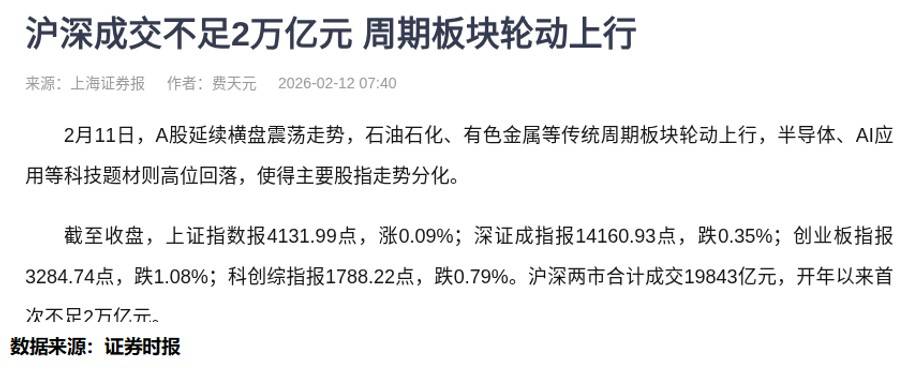
近期A股市场呈现横盘震荡格局,石油石化、有色金属等传统周期板块轮动走高,半导体、AI应用等科技题材则高位回落,主要股 指走势分化明显,沪深两市成交规模阶段性收窄至2万亿元以内。化工板块因细分产品供需格局变化反复活跃,相关个股连续4个交 易日价格走高,部分标的当日价格封至高位;商业航天概念也因行业关键试验取得突破出现局部异动。多家机构基于2010年以来的 历史行情数据观察,认为春节假期前后市场风格切换概率较高,节前价值与大盘风格占优,节后成长与中小盘风格或迎来表现窗 口,AI产业链、企业出海、涨价资源品被列为核心关注方向。面对板块快速轮动的市场环境,多数参与者仅依靠价格走势判断,往 往陷入追涨杀跌的循环,而量化大数据为观察市场核心行为提供了新的、更可靠的视角。 一、 高位波动下的行为识别 2025年10月,上证指数逼近4000点关口,近千家个股创下年内新高,但多数参与者的账户表现并未同步。从价格走势维度看,部分 个股两个月内价格走高超70%,但48个交易日中26天出现价格回落,占比超半数;且每创阶段新高后均进入阶段性调整,连续八轮 的波动使得多数参与者难以坚持持有,最终错失后续行情成果。 看图1: 某光通信概念 ...

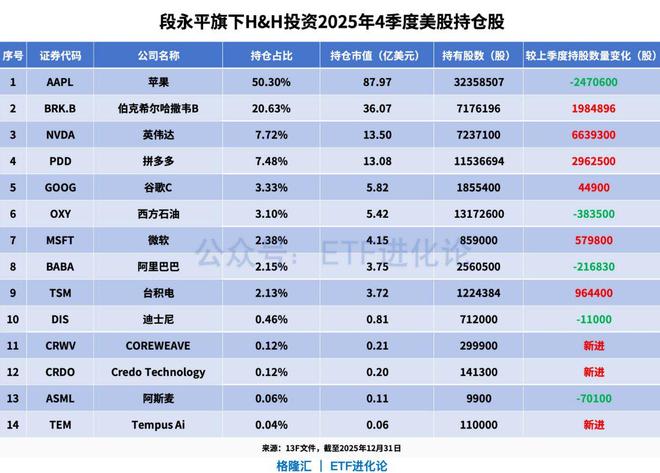
段永平试水“AI交易”:卖苹果加仓英伟达,新开仓三家“新面孔”
Ge Long Hui A P P· 2026-02-18 02:29
Core Insights - Notable investor Duan Yongping significantly increased his position in Nvidia by over 11 times in Q4, while substantially reducing his stake in Apple [1] - Duan Yongping's Q4 activity included a total of six stock increases, with Nvidia seeing the largest increase, followed by Berkshire Hathaway [1] - The total holding value of Nvidia reached $1.35 billion, making it the third-largest position in Duan's portfolio, accounting for 7.72% [1] Stock Position Changes - Apple (AAPL) saw a reduction in holdings by 2,470,600 shares, now representing 50.30% of the portfolio with a market value of $879.7 million [2] - Berkshire Hathaway (BRK.B) increased by 1,984,896 shares, now holding 20.63% of the portfolio valued at $360.7 million [2] - Nvidia (NVDA) was increased by 6,639,300 shares, now holding 7.72% of the portfolio valued at $1.35 billion [2] New Investments - Duan Yongping initiated positions in three emerging tech companies: CoreWeave, Credo Technology, and Tempus Ai, with respective portfolio weights of 0.12%, 0.12%, and 0.04% [1] - Although the combined weight of these new positions is approximately 0.28%, they strategically cover critical nodes in the AI industry chain: computing power, connectivity, and application [1]


台湾基金受益高股息策略与AI产业链,2025年资金流入强劲
Xin Lang Cai Jing· 2026-02-17 14:22
Group 1: Core Insights - The Taiwan Fund has shown strong performance, benefiting from its high dividend policy and market recognition of structural opportunities in Taiwanese stocks [1] - In 2025, the overall fund inflow for Taiwanese ETFs was significant, with the Yuanta Taiwan 50 ETF (0050) achieving a net inflow of NT$335.9 billion, surpassing NT$1.13 trillion in total size, making it the first Taiwanese ETF to exceed NT$1 trillion [1] - High dividend ETFs like Yuanta High Dividend (0056) and Qunyi Taiwan Selected High Yield also recorded inflows in the billion NT dollar range, reflecting market demand for stable cash returns [1] Group 2: Industry Policy and Environment - The Taiwanese stock market occupies a key position in the AI industry chain, benefiting from the global AI capital expenditure cycle [1] - The Norwegian Sovereign Wealth Fund (NBIM) significantly adjusted its holdings in Taiwanese stocks in the second half of 2025, focusing on increasing positions in high-precision manufacturing sectors such as semiconductor testing and low-orbit satellite components [1] - The Taiwan Fund, as a one-stop investment tool for Taiwanese stocks, indirectly benefits from these structural opportunities, with its portfolio including core AI hardware companies like TSMC, enhancing its sustainable dividend capacity [1] Group 3: Fund Movement - At the beginning of 2026, public funds implemented high dividend payouts, with Huatai-PB CSI 300 ETF achieving a single dividend total of NT$11 billion, setting a record for domestic ETFs [2] - This trend is driven by improved liquidity and policy support, as fund managers optimize investor returns through dividends [2] - The Taiwan Fund's dividend policy aligns with the overall market trend of increased payouts, enhancing short-term market attention [2]
奥斯汀科技股价持续疲软,交投清淡受板块影响
Jing Ji Guan Cha Wang· 2026-02-13 20:15
以上内容基于公开资料整理,不构成投资建议。 经济观察网根据经济观察网2026年2月12日至14日的报道,奥斯汀科技(OST.OQ)近7日(截至2月14日)未 出现重大公司特定事件或新闻热点,股价表现持续疲软。截至2月14日,股价收于1.70美元,近5日、近 20日及年初至今跌幅均为0.29%,当日涨跌幅为0.00%,振幅0.00%,成交量为0,显示交投极度清淡。 公司市盈率(TTM)为负值,市净率1.45倍,总市值约0.10亿美元,属于小微盘股,最新财报(截至2025年 9月30日)显示收入主要来自偏光片(占比49.19%)和显示模块(占比38.40%)。近期市场关注点集中于AI产 业链扩散,但公司作为电子元器件供应商未直接参与相关热点,股价波动主要受电子元器件板块整体疲 软及低流动性影响。 ...
广发证券首席策略分析师刘晨明 备战马年第一波上涨期
Shen Zhen Shang Bao· 2026-02-12 18:47
Core Viewpoint - The A-share market is expected to experience its first wave of upward momentum in the Year of the Horse, with optimism surrounding sectors such as the AI industry chain, space photovoltaics, and non-bank financials [1][2]. Group 1: Market Timing - The spring market rally is anticipated to begin in February, historically the strongest period for such movements, with a 100% probability of small-cap indices rising between the Spring Festival and the National People's Congress [1]. - Previous instances of early spring rallies occurred during economic upturns or policy shifts, with notable years being 2013, 2014, 2015, and 2020 [2]. Group 2: Market Conditions - The release of annual report forecasts has alleviated negative fundamental disturbances, with a record high of companies reporting low expectations or losses in 2025 [2]. - As negative financial news is digested, the market is expected to be in a better position starting in February, allowing for a more favorable trading environment [2]. Group 3: Investment Strategy - The correlation between spring rallies and corporate performance is strong, with recommended sectors including the ByteDance industry chain, space photovoltaics, and non-bank sectors such as brokerage and insurance [2]. - Other sectors to consider for investment include optical modules, semiconductors, humanoid robots, chips, PCBs, and innovative pharmaceuticals, with additional tracking suggested for metals, satellites, storage, chemicals, and power grids [2].

科技、新能源板块携手走强,科创50ETF易方达(588080)、创业板ETF易方达(159915)标的指数涨超1%
Mei Ri Jing Ji Xin Wen· 2026-02-12 07:24
Group 1 - The technology and new energy sectors showed strong performance, with significant activity in liquid cooling, CPO, semiconductors, computing power leasing, AI applications, and grid equipment, leading to an increase in related indices [1] - The Science and Technology Innovation 50 Index rose by 1.7%, while the ChiNext Index increased by 1.5% as of 2 PM [1] - Shenwan Hongyuan Securities indicated that the best opportunities lie in new technology directions during market fluctuations, with a focus on the AI industry chain rebound around the Chinese New Year [1] Group 2 - The Science and Technology Innovation 50 Index consists of 50 stocks from the Sci-Tech Innovation Board with high market capitalization and liquidity, with nearly 70% representation from the semiconductor industry, focusing on leading "hard technology" companies [1] - The ChiNext Index includes 100 stocks from the ChiNext Board, with approximately 60% weight in AI hardware and new energy industry chains, covering several leading CPO and lithium battery companies [1] - The E Fund Science and Technology Innovation 50 ETF (588080) and the E Fund ChiNext ETF (159915) track these indices, both offering a low management fee rate of 0.15% per year, providing investors with a cost-effective tool for allocating to the technology growth sector [1]

1月CPI、PPI传递新信号
Jing Ji Guan Cha Wang· 2026-02-12 04:51
2026年1月份,CPI同比增长0.2%,核心CPI保持温和上涨;PPI同比下降1.4%,降幅比上月收窄0.5个百 分点,PPI环比继续上涨。 2月11日,国家统计局公布2026年1月份CPI和PPI数据。1月份,居民消费需求持续恢复,居民消费价格 指数(CPI)环比上涨0.2%,同比上涨0.2%,扣除食品和能源价格的核心CPI同比上涨0.8%。受全国统 一大市场建设持续推进、部分行业需求增加及国际大宗商品价格传导等因素影响,工业生产者出厂价格 指数(PPI)环比上涨0.4%,同比下降1.4%。 核心CPI保持温和上涨 2026年1月,CPI同比增长0.2%,较前月下降0.6个百分点,居民消费价格增速小幅下行。不过,1月份核 心CPI温和上涨的态势没有改变。 国联民生(601456)首席经济学家陶川表示,核心CPI已经萌生出通胀"开门红"迹象。2026年1月核心 CPI环比上涨0.3%,创近6个月新高,其结构性走强印证年初居民消费需求逐步改善,为后续通胀温和 修复提供重要支撑。一方面,开年促消费政策效果持续显现,家用器具、日用杂品等价格延续上行,商 品消费稳步修复;另一方面,节前出行、文娱等服务需求逐步释放, ...
港股开盘 | 恒指低开0.2% 科网股走低
智通财经网· 2026-02-12 01:40
Group 1 - The Hang Seng Index opened down 0.2%, and the Hang Seng Tech Index fell by 0.47%, indicating a decline in tech stocks [1] - Zijin Mining rose over 2% after Citigroup raised its target price by over 30%, anticipating an increase in the company's dividend payout ratio [1] - CICC noted that the recent pullback in Hong Kong stocks was due to three pressures: hawkish expectations from the Federal Reserve, doubts about AI capital expenditure returns, and manufacturing PMI falling below expectations [1] Group 2 - Dongfang Caifu Securities emphasized that Hong Kong stock valuations are at historical lows, with the Hang Seng Index PE at only 12 times and the Hang Seng Tech PE at 25 times, attracting southbound capital for bottom-fishing [1] - Dongwu Securities warned that despite the accelerated inflow of southbound funds, overall trading volume in Hong Kong stocks has decreased, indicating a cautious market sentiment and high volatility risk in the short term [1] - Guangfa Securities predicted that Hong Kong stocks may experience a phase of upward movement around the Chinese New Year, with an 82% probability of the Hang Seng Index rising in the last three trading days before the holiday [1]
奥斯汀科技股价表现疲软,交投清淡
Jing Ji Guan Cha Wang· 2026-02-11 19:55
Stock Performance - As of February 11, 2026, Austin Technology's stock price closed at $1.70, with a decline of 0.29% over the past 5 days, 20 days, and year-to-date [2] - On February 11, the stock showed no change in price, with a trading volume of 0, indicating extremely low trading activity [2] - The electronic components sector decreased by 0.39%, while the Dow Jones increased by 1.07% and the Nasdaq rose by 0.68%, indicating that the company's stock performance lagged behind both the industry and the broader market [2] Company Fundamentals - The company's price-to-earnings ratio (TTM) is negative, and its price-to-book ratio is 1.45, with a total market capitalization of approximately $0.10 billion, categorizing it as a micro-cap stock [3] - The latest financial report (as of September 30, 2025) indicates that revenue primarily comes from polarizers (49.19%) and display modules (38.40%) [3] - Recent market focus has shifted towards the expansion of the AI industry from digital to physical realms, but Austin Technology has not publicly indicated direct involvement in these trends [3] - Current stock price fluctuations are mainly influenced by overall sector weakness and low liquidity [3]
沪深成交不足2万亿元 周期板块轮动上行
Shang Hai Zheng Quan Bao· 2026-02-11 17:49
Group 1 - The A-share market continued to show a sideways trend, with traditional cyclical sectors like oil and petrochemicals rising, while technology sectors such as semiconductors and AI applications experienced a pullback, leading to a divergence in major index performances [1] - The Shanghai Composite Index closed at 4131.99 points, up 0.09%, while the Shenzhen Component Index fell 0.35% to 14160.93 points, and the ChiNext Index dropped 1.08% to 3284.74 points, with total trading volume in both markets reaching 198.43 billion yuan, marking the first time this year it fell below 200 billion yuan [1] Group 2 - The chemical sector showed significant activity, with the basic chemical index rising by 1.40% and accumulating over 13% gains since the beginning of the year. Notable stocks included Baichuan Co., which achieved a four-day consecutive rise, and several others that hit the daily limit [2] - Baichuan Co. reported a cumulative increase of 107% since the beginning of the year, responding to institutional inquiries about the price trend of TMP (Trimethylolpropane), which rose from 8000 yuan/ton at the end of 2025 to 15000 yuan/ton currently, driven by strong demand and supply tightness due to production adjustments [2] Group 3 - According to a report from Zhongyin Securities, the chemical industry is expected to accelerate the elimination of outdated capacity under stricter energy consumption, carbon emission, and safety standards, transitioning from scale expansion to high-quality growth during the 14th Five-Year Plan period [3] - The demand for chemical products is anticipated to maintain good growth, supported by the implementation of domestic demand expansion policies and the rapid development of downstream industries such as new energy, AI, semiconductors, and humanoid robots [3] Group 4 - Recent market trends indicate a rapid rotation among leading sectors, with value styles outperforming growth styles. Some institutions predict a potential style shift after the Spring Festival, suggesting a focus on technology growth sectors with price elasticity [4] - Historical data from 2010 to 2025 shows a high probability of style switching around the Spring Festival, typically favoring value and large-cap stocks before the holiday and shifting towards growth and small-cap stocks afterward [4]