
新兴产业

Search documents
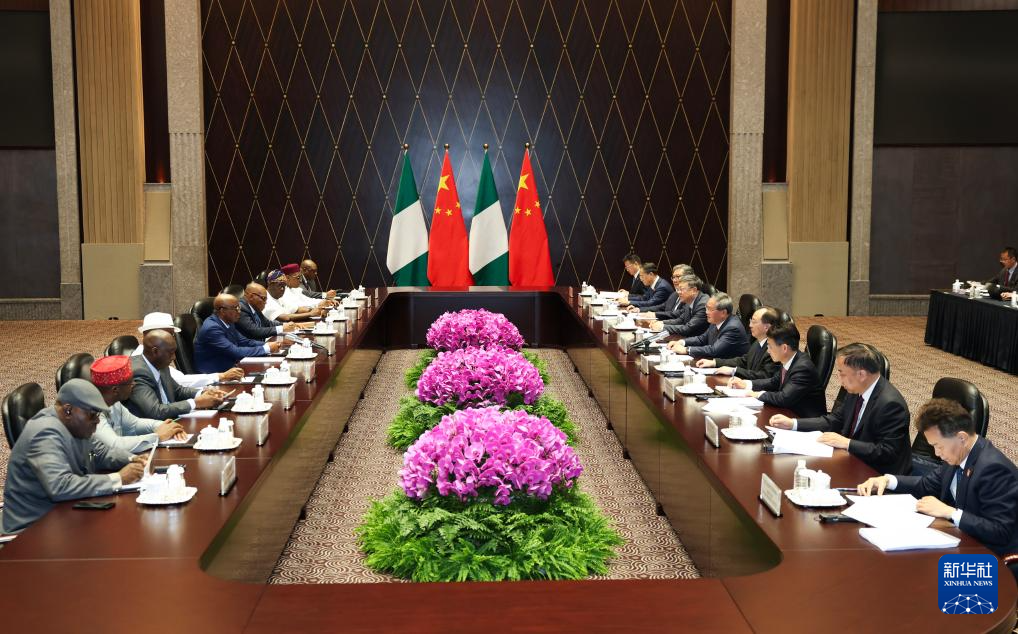
第八届进博会丨李强会见尼日利亚众议长塔杰丁
Xin Hua Wang· 2025-11-05 00:41
Core Points - The meeting between Chinese Premier Li Qiang and Nigerian Speaker Tajuddin highlights the deep traditional friendship and partnership between China and Nigeria, emphasizing the rapid development of bilateral relations into a comprehensive strategic partnership [2][3] - Both countries, as developing nations with large populations and significant development potential, are encouraged to strengthen cooperation in various sectors, including trade, investment, agriculture, and emerging industries like clean energy and artificial intelligence [3][4] Group 1 - China and Nigeria are committed to enhancing their economic cooperation through initiatives such as the "Ten Cooperation Actions" and the Belt and Road Initiative, aiming for high-quality development and mutual benefits [3] - The Chinese side supports Nigeria's increased role in international and regional affairs and seeks to coordinate efforts in multilateral mechanisms like BRICS and the WTO to promote a more equitable global governance system [3] Group 2 - Nigeria reaffirms its commitment to the One China principle and expresses a desire to strengthen exchanges in governance and expand cooperation in trade, infrastructure, and energy sectors [4] - The Nigerian Parliament is willing to support and ensure the success of the comprehensive strategic partnership with China, aiming for higher levels of cooperation [4]

上市公司投身产业实践 绘制昂扬向上科创曲线
Zhong Guo Zheng Quan Bao· 2025-11-04 20:17
Core Insights - The "14th Five-Year Plan" has laid a solid foundation for China's technological strength, with a projected R&D investment exceeding 3.6 trillion yuan in 2024, marking a 48% increase from 2020 [1] - A-shares listed companies are pivotal in transforming policy blueprints into industrial practices, with a total R&D investment of 1.16 trillion yuan in the first three quarters of 2025, reflecting a 3.88% year-on-year growth [1] - The focus on key areas such as integrated circuits, advanced materials, and biomanufacturing is expected to drive significant breakthroughs in core technologies during the "15th Five-Year Plan" [2] Group 1: Technological Breakthroughs - The "15th Five-Year Plan" emphasizes the need for decisive breakthroughs in critical core technologies across various sectors, including integrated circuits and high-end instruments [2] - Companies like Zhichun Technology are transitioning from equipment suppliers to solution partners, enhancing their competitive edge in the semiconductor industry [2] - The continuous increase in R&D investment by listed companies is crucial for enhancing their global market competitiveness [2] Group 2: Emerging and Future Industries - The development of strategic emerging industries such as new energy, aerospace, and low-altitude economy is highlighted as essential for economic growth [3] - Companies are actively engaging in the development of AMOLED display technologies, with a projected shipment area of nearly 8.8 million square meters in 2024 [3] - The rise of low-altitude economy is seen as a transition from policy-driven to technology-driven growth, with companies focusing on safety and efficiency [3] Group 3: Capital Market and Innovation Ecosystem - The capital market is undergoing reforms to support emerging industries, with companies like Yushu Technology and Blue Arrow Aerospace advancing their IPO processes [4] - The integration of innovation resources is being promoted, with companies forming innovation alliances to enhance collaboration across various sectors [5] - Artificial intelligence is identified as a key accelerator for the integration of technological and industrial innovation, with significant growth in AI applications [6]
规范新兴产业、未来产业 11月起一批重要国家标准开始实施
Zhong Guo Jing Ji Wang· 2025-11-04 08:23
Core Points - A series of important national standards will be implemented starting in November, aimed at regulating emerging and future industries, creating a favorable consumer environment, and ensuring the safety of people's lives and property [3]. Group 1: Electric Vehicles - The national standard for electric vehicle battery swapping safety requirements for commercial vehicles (GB/T 40032.2-2025) specifies safety requirements unique to N1, N2, and N3 class battery-swapping commercial electric vehicles, with other types encouraged to follow [4]. - The implementation of this standard will promote the adoption of battery swapping models in the commercial vehicle sector, ensuring safe and reliable operation of electric commercial vehicles and fostering the healthy development of the battery swapping industry [5]. Group 2: Construction Materials - The mandatory national standard for building waterproof coatings (GB 45671-2025) outlines safety technical requirements such as combustion performance, flash point, and harmful substance limits [6]. - This standard's implementation will help ensure the quality of construction projects, protect human health and environmental safety, and further guide the industry's green and high-quality development [7]. Group 3: Electrical Products - The recommended national standard for household and similar use plug sockets with USB power (GB/T 2099.31-2025) sets safety and electromagnetic compatibility requirements [8]. - The implementation of this standard will guide consumers in the safe use of USB power sockets, promote technological advancement in the power socket industry, and enhance product quality and competitiveness [9]. Group 4: Home Appliances - The recommended national standard for electric oil heaters (GB/T 28199-2025) defines terms, classifications, requirements, inspection rules, labeling, packaging, transportation, and storage requirements for household and similar use electric oil heaters [10][11]. - This standard will provide a more comprehensive and reliable technical basis for testing electric oil heater products, promoting technological progress in this sector [12]. Group 5: Personal Care Products - The recommended national standards for toothbrushes include general requirements and testing methods for manual toothbrushes (GB/T 19342—2024) and performance testing methods for electric toothbrushes (GB/T 45637-2025) [14][15]. - The implementation of these standards will further improve the standard system in the toothbrush sector, enhance product quality, and better meet market demands [16]. Group 6: Automotive Services - The recommended national standard for car rental services (GB/T 29911-2025) outlines overall requirements for small and micro passenger car rental services, including requirements for operators, vehicles, service personnel, service processes, rental platforms, and service quality management [17][18]. - The implementation of this standard will standardize operational behaviors in the car rental industry, improve service levels, and lead to high-quality development in the sector [19]. Group 7: Data Security - The recommended national standard for data security concerning sensitive personal information processing (GB/T 45574-2025) establishes general and specific security requirements for handling sensitive personal information [20][21]. - The implementation of this standard will provide technical support for regulating sensitive personal information processing and protecting the rights and interests of individuals [22]. Group 8: Civil Defense - The recommended national standard for the environmental hygiene of civil defense engineering during normal use (GB/T 17216-2025) specifies hygiene requirements applicable to civil defense projects used for accommodation and commercial purposes [23][24]. - The implementation of this standard will help create a healthy and hygienic environment for civil defense projects, preventing health risks [25]. Group 9: Fire Safety - The mandatory national standard for determining major fire hazards (GB 35181-2025) establishes rules for identifying significant fire hazards in buildings and locations [26][27]. - The implementation of this standard will aid in the timely identification and elimination of major fire hazards [28].

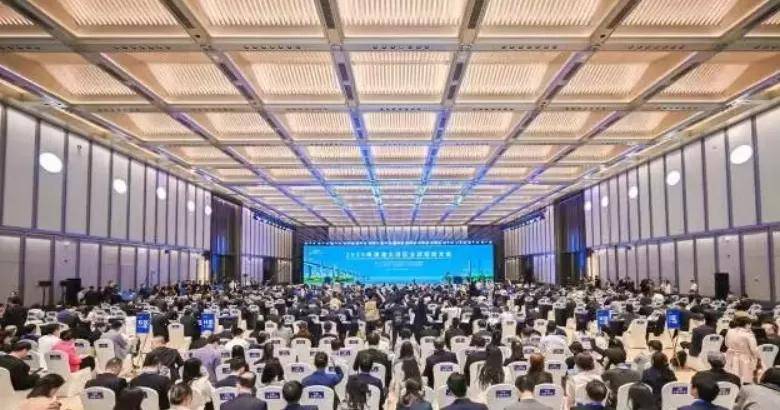
第四届粤港澳大湾区全球招商大会在穗举行
Sou Hu Cai Jing· 2025-11-04 07:38
Core Insights - The fourth Guangdong-Hong Kong-Macao Greater Bay Area Global Investment Conference was held in Guangzhou, showcasing the region's robust development and cooperation prospects [1] - The theme of the conference was "Investing in the Greater Bay Area for a Better Future," attracting global investors and entrepreneurs to discuss mutually beneficial cooperation and high-quality development [1] Group 1: Investment Opportunities - Since 2022, the conference has successfully held three sessions, resulting in 3,645 signed projects with a total investment and trade amount of 7 trillion yuan, including 92 projects exceeding 10 billion yuan [3] - Major companies like Siemens Healthineers, China National Offshore Oil Corporation, and ZF Friedrichshafen have made significant progress in the region, highlighting the Greater Bay Area's strong appeal as a global investment destination [3] - The participation of 465 Fortune Global 500 companies and 171 senior executives from China reflects global confidence in the development prospects of the Greater Bay Area [3] Group 2: Economic Growth - The Greater Bay Area is projected to surpass 14 trillion yuan in economic output by 2024, contributing to 1/9 of the national economic total while occupying less than 0.6% of the country's land area [3] - With a population of over 86 million, the region benefits from scale advantages and market dividends, positioning itself as a hub for global high-end resources [3] - The "Shenzhen-Hong Kong-Guangzhou" innovation cluster ranks first globally, and Guangdong has maintained the top position in regional innovation capabilities for nine consecutive years [3] Group 3: Business Environment - Guangdong has been recognized for four consecutive years as the province with the best business environment, implementing various policies to support foreign investment and market vitality [5] - The conference adopted a "1+9+N" format, including one main event, nine investment promotion meetings in the Pearl River Delta cities, and numerous overseas roadshows and investment inspections [5] - The event aimed to create a global investment brand and provide a platform for deeper understanding of the Greater Bay Area's investment environment [5]
收评:沪指跌0.41% 福建本地股领涨 金属股领跌
Xin Hua Cai Jing· 2025-11-04 07:30
Market Performance - On November 4, the three major stock indices in Shanghai and Shenzhen opened lower, with the Shanghai Composite Index experiencing a slight rise before consolidating, while the ChiNext Index declined after filling a gap [1] - By the end of the trading day, the Shanghai Composite Index closed at 3960.19 points, down 0.41%, with a trading volume of approximately 852.9 billion; the Shenzhen Component Index closed at 13175.22 points, down 1.71%, with a trading volume of about 1062.8 billion; the ChiNext Index closed at 3134.09 points, down 1.96%, with a trading volume of around 481.3 billion [1] Sector Performance - The Fujian and banking sectors led the gains, while tourism and the snow industry saw significant increases; however, metal stocks experienced notable adjustments, leading to declines in non-ferrous and lithium sectors [1] - The PEEK materials, sci-tech growth sectors, and AI mobile PC sectors also saw significant declines [1] Institutional Insights - According to institutional views, the current market volatility is seen as a buildup of momentum for the year-end and cross-year market trends, with expectations of clearer directions following a period of consolidation [2] - Recommendations include focusing on high-growth sectors such as semiconductors, consumer electronics, artificial intelligence, robotics, and low-altitude economy for potential investment opportunities [2] Policy Developments - The National Health Commission and other departments released guidelines to promote and regulate the application of "AI + healthcare," aiming to establish high-quality data sets and intelligent applications in healthcare by 2027, with full coverage of intelligent diagnostic assistance by 2030 [3] - The guidelines emphasize the creation of a robust AI application standard system in healthcare, aiming to enhance the quality of the health industry [3] Strategic Directions - The State-owned Assets Supervision and Administration Commission (SASAC) emphasized the need to cultivate emerging industries and open new growth avenues, focusing on upgrading traditional industries and fostering a modern industrial system centered on advanced manufacturing [4] - The SASAC also highlighted the importance of technological self-reliance and innovation, advocating for deep integration of technological and industrial innovation to stimulate new productive forces [4]
李家超:内地企业正积极开拓新兴市场 香港将发挥双向平台的核心功能推动企业出海
Zhi Tong Cai Jing· 2025-11-03 11:21
Core Viewpoint - Hong Kong is positioned as a key player in the Greater Bay Area (GBA), serving as a "super connector" and "super value creator" for both local and international markets, leveraging its status as a global financial, shipping, and trade center [1][2] Group 1: Development Strategies - The Northern Metropolis is identified as a crucial area for GBA development, enhancing collaboration between Hong Kong and mainland cities while promoting innovation and industrial growth [1] - The Lok Ma Chau Loop Cooperation Zone is highlighted as an accelerator for innovation, with the "Shenzhen-Hong Kong-Guangzhou" innovation cluster ranking first globally in the latest Global Innovation Index [2] - The government plans to implement incentive policies to attract high-value industries, particularly in the life sciences sector, and establish a clinical trial collaboration platform to facilitate synchronized trials in Hong Kong and Shenzhen [2] Group 2: Market Expansion Initiatives - Hong Kong aims to enhance its role as a dual-platform for "bringing in" and "going out," supporting mainland enterprises in establishing financial centers and regional headquarters in Hong Kong [2] - The government has established a dedicated task force for mainland enterprises to facilitate their overseas expansion, emphasizing the growing global demand for "Made in China" products [2][3] - The promotion of GBA opportunities is seen as a way for Hong Kong to connect with the world and foster mutual benefits, with plans for joint investment initiatives and global outreach activities [3]
国家发改委:有信心有能力实现全年经济社会发展目标任务
Zhong Guo Xin Wen Wang· 2025-10-31 06:44
Core Viewpoint - The National Development and Reform Commission (NDRC) expresses confidence and capability to achieve the annual economic and social development goals, supported by solid performance in the first three quarters of the year [1][3]. Economic Performance - GDP growth for the first three quarters is reported at 5.2%, maintaining a leading position among major global economies [1]. - Social retail sales increased by 4.5%, accelerating by 1.2 percentage points compared to the same period last year [1]. - Industrial added value for large-scale enterprises grew by 6.2%, marking the highest growth for the same period since 2022 [1]. Innovation and Industry Growth - China's innovation index has entered the global top ten, bolstering the development of emerging industries [1]. - The added value of equipment manufacturing and high-tech manufacturing increased by 9.7% and 9.6%, respectively, with their shares in large-scale industrial output rising by 2.1 and 0.8 percentage points year-on-year [1]. - The semiconductor and smart device manufacturing sectors saw significant growth, with added values increasing by 22.4% and 12.2% [1]. Quality and Efficiency - Improvements in product prices and corporate profits are noted, with industrial enterprise profits rising by 3.2% year-on-year, and a notable 21.6% increase in September alone [2]. Resilience and Export Performance - Despite external pressures, merchandise exports maintained a growth rate of 7.1%, with high-tech and high-value-added products gaining wider recognition [2]. - Exports to countries involved in the Belt and Road Initiative grew by 12.4%, and exports to ASEAN countries have seen an increase for eight consecutive months [2]. Consumer Demand and Structural Upgrades - Consumer demand is highlighted by a 5.2% increase in service retail sales, driven by popular events such as sports and concerts [2]. - The number of inbound tourists surged by 17.8% in the first three quarters, reflecting the impact of visa-free policies [2]. - Strong trends towards high-end, green, and intelligent development are observed, with rapid growth in related product outputs [2]. Future Outlook - International economic organizations have raised their forecasts for China's economic growth, indicating a positive outlook for 2025 [3]. - The NDRC plans to enhance policy research and timely implementation to ensure the achievement of annual goals [3].
有色金属日度策略-20251031
Fang Zheng Zhong Qi Qi Huo· 2025-10-31 05:25
1. Report Industry Investment Rating No relevant content provided. 2. Core Views of the Report - The overall trend of the non - ferrous metals sector is upward in the short - term, but there are fluctuations. The performance of different varieties within the sector varies significantly. The easing of Sino - US trade relations has led to a recovery in risk appetite, and the non - ferrous metals sector has shown a fluctuating upward trend driven by the strength of copper. However, geopolitical factors such as the G7's establishment of the "key mineral production alliance" may increase the impact on the supply, demand, trade, and investment of non - ferrous metals [11][12]. - The Fed's interest rate decision has an impact on non - ferrous metals. Although the Fed cut interest rates by 25 basis points in October and plans to end balance - sheet reduction in December, the uncertainty of a December rate cut has increased, causing fluctuations in the non - ferrous metals market [11][12]. 3. Summary by Relevant Catalogs 3.1 First Part: Non - Ferrous Metals Operation Logic and Investment Recommendations 3.1.1 Macro Logic - Sino - US trade relations have eased, risk appetite has recovered, and non - ferrous metals have shown a fluctuating upward trend driven by copper. The Fed cut interest rates by 25 basis points in October and will end balance - sheet reduction in December, but Powell's statement dampened the expectation of a year - end rate cut. The Bank of Canada cut interest rates by 25 basis points, and the Bank of Japan maintained its interest rate [11]. - The "15th Five - Year Plan" aims to promote key core technology research and develop emerging industries. China's industrial enterprise profits in September increased year - on - year, which is positive for non - ferrous metals. However, geopolitical factors such as the G7's key mineral production alliance may affect the non - ferrous metals market [12]. 3.1.2 Non - Ferrous Metals Strategy | Variety | Operation Logic | Support Area | Pressure Area | Market Judgment | Strategy | Recommendation Intensity | | --- | --- | --- | --- | --- | --- | --- | | Copper | Supply pressure persists. A major mine accident has occurred, and domestic electrolytic copper production is expected to decline in Q4. Demand will enter the peak season, and the price center is expected to rise. | 84000 - 85000 yuan/ton | 89000 - 90000 yuan/ton | Oscillate upwards | Buy on dips | +1 | | Zinc | Supply growth is gradually realized, and processing fees have declined. Demand during the peak season is relatively weak, and inventory is at a high level with fluctuations. | 21500 - 21600 yuan/ton | 22400 - 22500 yuan/ton | Fluctuate and rebound | Bullish on dips | +0.5 | | Aluminum Industry Chain | For aluminum, there is a slight outflow of funds, and the demand shows the characteristics of "stable in the peak season and differentiated internally". Alumina production capacity has decreased slightly, and the demand for recycled aluminum alloy is supported by tight scrap supply. | 20500 - 20800 yuan/ton; 2600 - 2700 yuan/ton; 20000 - 20500 yuan/ton | 21500 - 21800 yuan/ton; 3000 - 3200 yuan/ton; 21000 - 21200 yuan/ton | Aluminum oscillates strongly; Alumina oscillates and consolidates; Cast aluminum alloy oscillates strongly | Bullish approach; Short - term short; Bullish approach | +0.5/-0.5/+0.5 | | Tin | The processing fees of domestic tin smelters are temporarily flat, and the start - up rate has increased significantly. However, the raw material shortage problem is still serious. Demand has improved slightly during the peak season. | 260000 - 270000 yuan/ton | 290000 - 300000 yuan/ton | Oscillate strongly | Bullish approach | +0.5 | | Lead | The supply of recycled lead has failed to meet expectations, and the demand for lead - acid batteries has declined after the price increase. The import of crude lead has supplemented the raw material end. | 17300 - 17500 yuan/ton | 17800 - 18000 yuan/ton | Rise and then fall | Reduce long positions on rallies | +0.5 | | Nickel | The supply of nickel ore is strengthening, and the profit of nickel pig iron is declining. The supply of refined nickel is still growing. The demand for nickel pig iron has slowed down, and the price is under pressure. | 118000 - 120000 yuan/ton | 125000 - 128000 yuan/ton | Correct in the range | Slightly bullish on dips | +0.5 | | Stainless Steel | The supply and demand are relatively weak, the cost support has weakened, and the inventory has slightly increased recently. The market continues to oscillate. | 12500 - 12600 yuan/ton | 13000 - 13200 yuan/ton | Oscillate | Bullish on dips | +0.5 |[13][14][15] 3.2 Second Part: Non - Ferrous Metals Market Review | Variety | Closing Price | Change Rate | | --- | --- | --- | | Copper | 87960 | - 0.85% | | Zinc | 22365 | - 0.29% | | Aluminum | 21245 | - 0.23% | | Alumina | 2816 | - 2.19% | | Tin | 283600 | - 1.09% | | Lead | 17350 | - 0.03% | | Nickel | 120980 | - 0.46% | | Stainless Steel | 12725 | - 0.62% | | Cast Aluminum Alloy | 20705 | 0.07% |[16][17] 3.3 Third Part: Non - Ferrous Metals Position Analysis No specific text content provided, only mentioned a chart about the latest position analysis of the non - ferrous metals sector [18]. 3.4 Fourth Part: Non - Ferrous Metals Spot Market | Variety | Name | Price | Change Rate | | --- | --- | --- | --- | | Copper | Yangtze River Non - Ferrous Copper Spot Price | 88070 yuan/ton | 0.30% | | | Wumao 1 Average Price | 87920 yuan/ton | 0.21% | | | Zhongyuan Non - Ferrous 1 Copper Market Price | 88070 yuan/ton | 0.30% | | Zinc | Yangtze River Non - Ferrous 0 Zinc Spot Average Price | 22240 yuan/ton | - 0.27% | | | Yangtze River Non - Ferrous 1 Zinc Spot Average Price | 22140 yuan/ton | - 0.27% | | | Nanchu Foshan 0 Zinc Ingot Average Price | 22110 yuan/ton | - 0.14% | | Aluminum | Yangtze River Non - Ferrous Aluminum Spot Average Price | 21200 yuan/ton | 0.24% | | | Nanchu Foshan A00 Aluminum Ingot Average Price | 21070 yuan/ton | 0.00% | | | LME Aluminum Spot Closing Price | 2886 US dollars/ton | - 0.19% | | Alumina | Antaike Alumina National Average Price | 2906 yuan/ton | 0.00% | | | Monohydrate Bauxite Henan Arrival Price | 535 yuan/ton | 0.00% | | | Alumina Australia FOB Intermediate Price | 318 US dollars/ton | 0.00% | | Nickel | Russian Nickel (Shanghai) | 121810 yuan/ton | 0.38% | | | Premium | 450 yuan/ton | 0.00% | | Stainless Steel | Spot Price | 12900 yuan/ton | 0.00% | | | Scrap Stainless Steel (Wuxi) | 9100 yuan/ton | - 0.55% | | Tin | 1 Tin Yangtze River Non - Ferrous Spot Average Price | 284100 yuan/ton | - 0.35% | | | 60% Tin Concentrate Average Price (Guangxi) | 277000 yuan/ton | - 0.45% | | Lead | Lead Ingot (1) | 16921 yuan/ton | - 0.02% | | | Scrap Lead | 10075 yuan/ton | 0.00% | | Cast Aluminum Alloy | Aluminum Alloy ADC12 (Shanghai) | 21150 yuan/ton | 0.00% | | | Scrap Aluminum Crushing Primary Aluminum (Shanghai) | 10120 yuan/ton | 0.10% |[18][19] 3.5 Fifth Part: Non - Ferrous Metals Industry Chain No specific text content provided, only mentioned various charts related to the non - ferrous metals industry chain such as inventory, processing fees, and price trends for each variety [21][22][24] 3.6 Sixth Part: Non - Ferrous Metals Arbitrage No specific text content provided, only mentioned various charts related to non - ferrous metals arbitrage such as RMB - to - foreign - currency ratio changes, basis, and spread trends for each variety [48][49][51] 3.7 Seventh Part: Non - Ferrous Metals Options No specific text content provided, only mentioned various charts related to non - ferrous metals options such as historical volatility, implied volatility, and trading volume and open interest trends for each variety [64][66][69]

皖台共拓产业路:从传统制造向新兴赛道跨越的合作共赢
Xin Hua Wang· 2025-10-31 03:24
Core Insights - The collaboration between Taiwan and Anhui is transitioning from traditional manufacturing to emerging industries, highlighting a win-win partnership in economic development [1][2]. Group 1: Industry Development - Anhui province is evolving from a traditional agricultural base to a technology powerhouse, with significant growth in emerging industries such as new energy vehicles, integrated circuits, and artificial intelligence [1][2]. - By September 2025, Anhui is expected to have approved over 2,500 Taiwan-funded projects, attracting more than $20 billion in direct investments across various sectors [2]. Group 2: Business Expansion - Taiwanese businesses are shifting their focus from traditional sectors like textiles to high-tech industries, with a strong alignment between Taiwan's advantageous industries and Anhui's emerging sectors [2]. - Companies like 联宝 (Lianbao) have expanded their operations in Anhui, moving from producing laptop components to a broader range of products including automotive parts and precision bearings, with annual output exceeding 300 million RMB [2]. Group 3: Entrepreneurial Opportunities - Young Taiwanese entrepreneurs are increasingly establishing businesses in Anhui, drawn by the region's supportive environment and logistical advantages, as exemplified by a semiconductor company founded by three Taiwanese sisters [3][4]. - The local government provides comprehensive support for new businesses, enhancing the confidence of entrepreneurs in the region [3].
为何要再造一个高技术产业
Jing Ji Ri Bao· 2025-10-30 22:14
Core Insights - The Chinese government aims to cultivate and expand emerging and future industries, with the goal of creating a new high-tech industry equivalent to the size of China's existing high-tech sector over the next decade, injecting continuous new momentum into the economy and high-quality development [1][3] Economic Context - China's economic growth faces challenges due to the weakening of traditional growth drivers and the slow replacement by new drivers, necessitating the reconstruction of a high-tech industry to stabilize growth [1][2] - The current contribution of high-tech manufacturing to industrial value added is less than 20%, indicating a significant gap compared to developed countries, which positions the reconstruction of a high-tech industry as a strategic move to enhance competitiveness [2] Strategic Importance - The reconstruction of a high-tech industry is seen as a critical step in reshaping industrial advantages, allowing China to consolidate its leading position in advantageous sectors and seize opportunities in future markets [2][4] - The ongoing technological revolution, particularly in areas like artificial intelligence, presents both opportunities and uncertainties, making the establishment of a high-tech industry essential for capturing new technological advancements and mitigating risks [2][3] Industrial Foundation - China's "three new" economy is projected to contribute 24.29 trillion yuan to GDP in 2024, exceeding 18%, supported by a robust industrial system and leadership in sectors like new energy vehicles and 5G [3] - The country ranks second globally in R&D expenditure, with significant breakthroughs in quantum computing and artificial intelligence, indicating a strong foundation for the development of a new high-tech industry [3] Future Industry Development - The focus will be on nurturing emerging pillar industries such as new energy, new materials, and aerospace, which are expected to create substantial market opportunities and drive the expansion of the high-tech sector [3][4] - Future industries will be strategically developed in areas like quantum technology and brain-computer interfaces, transitioning from technological reserves to market applications, thus becoming new growth points for the economy [3] Transformation of Manufacturing - The initiative to rebuild a high-tech industry represents a qualitative transformation of Chinese manufacturing, moving away from being "big but not strong" to a more resilient and innovative position in global competition [4]