
戴维斯双击

Search documents
风控指标位于临界位置,如何应对?
Sou Hu Cai Jing· 2025-09-07 10:34
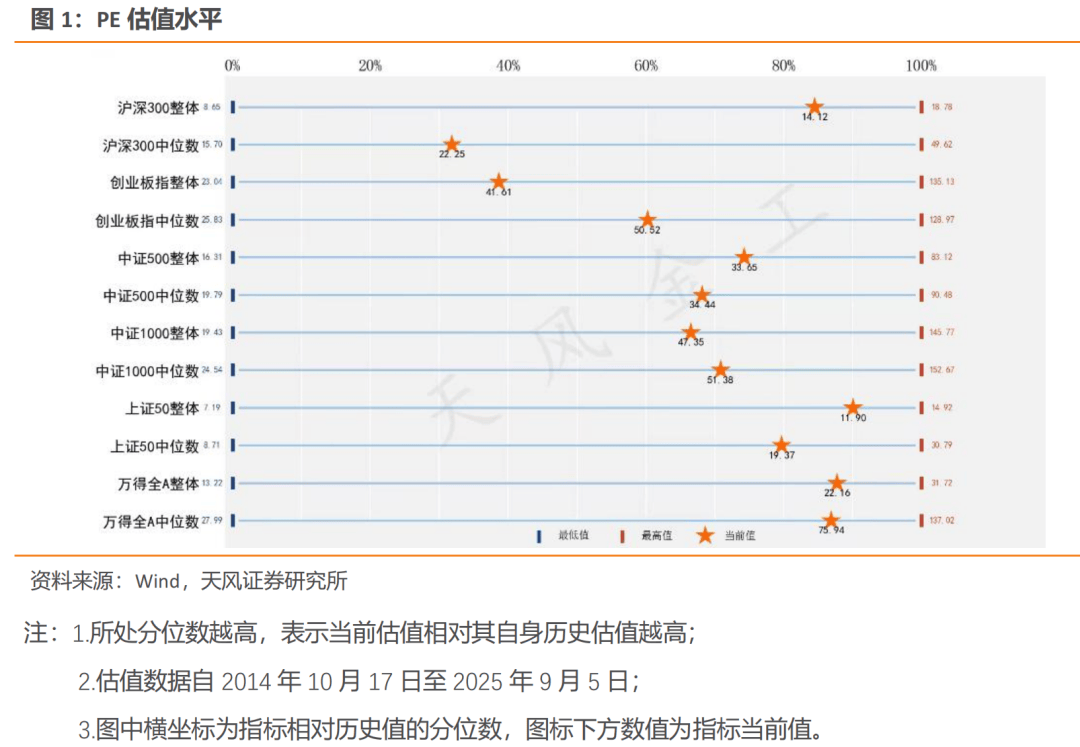
Market Overview - The market continues to operate in an upward trend, with the core observation variable being whether the market's profit-making effect can be sustained. As long as the profit-making effect remains positive, incremental funds are likely to continue entering the market [1][3][9] - The current WIND All A trend line is around 6030 points, with a profit-making effect of 1%, which is at a critical position but still positive. It is advised to hold patiently until the profit-making effect turns negative [1][3][9] - Short-term expectations of a Federal Reserve interest rate cut have increased, which may enhance global risk appetite [1][3][9] Investment Strategy - The Davis Double Strategy achieved an excess return of 3.24% this week, with a cumulative absolute return of 48.29% for the year [10] - The net profit gap strategy also reported an excess return of 0.00% this week, with a cumulative absolute return of 46.58% for the year [10][14] - The recommended position is 80%, indicating a moderate level of investment in the market [4] Sector Allocation - Mid-term sector allocation continues to recommend turnaround sectors, particularly Hong Kong innovative pharmaceuticals and securities insurance, which are expected to maintain an upward trend [2][3] - Policy-driven sectors such as chemicals, non-ferrous metals, and innovative energy are also anticipated to sustain upward momentum [2][3] - The TWO BETA model continues to recommend technology sectors, focusing on consumer electronics and computing power [2][3] Market Volatility - Current market volatility has increased significantly, with some sectors experiencing substantial fluctuations. It is recommended to maintain a balanced allocation and to increase exposure to previously lagging sectors to diversify risk [1][3][9]

煤炭与消费用燃料行业周报:焦煤期货大涨后,后续如何看?-20250907
Changjiang Securities· 2025-09-07 09:15
Investment Rating - The industry investment rating is "Positive" and maintained [10] Core Viewpoints - The report indicates that after a significant rise in coking coal futures by 6%, the price support for coking coal remains strong due to tight supply and replenishment effects. In the medium to long term, the focus will be on "anti-involution" and price stability, with potential for a demand recovery driven by economic stimulus, which could lead to a "Davis Double" for coking coal [2][7] - The coal index (Yangtze) increased by 0.34%, outperforming the CSI 300 index by 1.15 percentage points, ranking 9th out of 32 industries [6][15] - The report emphasizes the importance of price stability as indicated by recent policies from Shanxi and Shaanxi provinces, which aim to promote stable coal market operations [6][7] Summary by Sections Coking Coal Market - As of September 5, the price of main coking coal at Jingtang Port was 1540 RMB/ton, a decrease of 70 RMB/ton week-on-week. The report suggests that while short-term fluctuations may increase due to a slowdown in downstream purchasing demand, the medium to long-term outlook remains positive with potential for price support [6][7][17] Thermal Coal Market - The market price for thermal coal at Qinhuangdao Port was 679 RMB/ton as of September 5, down 11 RMB/ton week-on-week. Despite a seasonal transition from peak to off-peak demand, the report anticipates limited downside for coal prices due to ongoing supply constraints and replenishment needs [6][16] Investment Recommendations - The report recommends a focus on companies with improving fundamentals under the "anti-involution" theme, suggesting a mix of elastic stocks and stable profit leaders. Specific companies highlighted include Yanzhou Coal Mining Company, China Shenhua Energy, and others [8][29]
本轮牛市走到哪个阶段了?
雪球· 2025-09-06 05:04
Group 1 - The article discusses the typical stages of a bull market, which include valuation repair, performance-driven improvement, and emotional bubble phases. The transition to the emotional bubble phase depends on whether performance expectations can be sustained [3][4]. - The current market is experiencing a rapid rise followed by adjustments, indicating it is in the latter part of the performance improvement phase, with an estimated 3% growth in overall A-share earnings for the first half of the year and a projected 6% growth for the entire year [5][6]. - The article compares the current market conditions to the bull market from 2019 to 2021, noting similarities in the K-line charts and the rapid nature of both market phases [8][9]. Group 2 - Historical analysis shows that during the previous bull market, the index experienced a prolonged period of oscillation after the rapid rise, which eventually led to a bear market [11][12]. - The article emphasizes that the future trajectory of the current market will depend on the realization of performance expectations, with forecasts indicating double-digit growth in net profit for the index from 2025 to 2027 [14][15]. - The predicted growth rate for 2025 is 16.05%, which is significantly higher than the 6% growth forecasted by UBS, raising questions about the reliability of these projections and their impact on market performance [16].

57岁光储首富宣布跨界,公司市值直逼3000亿元
2 1 Shi Ji Jing Ji Bao Dao· 2025-09-06 02:30
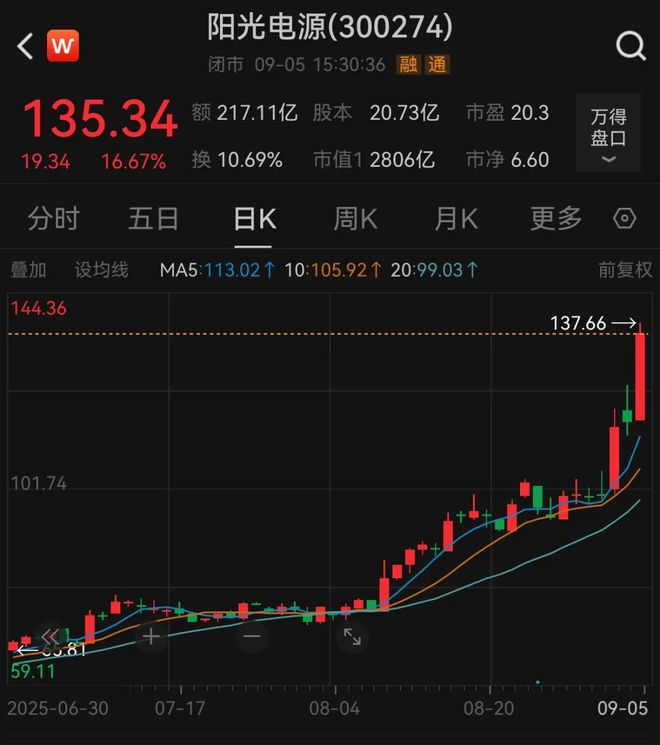
Core Viewpoint - The article highlights the remarkable growth and strategic positioning of Sungrow Power Supply Co., Ltd. in the renewable energy sector, particularly in energy storage, which has significantly contributed to its market valuation nearing 300 billion yuan [1][3]. Group 1: Company Growth and Market Performance - Sungrow's stock price surged by 35.52% in the past week and over 100% since July, with a dynamic P/E ratio increasing from below 10 times to 18 times [3]. - As of September 5, the stock price reached 135.34 yuan per share, with a market capitalization of 280.6 billion yuan, marking a historical high [1]. - The company's founder, Cao Renxian, holds a 30.46% stake, valued at 85.4 billion yuan, making him the wealthiest individual in the energy storage sector [3]. Group 2: Strategic Shifts and Innovations - Cao Renxian's entrepreneurial journey began with a focus on renewable energy technology, leading to a strategic pivot towards energy storage four years ago, which has proven crucial for navigating industry cycles [7]. - In 2025, energy storage system shipments are expected to reach 40 to 50 GWh, with energy storage revenue growing by 127.78% year-on-year, becoming the largest revenue source for the company [8]. - The gross margin for the energy storage business stands at 39.92%, significantly higher than competitors like Haibosichuang and CATL [8]. Group 3: International Market Expansion - Sungrow's overseas revenue reached 25.379 billion yuan in the first half of 2025, an increase of 88.32%, with the international revenue share rising from 35% to 58.3% between 2023 and 2025 [8]. - The company aims to surpass Tesla in the European market, increasing its market share from 10% in 2023 to 35% by 2025 [9]. - In North America, market share is projected to grow from 5% to 12%, while maintaining a dominant 48% share in the Middle East [9]. Group 4: Future Prospects and New Ventures - Sungrow has established an AIDC division to integrate power supply technology with data center energy needs, anticipating significant growth in global data center energy storage demand [10][11]. - The company plans to issue H-shares on the Hong Kong Stock Exchange to enhance its global influence and address cross-border capital management challenges [15][16]. - The establishment of overseas production bases, such as a 15 GWh facility in Hungary and a 20 GWh factory in Thailand, is expected to support future growth [16]. Group 5: Market Sentiment and Analyst Ratings - Analysts maintain positive ratings for Sungrow, with several firms adjusting their target prices upward, reflecting confidence in the company's growth trajectory [18].

Agent会给百融云戴维斯双击-财经-金融界
Jin Rong Jie· 2025-09-05 06:13
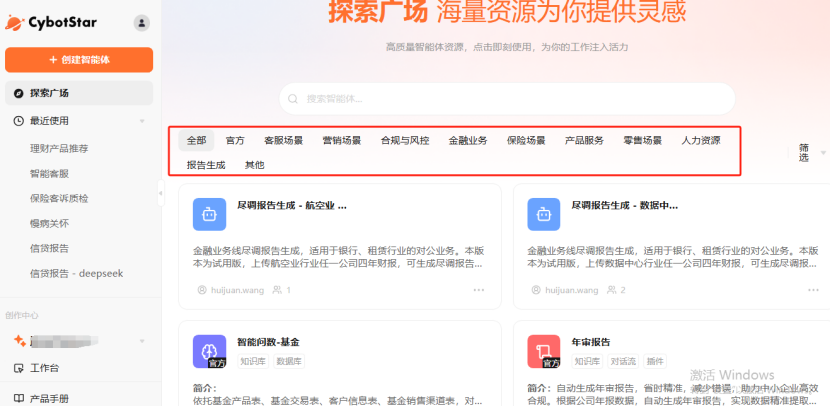
Group 1 - The core viewpoint of the articles emphasizes the significance of AI as a leading technology and the potential for companies like 百融云 to leverage AI products for business growth, particularly through their "百工" Agent platform [1][2][7] - The "百工" Agent platform is highlighted as a key product that enables companies to build AI applications more easily and effectively, contributing to the growth of 百融云's business lines, particularly in BaaS and MaaS [2][6] - 百融云's ability to understand customer business models is a competitive advantage, allowing it to secure contracts and drive revenue growth through its AI solutions [2][3] Group 2 - 百融云's financial performance is strong, with reported revenue exceeding 1.6 billion yuan, a year-on-year increase of 22%, and an adjusted net profit of 254 million yuan, up 29%, indicating the value of its AI products in B-end applications [6] - The company's core customer retention rate for its MaaS business is exceptionally high at 98%, reflecting the effectiveness of its AI models in user profiling and modeling [6] - The "百工" Agent is positioned as a potential catalyst for a "Davis Double" effect, where the rapid growth of new business lines can significantly enhance the company's valuation [7]
有色金属股午后涨幅扩大 大宗商品抗通胀属性凸显 机构称资源股将迎戴维斯双击
Zhi Tong Cai Jing· 2025-09-05 06:01
Group 1 - Non-ferrous metal stocks have seen significant gains, with Tianqi Lithium up 8.34% to HKD 42.6, Ganfeng Lithium up 7.34% to HKD 33.36, Zijin Mining up 5.62% to HKD 28.18, China Aluminum up 5.05% to HKD 6.87, and China Hongqiao up 4.13% to HKD 24.72 [1] - The expectation of a Federal Reserve interest rate cut is anticipated to significantly boost commodity demand, while the expectation of a weaker dollar highlights the anti-inflation properties of bulk commodities [1] - As of mid-2025, the A-share precious and industrial metals sectors are in a "high profitability, low valuation" phase, with the potential for increased valuation driven by active domestic capital markets and the "high-cut low" rotation effect [1] Group 2 - The ongoing energy revolution in China and the global computing power revolution are expected to continuously drive high growth in metal raw material demand [1] - There is a noticeable trend of countries increasingly protecting and pursuing critical mineral resources, leading to a clear head-of-core resource characteristic [1] - A revaluation of critical mineral resources is expected to gradually offset the negative valuation pressure from commodity cycle attributes, with the resource valuation system anticipated to be enriched and optimized in the future [1]



港股异动 | 有色金属股午后涨幅扩大 大宗商品抗通胀属性凸显 机构称资源股将迎戴维斯双击
智通财经网· 2025-09-05 06:01
Core Viewpoint - The rise in non-ferrous metal stocks is attributed to increasing expectations of interest rate cuts by the Federal Reserve, which is expected to boost commodity demand and enhance the anti-inflation characteristics of bulk commodities [1] Group 1: Stock Performance - Tianqi Lithium (09696) increased by 8.34%, trading at 42.6 HKD - Ganfeng Lithium (01772) rose by 7.34%, trading at 33.36 HKD - Zijin Mining (02899) saw a 5.62% increase, trading at 28.18 HKD - China Aluminum (02600) grew by 5.05%, trading at 6.87 HKD - China Hongqiao (01378) increased by 4.13%, trading at 24.72 HKD [1] Group 2: Market Analysis - According to Industrial Securities, the expectation of interest rate cuts will significantly boost commodity demand - The anticipated depreciation of the US dollar highlights the anti-inflation properties of bulk commodities - By mid-2025, the A-share precious and industrial metal sectors are expected to be in a "high profitability, low valuation" phase [1] Group 3: Future Outlook - The transition in China's power sector and the global computing power revolution will continue to drive high demand for metal raw materials - There is an increasing trend among countries to protect and pursue critical mineral resources, leading to a clear head-of-core resource characteristic - A gradual revaluation of critical mineral resources is expected to offset the negative valuation pressure from commodity cycle attributes - The valuation system for resource products is anticipated to be continuously enriched and optimized in the future [1]

黄金新一轮涨势即将开启?今年来涨超黄金30%的黄金股ETF(517520)弹性更大!
Sou Hu Cai Jing· 2025-09-05 03:17
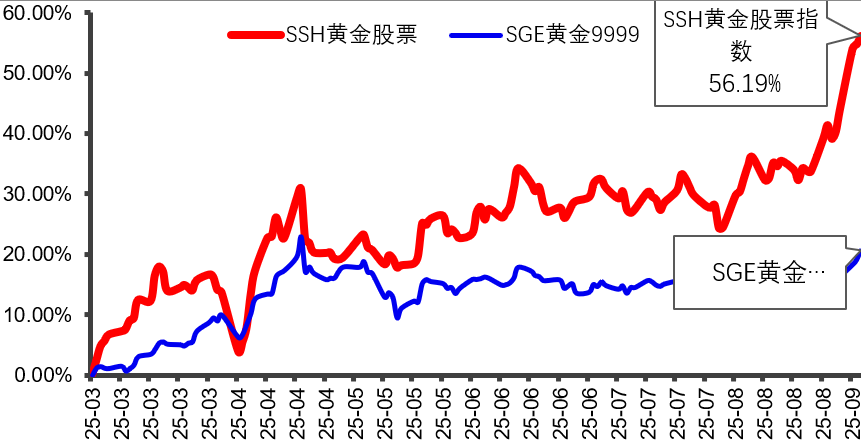
Group 1: Market Trends - The largest gold stock ETF (517520) has seen a significant increase, closing up over 8% recently and showing a year-to-date gain of over 68% [1] - Gold prices have surged, breaking through the historical peak of $3,570 per ounce, driven by expectations of imminent interest rate cuts by the Federal Reserve [1][5] - The market is experiencing a strong inflow of funds into gold-related investments, with the gold stock ETF attracting a total of 1.346 billion yuan in net inflows over six days [1] Group 2: Economic Indicators - The U.S. JOLTS job openings have dropped to a one-year low, reinforcing the case for a more accommodative monetary policy from the Federal Reserve [6] - Recent employment data, including a lower-than-expected increase in ADP employment numbers and a rise in initial jobless claims, has heightened expectations for a rate cut [3][6] Group 3: Federal Reserve Policy - Federal Reserve officials are advocating for interest rate cuts, with market expectations for a September rate cut reaching 96.6% [5] - Concerns about the independence of the Federal Reserve may lead to a loss of confidence in fiat currencies, prompting investors to turn to gold and other non-sovereign assets [5][6] Group 4: Gold Demand and Future Outlook - Strong physical demand for gold is noted, with the World Gold Council planning to pilot a "digital gold" project by 2026, potentially revolutionizing the $900 billion gold market [6] - Analysts predict a bullish trend for gold prices, with short-term targets between $3,600 and $3,800 per ounce, and long-term projections possibly exceeding $4,000 [7] - The performance of gold mining companies is expected to improve significantly, with several reporting substantial profit growth due to rising gold prices and increased production [7][8]
新品放量叠加研产销一体化闭环构筑,心玮医疗-B迎来“戴维斯双击”
Zhi Tong Cai Jing· 2025-09-05 01:05
Core Viewpoint - The domestic medical device industry has experienced a bifurcated landscape in the first half of the year, with overall revenue declining while innovative companies like Xinwei Medical have shown significant growth and profitability improvements [1][14]. Group 1: Industry Overview - The medical device sector's overall revenue in Q2 2025 declined by 4.77% year-on-year, with net profit dropping by 23.71% [1]. - Despite the industry's challenges, the medical device sector has seen a market increase of over 20% year-to-date, indicating investor confidence in innovative medical devices [1]. Group 2: Company Performance - Xinwei Medical reported a revenue of 186 million yuan in the first half of 2025, marking a 44.4% year-on-year increase, and achieved a net profit of 50.9 million yuan, successfully turning a profit [4][14]. - The company has demonstrated strong internal growth capabilities, with a 60% increase in the overall implantation volume of its ischemic products and a 563% increase in revenue from hemorrhagic products [5][6]. Group 3: Product Development and Innovation - Xinwei Medical has launched several key products, including the "Great Wall" stent for aneurysm embolization, which has rapidly expanded its market presence [6]. - The company has a robust pipeline with 32 products approved by NMPA and several others in various stages of clinical trials and registration [9][11]. Group 4: Operational Efficiency - Xinwei Medical has improved its operational efficiency, reducing sales and management expenses as a percentage of total revenue from 44.8% to 37.0% [8]. - The company achieved a significant increase in operating cash flow, reaching 5.4 million yuan, a year-on-year growth of over 80% [7]. Group 5: Market Expansion - Xinwei Medical has established a wide distribution network covering over 2,500 hospitals across China and is actively pursuing international market opportunities [12][13]. - The global peripheral intervention market is estimated at $10 billion, with the Chinese market accounting for approximately 12%-15% of this total [12].
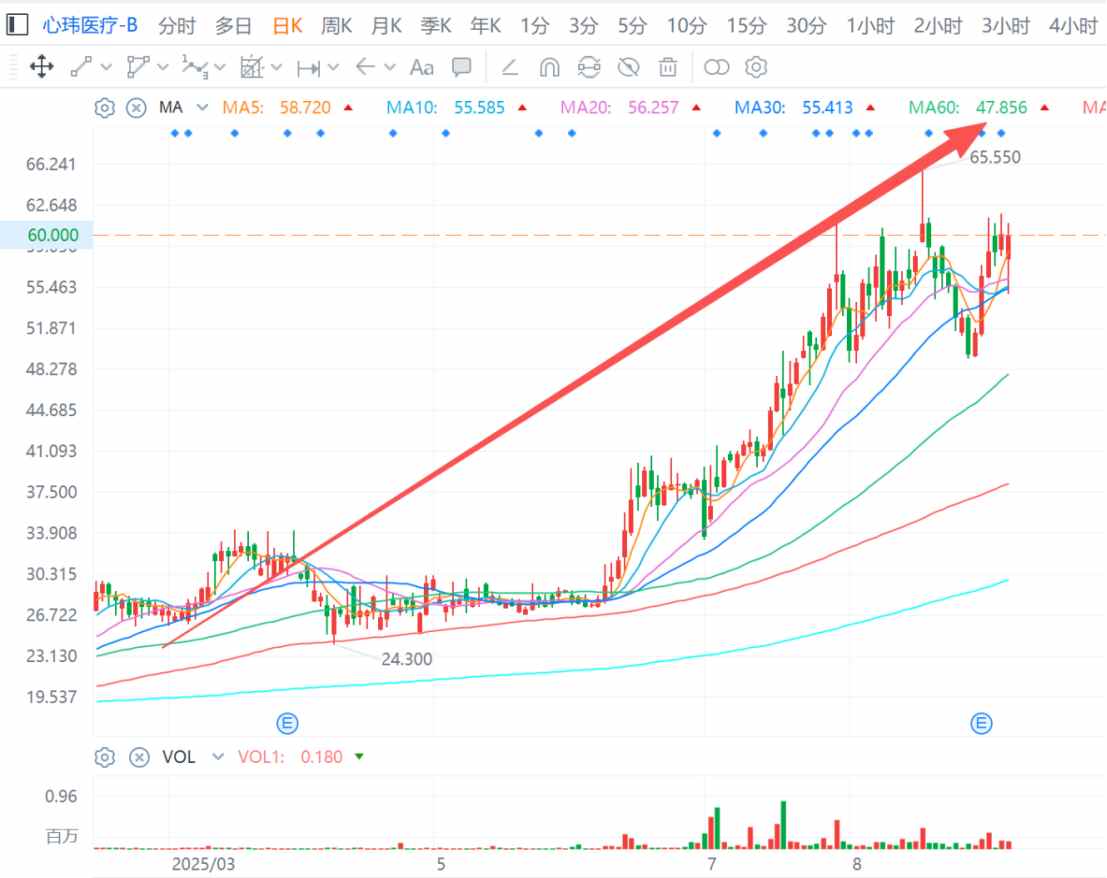
新品放量叠加研产销一体化闭环构筑,心玮医疗-B(06609)迎来“戴维斯双击”
智通财经网· 2025-09-05 01:02
Core Viewpoint - The domestic medical device industry is experiencing a bifurcated landscape, with revenue and profit declines in the sector due to factors like volume-based procurement and DRG cost control, while innovative companies like Xinwei Medical are showing strong growth and profitability, indicating market confidence in long-term value [1][14]. Industry Overview - The medical device sector saw a 4.77% year-on-year decline in overall revenue and a 23.71% drop in net profit attributable to shareholders in Q2 2025 [1]. - Despite the challenges, the medical device sector has shown a more than 20% increase in the secondary market, reflecting optimism for innovative medical devices [1]. Company Performance - Xinwei Medical reported a 44.4% year-on-year increase in revenue for the first half of 2025, reaching 186 million yuan, and achieved a net profit of 50.9 million yuan, marking a turnaround from losses [4][13]. - The company’s strong performance is attributed to its innovative product offerings and effective operational strategies, which have led to a significant improvement in its financial health [4][7]. Product Development - Xinwei Medical has successfully launched several key products, including the Captor® thrombectomy stent and a comprehensive treatment solution for intracranial aneurysms, contributing to a 563% increase in revenue from hemorrhagic products [5][6]. - The company has a robust pipeline with 32 products approved by NMPA and several others in various stages of clinical trials and registration [9][11]. Operational Efficiency - Xinwei Medical has improved its operational efficiency, with a significant reduction in sales and management expenses from 44.8% to 37.0% of total revenue, and a 35.1% decrease in R&D spending [8]. - The company achieved a gross profit of 127 million yuan, a 53.9% increase year-on-year, with a gross margin of 68.2% [8]. Market Expansion - Xinwei Medical is expanding its market presence, with over 1,400 hospitals actively implanting its ischemic products, a 24% increase year-on-year [12]. - The company is also pursuing international markets, with products registered in 15 countries and ongoing registration efforts in 21 additional regions [13]. Strategic Outlook - The company is positioned for growth through a combination of innovative R&D, integrated operations, and international expansion, aiming to become a leading player in the global medical device market [14].