美联储降息预期

Search documents
消费指数集体涨超1%,港股通消费ETF易方达(513070)近一周获资金持续布局
Sou Hu Cai Jing· 2026-02-03 11:13
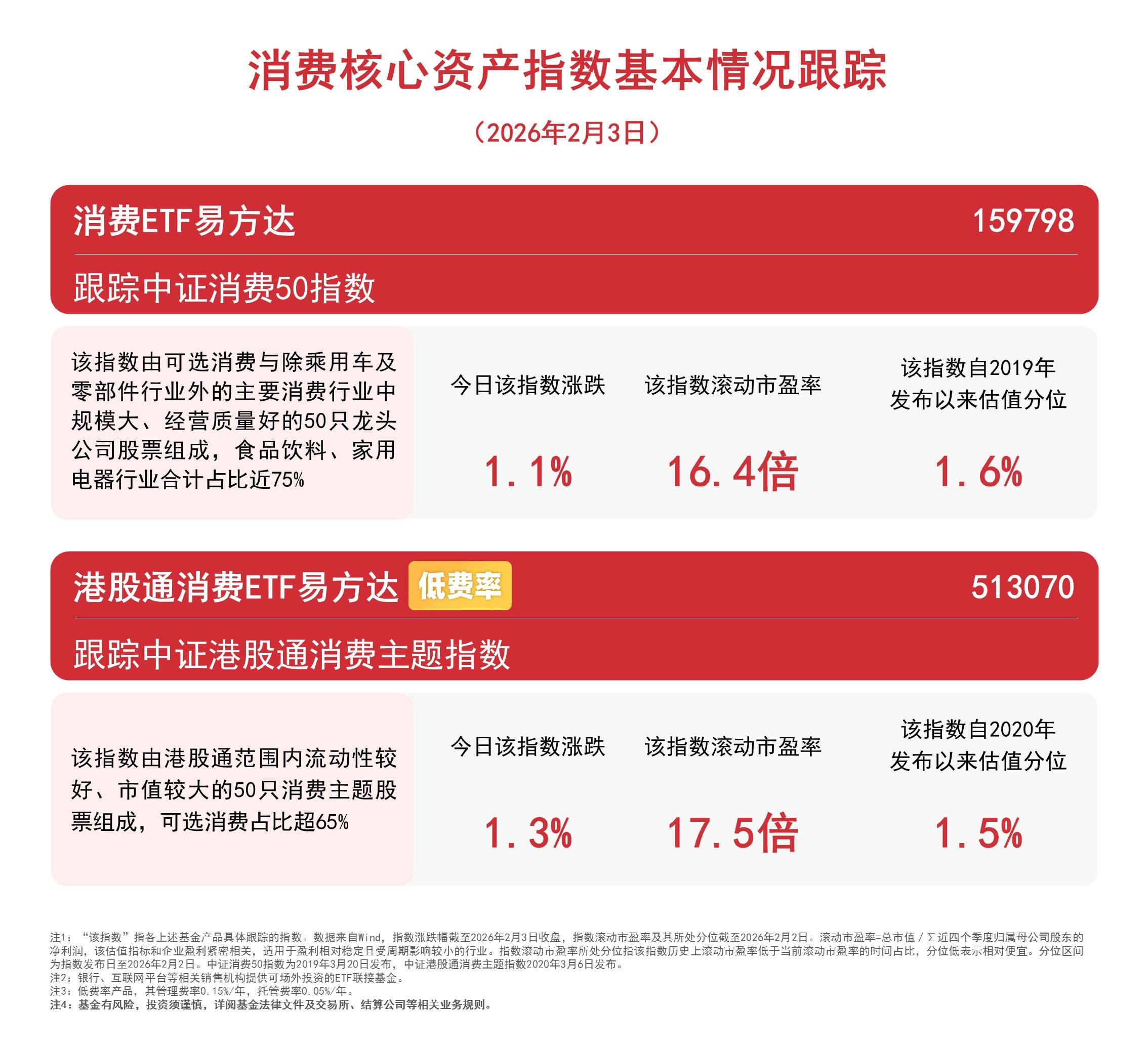
Group 1 - The core viewpoint of the articles indicates a positive trend in the Hong Kong stock market, particularly in the consumer sector, with the CSI Hong Kong Stock Connect Consumer Theme Index rising by 1.3% and the CSI Consumer 50 Index increasing by 1.1% [1] - The recent inflow of funds into consumer ETFs, specifically the E Fund Hong Kong Stock Connect Consumer ETF (513070), has attracted over 300 million yuan in the past week, indicating strong investor interest [1] - According to a report from Galaxy Securities, the short-term expectation for the Federal Reserve to lower interest rates has decreased, which may affect investor risk appetite. The technology sector is expected to remain a long-term investment focus due to multiple favorable factors such as price increases in the supply chain, trends in domestic production, and accelerated AI applications [1] Group 2 - The consumer sector is anticipated to continue benefiting from policy support, with current valuations at relatively low levels, suggesting significant medium to long-term upside potential. Future attention should be paid to the implementation of policies and improvements in consumer data [1]

金价暴跌之后又暴涨!买金卖金都大排长龙,有人透支年终奖赶紧“上车”,金店员工:忙得没空吃饭!上金所紧急公告
Mei Ri Jing Ji Xin Wen· 2026-02-03 10:56
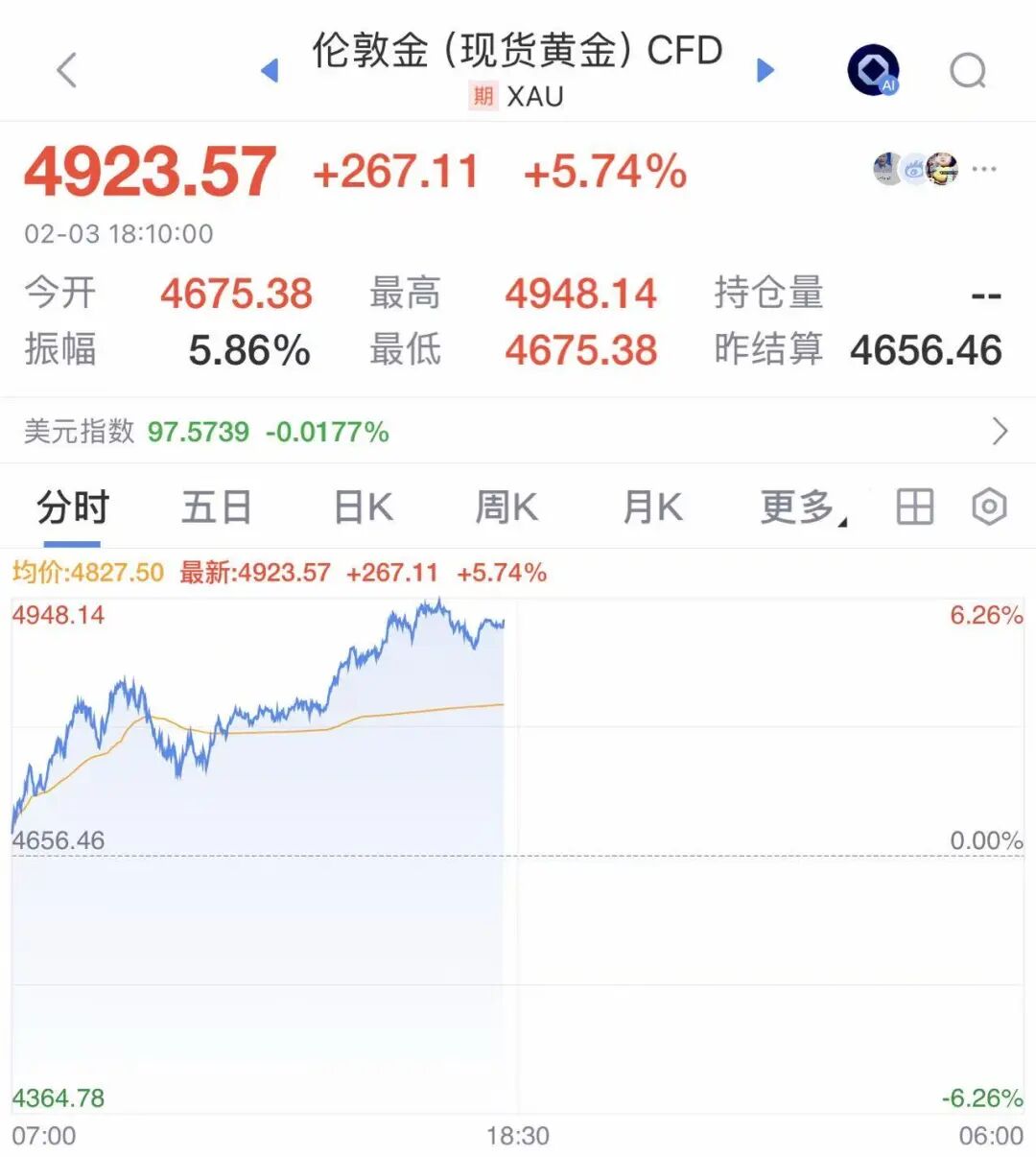
在经历了两天"史诗级"暴跌后,2月3日黄金和白银价格开始强力反弹。截至发稿,现货黄金报4923.57美元/盎司,重新站上4900美元关口,日内涨幅近 6%。现货白银报87.15美元,日内涨幅超10%。 卖金买金都大排长龙 有人"落袋为安",有人"抓紧上车" 近日剧烈波动的行情同时点燃了消费者的变现意愿与购金热情——"落袋为安"与"抓紧上车"两种心态交织,构成了当前黄金市场"回收热"与"抢购热"并存 的独特景象。 "现在金条回收的价格是多少?"在北京市丰台区一家黄金回收店内,一位女士盯着手机上的实时金价向店主询问,她身后还有不少市民排队等待;十几公 里外,朝阳区某商场内的老铺黄金柜台前,队伍蜿蜒曲折,有消费者苦笑道:"为了买一款金葫芦项链,已经排了3个小时的队。" "尽管年终奖还没发,但正好赶上金价跌了点,所以提前给自己安排上了'玫瑰花窗'吊坠。"一位在老铺黄金购买完饰品的女士告诉《证券日报》记者,"还 好今天来得早,不然还不一定能买上。" "忙得连吃饭的时间都没有。"北京房山区一家黄金回收门店的工作人员一边为顾客称重金饰,一边对记者感慨道。 据央视财经报道,2月2日,记者走访北京市场发现,投资金交投活跃,部分 ...
油脂:宏观因素及资金离场扰动,高位波动加剧
Chang Jiang Qi Huo· 2026-02-03 07:58
1. Report Industry Investment Rating No relevant information provided. 2. Core Viewpoints of the Report - In the short - term, the easing of tensions in the Middle East and between Russia and Ukraine has led to a decline in international crude oil prices, weakening support for vegetable oils. Coupled with profit - taking by funds after the previous sharp rise, the risk of a short - term high - level correction in domestic oils has increased. However, the strong fundamentals of soybean and palm oils remain unchanged, so the correction range is expected to be limited. It is recommended to wait for the correction and then go long. Among them, palm oil and soybean oil are expected to be relatively stronger, while rapeseed oil will be relatively weaker [1][19]. - In the long - term, after the Spring Festival, the supply - demand of domestic and international oils will gradually ease, leading to a correction in domestic oils. But with the strong expectation of the Fed's interest rate cut and positive macro - situation, along with potential positive factors such as Indonesia's production reduction risk and the US biodiesel policy, the general direction of oils is upward. After the correction caused by the increase in Malaysian palm oil production and the large arrival of Brazilian soybeans, a bullish approach should still be taken [2][20]. 3. Summary by Variety Palm Oil - Short - term: The strong fundamentals of palm oil will last until February, and with the spill - over effect of US biodiesel policies, the correction range of spot and futures prices is limited. After the emotional decline, there is still upward momentum. However, the relatively high inventory levels in Malaysia and China will limit its further upward space. For example, in January 2026, Malaysian palm oil production decreased while exports increased, and the inventory is expected to decline further in February [5]. - Long - term: Starting from March, Malaysian palm oil production may rebound, while consumption demand will weaken, which may lead to a price correction. But considering the positive domestic macro - situation in 2026, low inventory and potential production reduction in Indonesia, and the possibility of implementing the B50 biodiesel plan, the correction range is expected to be limited, and a long - term bullish view is maintained [6]. Soybean Oil - Short - term: Similar to palm oil, soybean oil is supported by both domestic and foreign positive factors, and the correction is expected to be limited. Positive factors include strong US soybean demand, potential US biodiesel policies, the early - stage harvest of Brazilian soybeans in the 25/26 season, and the drought in Argentina. However, the expected high yield of Brazilian soybeans and the risk of the US biodiesel policy falling short of expectations will limit its upward space [12]. - Long - term: After the Spring Festival, the large arrival of Brazilian soybeans and the easing of domestic soybean supply - demand will put pressure on US soybean and domestic soybean oil prices. In the third quarter, soybean oil prices are expected to fluctuate widely, with attention on the purchase progress of Brazilian soybeans, the sowing and growth of US new - crop soybeans, and the progress of biodiesel policies [13]. Rapeseed Oil - Short - term: Although the current spot supply - demand of domestic rapeseed oil is still tight, after the China - Canada negotiation, there is news that China has increased the purchase of Canadian rapeseed, and the first batch of Australian rapeseed has been processed. The supply - demand tension is expected to ease marginally, making its fundamentals weaker than those of soybean and palm oils. The price trend will follow the latter two, and attention should be paid to China - Canada and China - US relations [15][16]. - Long - term: In the 25/26 season, global rapeseed production (except in Ukraine) has increased year - on - year, with general demand, showing a clear pattern of looser supply - demand. In China, due to the improvement of China - Canada and China - Australia relations, the supply - demand of rapeseed is expected to continue to ease, and the price of far - month rapeseed oil may be relatively weak [17].
中辉有色观点-20260203
Zhong Hui Qi Huo· 2026-02-03 05:50
金银:国内情绪性跌势远大于外部 中辉有色观点 | I | 1000 - 1000 6 1 | | | 15 2 | | --- | --- | --- | --- | --- | | | | 11 | No | 1 | | 中辉有色观点 | | | | --- | --- | --- | | 品种 | 核心观点 | 主要逻辑 | | 黄金 | | 市场关注交易情绪层面,早已超买和超高的 VIX 指数情绪被浇灭,金银飞流直下三 | | | 等待降波 | 千尺。基本面短期对盘面影响不大,中长期地缘秩序重塑,不确定性持续存在,央 | | ★ | | 行继续买黄金,长期战略配置价值不变。本周关注调整幅度 | | | | 此前提示白银交易太过于拥挤,这一天回来,近日调整甚是惨烈。尽管长期理由仍 | | 白银 | 等待企稳 | 然存在供需缺口连续 5 年,全球大财政均对白银长期有利),但是短期市场会沉浸 | | ★★ | | 在悲观情绪中,保持关注。 | | | | 美国制造业 PMI 超预期,提振市场风险偏好,但随着长假临近,中下游需求疲软叠 | | 铜 | 长线持有 | 加投机多头获利了结意愿强烈,短期建议降低仓位控 ...
邦达亚洲:美联储降息预期降温 美元指数刷新6日高位
Xin Lang Cai Jing· 2026-02-03 05:36
Group 1: UK Manufacturing Sector - The UK manufacturing sector experienced one of its best months since the Labour Party took office, gradually recovering from the impacts of tax policies and geopolitical tensions [1][6] - The S&P Global Manufacturing Purchasing Managers' Index (PMI) rose to 51.8 in January, up from 50.6 in the previous month, indicating expansion as it has remained above the critical 50 mark for three consecutive months [1][6] - The increase in new export orders, the first improvement in four years, was driven by growth in exports to Europe, the US, and China, contributing to the fastest output growth since October of the previous year [1][6] Group 2: Eurozone Manufacturing Sector - The Eurozone manufacturing activity remained in contraction for the third consecutive month, with the January PMI at 49.5, although it improved from 48.8 in December 2025 [2][7] - The manufacturing output index rose from 48.9 in December 2025 to 50.5 in January, indicating mild growth, but new orders continued to decline for the third month [2][7] - Input costs increased at the fastest rate in three years, primarily due to rising energy prices, while manufacturers faced limited pricing power, resulting in stable output prices compared to the previous month [2][7] Group 3: Currency Market Insights - The US dollar index rose to a six-day high, trading around 97.50, supported by a decrease in interest rate cut expectations from the Federal Reserve and positive manufacturing data [3][8] - The euro weakened against the dollar, falling below the 1.1800 mark, influenced by the strengthening dollar and the Fed's outlook, despite some positive economic data from the Eurozone [4][9] - The British pound also declined, trading around 1.3680, affected by the dollar's strength, although positive economic data from the UK limited its decline [5][10]
国债期货日报:PMI超预期,国债期货涨跌分化-20260203
Hua Tai Qi Huo· 2026-02-03 05:20
Report Summary 1. Report Industry Investment Rating No investment rating information is provided in the report. 2. Core Viewpoints - The bond market oscillates between stable growth and easing expectations. Influenced by the stock market, the Political Bureau meeting signaled loose monetary policy, the LPR remained unchanged, and the Fed's rate - cut expectations and global trade uncertainties increased the uncertainty of foreign capital inflows. Short - term attention should be paid to policy signals at the end of the month [3]. 3. Summary by Directory I. Interest Rate Pricing Tracking Indicators - **Price Indicators**: China's CPI (monthly) had a 0.20% month - on - month increase and a 0.80% year - on - year increase; China's PPI (monthly) had a 0.20% month - on - month increase and a - 1.90% year - on - year decrease [9]. - **Monthly Economic Indicators**: Social financing scale was 442.12 trillion yuan, with a month - on - month increase of 2.05 trillion yuan (+0.47%); M2 year - on - year growth was 8.50%, with a month - on - month increase of 0.50% (+6.25%); Manufacturing PMI was 49.30%, with a month - on - month decrease of 0.80% (-1.60%) [10]. - **Daily Economic Indicators**: The US dollar index was 97.61, up 0.49 (+0.50%); The offshore US dollar to RMB exchange rate was 6.9411, down 0.011 (-0.16%); SHIBOR 7 - day was 1.49, down 0.10 (-6.01%); DR007 was 1.49, down 0.10 (-6.40%); R007 was 1.68, up 0.17 (+11.44%); The 3 - month inter - bank certificate of deposit (AAA) was 1.58, unchanged (+0.00%); The AA - AAA credit spread (1Y) was 0.09, unchanged (+0.00%) [11]. II. Overview of the Treasury and Treasury Futures Market The report provides multiple charts showing the trends and proportions related to the treasury futures market, including the closing prices, price changes, precipitation of funds, positions, and net positions of various treasury futures varieties [13][14][18]. III. Overview of the Money Market Liquidity The report presents charts on the inter - bank pledged repurchase transaction statistics, local government bond issuance, the spread between China Development Bank bonds and treasury bonds, treasury bond issuance, Shibor interest rate trends, and the yield trends of inter - bank certificates of deposit (AAA) [24][27][29]. IV. Spread Overview The report shows the trends of inter - period spreads of various treasury futures varieties and the spreads between spot bond term spreads and futures cross - variety spreads through multiple charts [34][35][37]. V. Two - Year Treasury Futures The report includes charts on the implied interest rate and the maturity yield of the two - year treasury futures main contract, the IRR of the TS main contract and the funding rate, and the three - year basis and net basis trends of the TS main contract [43][45]. VI. Five - Year Treasury Futures The report provides charts on the implied interest rate and the maturity yield of the five - year treasury futures main contract, the IRR of the TF main contract and the funding rate, and the three - year basis and net basis trends of the TF main contract [47][55]. VII. Ten - Year Treasury Futures The report offers charts on the implied yield and the maturity yield of the ten - year treasury futures main contract, the IRR of the T main contract and the funding rate, and the three - year basis and net basis trends of the T main contract [56][57]. VIII. Thirty - Year Treasury Futures The report contains charts on the implied yield and the maturity yield of the thirty - year treasury futures main contract, the IRR of the TL main contract and the funding rate, and the three - year basis and net basis trends of the TL main contract [62][67]. 4. Strategies - **Unilateral**: As the repurchase rate declines, the prices of treasury futures oscillate [4]. - **Arbitrage**: Pay attention to the decline of the 2603 basis [4]. - **Hedging**: There is medium - term adjustment pressure, and short - sellers can use far - month contracts for moderate hedging [4].
有色恐慌杀跌,关注下游买盘
Zhong Xin Qi Huo· 2026-02-03 01:21
Group 1: Investment Rating - No investment rating for the industry is provided in the report. Group 2: Core Views - The overall sentiment in the non - ferrous metals market has been affected by macro factors such as the Fed's interest rate decision, the nomination of the next Fed chair, and changes in the US dollar index. There was a panic sell - off in non - ferrous metals, but short - term panic has been released. If precious metals stop falling or base metals stabilize, there may be opportunities to go long on copper, aluminum, tin, and nickel. In the medium term, due to the expected weak US dollar and supply - side disturbances, copper, aluminum, and tin are expected to maintain a volatile and upward trend. In the long term, the potential incremental stimulus policies in China and supply - related issues still support the prices of copper, aluminum, and tin [1]. - Different non - ferrous metal varieties have their own characteristics. For example, copper prices have dropped significantly due to the rebound of the US dollar index, but the medium - and long - term supply - demand outlook is positive; alumina prices are expected to fluctuate as the expectation of production cuts competes with the reality of oversupply; aluminum prices have corrected significantly due to fluctuating capital sentiment, but are expected to be volatile and upward in the short - to medium - term [1][2][7]. Group 3: Summary by Variety Copper - **Current situation**: In December 2025, China's electrolytic copper production was 1155300 tons, a month - on - month increase of 14800 tons and a year - on - year increase of 11.68%. On February 2, 2026, the spot price of Shanghai 1 electrolytic copper was at a discount of - 160 yuan/ton, a month - on - month increase of 15 yuan/ton. The social copper inventory was 335900 tons, a month - on - month decrease of 5500 tons. The spot TC of 25% copper concentrate was - 50.2 dollars/dry ton, unchanged from the previous period [7]. - **Logic**: Trump's nomination of Kevin Warsh for Fed chair led to a rapid rise in the US dollar index and a large adjustment in copper prices. The supply of copper ore is increasingly disturbed, and the spot TC of copper concentrate continues to decline. The long - term processing fee for copper mines in 2026 is at a record low, strengthening the expectation of a contraction in refined copper supply. Terminal demand is weak during the off - season, but the long - term supply - demand is expected to be tight [8]. - **Outlook**: The copper price is expected to be volatile and upward in the medium - and long - term [8]. Alumina - **Current situation**: On January 29, 2026, the national weighted index of alumina spot was 2610.4 yuan/ton (unchanged), and the alumina warehouse receipts were 161521 tons, a month - on - month increase of 2402 tons [8][9]. - **Logic**: Macro sentiment amplifies price fluctuations. The current average spot price is much lower than at the end of last year, and high - cost inland production capacity faces losses, leading to an intensified expectation of supply contraction. However, the supply contraction is insufficient in reality, and the prices of raw materials such as bauxite and caustic soda are also weak, weakening the price support. The futures price is stronger than the spot price, but there is also pressure above [9]. - **Outlook**: The alumina price is expected to be volatile [9]. Aluminum - **Current situation**: On February 2, 2026, the average spot price of domestic electrolytic aluminum was 23723 yuan/ton, a month - on - month decrease of 922 yuan/ton; the spot premium was - 220 yuan/ton, a month - on - month decrease of 10 yuan/ton. The inventory of aluminum ingots in major domestic consumption areas was 829000 tons, a month - on - month increase of 29000 tons; the inventory of aluminum rods was 267000 tons, a month - on - month increase of 14000 tons. The warehouse receipts of electrolytic aluminum on the Shanghai Futures Exchange were 150459 tons, a month - on - month increase of 5388 tons [10][12][13]. - **Logic**: The US January interest rate meeting was neutral, and Trump's nomination of Warsh as the next Fed chair reduced short - term risk appetite, but the macro expectation is expected to remain positive. The domestic production capacity is stable, and the smelting profit is high. Overseas, the Indonesian project is in line with expectations, but there are still constraints on medium - term supply expansion. The weekly initial operating rate has decreased, and high prices suppress demand. The exchange's aluminum ingot delivery has expanded, and the weekly social inventory has continued to accumulate [13]. - **Outlook**: The aluminum price is expected to be volatile and upward in the short - to medium - term, and the price center is expected to rise in the medium - term [13]. Aluminum Alloy - **Current situation**: On February 2, 2026, the price of ADC12 was 23300 yuan/ton, a month - on - month decrease of 400 yuan/ton [14]. - **Logic**: The price of scrap aluminum follows the price of aluminum ingots, and the supply is tight in the short - term, providing strong cost support. Some manufacturers have started the Spring Festival holiday in advance, and the medium - term tax return policy and tax transfer may still constrain supply. The policy of trading in old cars for new ones continues, but the subsidy has decreased. High prices suppress downstream demand in the short - term, and the inventory has accumulated [15]. - **Outlook**: The price is expected to be volatile and upward in the short - to medium - term [15]. Zinc - **Current situation**: On February 2, 2026, the premium of Shanghai 0 zinc to the main contract was 15 yuan/ton, Guangdong 0 zinc was - 15 yuan/ton, and Tianjin 0 zinc was - 50 yuan/ton. As of February 2, the total inventory of zinc ingots in seven places was 111200 tons, a month - on - month increase of 3800 tons [16]. - **Logic**: The Fed's January interest rate decision was in line with expectations, but Trump's nomination of the next Fed chair led to a change in the macro expectation. The decline in zinc ore processing fees has slowed down, but the supply of zinc ore is still tight in the short - term, and the smelter's profit has declined. The domestic consumption is entering the off - season, and the demand expectation is average [17]. - **Outlook**: The zinc price is expected to be volatile in the short - term and may decline in the long - term [17]. Lead - **Current situation**: On February 2, 2026, the price of waste electric vehicle batteries was 10025 yuan/ton (a decrease of 25 yuan/ton), and the price difference between primary and secondary lead was 125 yuan/ton (unchanged). The price of 1 lead ingots was 16575 - 16675 yuan/ton, with an average price of 16625 yuan/ton, a month - on - month decrease of 100 yuan/ton. The spot premium of Henan lead ingots was - 225 yuan/ton, a month - on - month decrease of 35 yuan/ton. The social inventory of lead ingots in major domestic markets was 39000 tons, a month - on - month increase of 60 tons; the latest warehouse receipts of Shanghai lead were 29418 tons, unchanged from the previous period [19]. - **Logic**: The spot premium has decreased, and the price difference between primary and secondary lead has remained stable. The price of waste batteries has decreased slightly, and the profit of secondary lead smelting has narrowed, resulting in a slight decrease in production. The orders for electric bicycles have weakened slightly, while the orders for automobile batteries have improved. The operating rate of lead - acid battery enterprises has declined from the previous high, but it is still at a relatively high level compared to the same period in previous years [19]. - **Outlook**: The lead price is expected to be volatile [19]. Nickel - **Current situation**: On February 2, 2026, the warehouse receipts of Shanghai nickel were 46574 tons, a month - on - month decrease of 302 tons; the LME nickel inventory was 285528 tons, a month - on - month decrease of 756 tons. The price of high - nickel iron in the Chinese market was 1045 - 1075 yuan/nickel (including tax at the factory), unchanged from the 30th [20]. - **Logic**: The supply of nickel is still under pressure as the domestic electrolytic nickel production increased in December, and the production of MIHP, ferronickel, and nickel ice in Indonesia remained high. The demand has entered the traditional off - season. The stainless steel production has increased slightly due to profit repair, but the electroplating and alloy sectors are expected to decline. Indonesia plans to revise the domestic trade pricing method of nickel ore and lower the nickel ore quota in 2026, which has significantly adjusted the market's cost and balance expectations [20]. - **Outlook**: The nickel price is expected to be volatile and upward, and continuous tracking of Indonesia's policy changes is needed [20]. Stainless Steel - **Current situation**: On February 2, 2026, the inventory of stainless steel futures warehouse receipts was 43758 tons, a month - on - month increase of 239 tons. The spot price of Foshan Hongwang 304 was at a premium of 830 yuan/ton to the stainless steel main contract. The price of high - nickel iron in the Chinese market was 1045 - 1075 yuan/nickel (including tax at the factory), unchanged from the 30th [21]. - **Logic**: The price of nickel iron has recovered, and the cost of stainless steel still has some support. The stainless steel production decreased in December, and the production schedule in January may increase slightly due to profit repair, but the terminal demand remains cautious. The social inventory has slightly accumulated, and there may still be pressure on inventory during the off - season [21]. - **Outlook**: The stainless steel price is expected to be volatile and upward, and continuous tracking of Indonesia's policy changes is needed [22]. Tin - **Current situation**: On February 2, 2026, the LME tin warehouse receipt inventory remained unchanged at 7095 tons, the Shanghai tin warehouse receipt inventory increased by 30 tons to 8524 tons, and the Shanghai tin positions decreased by 3262 lots to 92297 lots. The average spot price of Yangtze River Non - Ferrous 1 tin ingots was 428550 yuan/ton, a month - on - month decrease of 10150 yuan/ton [22]. - **Logic**: The supply of tin is the key factor affecting the price. The supply problem in Wa State may be alleviated, but the supply in Indonesia is still restricted in the short - term, and the situation in the Democratic Republic of the Congo exacerbates supply concerns. In the future, the supply of tin ore is tightening, and the production of refined tin is difficult to increase. The processing fee of tin concentrate has increased, reflecting the increased financial pressure of some smelters. The demand for tin in the semiconductor, photovoltaic, and new - energy vehicle industries continues to rise, and the inventory needs to be rebuilt [22]. - **Outlook**: The tin price is expected to be volatile and upward in the medium - and long - term, but short - term price fluctuations need to be watched out for [23]. Market Monitoring - On February 2, 2026, the comprehensive index of CITICS Futures commodities, the specialty index (including the commodity 20 - index and the industrial products index), and the sector index (non - ferrous metals index) all showed different degrees of decline. The non - ferrous metals index had a daily decline of - 5.11%, a 5 - day decline of - 4.88%, and a 1 - month increase of + 0.88% and the same increase since the beginning of the year [150][152].
美联储降息预期减弱 市场观望情绪浓厚
Xin Lang Cai Jing· 2026-02-02 14:52
Core Viewpoint - Domestic cotton prices are supported by a warm macro atmosphere and quick spot sales, while international cotton prices are under pressure due to geopolitical tensions and a decline in U.S. cotton export contracts, leading to a continued weak oscillation pattern [1][2]. Price Review - Domestic cotton supply is abundant, with spot sales increasing, resulting in a slight rise in cotton prices. The main contract price for Zhengzhou cotton futures averaged 14,726 CNY/ton, up 130 CNY/ton (0.9%) from the previous week. The national cotton price B index averaged 15,947 CNY/ton, up 121 CNY/ton (0.8%) [2]. - Internationally, geopolitical tensions have led to a decline in market sentiment, with the main contract price for New York cotton futures averaging 63.44 cents/pound, down 0.64 cents/pound (1.0%) from the previous week. The international cotton index (M) averaged 72.36 cents/pound, with an import cost of 12,394 CNY/ton, down 26 CNY/ton (0.2%) [2]. - The price difference between domestic and international cotton has widened to 3,553 CNY/ton, an increase of 147 CNY/ton from the previous week [2]. Textile Market - Yarn prices continue to rise, with domestic yarn prices stronger than imported yarn. The average price for domestic C32S yarn is 21,376 CNY/ton, up 70 CNY/ton (0.3%), while the average price for imported C32S yarn is 20,980 CNY/ton, up 48 CNY/ton (0.2%) [3]. - Polyester staple fiber prices increased by 195 CNY/ton to 6,696 CNY/ton [3]. Market Outlook - The macro market shows weak expectations for short-term interest rate cuts by the Federal Reserve, with ongoing risks of a U.S. government shutdown and escalating U.S.-Iran tensions affecting market sentiment. The Fed has maintained the benchmark interest rate at 3.50%-3.75% since January, reducing expectations for immediate rate cuts [4]. - Domestic policies aimed at boosting service consumption and improving industrial profits are expected to support economic expectations. The State Council has issued a plan to stimulate service consumption, and industrial profits have shown positive growth for the first time in four years [4]. - The cotton market is experiencing tightening international supply and resilient consumption demand. Brazilian cotton exports have significantly slowed, and Australian cotton production is expected to decline due to irrigation water shortages. U.S. cotton contract signings have dropped by 51% week-on-week [5]. - Domestic cotton sales are stable, with a sales rate of 64.5%, up 22.9 percentage points year-on-year. However, as the Spring Festival approaches, market activity is expected to slow down, with companies focusing on recovering payments and clearing inventory [5][6]. Summary - The current cotton market is characterized by domestic fundamentals supporting prices while international macro factors exert pressure. Despite domestic sales and yarn price support, market drivers are expected to weaken as production winds down ahead of the Spring Festival. Short-term cotton prices are anticipated to oscillate within a range, with attention needed on post-holiday textile enterprise resumption, global trade policies, and U.S. planting intentions [6].
消费板块局部活跃,关注消费ETF易方达(159798)、港股通消费ETF易方达(513070)等产品投资价值
Sou Hu Cai Jing· 2026-02-02 10:57
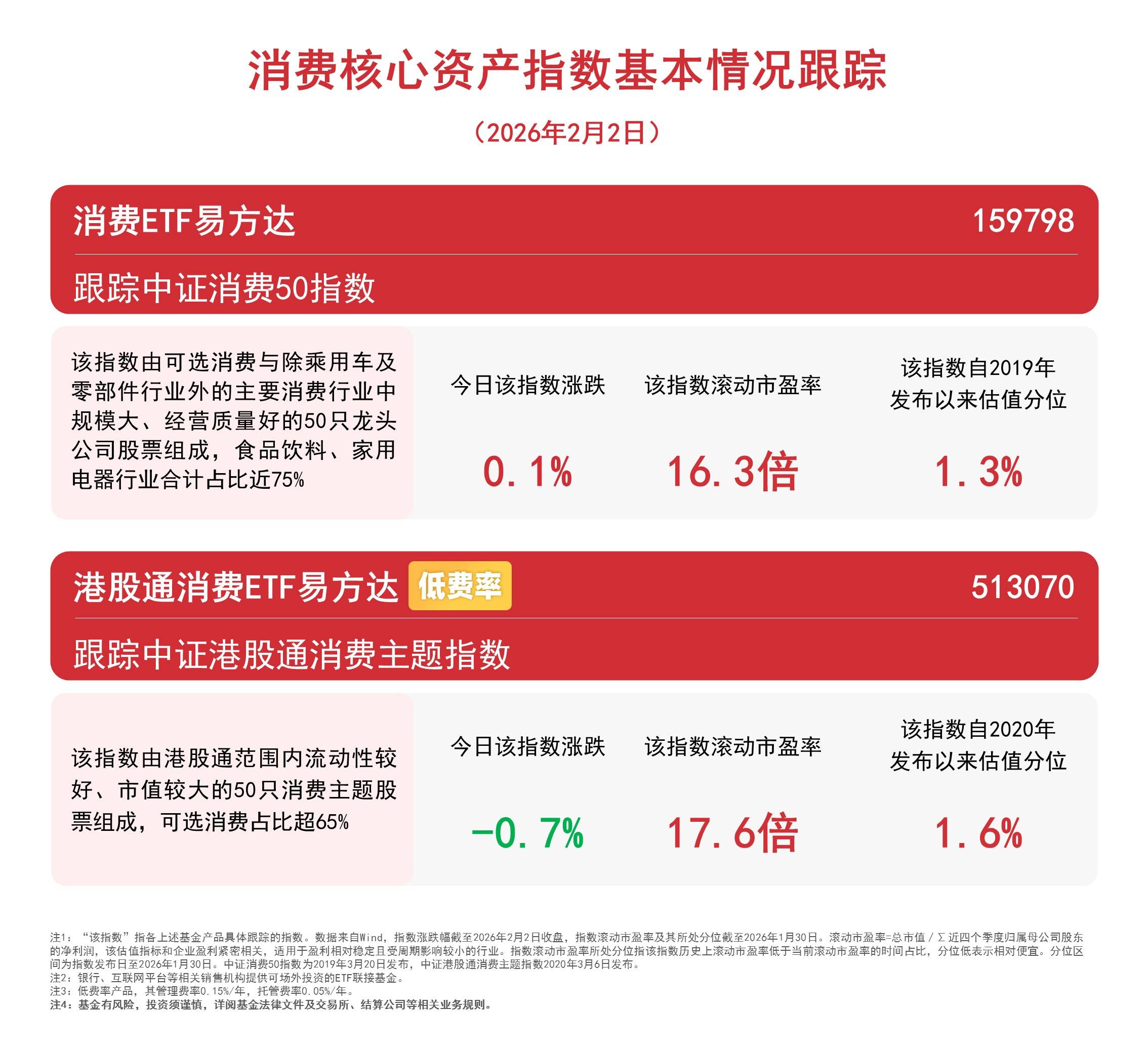
2月2日,市场全线回调,消费板块局部活跃,跌幅相对较窄,食品饮料、耐用消费等细分板块逆势上涨。截至收盘,中证消费50指数上涨0.1%,中证港股 通消费主题指数下跌0.7%。相关ETF受资金关注,Wind数据显示,港股通消费ETF易方达(513070)上周"吸金"约3亿元。 银河证券研报指出,展望未来,美联储短期内降息预期降低,投资者风险偏好将受影响,配置方面,科技板块仍是中长期投资主线,在产业链涨价、国产 化、AI应用加速推进等多重利好共振下,有望震荡上行;消费板块则有望持续受益于政策支持,且当前估值处于相对低位,中长期上涨空间较大,后续需 关注政策落地力度及消费数据改善情况。 每日经济新闻 ...
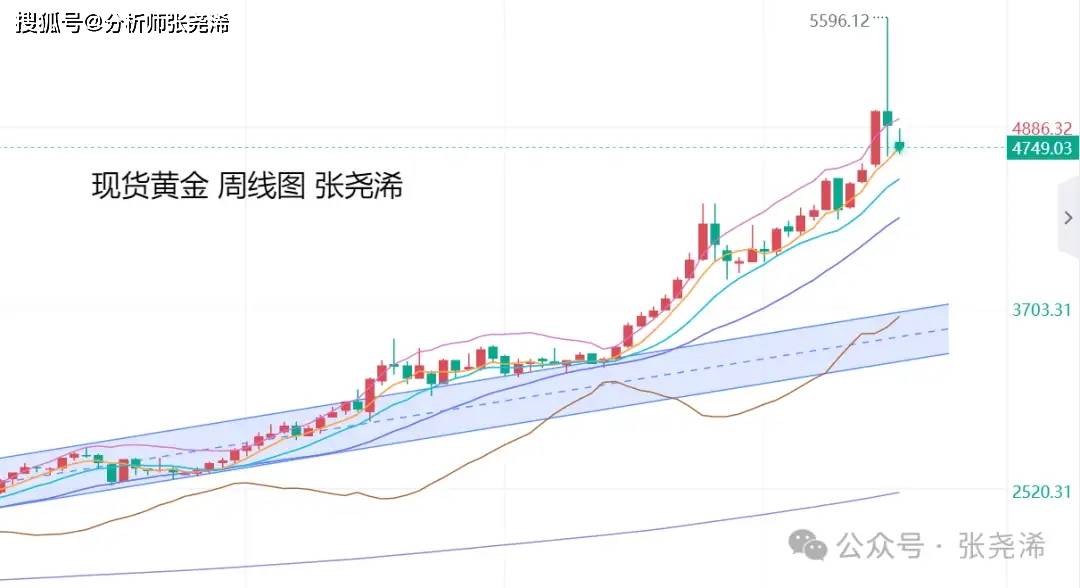
张尧浠:金价牛市偏技术性跳水、短期将迎筑底反弹修复
Sou Hu Cai Jing· 2026-02-02 00:40
张尧浠:金价牛市偏技术性跳水、短期将迎筑底反弹修复 黄金市场上周:国际黄金创历史记录性涨幅后,又创历史记录性大跌,最终收取巨长上影线倒垂形态,对于后市来讲,有再度陷入阶段性见顶调整的预期, 以及数周的横盘震荡整理的趋势。但整体的牛市趋势依然有效,每次阶段性的调整,在当下来看,依然还是再度的入场机会。 具体走势上,金价自周初高开于5005.58美元/盎司,并先行连续攀升,于周四进一步录得当周高点5595.97美元后,大幅跳水后,剧烈震荡,并到周五时段, 又显史诗级跳水行情,收复当周涨幅的同时,还进一步跌至4588.52美元当周低点,最终有所震荡回升,收于4860.31美元,相对于前周收盘价4982.08美元, 周振幅613.89美元,收跌121.77美元,跌幅2.44%。 影响上,受地缘局势不确定性再度升级,以及市场对于1月底前美国政府停摆的担忧,再加上特朗普威胁对加拿大韩国等加征关税威胁,和对于美元的进一 步言论等等,助力金价先行攀升冲击历史高点; 但由于地缘局势有所缓和,美联储决议保持利率不变,鲍威尔也未提及降息,暗示后市在5月份之前都不会降息,再加上美股市场的连续暴跌,也引发了贵 金属的获利弥补,同时,在 ...