
扩内需

Search documents
反内卷、通胀与市场展望
Tianfeng Securities· 2025-08-31 08:12
1. Report Industry Investment Rating No information about the industry investment rating is provided in the content. 2. Core View of the Report The report focuses on understanding the current low inflation and providing an outlook for inflation and the bond market in the second half of the year. It points out that the low inflation is mainly due to a negative output gap and high real interest rates, which suppress aggregate demand. Under the "anti - involution" policy, prices are expected to rise moderately at a low level in the second half of the year, with CPI and PPI showing different trends. In the bond market, the "weak recovery, low inflation" environment provides support, but there are also upward pressure on interest rates and uncertainties [1][2][3][5]. 3. Summary According to the Table of Contents 3.1 How to Understand the Current Low Inflation? - **Negative Output Gap**: China's GDP growth rate has a gap with the potential growth rate, the youth unemployment rate is high, industrial capacity utilization is low, and CPI and PPI are running at a low level, indicating that aggregate demand is lower than aggregate supply [2][18]. - **High Real Interest Rates**: Although the central bank has been lowering the nominal interest rate, the real interest rate has risen due to extremely low inflation and GDP deflator, which inhibits aggregate demand and forms a "passive tightening" effect [3][22]. 3.2 Current Characteristics of the Inflation Market - **Widening CPI - PPI Scissors**: In July 2025, the CPI - PPI scissors reached 3.6 percentage points, reflecting problems such as poor price transmission and unbalanced economic recovery, and squeezing the profits of downstream manufacturing enterprises [4][26]. - **Core CPI Reaching a New High**: In July 2025, the core CPI reached a new high since March 2024, becoming the main support for CPI, which shows positive changes in price operation and the effectiveness of policies [4]. - **"Anti - Involution" Not Driving PPI Upward**: "Anti - involution" policies have promoted the rise of commodity futures prices, but PPI has not increased. This may be due to the difference in pricing logic between futures prices and PPI, and the problem of insufficient terminal demand [4][34]. 3.3 Outlook for Inflation and the Bond Market under "Anti - Involution" - **Inflation Outlook**: In the second half of the year, CPI is expected to rise moderately, with estimated year - on - year growth rates of 0.1% and 0.5% in the third and fourth quarters respectively, and around 0% for the whole year. PPI is expected to maintain a trend of volatile recovery with narrowing year - on - year decline, with estimated year - on - year growth rates of - 2.7% and - 1.5% in the third and fourth quarters respectively, and around - 2% for the whole year, with a low possibility of turning positive within the year [5][41][51]. - **Bond Market Outlook**: In the "weak recovery, low inflation" environment, the bond market is supported by the fundamental logic and the central bank's monetary easing. However, the warming of the equity market and the "anti - involution" and "expanding domestic demand" policies may bring upward pressure on the interest rate center. The impact of the "anti - involution" policy on the bond market depends on whether the price increase expectation can be supported by real demand [6][57].
中国银河证券:PMI为何回升?
智通财经网· 2025-08-31 08:05
Core Viewpoint - The recovery of the PMI manufacturing index in August, along with improvements in production, new orders, and prices, indicates the initial effects of policies aimed at expanding domestic demand and countering excessive competition. The stock market's recovery is boosting economic confidence, which may lead to a rebound in consumer spending. Future policies to expand domestic demand are expected to strengthen the positive economic trend, especially in the service consumption sector as the impact of durable goods policies diminishes [1][7]. Group 1: Economic Resilience - The production index in August rose to 50.8%, while the new orders index was at 49.5%, indicating a strong resilience in the economy despite a widening supply-demand gap of 1.3 percentage points [2]. - The increase in production is attributed to stable domestic demand and a recovering stock market, alongside exporters rushing to ship goods due to new tax regulations [2]. Group 2: Price Index Trends - The PMI output price index and raw material purchase price index increased by 0.8 percentage points and 1.8 percentage points to 49.1% and 53.3%, respectively, marking three consecutive months of price increases [3]. - The rise in prices is linked to the initial success of measures to curb excessive competition, with 11 out of 16 industries showing price increases [3]. Group 3: Inventory and Procurement Dynamics - The finished goods inventory index fell by 0.6 percentage points to 46.8%, while raw material inventory and procurement levels rose, indicating a shift towards passive inventory reduction [4]. - Companies are adjusting procurement levels in response to new orders, maintaining low inventory levels as demand and exports increase [4]. Group 4: Performance of Enterprises - Large enterprises saw a significant increase in their index to 50.8%, while small enterprises slightly rose to 46.6%, and medium enterprises fell to 48.9% [5]. - The service sector, particularly transportation and entertainment, benefited from summer consumption, with business activity indices for rail and air transport exceeding 55% [6]. Group 5: Future Outlook - The PMI manufacturing index remains in contraction for five consecutive months, highlighting ongoing economic pressures, particularly for small and medium enterprises [7]. - Continued policy support is necessary to sustain economic recovery, especially in demand, with upcoming measures to stimulate service consumption and digital economy initiatives [7].

2025年8月PMI分析:PMI为何回升?
Yin He Zheng Quan· 2025-08-31 06:26
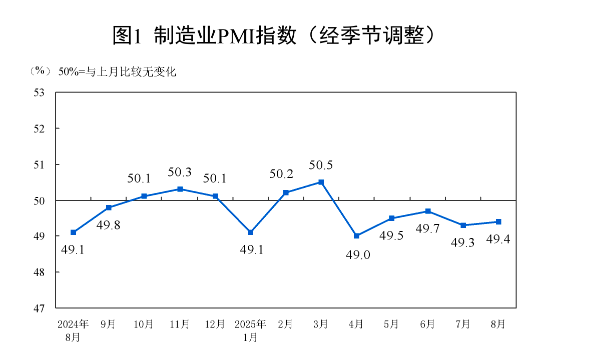
Group 1: PMI and Economic Indicators - The manufacturing PMI for August 2025 is 49.4%, a slight increase of 0.1 percentage points from the previous month, indicating a modest improvement in manufacturing sentiment[1] - The production index rose to 50.8% in August, up from 50.5% in July, while the new orders index increased to 49.5% from 49.4%[2] - The gap between supply and demand widened to 1.3 percentage points, suggesting production still exceeds demand[2] Group 2: Price and Inventory Trends - The PMI for factory prices and raw material purchase prices increased by 0.8 percentage points and 1.8 percentage points, reaching 49.1% and 53.3% respectively, marking three consecutive months of price increases[3] - Finished goods inventory index decreased by 0.6 percentage points to 46.8%, while raw material inventory and procurement volume rose to 48% and 50.4% respectively[4] Group 3: Sector Performance - Large enterprises saw a PMI increase of 0.5 percentage points to 50.8%, while small enterprises rose slightly by 0.2 percentage points to 46.6%, and medium enterprises fell by 0.6 percentage points to 48.9%[5] - The service sector's business activity index improved to 50.5%, driven by summer consumption in transportation and entertainment[5] Group 4: Future Outlook - The PMI's recovery reflects initial effects of policies aimed at expanding domestic demand and countering excessive competition, but the manufacturing sector remains under pressure with five consecutive months in contraction territory[7] - Continued policy support is necessary, especially for demand-side measures, to sustain economic improvement as export pressures may increase in October[7]
制造业PMI回升至49.4%,“反内卷”政策效果显现
第一财经· 2025-08-31 06:10
Core Viewpoint - The economic climate in China is showing signs of recovery due to the easing of extreme weather conditions and the implementation of policies aimed at stabilizing the economy and employment [3][4]. Manufacturing Sector - The manufacturing Purchasing Managers' Index (PMI) for August is reported at 49.4%, a slight increase of 0.1 percentage points from the previous month, indicating a modest improvement in manufacturing sentiment [3][6]. - The new orders index within the manufacturing PMI is at 49.5%, also up by 0.1 percentage points, while the production index has risen to 50.8%, reflecting a stable expansion in production activities [6][8]. - The prices of raw materials have increased, with the purchasing price index at 53.3%, up 1.8 percentage points, marking three consecutive months of growth [6][7]. - Large enterprises continue to show stable expansion with a PMI of 50.8%, while small enterprises have shown signs of recovery with a PMI of 46.6%, indicating a narrowing decline in supply and demand [8][9]. Non-Manufacturing Sector - The non-manufacturing business activity index stands at 50.3%, up 0.2 percentage points, indicating ongoing expansion in this sector [12]. - The service sector's business activity index has reached 50.5%, the highest point this year, with certain industries like capital market services and transportation showing strong performance [13]. - Despite some sectors like retail and real estate remaining below the critical point, the overall sentiment in the service industry is optimistic, with a business activity expectation index of 57.0% [13][14]. Economic Outlook - Experts predict that the positive factors accumulating in the market will lead to continued economic recovery in September and the fourth quarter, with stable demand and production activities in the manufacturing sector [9][14].

制造业PMI回升至49.4% “反内卷”政策效果显现
Di Yi Cai Jing· 2025-08-31 04:16
Economic Recovery Indicators - The manufacturing PMI for August is reported at 49.4%, a slight increase of 0.1 percentage points from the previous month, indicating a modest improvement in manufacturing sentiment [1] - The non-manufacturing business activity index stands at 50.3%, up by 0.2 percentage points from last month, continuing to show expansion in the non-manufacturing sector [1] Price Indices - The purchasing price index for major raw materials is at 53.3%, rising by 1.8 percentage points, while the factory price index is at 49.1%, increasing by 0.8 percentage points, both indicating a general improvement in market prices [1][4] - The raw material purchasing price index has been in the expansion zone for two consecutive months, reflecting a significant rise in raw material costs [4] Demand and Production Trends - The new orders index in the manufacturing PMI is at 49.5%, up by 0.1 percentage points, while the new export orders index is at 47.2%, also increasing by 0.1 percentage points, suggesting a stabilization in demand [4] - The production index is reported at 50.8%, an increase of 0.3 percentage points, indicating stable expansion in production activities [4] Business Expectations - The manufacturing business activity expectation index is at 53.7%, rising by 1.1 percentage points, reflecting improved market confidence and expectations across various industries [6] - Large enterprises show stable expansion with a PMI of 50.8%, while small enterprises have a PMI of 46.6%, indicating a recovery trend [6] Non-Manufacturing Sector Performance - The non-manufacturing business activity index remains in expansion at 50.3%, with the service sector index at 50.5%, reaching a yearly high [9] - The service industry shows optimism with a business activity expectation index of 57.0%, indicating positive market outlook [9] Construction Sector Insights - The construction sector's business activity index is at 49.1%, down by 1.5 percentage points, reflecting a slowdown due to adverse weather conditions [10] - The construction business activity expectation index is slightly up at 51.7%, indicating cautious optimism for future activities [10]
三大指数均回升!国家统计局发布重要数据
Zhong Guo Zheng Quan Bao· 2025-08-31 02:46
Core Viewpoint - The manufacturing and non-manufacturing sectors in China showed signs of improvement in August, with key indices indicating a continued expansion in economic activity [1][2][7]. Manufacturing Sector - The manufacturing Purchasing Managers' Index (PMI) for August was reported at 49.4%, reflecting a 0.1 percentage point increase from July, indicating a slight improvement in manufacturing sentiment [2][4]. - The production index reached 50.8%, up 0.3 percentage points from July, marking the fourth consecutive month above the critical point, suggesting accelerated production expansion [4]. - The new orders index was at 49.5%, with a 0.1 percentage point increase from the previous month, indicating a modest rise in demand [4]. - The price indices for major raw materials and factory output were 53.3% and 49.1%, respectively, both showing increases, which suggests an overall improvement in market price levels [4]. - Large enterprises reported a PMI of 50.8%, up 0.5 percentage points from July, indicating a sustained expansion, while small enterprises saw a PMI of 46.6%, reflecting a slight improvement [4]. - The production and business activity expectations index was at 53.7%, up 1.1 percentage points from July, indicating increased confidence among manufacturers regarding future market conditions [4]. Non-Manufacturing Sector - The non-manufacturing business activity index for August was 50.3%, a 0.2 percentage point increase from July, indicating continued expansion in the sector [7][9]. - The service sector's business activity index reached 50.5%, up 0.5 percentage points from July, marking the highest level for the year, with certain industries like capital market services showing particularly strong growth [9]. - The construction sector's business activity index fell to 49.1%, down 1.5 percentage points from July, attributed to adverse weather conditions affecting production [9]. - The business activity expectations index for the service sector was 57%, reflecting a 0.4 percentage point increase from July, indicating optimism among service providers regarding market prospects [9][10].
碳酸锂市场周报:供给放缓需求回暖,锂价或将有所支撑-20250829
Rui Da Qi Huo· 2025-08-29 08:22
1. Report Industry Investment Rating - Not provided in the content 2. Core Viewpoints of the Report - The lithium carbonate market's fundamentals may show a situation where the supply growth rate converges and demand gradually recovers. The price of lithium carbonate may be supported. It is recommended to conduct light - position short - term long trades at low prices and control risks, and also to construct a long straddle option to bet on increased volatility [7][8][61] 3. Summary by Relevant Catalogs 3.1 Weekly Highlights Summary - **Market Review**: The weekly line of the lithium carbonate main contract fluctuated weakly, with a change rate of - 2.25% and an amplitude of 7.37%. As of the end of this week, the main contract closed at 77,180 yuan/ton [7] - **Macro Environment**: The National Development and Reform Commission will improve policies to expand domestic demand, create a fair competition environment, and support enterprises in innovation and employment [7] - **Fundamentals**: Overseas miners may hold back supply and raise prices, and domestic mining disturbances will affect raw material supply, keeping lithium ore prices firm. High ore prices provide cost support for lithium prices. Given the current high supply and inventory pressure, the supply growth rate of lithium carbonate may slow down. With the arrival of the traditional consumption peak season, downstream demand for replenishment will increase [7] - **Strategy Suggestion**: Conduct light - position short - term long trades at low prices and control trading rhythm to manage risks [8] 3.2 Futures and Spot Market - **Futures Price**: As of August 29, 2025, the closing price of the lithium carbonate main contract was 77,180 yuan/ton, a week - on - week decrease of 1,780 yuan/ton. The near - far month spread was - 180 yuan/ton, a week - on - week decrease of 740 yuan/ton [14] - **Spot Price**: As of August 29, 2025, the average price of battery - grade lithium carbonate was 79,650 yuan/ton, a week - on - week decrease of 4,250 yuan/ton. The basis of the main contract was 2,470 yuan/ton, a week - on - week decrease of 2,470 yuan/ton [20] 3.3 Upstream Market - **Lithium Spodumene**: As of August 29, 2025, the average price of lithium spodumene concentrate (6% - 6.5%) was 950 US dollars/ton, a week - on - week decrease of 20 US dollars/ton. The US dollar - RMB spot exchange rate was 7.1385, a week - on - week decrease of 0.55% [24] - **Lithium Mica**: As of August 29, 2025, the average price of lithium mica (Li₂O: 2.0% - 3%) was 2,645 yuan/ton, with no week - on - week change. The average price of lithiophilite was 7,650 yuan/ton, a week - on - week decrease of 175 yuan/ton [29] 3.4 Industry Supply and Demand - **Supply Side**: As of July 2025, the monthly import volume of lithium carbonate was 13,845.31 tons, a decrease of 3,852.31 tons from June, a decrease of 21.77% month - on - month and 42.67% year - on - year. The monthly production was 44,600 tons, an increase of 500 tons from June, an increase of 1.13% month - on - month and 14.36% year - on - year. The monthly operating rate was 43%, a decrease of 5% month - on - month and 32% year - on - year [34] - **Demand Side** - **Intermediate Products**: As of August 29, 2025, the average price of lithium hexafluorophosphate was 55,750 yuan/ton, with no week - on - week change. As of July 2025, the monthly production of electrolyte was 179,450 tons, an increase of 6,800 tons from June, an increase of 3.94% month - on - month and 44.16% year - on - year [37] - **Cathode Materials**: The prices of lithium iron phosphate and lithium hexafluorophosphate remained flat, while the prices of ternary materials, lithium manganate, and lithium cobaltate decreased. The production of lithium iron phosphate, electrolyte, ternary materials, and lithium cobaltate increased, while the production of lithium manganate decreased [37][42][45][50][53] - **New Energy Vehicles**: As of July 2025, the penetration rate of new energy vehicles was 44.99%, a month - on - month increase of 0.68% and a year - on - year increase of 8.61%. The monthly production was 1,243,000 vehicles, a month - on - month decrease of 1.97%; the sales volume was 1,262,000 vehicles, a month - on - month decrease of 5.04%. The cumulative export volume was 1.308 million vehicles, a year - on - year increase of 84.75% [55][60] 3.5 Options Market - According to the option parity theory, the premium of the synthetic underlying asset is - 0.04, presenting a reverse arbitrage opportunity. Based on the performance of option at - the - money contracts and fundamental conditions, it is recommended to bet on increased volatility and construct a long straddle option [63]
交行河南省分行多维发力激活消费新势能
Huan Qiu Wang· 2025-08-29 03:54
Group 1 - Consumption is a key hub for the national economic cycle and a main engine for high-quality economic development, with the Bank of Communications Henan Branch actively responding to the national call to "expand domestic demand and promote consumption" [1] - The bank has innovated loan services to support small and micro enterprises, effectively activating consumption momentum and bridging supply and demand through financial means [1] - The "old-for-new" policy has created sales surges but also financial pressure on participating merchants, prompting the bank to customize "national subsidy funds" loan solutions for small merchants [1] Group 2 - The bank successfully issued a 1 million yuan credit loan to a well-known home appliance dealer in Henan within three working days, increasing the amount to 2 million yuan to alleviate the dealer's liquidity pressure [1] - The bank launched the "Bank of Communications Neighbor Season, Benefits at Home" consumer activity, providing consumer vouchers in high-frequency consumption scenarios such as supermarkets and convenience stores [2] - The bank upgraded its credit card "old-for-new" activity, allowing consumers to enjoy additional benefits on top of government subsidies, creating a dual discount effect [2] - The "Hundred Counties and Ten Thousand Stores" credit card initiative aims to deliver quality financial services and exclusive discounts to rural areas, fostering a healthy and active county-level consumption financial ecosystem [2]

1-7月工企利润数据点评:四季度增量政策或仍值得期待
Bank of China Securities· 2025-08-28 02:34
Profit and Revenue Analysis - From January to July 2025, the total profit of industrial enterprises reached CNY 40,203.5 billion, a year-on-year decrease of 1.7%, with the decline narrowing by 0.1 percentage points compared to the first half of the year[1] - In July 2025, industrial enterprises' profits fell by 1.5% year-on-year, with the decline narrowing by 2.8 percentage points from June[1] - The operating income of industrial enterprises grew by 2.3% year-on-year from January to July, with the growth rate slowing by 0.2 percentage points compared to the first half of the year[1] Cost and Profitability Metrics - The operating income profit margin for industrial enterprises was 5.2% from January to July, unchanged from the first half of the year[2] - Operating costs increased by 2.5% year-on-year during the same period, with the growth rate slowing by 0.3 percentage points compared to the first half[1] - The average revenue per CNY 100 of assets was CNY 74.0, an increase of CNY 0.1 from the first half of the year[1] Industry Performance Insights - The mining industry accounted for 12.3% of total industrial profits, continuing to decline, with profits in this sector dropping by 31.6% year-on-year[9] - High-tech manufacturing contributed positively to the profit growth of industrial enterprises, adding 1.9 percentage points to the cumulative year-on-year profit growth[11] - The overall industrial production value increased by 6.3% year-on-year, slightly slowing by 0.1 percentage points compared to the first half of the year[6] Future Policy Expectations - There are expectations for incremental policies in the fourth quarter to address the weak pricing environment affecting industrial profitability[18] - The negative contribution from the mining and raw materials processing industries to profit growth is anticipated to continue, while traditional and high-tech manufacturing sectors provide some support[18]
国债期货日报-20250826
Rui Da Qi Huo· 2025-08-26 11:17
1. Report Industry Investment Rating No relevant content provided. 2. Core View of the Report - On August 26, 2025, the yields of treasury bond cash bonds strengthened collectively, and treasury bond futures also strengthened. The domestic fundamental data showed some weaknesses, while overseas, the market bet on the Fed's interest - rate cut in September. As bond yields approach the high point in mid - March this year, the allocation value has significantly increased, and the sensitivity of the bond market to external factors may decrease marginally. If the capital and fundamental fluctuations are limited, the suppression of the bond market by the strengthening of the equity market is expected to be limited, and the bond market pricing is expected to gradually return to the rational range dominated by fundamentals. However, the interest - rate center lacks the motivation to decline further. It is recommended to pay attention to the trading opportunities brought by the phased repair of treasury bond futures [2]. 3. Summary According to Relevant Catalogs 3.1 Futures Disk - T, TF, TS, and TL main contract closing prices increased by 0.06%, 0.04%, 0.01%, and 0.47% respectively. The trading volumes of T, TF, and TS main contracts increased by 7896, 15736, and 12209 respectively, while the trading volume of TL main contract decreased by 5603 [2]. 3.2 Futures Spreads - Multiple futures spreads showed changes, such as the TL2512 - 2509 spread increasing by 0.12 to - 0.39, and the T12 - TL12 spread decreasing by 0.53 to - 8.85 [2]. 3.3 Futures Positions - The positions of T, TF, TS, and TL main contracts all increased, by 2635, 1227, 1543, and 1901 respectively. The net short positions of T and TL top 20 increased, while those of TF and TS top 20 decreased [2]. 3.4 Top Two CTD (Clean Prices) - The clean prices of multiple bonds increased, such as 220025.IB increasing by 0.0703 to 107.302, and 220017.IB increasing by 0.0315 to 99.0955 [2]. 3.5 Active Treasury Bond Yields - The yields of 1y, 3y, 5y, 7y, and 10y active treasury bonds decreased by 1.25bp, 0.50bp, 1.75bp, 2.50bp, and 2.15bp respectively [2]. 3.6 Short - term Interest Rates - Silver - pledged overnight interest rate increased by 3.44bp to 1.3644%, while Shibor overnight decreased by 3.90bp to 1.3170%. Other short - term interest rates also showed different changes [2]. 3.7 LPR Rates - The 1y and 5y LPR rates remained unchanged at 3.00% and 3.5% respectively [2]. 3.8 Open Market Operations - The issuance scale was 405.8 billion yuan, the maturity scale was 580.3 billion yuan, and the interest rate was 1.4% for 7 - day reverse repurchase, with a net withdrawal of 174.5 billion yuan [2]. 3.9 Industry News - The Hong Kong Monetary Authority launched the optimization arrangement for offshore RMB bond repurchase business. Shanghai optimized real - estate policies. The National Development and Reform Commission held a corporate symposium to listen to opinions on expanding domestic demand and stabilizing employment [2]. 3.10 Key Points of Attention - On August 28 at 17:00, the Eurozone's industrial sentiment index for August will be released. On August 29 at 20:30, the annual rate of the US core PCE price index for July will be released [3].