
智能化

Search documents
671亿元!江苏省战新母基金第四批产业专项基金启动
FOFWEEKLY· 2026-02-03 10:14
Core Viewpoint - The establishment of the fourth batch of industry-specific funds by Jiangsu's strategic emerging industry mother fund, totaling 671 billion yuan, marks a significant step in promoting the integration of technological and industrial innovation in the province [1][3]. Group 1: Fund Overview - The fourth batch consists of four funds with a total scale of 671 billion yuan, aimed at fostering new productive forces in Jiangsu [1]. - The Long Triangle Venture Capital Guidance Fund, with a scale of 551 billion yuan, is one of the first three regional funds established under the national venture capital guidance fund [3]. - The provincial enterprise industry-specific fund includes two funds totaling 110 billion yuan, and a municipal industry-specific mother fund of 10 billion yuan [5]. Group 2: Investment Focus - The funds will primarily target sectors such as biomedicine, new energy, integrated circuits, artificial intelligence, robotics, low-altitude economy, new power, and aerospace [7]. - The Jiangsu New Energy (Guoxin) Industry Special Fund has a total scale of 50 billion yuan, with an initial phase of 10 billion yuan, focusing on the new energy sector and related strategic emerging industries [10]. - The Lianyungang Security Industry Special Mother Fund, initiated by Lianyungang Financial Holding Group, focuses on the entire security industry chain, including high-end equipment manufacturing and artificial intelligence [13]. Group 3: Key Characteristics - The fourth batch of industry-specific funds exhibits three main characteristics, including significant leverage effects, focusing on key investment areas, and enhancing the core competitiveness of industries [14][16][18]. - The funds aim to attract more capital and quality project resources to support the integration of technological and industrial innovation in Jiangsu [17].

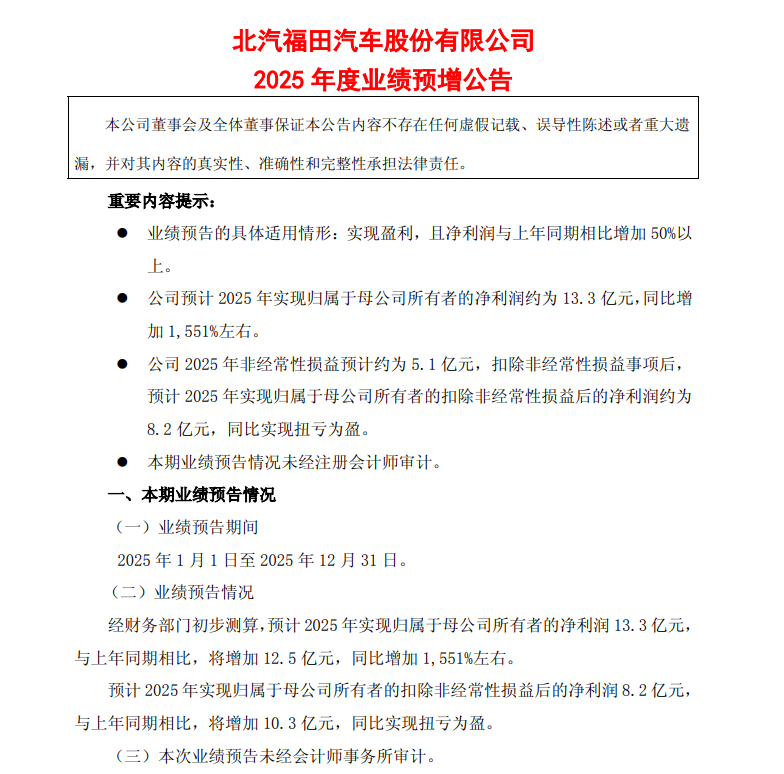
重构“利润引力”:福田汽车如何用战略引力拉动1551%增长
Mei Ri Jing Ji Xin Wen· 2026-02-03 09:25
Core Viewpoint - Foton Motor is expected to see a profit increase of 1551% and a non-recurring net profit of 820 million yuan by 2025, showcasing its strong performance amid a mild recovery in the commercial vehicle industry. This financial success is attributed to the company's strategic focus on "comprehensive internationalization, comprehensive electrification, and comprehensive intelligence" rather than just industry trends [1][4]. Financial Performance - The profit explosion for Foton Motor in 2025 is driven by a significant restructuring of internal growth quality and a strategic shift towards high-value segments, including heavy trucks, high-tech new energy vehicles, and profitable overseas operations [4][7]. - Heavy truck sales reached 142,000 units, doubling year-on-year with a growth rate exceeding the industry average. The "Ouman Galaxy" series has enhanced brand premium through technological upgrades [4][7]. - The new energy segment saw sales surpassing 100,000 units, with an impressive year-on-year increase of 87.21%. The sales of new energy heavy trucks grew over 300%, reflecting both volume growth and technological value realization [7][10]. - Overseas sales reached 164,500 units, with product prices 15%-20% higher than domestic counterparts, indicating a successful transition from merely exporting products to enhancing brand and value globally [7][10]. Strategic Execution - Foton Motor's impressive financial results stem from years of strategic commitment and effective execution across R&D, product development, global operations, and cost control [8][10]. - The company has consistently invested more in R&D than the industry average, focusing on core areas such as new energy systems and intelligent technologies, leading to competitive advantages [8][10]. - A diverse product matrix has been developed, with new launches covering a wide range of vehicle types and technologies, allowing the company to avoid price competition and achieve reasonable value returns [8][10]. Industry Insights - Foton Motor's unique growth serves as a model for the Chinese commercial vehicle industry, indicating a shift in competitive focus from manufacturing and sales to technology-driven scenarios and ecosystem creation [11][13]. - The core logic of competition is evolving from "cost-performance" to "value chain cost-performance," emphasizing the importance of the total cost of ownership (TCO) for users [13][15]. - The role of companies is transitioning from "equipment manufacturers" to "solution and ecosystem service providers," expanding profit sources from one-time sales to ongoing services and operations [13][15]. - Globalization is moving beyond mere market expansion to localizing capabilities and ecosystems, as demonstrated by Foton's practices in Brazil and Thailand, which integrate into regional economic cycles for sustainable premium and risk resilience [15].

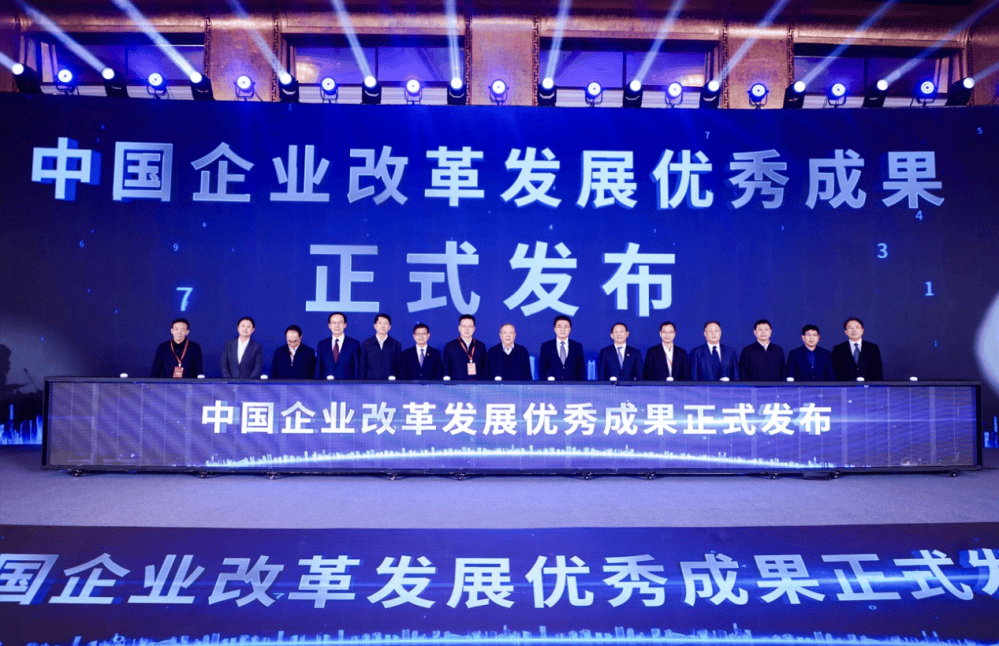
京东“业采融合”入选2025中国企业改革发展优秀成果,助力政企采购数智化升级
Sou Hu Cai Jing· 2026-02-03 07:52
Core Insights - The annual meeting of the China Enterprise Reform and Development Research Association highlighted the importance of enterprise reform and upgrading industrial chains, with JD's government and enterprise business receiving recognition for its innovative practices in digital and intelligent supply chain integration [1][3] Group 1: Awards and Recognition - JD's government and enterprise business won the first prize in the "Excellent Achievements in China's Enterprise Reform and Development" for its project on "Digital Intelligence Driving 'Business-Purchase Integration'" among 716 submissions [1][3] - JD is the only private enterprise to receive both the special award and first prize in this evaluation, which is guided by the State-owned Assets Supervision and Administration Commission and supported by various national departments [3] Group 2: Industry Challenges and Opportunities - The current economic landscape in China is characterized by structural optimization and transformation, facing challenges such as insufficient collaborative efficiency in supply chains and the need for enhanced risk resilience [3][4] - The integration of intelligent, green, and collaborative development presents significant opportunities for the industry, with JD emphasizing the need for breaking down barriers between business and procurement systems [4] Group 3: Business Model and Strategy - JD's "Business-Purchase Integration" concept aims to transform procurement from a "cost center" to a "strategic value center," facilitating deeper collaboration between procurement and core business functions [4] - The company is committed to supporting small and medium-sized enterprises (SMEs) and promoting high-quality development through its digital procurement solutions and services [5][7] Group 4: Service Reach and Impact - JD's government and enterprise business serves over 8 million government and enterprise clients, including more than 30,000 large clients, covering over 90% of the Fortune Global 500 companies in China [7] - The business has significantly aided numerous specialized and innovative "little giant" enterprises in achieving digital procurement upgrades, contributing to cost reduction and efficiency improvements across various sectors [7]

牧原股份:积极探索将各项新技术应用到养猪生产全流程
Ge Long Hui· 2026-02-03 07:20
Group 1 - The company is continuously monitoring developments in cutting-edge technologies and increasing its investment in research and development in the areas of intelligence and digitalization [1] - The company is actively exploring the application of various new technologies throughout the entire pig farming production process [1] - The company is developing various intelligent equipment based on business scenarios to better serve pig farming production, enhance breeding efficiency, and reduce breeding costs [1]

牧原股份(002714.SZ):积极探索将各项新技术应用到养猪生产全流程
Ge Long Hui· 2026-02-03 07:17
格隆汇2月3日丨牧原股份(002714.SZ)在投资者互动平台表示,公司持续关注前沿技术发展动态,不断 加大在智能化、数字化方面的研发投入,积极探索将各项新技术应用到养猪生产全流程,基于业务场景 研发各类智能装备,以更好地服务养猪生产,提升养殖效率,降低养殖成本。 ...
人民财评:坚守创新内核,中国造船业书写新篇章
Ren Min Wang· 2026-02-03 05:49
Group 1 - The core viewpoint of the articles highlights that China's shipbuilding industry continues to lead globally, maintaining its position for 16 consecutive years, with a focus on high technology, high added value, and green transformation [1][2] - By 2025, China's shipbuilding industry is expected to excel in three major indicators, showcasing its comprehensive strength in high-end equipment manufacturing [1] - China is the only country capable of building three top-tier ship types: large cruise ships, large LNG carriers, and aircraft carriers, with 16 out of 18 major ship types having the highest new order volume globally [1] Group 2 - The integration of artificial intelligence and new technologies in shipbuilding processes has led to significant efficiency improvements, including a 200% increase in warehouse space utilization and a 50% increase in inbound and outbound efficiency [2] - The second domestically produced large cruise ship, "Aida Huacheng," has achieved over 91% progress, with its construction cycle shortened by nearly 8 months compared to the first ship [2] - China's shipbuilding industry has achieved full coverage of green and environmentally friendly technologies for mainstream ship types, contributing to global carbon neutrality efforts [2] Group 3 - Looking ahead to the 14th Five-Year Plan, the shipbuilding industry must focus on innovation, strengthen forward-looking technology research and development, and enhance the resilience of the industry [3] - There is confidence that China's shipbuilding industry will continue to expand into broader markets and write new chapters in its development [3]
中国汽车强省格局生变
2 1 Shi Ji Jing Ji Bao Dao· 2026-02-02 23:10
Core Insights - In 2025, China's automotive industry is undergoing significant transformation driven by technology and policy, with production reaching 34.78 million vehicles, a year-on-year increase of 10.2% [1] - The shift in statistical methodology by the National Bureau of Statistics from "enterprise legal person location" to "production location" has altered the automotive production landscape, impacting regional rankings [1][3] - The rise of new energy vehicles (NEVs) is a crucial factor in the changing industry dynamics, with traditional automotive hubs like Jilin falling out of the top ten rankings [1][5] Production and Regional Dynamics - In 2025, the top ten provinces for automotive production are Anhui, Guangdong, Chongqing, Shandong, Jiangsu, Zhejiang, Shanghai, Shaanxi, Hunan, and Hubei, with Anhui surpassing Guangdong due to statistical adjustments and rapid development [2][3] - Anhui's automotive production reached 3.69 million units, while Guangdong produced 3.04 million units, reflecting a shift in focus from traditional fuel vehicles to NEVs and high-end manufacturing [2][3] - The production of NEVs in Anhui has exceeded 1.6 million units, showcasing a significant leap in the province's automotive capabilities [3][6] Competitive Landscape - The competition between provinces like Anhui and Guangdong is characterized by complementary strengths rather than direct rivalry, with Anhui focusing on manufacturing scale and Guangdong on R&D and global supply chain integration [4][5] - Guangdong's NEV exports grew by 210% in 2025, with companies like BYD and XPeng leveraging the Greater Bay Area's logistics and marketing networks to expand internationally [4][5] - The automotive industry is transitioning from price and configuration competition to a comprehensive capability competition, emphasizing cost control, technology integration, and global operational capacity [6] Technological Advancements - The intelligentization wave is becoming a critical battleground, with the Ministry of Industry and Information Technology promoting advancements in automotive chips, operating systems, and AI technologies [7] - Sales of passenger vehicles equipped with Level 2 driving assistance features increased by 21.2% in 2025, indicating a growing market for smart vehicles [7] - The focus on upgrading infrastructure and enhancing industrial collaboration is essential for the healthy development of the automotive sector, with an emphasis on avoiding redundant construction and fostering innovation [8]

东风汽车锚定325万辆年度目标 杨彦鼎:技术落地+全品协同攻坚硬指标
Zhong Guo Zheng Quan Bao· 2026-02-02 22:55
Core Insights - Dongfeng Motor Corporation is focusing on technology autonomy and high-quality transformation, with 2026 designated as the "Year of Technology Realization" [1] - The company aims to achieve a total sales target of 3.25 million vehicles in 2026, including 1.7 million new energy vehicles and 600,000 exports [3] Technology Development - Dongfeng's R&D investment intensity is projected to reach 7.9% in 2025, significantly above the industry average, supporting technological innovation [1] - The company has made breakthroughs in core components, including the mass production of the automotive-grade high-end MCU chip DF30 and a 67% localization rate for chips in its self-owned brand vehicles [1] - The Maher hybrid engine has achieved a thermal efficiency of over 48%, set to be widely applied in new energy vehicles launched in 2026 [1] Intelligent Systems - The "T200" intelligent driving system will be widely adopted in main models by 2026, offering L2+ level assistance for highways and urban roads [2] - The commercial vehicle sector is also advancing, with over 70 new energy models planned for release in 2025, including hydrogen fuel and hybrid vehicles [2] - The D600 strategic product platform has been established, featuring over 50 base models and more than 200 extended models, with an 80% modularization rate [2] Sales and Market Strategy - Dongfeng's product matrix covers high-end, mainstream, and niche markets, with specific strategies for each segment [3] - The company plans to launch 8 new models under the Dongfeng Yipai brand and 15 new or upgraded products under Dongfeng Fengshen from 2026 to 2028 [3] - The commercial vehicle segment targets a sales volume of 131,000 units in 2025, with a 34% increase to 176,000 units in 2026 [4] Organizational Reforms - Dongfeng will enhance the autonomy of frontline business units and improve incentive mechanisms to boost market responsiveness and operational efficiency [5] - The company aims to inject strong momentum into the high-quality development of the Chinese automotive industry through technology, brand, and reform initiatives [5]

百余家央企控股上市公司2025年业绩报喜
Shang Hai Zheng Quan Bao· 2026-02-02 18:44
Group 1: Company Performance and Projections - Changxin Bochuang is experiencing steady revenue growth in data communication products due to demand from cloud computing and artificial intelligence, with a projected net profit increase of over 300% year-on-year [1] - Tongfang Co., Ltd. is expected to achieve a net profit growth of 220.02% to 291.14% by 2025, driven by strategic planning, technological innovation, digital transformation, and international operations [1] - Chengdu Huamei is set to undertake several key national research projects, which will enhance its competitiveness in the integrated circuit field, with a projected net profit growth of 74.35% to 108.73% by 2025 [1] - A total of 19 state-owned listed companies are expected to double their net profit growth by 2025, with companies like Shenghe Resources, Xinxing Casting Pipe, and Aerospace Science and Technology projected to exceed 200% net profit growth [1] Group 2: Loss Reduction and Operational Improvements - 41 state-owned enterprises are expected to reduce their losses in 2025, with companies like China First Heavy Industries and China Great Wall facing reduced losses despite ongoing challenges [2] - China First Heavy Industries is projected to significantly reduce its losses by 32.76 billion to 34.26 billion yuan through strategic expansion into advantageous sectors and asset optimization [2] - Maanshan Iron & Steel is implementing extreme cost control measures and operational reforms, expecting to reduce losses by 40.26 billion to 40.86 billion yuan in 2025 [2] - The domestic steel industry is continuing a trend of reducing production while adjusting its structure, with six state-owned steel companies, including Maanshan Iron & Steel, expected to achieve loss reduction [2] Group 3: Chemical Industry Strategies - In the chemical sector, Sinochem International is enhancing operational capabilities to combat declining prices, achieving significant loss reduction through cost management and increased operational efficiency [3] - Companies like Anmaida A and China Resources Materials are also expected to achieve loss reduction while increasing investments in strategic emerging industries [3] - Aerospace Software is increasing R&D and sales investments to enhance core competitiveness, which may lead to short-term expense increases but is expected to support future growth [3] - China Resources Materials is promoting differentiated products in emerging markets, contributing to revenue and gross profit growth [3]


2027年起汽车须配备机械车门把手,国标消除隐藏式门把手隐患
Xin Jing Bao· 2026-02-02 15:04
《汽车车门把手安全技术要求》规定,对于新申请批准的车型,到2028年1月1日要全部符合要求。已获 得批准的车型,到2029年1月1日要符合全部标准要求。 新京报消息,由工信部组织制定的强制性国家标准《汽车车门把手安全技术要求》将于2027年1月1日起 开始实施,标准要求每个车门(不包括背门)应配备机械释放车门外把手和机械释放车门内把手,以消 除隐藏式车门把手可能产生的安全隐患。这意味着流行的隐藏式门把手设计将迎来大变革。 随着汽车电动化、智能化的快速发展,隐藏式车门把手凭借美观、科技感强等优势被广泛应用。《汽车 车门把手安全技术要求》指出,市场上的车门把手产品呈现出工作原理、形式多样化趋势,但在市场应 用过程中暴露出强度不足、控制逻辑潜在安全风险、识别操作难(隐蔽无标志)、断电失效、夹手等, 潜在逃生、救援风险。这些问题也带来了潜在的逃生与救援风险。例如:碰撞、起火等事故中,造成断 电现象,使电动式外门把手、电动式车门内把手失效,增大救援及逃生阻碍;无明显、统一标志,增加 紧急情况下的操作难度。 针对一些车门外把手操作不便和事故后无法开启车门的问题,国标规定每个车门(不包括背门)应配备 机械释放车门外把手。车 ...