
美元走势

Search documents
瑞银:进一步暂停关税对美元的影响尚不明朗
news flash· 2025-07-04 12:24
Core Viewpoint - UBS analysts indicate that the impact of a potential further suspension of tariffs on the US dollar remains uncertain, with a 90-day tariff suspension ending on July 9 [1] Group 1 - A further suspension of tariffs may be interpreted as a reluctance to implement tariffs, potentially boosting risk-sensitive currencies [1] - If high tariffs are avoided, the US dollar could receive some initial support [1] - However, a reduction in tariffs might lead the market to price in expectations for further interest rate cuts by the Federal Reserve [1] Group 2 - Federal Reserve Chairman Jerome Powell recently stated that if tariffs had not boosted inflation expectations, he would have already cut interest rates [1]

荷兰国际:美国就业数据是美元走势的关键
news flash· 2025-07-03 12:02
Core Viewpoint - The upcoming U.S. non-farm payroll report will play a crucial role in determining whether the recent downward trend of the U.S. dollar will continue [1] Group 1: Employment Data Impact - The Federal Reserve Chairman Powell believes that persistent inflation and a solid labor market indicate that interest rates should remain at restrictive levels [1] - Any unexpected downturn in the employment report could weaken Powell's position and increase market expectations for a rate cut in the July meeting [1] - Unless the employment data is weaker than expected, the dollar may continue to consolidate before the U.S. holiday on July 4 [1]
金价预测:黄金/美元买家在美国非农就业数据公布前稍作喘息
Sou Hu Cai Jing· 2025-07-03 10:18
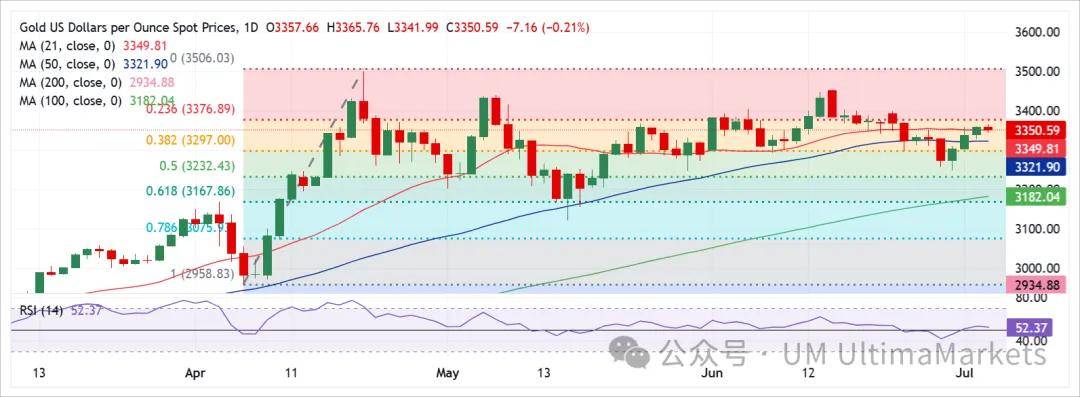
Core Viewpoint - Gold prices are experiencing volatility ahead of the U.S. non-farm payroll data release, with a focus on potential impacts from employment figures and Federal Reserve interest rate expectations [1][2][6]. Group 1: Market Dynamics - Gold prices paused after three days of gains, with attention shifting to the upcoming U.S. non-farm employment data [1]. - The U.S. dollar has seen a temporary halt in its decline, which has exerted bearish pressure on gold prices [3]. - Concerns over the U.S. labor market have resurfaced, contributing to renewed selling pressure on the dollar [3][4]. Group 2: Employment Data Expectations - The market anticipates an increase of 110,000 in non-farm payrolls for June, with the unemployment rate expected to rise slightly to 4.3% from 4.2% in May [7]. - A non-farm payroll figure below 100,000 could intensify selling pressure on the dollar and increase the likelihood of a Fed rate cut in July, which would be favorable for gold prices [8]. Group 3: Technical Analysis - As of the latest data, gold prices are struggling around the 21-day simple moving average (SMA) at $3,350, having faced rejection near $3,365 [12]. - The 14-day relative strength index (RSI) is above the midpoint, currently close to 52.30, indicating potential buying interest [13]. - A poor U.S. employment report could restore upward momentum towards the 23.6% Fibonacci retracement level at $3,377, with a significant upward trend possible if prices close above this level [14][15].

【BCR市场焦点】加息落幕后的博弈:美元陷入拉锯战
Sou Hu Cai Jing· 2025-07-03 07:50
Group 1 - The core viewpoint of the article indicates that the US dollar index (DXY) is experiencing fluctuations at high levels due to uncertainties surrounding the Federal Reserve's monetary policy, global risk capital flows, and de-dollarization actions by various central banks [2] - The three main factors supporting the dollar—relative interest rate advantages, US economic resilience, and safe-haven buying—are facing challenges this year [3] Group 2 - The Federal Reserve has maintained interest rates in the range of 5.25% to 5.5% since December of last year, with market expectations shifting towards potential rate cuts in September or November, which diminishes the dollar's upward momentum [4] - Recent US economic data shows signs of weakening, with initial jobless claims exceeding expectations, raising concerns about the impact of high interest rates on the real economy [5] Group 3 - The competitive landscape for global currencies is changing, with the dollar's strong position being challenged [6] - The European Central Bank's potential slow pace of rate cuts due to persistent inflation may lead to a temporary decline in the dollar against the euro [7] - The Bank of Japan may end its negative interest rate policy, which could result in a strong rebound of the yen against the dollar [8] - The Chinese yuan and emerging market currencies are showing resilience due to supportive policies and capital inflows [9] Group 4 - Technical analysis indicates key support levels for the dollar index at 104.20 and 103.50, with resistance levels at 106.00 and 107.10 [10] - Market sentiment is characterized by reduced bullish positions on the dollar, with increased implied volatility in the options market, suggesting intense competition between bulls and bears [11] Group 5 - Short-term strategy suggests a cautious approach with a focus on upcoming economic data, particularly the non-farm payroll and CPI data in July, which could influence the dollar's trajectory [12] - A diversified currency portfolio is recommended to hedge against dollar volatility, focusing on currencies like the euro, yen, and yuan [13] Group 6 - The upcoming US non-farm payroll data is critical, with expectations of a slowdown in job growth and a potential rise in the unemployment rate, which could impact the Federal Reserve's rate cut decisions [16][17]

机构:预计关税推高通胀之后美元有望暂获喘息
news flash· 2025-07-02 20:17
Core Viewpoint - The dollar is expected to strengthen over the next few months due to tariffs driving inflation and delaying interest rate cuts by the Federal Reserve [1] Group 1: Economic Impact - Tariffs are anticipated to accelerate consumer price increases starting in August, which will limit the Federal Reserve's ability to cut interest rates [1] - The strategist predicts that the euro to dollar exchange rate will temporarily fall to the range of 1.13-1.15, while the yen to dollar exchange rate will decline to 145-150, indicating a drop of approximately 4% for both currencies [1] Group 2: Federal Reserve Outlook - The Federal Reserve is expected to maintain interest rates until December, with a potential slight adjustment for the dollar at that time [1]
Vatee外汇:美元半年最差,却会在七月意外翻身吗?
Sou Hu Cai Jing· 2025-07-02 10:06
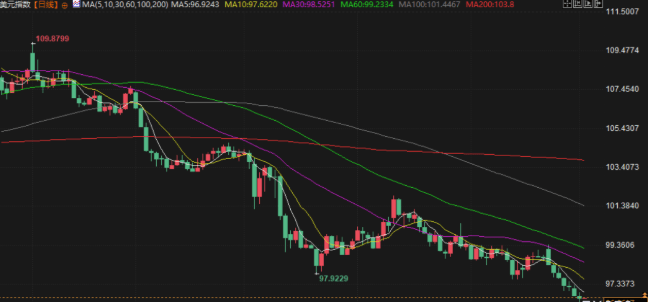
Group 1 - The US dollar index has experienced its worst start in nearly fifty years, dropping below 97 due to concerns over trade friction, fiscal deficits, and economic slowdown [1][3] - Unexpectedly high job vacancies reported by the US Labor Department indicate resilient labor demand, while a significant tax and spending bill passed by the Senate has led to a rapid increase in long-term yields [1][3] - The market is reassessing the risks of a "too bearish" outlook on the dollar, with the dollar recovering nearly half of its losses against the yen and Swiss franc following the data release [1][3] Group 2 - Despite debt pressures casting a shadow over the dollar, short positions have reached extreme levels since the beginning of the year [3] - If the fiscal bill passes in the House, market focus will shift from the deficit to short-term demand stimulation and corporate profit boosts, potentially supporting the dollar [3] - The Federal Reserve Chairman Jerome Powell has maintained a wait-and-see approach but has not ruled out further rate cuts this year, creating a balance between bullish and bearish sentiments for the dollar [3] Group 3 - The ten-year US Treasury yield has returned to 4.25%, indicating that traders are preparing for a re-inflation scenario driven by fiscal stimulus [4] - Key upcoming events include the tariff negotiations on July 9, which could significantly impact the dollar's performance depending on the outcomes [4] - The market is advised to be cautious of overly bearish positions on the dollar, with short-term strategies favoring buying the dollar against high beta currencies [4] Group 4 - The future of the dollar depends on three factors: whether the trade window closes, the resilience of US data, and any adjustments in the Federal Reserve's language [5] - July is expected to be a month of both risks and opportunities for the dollar, with potential for recovery if conditions tilt in favor of bullish sentiment [5]
2025年7月2日,国内黄金9995价格多少钱一克?
Sou Hu Cai Jing· 2025-07-02 00:46
Core Insights - Domestic gold price (99.95%) is reported at 777.1 CNY per gram, up by 0.84% [1] - International gold price stands at 3351.0 USD per ounce, increasing by 0.04% [2] Geopolitical Factors - Ongoing geopolitical tensions, particularly the Russia-Ukraine conflict and Middle Eastern dynamics, are supporting gold prices as a safe-haven asset [2] - Emerging markets like China, Vietnam, and India are increasing their gold reserves, which is crucial for stabilizing gold prices [2] Currency Dynamics - A weakening dollar and sustained demand for safe-haven assets are driving gold futures prices higher for the second consecutive day [2] - The dollar is currently in a severely oversold condition, and any rebound could increase the purchasing cost of dollar-denominated commodities, potentially making the dollar a competing safe-haven option against gold [2] Market Supply and Demand - The gold market is experiencing a split; the U.S. market has an oversupply of gold bars and coins, leading to investor sell-offs, while the Asia-Pacific region shows strong demand, with China experiencing a 12% year-on-year increase [2] - Over 90% of surveyed central banks express intent to continue increasing their gold reserves in the next 12 months [2] Price Trends and Forecasts - Short-term gold price fluctuations are influenced by dollar movements, geopolitical factors, and market supply-demand dynamics [3] - Long-term support for gold prices is expected from ongoing geopolitical conflicts, complex economic conditions, and central banks' continued gold purchases [3] - Institutions like Galaxy Securities predict that COMEX gold prices may steadily break through 3300 USD per ounce, with extreme scenarios potentially reaching 3500 USD per ounce [3]
汇丰全盘剖析黄金逻辑:上涨动能或已接近极限
Hua Er Jie Jian Wen· 2025-07-01 12:20
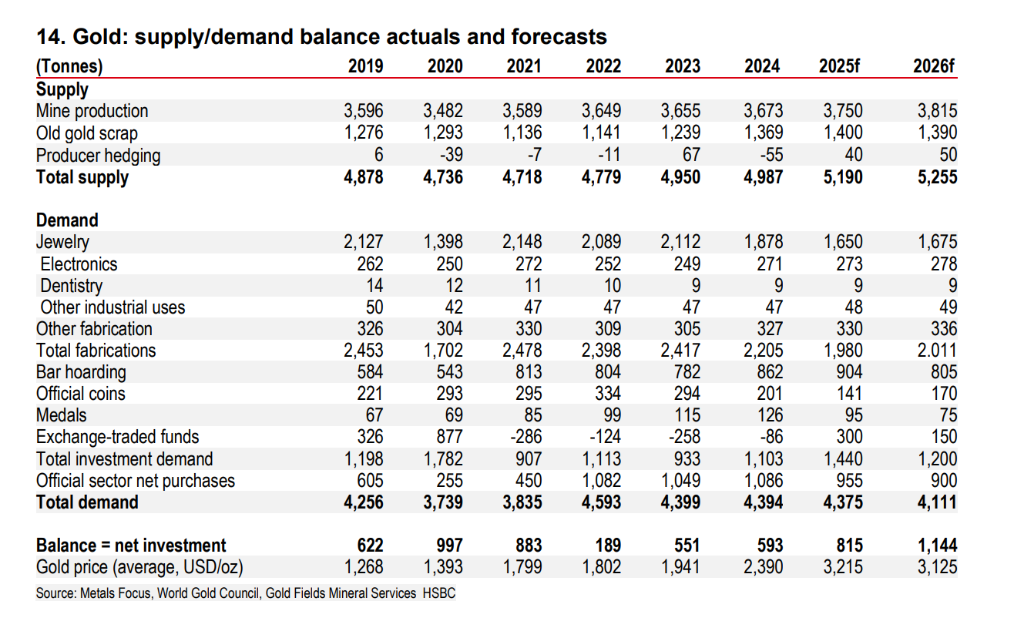
Core Viewpoint - Gold prices have seen a significant pullback after reaching a historical high of $3,500 per ounce on April 22, 2025, with geopolitical factors and central bank purchases continuing to support gold, but prices may be nearing a peak due to weakening physical demand, increased supply, and a slower-than-expected rate cut by the Federal Reserve [1][6][12]. Group 1: Supply and Demand Dynamics - Total gold supply is projected to increase from 4,950 tonnes in 2023 to 5,190 tonnes in 2025, driven by mine production and old gold scrap recovery [2]. - Jewelry demand, which constitutes about half of global gold consumption, is expected to decline significantly, with a 21% year-on-year drop in Q1 2025 to 380.3 tonnes [21]. - Investment demand remains strong, with gold ETFs seeing a net increase of 7.94 million ounces in 2023, reaching 90.79 million ounces [14]. Group 2: Geopolitical and Economic Factors - Geopolitical risks have historically supported gold prices, but the market's response may have reached saturation, as evidenced by the failure to surpass the April high following tensions with Iran [6]. - The Federal Reserve's anticipated rate cuts are expected to be less aggressive than previously thought, which could negatively impact gold prices [12]. - Global trade growth is projected to slow, with only a 1.8% increase expected in 2025, which typically supports gold prices [9]. Group 3: Central Bank Purchases and Future Projections - Central bank demand for gold remains robust, with purchases expected to total 955 tonnes in 2025, although this is lower than previous years [28]. - HSBC has raised its average gold price forecast for 2025 to $3,215 per ounce, with a trading range of $3,100 to $3,600 per ounce [2]. - The forecast for gold prices in 2026 is set at $3,125 per ounce, indicating a potential decline in price momentum [2].

金价止跌回升反弹走强 短线仍处于宽幅拉锯
Jin Tou Wang· 2025-07-01 03:55
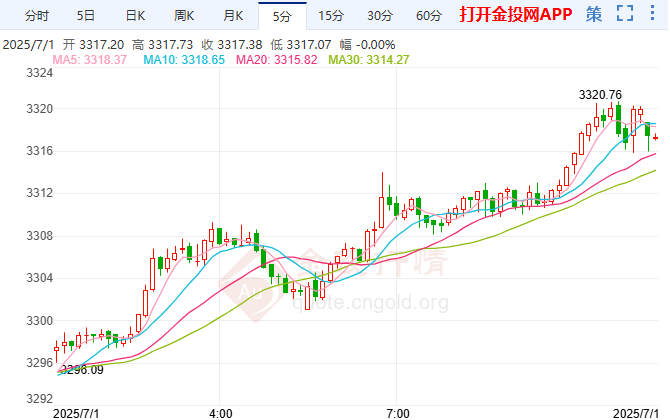
Group 1 - The core viewpoint indicates that gold prices are on an upward trend, recently surpassing the $3,320 mark, with potential targets at $3,350 and $3,400 if key resistance levels are broken [1][5] - The US dollar continues to decline due to concerns over increasing government deficits and uncertainties regarding trade agreements, reaching a near four-year low against the euro [3][4] - The US Dollar Index (DXY) closed down nearly 0.5% at 96.77, amidst internal disagreements within the Republican Party regarding President Trump's proposed tax and spending plan, which is projected to increase national debt by $3.3 trillion [4] Group 2 - Recent trading patterns show that gold has rebounded after touching support levels in its upward trend channel, indicating strengthened bullish momentum and a potential target of $3,400 [5] - The daily chart suggests that gold prices have returned above the 60-day moving average, reinforcing bullish prospects, while the weekly chart indicates that the market remains in a tug-of-war phase with significant retracement demand [4][5] - Short-term trading strategies should focus on a range-bound approach, with key support levels at $3,306 and $3,290, and resistance levels at $3,330 and $3,345 [5]
摩根大通:新兴市场资金流动监测_美元,我的魔力何在
摩根· 2025-07-01 00:40
Investment Rating - The report does not explicitly provide an investment rating for the emerging markets (EM) sector, but it discusses the current state of capital flows and economic conditions, indicating a cautious outlook due to various factors affecting inflows [2][4][14]. Core Insights - The report highlights a "sudden stall" in capital flows to emerging markets, with cumulative net outflows of $27 billion through April 2025, driven primarily by portfolio investments [10][14]. - Despite a weaker dollar acting as a push factor for inflows, the lack of stronger growth in emerging markets limits the pull factor, resulting in sluggish inflows [7][9]. - The report notes that current accounts in emerging markets are generally in good shape, which has insulated them from significant macroeconomic damage despite the capital flow challenges [14][16]. Summary by Sections Economic Overview - The report discusses the elevated probability of a US recession at 40%, with uncertainties surrounding US trade policies and geopolitical risks impacting global economic conditions [1]. - It mentions that the dollar has weakened significantly since March, which typically would benefit emerging markets, but this has not translated into expected inflows [2][4]. Capital Flows Analysis - The report identifies both push and pull factors influencing capital flows, with a weaker dollar serving as a push factor and the growth differential between emerging and developed markets acting as a pull factor [3]. - It notes that portfolio inflows have been weak since October, with a significant outflow of $115 billion in April 2025, attributed to market turmoil [10][12]. Growth and Inflation Outlook - The report suggests that domestic demand in emerging markets remains soft, and any escalation in tariffs could skew risks further to the downside, impacting growth differentials [9]. - It emphasizes that while inflation is expected to move lower, some central banks in emerging markets may have room to cut rates due to contained macro risks [14][16].