
资产荒

Search documents
交银施罗德基金马韬:聚焦底部反转机会或成下半年重点投资策略
2 1 Shi Ji Jing Ji Bao Dao· 2025-08-18 12:01
Group 1 - The core viewpoint of the article highlights the evolution of asset classes from a "bond bull market" to a "stock bull market" since the significant policy adjustments on September 24, 2022, influenced by a low interest rate environment [1][4] - The current market is experiencing an "asset shortage," leading asset management institutions to seek higher credit risk assets with larger credit spreads [1][3] - The phenomenon of high equity risk premiums compared to low bond credit spreads has only occurred three times in the past decade, indicating a significant market divergence [3] Group 2 - The macroeconomic environment is gradually recovering, with M1 growth exceeding market expectations, influenced by fiscal policy and trade surpluses converting into corporate cash [4][5] - The "barbell strategy" in stock investment has shown strong performance, combining large-cap and small-cap stocks, as well as high-dividend and high-volatility assets [4][6] - Recent trends indicate a reversal in mid-cap and mid-valuation sectors, supported by domestic policies aimed at clearing ineffective supply and improving asset profitability [5][6] Group 3 - Internationally, the focus on artificial intelligence investments is notable, but there is potential for growth in manufacturing-related investments due to rising industrial prices in the U.S. [5][6] - U.S. companies exhibit a positive outlook on capital expenditures across various sectors, which may significantly impact global midstream industries [6]


【招银研究】政策空间打开,风险偏好修复——宏观与策略周度前瞻(2025.08.18-08.22)
招商银行研究· 2025-08-18 10:08
Group 1: US Economic Outlook - The US economy continues to show signs of recovery, with the Atlanta Fed's GDPNOW model predicting a Q3 growth rate of 2.6%, driven by private consumption growth of 2.2% and private investment growth of 2.3% [2] - The job market remains stable, with initial jobless claims at 224,000 and continuing claims at 1.953 million, indicating a balanced employment situation with limited upward pressure on the unemployment rate [2] - Inflationary pressures are rising, with July PPI unexpectedly increasing to 3.3%, raising concerns about inflation despite the primary driver being structural growth in asset management fees [2] Group 2: US Stock Market Performance - US stocks are on an upward trend, supported by strong corporate earnings, with S&P 500 companies showing an EPS growth rate of 11.8% and approximately 81% exceeding earnings expectations [3] - Despite the positive earnings outlook, stock valuations are considered high, limiting further upside potential [3] - The bond market is expected to experience limited downward movement in yields due to market expectations of a rate cut being largely priced in [3] Group 3: Chinese Economic Conditions - China's economy is experiencing a slowdown, with external demand strengthening while internal demand and production are both slowing down [6] - July's export growth was 8% year-on-year, while investment growth fell to 1.6% and retail sales growth dropped to 3.7% [6] - Financial data shows a divergence, with social financing growth rising to 9.0% but new RMB loans declining to a historical low [6] Group 4: Policy Measures in China - The Chinese government has introduced two subsidy policies aimed at boosting consumption, including personal consumption loan subsidies and service industry loan subsidies, which are expected to stimulate demand [9] - The central bank's monetary policy remains focused on maintaining a moderately loose stance, with potential for further easing if economic conditions worsen [10] - The "anti-involution" policy is becoming a central theme in financial policy, emphasizing a balance between supporting the real economy and maintaining financial health [10] Group 5: Market Strategies - The domestic market is seeing a gradual recovery in risk appetite, with a recommendation to hold medium to short-duration bonds while being cautious with long-duration bonds [11] - The A-share market is expected to continue its upward trend, supported by a loose monetary policy and improving economic expectations [12] - In the Hong Kong market, the Hang Seng Index is benefiting from US rate cut expectations, with a focus on dividend assets and technology sectors for investment [13]
加仓!加仓!净买入超6400亿元
Zhong Guo Ji Jin Bao· 2025-08-18 09:33
Core Insights - The insurance industry is experiencing steady growth in key metrics, driven by sustained savings demand and the implementation of the "reporting and operation integration" policy [1] - Insurance funds are increasingly adopting a "barbell" investment strategy, enhancing allocations in both bonds and equities [3] Group 1: Industry Performance - As of mid-2025, the total assets of the insurance industry grew by 9.2% year-on-year, with total premium income increasing by 5.1% [1] - The growth in premium income is primarily driven by life insurance, with a reported growth rate of 5.4% for the first half of the year, up from 3.3% in the previous month [1] Group 2: Investment Allocation - By the end of Q2 2025, the balance of insurance funds reached 36.23 trillion yuan, a year-on-year increase of 17.39%, with a quarter-on-quarter growth of 3.7% [1] - The allocation to equities has significantly increased, with a total stock balance of 3.07 trillion yuan, representing an 8.8% share of the total investment, and a net increase of 640.6 billion yuan in the first half of the year [2] - The bond allocation remains the primary focus, accounting for over 51% of the total, with a bond balance of 17.87 trillion yuan, marking a new high [2] Group 3: Market Trends - The stock balance has surged by 47.57% compared to the previous year, outpacing the overall growth of insurance fund allocations [2] - The low interest rate environment has led to an "asset shortage," prompting insurance funds to increase their equity allocations and engage in long-term investment strategies [2] - Insurance funds are actively participating in the capital market through shareholding and private fund establishment, reflecting confidence in the recovery and long-term value of the insurance sector [3]
加仓!加仓!净买入超6400亿元
中国基金报· 2025-08-18 09:32
Core Viewpoint - The insurance industry is experiencing steady growth in key indicators, driven by sustained savings demand and the implementation of the "bank-insurance integration" policy, leading to a notable increase in both bond and equity allocations in investment strategies, particularly emphasizing a "barbell" strategy [2][5]. Group 1: Insurance Industry Performance - As of mid-2025, the total assets of the insurance industry grew by 9.2% year-on-year, with total premium income increasing by 5.1% [2]. - The growth in premium income is primarily driven by life insurance, with a reported growth rate of 5.4% for personal insurance companies in the first half of the year, a significant increase from 3.3% in the previous month [2]. Group 2: Investment Allocation - By the end of Q2 2025, the balance of insurance funds reached 36.23 trillion yuan, marking a year-on-year increase of 17.39% and a quarter-on-quarter increase of 3.7% [2][3]. - The allocation of insurance funds remains heavily focused on bonds, which account for over 51% of the total investment, with a bond balance of 17.87 trillion yuan, reflecting a record high [4]. - The stock balance for life and property insurance companies reached 3.07 trillion yuan, representing an increase of 47.57% compared to the previous year, with a net increase of 640.6 billion yuan in the first half of the year [3][4]. Group 3: Market Trends and Strategies - The low interest rate environment has led to an "asset shortage," prompting insurance companies to increase their allocation to equity assets and expand long-term investment trials [3]. - Regulatory support for insurance funds to enter the market has facilitated this trend, allowing for continued investment through shareholding and private fund establishment [3]. - The "barbell" strategy is becoming more pronounced, with insurance funds increasing both bond and equity allocations, particularly in high-dividend sectors such as banks and public utilities [5].



以史为镜!这次A股十年新高有何不同?
Zheng Quan Shi Bao· 2025-08-18 09:14
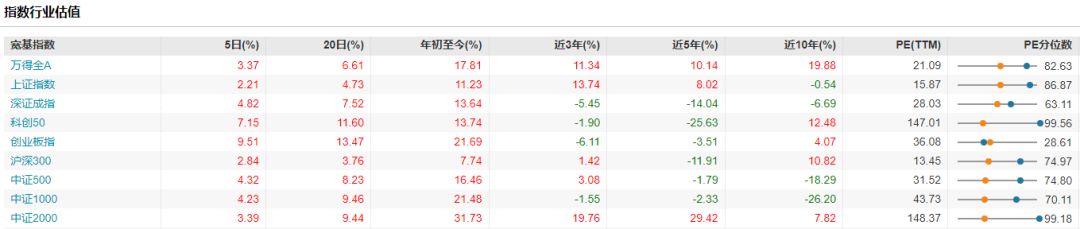
证券时报记者 吴少龙 王军 胡华雄 8月18日,A股市场涨势如虹,人气进一步高涨,多个指数盘中创阶段新高。 其中,上证指数盘中突破2021年2月18日曾触及的3731.69点高点,创出自2015年8月20日之后的近10年新高。深证成指、创业板指数均突破2024年10月8日 的高点,创出最近两年新高。北证50指数盘中突破1500点,创出历史新高。 在银行等权重的带领下,目前A股整体市盈率为21.09倍,处于近十年历史分位数的82.78%。 数据显示,截至2025年8月18日,上证指数滚动市盈率(PE-TTM)约15.87倍,处于近十年历史分位数的86.50%。而10年前的2015年8月20日,上证指数滚 动市盈率(PE-TTM)约为16.5倍,当年的6月12日,上证指数滚动市盈率(PE-TTM)最高一度达到23倍;4年多前的2021年2月18日,上证指数滚动市盈 率(PE-TTM)为16.81倍。 值得关注的是,目前,各大指数呈现较为明显的分化,其中深证成指处于近十年历史分位数的63.21%;创业板指较低,为28.98%。沪深300、中证500、 中证1000均已经超过70%。 招商证券的观点称,由于当前A股整 ...
以史为镜!这次A股十年新高有何不同?
证券时报· 2025-08-18 09:08
Core Viewpoint - The A-share market has shown significant growth, with multiple indices reaching new highs, indicating a strong bullish sentiment and potential investment opportunities in the market [1][11]. Market Performance - On August 18, 2025, the Shanghai Composite Index broke its previous high of 3731.69 points, marking a nearly 10-year high since August 20, 2015 [1]. - The Shenzhen Component Index and the ChiNext Index also surpassed their recent highs, while the North Star 50 Index reached a historical high above 1500 points [1]. Key Indicators - The overall market performance is reflected in various indices, with the Wind All A Index showing a year-to-date increase of 17.81% and a 5-day increase of 3.37% [4]. - The current overall price-to-earnings (PE) ratio for A-shares stands at 21.09, which is in the 82.63 percentile of the last ten years [5]. Historical Comparisons - The rolling PE ratio for the Shanghai Composite Index is approximately 15.87, which is in the 86.50 percentile historically [8]. - The number of listed companies has increased significantly from 2800 in 2015 to 5432 currently, nearly doubling over the past decade [9]. Market Dynamics - The current market rally is attributed to policy benefits, industrial upgrades, and a global capital reallocation trend, leading to increased foreign investment in Chinese assets [11]. - Foreign capital has shown a growing interest in Chinese assets, with net inflows into domestic stocks and funds reaching $10.1 billion in the first half of the year [11]. Investment Trends - The low interest rate environment has made equity assets more attractive, particularly stable high-dividend stocks in sectors like banking and utilities [12]. - The number of new investor accounts has surged, with 1.96 million new accounts opened in July 2025, a 71% year-on-year increase [14]. Margin Trading - Margin trading has become increasingly active, with the margin balance exceeding 2 trillion yuan, marking a ten-year high [16]. - As of August 15, 2025, the margin balance reached 20,626 billion yuan, reflecting a significant increase in trading activity [16]. Sector Performance - Since April 8, 2025, the defense and military sector has led the market with a 54.14% increase, followed by communications and biomedicine sectors, both exceeding 40% [20]. - Individual stocks have shown remarkable performance, with some stocks like Shangwei New Materials increasing by 1463.38% since April 8, 2025 [22][23]. Future Outlook - Analysts are optimistic about the future performance of the Chinese stock market, with expectations of continued inflows of capital as investors shift their assets [24]. - Several international investment banks have upgraded their ratings on Chinese assets, indicating a positive outlook for the A-share market [26].

创业板指创阶段新高,创业50ETF(159682)上午收涨近4%,机构:市场趋势向上依然具备确定性
2 1 Shi Ji Jing Ji Bao Dao· 2025-08-18 05:20
Group 1 - The A-share market experienced a strong performance on August 18, with the ChiNext Index rising by 3.63% and surpassing the 2600-point mark, breaking through last year's high of 924 [1] - The ChiNext 50 Index (399673.SZ) increased by 4.0%, with notable stocks such as Zhinan Compass and Mango Super Media hitting the daily limit, Tonghuashun rising over 15%, and Zhongji Xuchuang increasing by over 10% [1] Group 2 - The Chuangye 50 ETF (159682) rose by 3.83% with a trading volume of 164 million yuan, tracking the ChiNext 50 Index, which includes sectors like manufacturing, finance, and information technology [2] - East Wu Securities anticipates that the market will maintain relative strength in the short term due to liquidity, although it may experience volatility and consolidation as it attempts to break previous highs [2] - The mid-term outlook remains positive with factors such as policy support, asset scarcity, and the potential for a US dollar interest rate cut contributing to an upward market trend [2]

A股,创近10年新高!刚刚,财政部出手!
Zheng Quan Shi Bao Wang· 2025-08-18 05:15
Core Viewpoint - The stock market's surge has put significant pressure on the bond market, with the A-share market reaching historical highs while government bonds experience notable declines [1][2]. Group 1: Stock Market Performance - The Shanghai Composite Index rose over 1% to reach 3740 points, marking the highest level since August 21, 2015, and a nearly ten-year high [1][2]. - The total market capitalization of A-shares surpassed 100 trillion yuan for the first time in history [2]. - The ChiNext Index increased by 3%, crossing the 2600-point mark, with a year-to-date gain exceeding 20% [1]. Group 2: Bond Market Reaction - The bond market saw significant declines, with the 30-year government bond futures dropping over 1%, reaching a four-month low [2]. - The yield on the 30-year government bond rose by 3.35 basis points to 2.0275% [1]. - The Ministry of Finance announced measures to support government bond market making and improve liquidity in the secondary market [1][2]. Group 3: Investor Behavior - Active trading and inflows from leveraged funds and private equity have been driving the recent stock market rally, despite a high ratio of household deposits to A-share market capitalization [3]. - There is a noted increase in retail investor discussions about stocks and a gradual rise in fund subscriptions, indicating a potential uptick in retail participation [3]. - Foreign capital has shifted from net selling to net buying, with expectations of continued inflows into the stock market [3]. Group 4: Bond Market Outlook - The bond market's recent pullback is attributed to systematic reductions in duration by bond funds and brokerages, rather than economic fundamentals [5]. - The largest allocation force in the bond market, bank proprietary trading, cannot invest in stocks, which may lead to a shift in investment strategies [5]. - The bond market's performance will ultimately depend on economic fundamentals, with a gradual decoupling from stock market trends expected [5].
A股,创近10年新高!刚刚,财政部出手!
券商中国· 2025-08-18 04:07
Core Viewpoint - The stock market's surge has put significant pressure on the bond market, with the A-share market reaching historical highs while government bonds experience notable declines [1][3]. Group 1: Stock Market Performance - The Shanghai Composite Index briefly surpassed 3740 points, marking a rise of over 1% and reaching its highest level since August 21, 2015, a nearly ten-year high [1][3]. - The total market capitalization of A-shares exceeded 100 trillion yuan for the first time in history, indicating strong market performance [3]. - The ChiNext Index rose by 3%, surpassing 2600 points, with a year-to-date increase of over 20% [1]. Group 2: Bond Market Reaction - The bond market saw significant declines, with the 30-year government bond futures dropping by over 1%, and the 10-year government bond futures falling by 0.3% [1][3]. - The yield on the 30-year government bond increased by 3.35 basis points, reaching 2.0275% [1]. - The Ministry of Finance announced measures to support government bond market making and improve liquidity in the secondary market [1][3]. Group 3: Market Dynamics - The recent stock market rally has led to a shift in investment strategies, with active funds driving the current market momentum [7]. - Despite the stock market's performance, retail investor participation remains cautious, with a notable lack of new account openings and continued net redemptions in ETFs [7]. - Foreign capital has shifted from net selling to net buying, indicating potential for continued inflows into the stock market [7].

固收 如何看待社融数据、货政报告
2025-08-18 01:00
Summary of Conference Call Notes Industry Overview - The current economic environment shows weak loan demand and a decline in interest rate cut expectations, with fiscal policy becoming the main economic driver [1][4] - The financial industry is experiencing a reversal of internal competition, with new loans in July falling significantly below seasonal expectations, potentially leading to bank balance sheet contraction [1][4][5] Key Points and Arguments - **Loan Demand and Credit Market**: The increase in social financing is primarily driven by government financing, while loan growth is declining year-on-year, indicating weak market demand for loans [3][4] - **Government's Role**: The government is increasingly seen as a key economic driver, with fiscal flexibility taking precedence over large-scale interest rate cuts [4][7] - **Bank Balance Sheets**: Contraction in bank balance sheets due to limited bonds and loans will reduce the availability of quality investment assets, leading to a scarcity of investment opportunities [1][5] - **Interest Rate Policies**: The subsidy policy aims to lower loan rates but is not functioning smoothly, leading to cautious expectations for the bond market in the second half of the year [1][6] - **Monetary Policy Focus**: The current monetary policy emphasizes direct support for the real economy rather than relying on interbank market liquidity or significant interest rate cuts [7][9] Financial Data Insights - **M2 and M1 Growth**: M2 growth increased from 8.3% to 8.8%, while M1 showed significant changes, reflecting a shift in residents' risk preferences towards risk assets [8] - **Bond Market Challenges**: The bond market faces challenges from expected fluctuations and a lack of strong supportive factors, with potential adjustments in the 10-year treasury yield expected to be around 30-40 basis points [9][10] Investment Opportunities - **Credit Bond Market**: The credit bond market is currently weak, but structural opportunities exist, particularly in technology innovation bonds and green finance bonds [2][13][16] - **Green Finance Bonds**: There is a noticeable shift from green credit bonds to green finance bonds, with increased demand from institutions like insurance companies [14][15] - **Future Outlook for Credit Bonds**: The outlook for thematic credit bonds remains positive, especially for technology and green finance, supported by policy changes and competitive issuance costs [16] Market Trends and Strategies - **Yield Curve Expectations**: The yield curve for government bonds is expected to remain weak with upward pressure, suggesting that structural strategies may be more advantageous than simply expecting a downward shift [10][11] - **Investment Strategy Recommendations**: Focus on technology growth sectors and stable industries such as public utilities and traditional cyclical sectors for stable returns [20] Additional Insights - **Convertible Bond Market**: The convertible bond market is nearing historical valuation extremes, with limited upward price potential unless driven by equity market changes [18] - **Strong Redemption Impact**: Strong redemptions have led to price declines in convertible bonds, emphasizing the need to monitor high premium bonds to avoid forced redemptions [19]