
市场避险情绪

Search documents
全线大跌!超11万人爆仓
Sou Hu Cai Jing· 2025-08-03 10:03
Group 1 - The cryptocurrency market is experiencing a downturn, with major cryptocurrencies like Ethereum, Dogecoin, and BNB dropping over 3%, and Dogecoin seeing a 19% decline over the past week [2] - Over the past 24 hours, more than 110,000 traders have been liquidated in the cryptocurrency market, with a total liquidation amount of $369 million, including $310 million from long positions and $58.17 million from short positions [2] - The U.S. non-farm payroll data for July significantly underperformed expectations, indicating a rapid deterioration in the labor market, which has led traders to increase bets on a potential interest rate cut by the Federal Reserve in September [2] Group 2 - Market expectations for the Federal Reserve's subsequent easing monetary policy have risen sharply due to growing concerns about a U.S. economic recession, resulting in heightened risk aversion in the market [2]

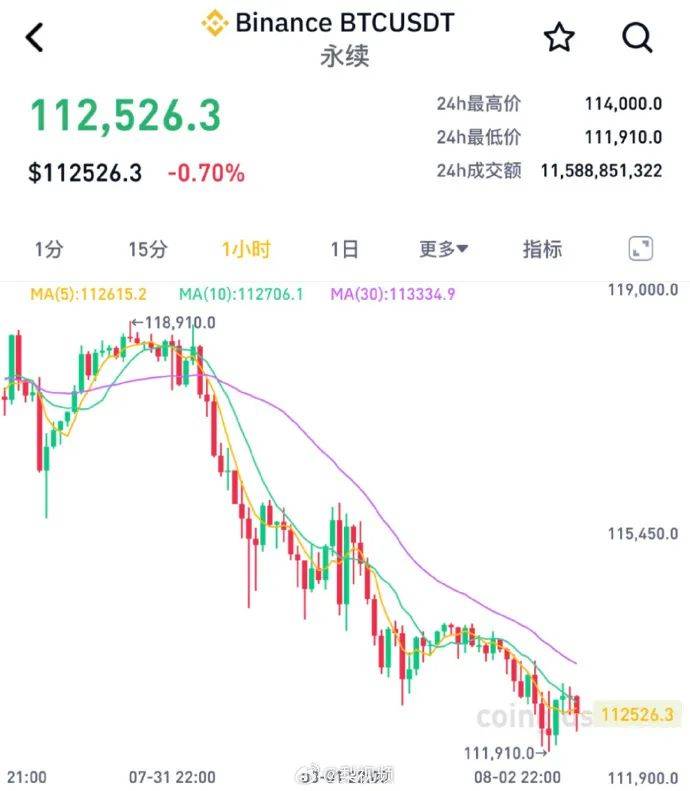
分析师:当前比特币仍处于6月底以来的震荡中枢
Sou Hu Cai Jing· 2025-08-03 02:03
Core Insights - The cryptocurrency market is experiencing a correction, with Bitcoin dropping below $112,000, leading to over 110,000 liquidations in the past 24 hours [1] - The U.S. non-farm payroll data for July significantly underperformed expectations, indicating a rapid deterioration in the labor market, which has increased traders' bets on a potential interest rate cut by the Federal Reserve in September [1] - There is a rising concern about a U.S. economic recession, contributing to heightened risk aversion in the market [1] Market Analysis - Analysts from BiyaPay indicate that Bitcoin is currently in a consolidation phase since late June, with $115,000 identified as a critical support level [1] - If Bitcoin falls below $114,000, it may test the support range of $111,000 to $112,500 [1] - Long-term holders currently control 53% of the supply, suggesting that any significant selling pressure would require new capital inflows to stabilize the market [1]
刚刚!美股,重大警告!
券商中国· 2025-08-02 16:07
Core Viewpoint - The article discusses the significant increase in average effective tariff rates in the U.S., reaching 18.3%, the highest in 91 years, and its potential impact on consumer prices and the economy [1][2][3]. Group 1: Tariff Rates and Economic Impact - As of July 31, the average effective tariff rate on U.S. imports is 18.3%, marking the highest level since 1934 [2]. - The tariff policy is projected to reduce the U.S. GDP growth rate by 0.5 percentage points annually in 2025 and 2026, and increase the unemployment rate by 0.3 percentage points by the end of 2025 and 0.7 percentage points by the end of 2026 [2]. - Consumers may face a 40% increase in shoe prices and a 38% increase in clothing prices in the short term, with long-term projections of a 19% increase for shoes and a 17% increase for clothing [2]. Group 2: Market Reactions and Predictions - The U.S. stock market experienced a significant drop, with a total market value loss exceeding $1 trillion, attributed to rising tariff concerns and poor employment reports [1][5]. - Analysts predict that the additional tariffs, combined with weak employment data, may lead to further declines in the S&P 500 index in August [3]. Group 3: Export License Delays - The U.S. export licensing agency is reportedly near paralysis due to internal chaos, resulting in thousands of export license applications being stalled, the worst backlog in over 30 years [6]. - Delays in license approvals are putting U.S. companies at a competitive disadvantage globally and raising concerns among businesses seeking overseas sales opportunities [6]. Group 4: International Trade Relations - The U.S. has imposed new tariffs on 69 trading partners, with rates ranging from 10% to 41%, affecting various countries differently [4][5]. - Despite threats from the U.S. regarding oil imports from Russia, India has not altered its purchasing strategy, continuing to buy Russian oil [7].
“黑天鹅”来袭,全线下跌
Zheng Quan Shi Bao· 2025-08-02 00:23
Core Viewpoint - The announcement of "reciprocal tariffs" by the U.S. has triggered global market turmoil, leading to declines in both U.S. and European stock markets [1][6]. Market Performance - U.S. stock indices closed lower, with the Dow Jones Industrial Average down 1.23% at 43,588.58, the S&P 500 down 1.60% at 6,238.01, and the Nasdaq down 2.24% at 20,650.13 [2]. - For the week, the Dow Jones fell 2.92%, the S&P 500 dropped 2.36%, and the Nasdaq decreased by 2.17% [2]. - European markets also experienced declines, with Germany's DAX down 2.66%, France's CAC40 down 2.91%, and the UK's FTSE 100 down 0.70% [2][3]. Economic Indicators - Recent U.S. labor market data shows a significant slowdown, with non-farm payrolls adding only 73,000 jobs in July, below expectations, and the unemployment rate rising to 4.2% [6]. - Revisions to previous months' data revealed a sharp downward adjustment, with May's job additions revised from 144,000 to just 19,000 and June's from 147,000 to 14,000 [6]. - This data suggests a rapid deceleration in the labor market, raising concerns about a potential recession [6]. Federal Reserve Response - The weak labor market data has increased pressure on the Federal Reserve to consider interest rate cuts, especially in light of the new tariffs [7]. - Fed Chair Jerome Powell emphasized the need to remain vigilant about inflation risks, particularly with the backdrop of new tariffs imposed by President Trump [6][7]. Tariff Details - President Trump signed an executive order to raise tariffs on Canada from 25% to 35%, effective August 1, with new reciprocal tariff rates ranging from 10% to 41% for various countries [7][8]. Oil Market Impact - International oil prices fell sharply, with U.S. crude down 2.89% to $67.26 per barrel and Brent crude down 3.00% to $69.55 per barrel, driven by concerns over the labor market and OPEC+ production increases [9][10]. - OPEC+ has increased production significantly, with a total increase of 1.8 million barrels per day since May, contributing to downward pressure on oil prices [10]. Precious Metals and Bonds - On August 1, international precious metals futures saw gains, with COMEX gold up 2.01% to $3,416.00 per ounce and silver up 1.07% to $37.11 per ounce [11]. - U.S. Treasury yields fell across the board, with the 2-year yield down 25.49 basis points to 3.698% and the 10-year yield down 14.62 basis points to 4.220% [11].

“黑天鹅”来袭!全线下跌!
Zheng Quan Shi Bao· 2025-08-02 00:10
Core Viewpoint - The introduction of "reciprocal tariffs" by the U.S. has triggered global market turmoil, leading to declines in both U.S. and European stock markets [1][6]. Market Performance - U.S. stock indices closed lower, with the Dow Jones Industrial Average down 1.23% at 43,588.58, the S&P 500 down 1.60% at 6,238.01, and the Nasdaq down 2.24% at 20,650.13 [2][3]. - For the week, the Dow Jones fell 2.92%, the S&P 500 dropped 2.36%, and the Nasdaq decreased by 2.17% [2]. - European markets also experienced declines, with Germany's DAX down 2.66%, France's CAC40 down 2.91%, and the UK's FTSE 100 down 0.70% [2][3]. Economic Indicators - Recent data indicates a significant slowdown in the U.S. labor market, with non-farm payrolls adding only 73,000 jobs in July, below expectations, and the unemployment rate rising to 4.2% [6][7]. - Revisions to previous months' employment data showed a drastic reduction, with May's job additions revised down from 144,000 to 19,000 and June's from 147,000 to 14,000 [6]. - The labor market's rapid deterioration raises concerns about a potential recession, as indicated by the market's heightened risk aversion [6][7]. Tariff Developments - President Trump signed an executive order to increase tariffs on Canada from 25% to 35%, effective August 1, and indicated adjustments to "reciprocal tariffs" for other countries, with rates ranging from 10% to 41% [7][8]. - This move has intensified market fears and contributed to the overall decline in stock prices [6][7]. Oil Market Impact - International oil prices fell sharply, with U.S. crude down 2.89% to $67.26 per barrel and Brent crude down 3.00% to $69.55 per barrel [9][10]. - The decline in oil prices is attributed to disappointing U.S. employment data and ongoing production increases by OPEC+, which has raised concerns about a potential oversupply in the market [10]. Precious Metals and Bonds - On August 1, international precious metals futures saw gains, with COMEX gold futures rising 2.01% to $3,416.00 per ounce and silver futures up 1.07% to $37.11 per ounce [11]. - U.S. Treasury yields fell across the board, with the 2-year yield down 25.49 basis points to 3.698% and the 10-year yield down 14.62 basis points to 4.220% [11].

【黄金期货收评】美非农定美元黄金走向 沪金日内上涨0.10%
Jin Tou Wang· 2025-08-01 09:01
Group 1: Gold Market Overview - On August 1, the closing price of Shanghai gold futures was 770.72 yuan per gram, with a daily increase of 0.10% and a trading volume of 189,185 lots [1] - The spot price of gold in Shanghai on the same day was quoted at 767.20 yuan per gram, indicating a discount of 3.52 yuan per gram compared to the futures price [1] Group 2: U.S. Tariff Policy and Market Sentiment - The U.S. is set to reinstate "reciprocal tariffs" on August 1, with ongoing negotiations with several economies, including the UK, Vietnam, and the EU [2] - Despite President Trump's statement that there will be no further delays, U.S. Treasury Secretary Mnuchin emphasized that the negotiation window remains open even with the tariff increase [2] - Market sentiment appears to be weak regarding the tariff negotiations, with a focus on upcoming U.S. non-farm payroll and unemployment rate data to gauge the potential impact on the dollar index and gold prices [2]
今日早评-20250801
Ning Zheng Qi Huo· 2025-08-01 02:25
Key Points of the Research Report 1. Report Industry Investment Ratings No industry investment ratings are provided in the report. 2. Core Views - The short - term fundamentals of coking coal and coke are strong, and it is expected to maintain a volatile trend after a correction [2]. - Silver is expected to be in a high - level volatile and slightly bearish situation due to the weakening of short - term interest rate cut expectations [2]. - The 09 contract of soda ash is expected to fluctuate in the short term, and it is recommended to wait and see or short on rebounds [4]. - Crude oil should be treated with a volatile and bullish view [5]. - Methanol's 09 contract is expected to fluctuate in the short term, and it is recommended to wait and see or short on rebounds [6]. - The rebar futures price is expected to fluctuate and consolidate in the short term [7]. - Iron ore is expected to be volatile and bullish in the short term [7]. - Gold remains volatile and bearish [8]. - The bond market is affected by the stock - bond seesaw effect, and the logic of the bond market itself is unclear [8][9]. - Rapeseed meal is expected to be volatile and bearish in the short term [9]. - Palm oil is expected to be volatile and bearish in the short term [10]. - Short - term pig prices have adjusted, and short - term long positions can be considered; farmers can choose to sell for hedging according to the slaughter rhythm [12]. - It is advisable to wait and see for PTA [12]. - Rubber is relatively weak in the short term, and it is recommended to realize profits on short positions on dips [13]. - The L09 contract of LLDPE is expected to fluctuate in the short term, and it is recommended to wait and see [14]. 3. Summary by Variety Coking Coal - The price of low - sulfur main coking coal in Linfen Anze increased by 50 yuan/ton to 1500 yuan/ton. The inventory of 523 sample mines decreased by 30.2 tons week - on - week to 248.3 tons. After the fourth round of price increases for coke was implemented, the fifth round started. The market speculation sentiment cooled, and coking coal hit the daily limit down. The short - term fundamentals are strong, and it is expected to maintain a volatile trend after a correction, with a support level of 980 yuan/ton [2]. Silver - The core PCE price index in the US in June increased by 2.8% year - on - year, higher than the expected 2.7%. The actual consumer spending increased by only 0.1% month - on - month. The number of initial jobless claims in the US last week increased by 1000 to 218,000, lower than the market expectation. The short - term interest rate cut expectations weakened, which is bearish for silver. It is expected to be in a high - level volatile and slightly bearish situation [2]. Soda Ash - The national mainstream price of heavy - quality soda ash is 1366 yuan/ton, and the price is temporarily stable. The weekly output decreased by 3.32% week - on - week to 69.98 tons, and the total inventory of manufacturers decreased by 3.69% week - on - week to 179.58 tons. The float glass start - up rate is 75%, down 0.1% week - on - week. The market is expected to fluctuate in the short term, with a resistance level of 1285 for the 09 contract. It is recommended to wait and see or short on rebounds [4]. Crude Oil - The US Treasury imposed sanctions on a large number of individuals, entities, and vessels related to a shipping network. Russia and Saudi Arabia discussed the oil market situation. The US crude oil production in May increased by 24,000 barrels per day, breaking the previous record. The market is concerned about the possible significant production increase by OPEC+ in September, and the international oil price corrected. The overall situation is volatile and bullish [5]. Methanol - The market price in Jiangsu Taicang decreased by 15 yuan/ton to 2395 yuan/ton. The port inventory increased by 8.26 tons week - on - week to 80.84 tons, and the production enterprise inventory decreased by 1.53 tons week - on - week to 32.45 tons. The 09 contract is expected to fluctuate in the short term, with a resistance level of 2425. It is recommended to wait and see or short on rebounds [6]. Rebar - As of July 31, the weekly output decreased by 0.42% to 211.06 tons, the factory inventory decreased by 2.12% to 162.15 tons, the social inventory increased by 2.99% to 384.14 tons, and the apparent demand decreased by 6.08% to 203.41 tons. Affected by bad weather, the terminal demand is low, and it is expected to fluctuate and consolidate in the short term [7]. Iron Ore - From July 21 to July 27, the global iron ore shipment volume increased by 91.8 tons week - on - week to 3200.9 tons. The shipment volume from Australia and Brazil increased by 203.9 tons week - on - week to 2755.9 tons. Affected by the policy expectations and market sentiment, the current fundamentals are neutral to strong, and it is expected to be volatile and bullish in the short term, with a support level of 750 yuan/ton [7]. Gold - The US will resume collecting "reciprocal tariffs" on August 1. The tariff negotiations are ongoing, but the market risk - aversion sentiment is weak. Gold remains volatile and bearish, and attention should be paid to the US dollar trend [8]. Long - and Medium - Term Treasury Bonds - China's official manufacturing PMI in July was 49.3, down 0.4 percentage points month - on - month. The economic sentiment declined, and counter - cyclical adjustment needs to be increased. The stock market's short - term upward momentum weakened, and the stock - bond seesaw effect is favorable for the bond market. The bond market's own logic is unclear [8]. Short - Term Treasury Bonds - On July 31, most money market interest rates rose. The increase in money market interest rates is bearish for short - term bonds. The short - term upward momentum of the stock market weakened, which may be favorable for the bond market. The stock - bond seesaw effect is the main logic of the bond market [9]. Rapeseed Meal - As of July 27, the Canadian rapeseed export volume decreased by 72.78% week - on - week to 5.51 tons. The domestic rapeseed and rapeseed meal inventories are relatively low, but the demand is weak, and the granular rapeseed meal inventory is high. It is expected to be volatile and bearish in the short term [9]. Palm Oil - In July 2025, the Malaysian palm oil export volume decreased. The domestic palm oil inventory is sufficient, the downstream demand is weak, and the price is expected to be volatile and bearish in the short term [10]. Pig - On July 31, the national average pork price decreased by 1.1% to 20.45 yuan/kg. At the end of the month, the slaughter of farmers decreased, and the price - support intention increased. The short - term price adjustment is in place, and short - term long positions can be considered. Farmers can choose to sell for hedging according to the slaughter rhythm [12]. PTA - The polyester market inventory is concentrated in 16 - 26 days. The PTA supply is expected to be loose, and the downstream polyester load may continue to decline with limited space. The PX spot tension has eased, and the PX futures price is expected to be volatile and bearish. It is advisable to wait and see for PTA [12]. Rubber - The Thai raw material prices continued to fall. The Hainan raw material output increased seasonally. The annual natural rubber supply and demand are expected to be tight, but the short - term supply may increase, and the demand is not strong. The short - term situation is relatively weak [13]. LLDPE - The mainstream price in North China decreased by 7 yuan/ton to 7363 yuan/ton. The weekly output decreased by 1.08% week - on - week to 27.25 tons, and the production enterprise inventory decreased by 17.44% week - on - week to 14.25 tons. The L09 contract is expected to fluctuate in the short term, with a resistance level of 7385. It is recommended to wait and see [14].
金价震荡!2025年7月31日各大金店黄金价格多少钱一克?
Jin Tou Wang· 2025-07-31 07:28
Group 1 - Domestic gold prices remain stable overall, with some stores showing a shift from increase to decrease. The highest price today is 998 CNY per gram, while the lowest remains at 969 CNY per gram from Shanghai China Gold, resulting in a price difference of 29 CNY per gram between the highest and lowest stores [1][4]. - Specific gold prices from various brands are as follows: Lao Miao Gold at 992 CNY per gram (down 7), Liufu Gold at 998 CNY per gram (no change), Chow Tai Fook Gold at 998 CNY per gram (no change), and Zhou Liufu Gold at 978 CNY per gram (no change) [1][3]. - Platinum prices have seen a significant drop, with Zhou Shengsheng's platinum jewelry price falling by 17 CNY per gram to 550 CNY per gram. Additionally, the gold recycling price has decreased by 4.4 CNY per gram [4]. Group 2 - International gold prices experienced fluctuations, with a notable drop of over 50 USD, closing at 3275.29 USD per ounce, a decrease of 1.54%. However, as of the latest report, the price rebounded to 3300.38 USD per ounce, reflecting an increase of 0.77% [7]. - The decline in gold prices was attributed to positive U.S. economic data, which led to a two-month high in the U.S. dollar index and a rebound in U.S. Treasury yields. Ongoing U.S.-China trade negotiations have somewhat limited the extent of the price drop [7]. - The market is currently awaiting the release of U.S. GDP data, core PCE price index, and the Federal Reserve's interest rate decision, which are expected to influence gold prices further [7].

银河期货:关税博弈扰动市场 贵金属震荡待机
Jin Tou Wang· 2025-07-29 06:04
Group 1: Gold Futures Market Performance - As of July 29, the main gold futures in Shanghai reported a price of 770.70 CNY per gram, reflecting a decline of 0.33% [1] - The opening price for the day was 772.66 CNY per gram, with a maximum of 773.30 CNY and a minimum of 767.68 CNY [1] Group 2: Macro Economic News - Trump announced plans to impose tariffs on pharmaceuticals, with global tariffs expected to be around 15-20% [1] - U.S. Treasury Department forecasts a borrowing increase of 453 billion USD for Q3, raising the borrowing estimate to 1.007 trillion USD from April's prediction [3] - The probability of the Federal Reserve maintaining interest rates in July is 96.9%, while the likelihood of a 25 basis point cut is 3.1% [3] Group 3: Institutional Perspectives - The market's risk aversion is easing as the U.S. reaches agreements with Japan and the EU, while talks with China are ongoing [4] - Recent macro data from the U.S. shows resilience, reducing concerns about the deterioration of the U.S. economic fundamentals [4] - The uncertainty surrounding U.S. tariffs and policies is expected to lead to inflation rebound and economic slowdown, with precious metals likely to maintain high volatility in this uncertain environment [4]
银河期货:关注中美关税谈判进展 贵金属维持高位震荡
Jin Tou Wang· 2025-07-28 07:06
Group 1 - The core viewpoint is that the recent trade agreement between the US and EU has alleviated market risk sentiment, while US macro data shows resilience, reducing concerns about the deterioration of the US economic fundamentals [1][2] - The US and EU have reached a trade agreement that includes a 15% tariff on certain goods, $600 billion in US investments, and zero tariffs from EU countries on US products, although there is ambiguity regarding the coverage of pharmaceuticals and steel/aluminum [1] - The Federal Reserve's interest rate decisions are under scrutiny, with a 97.4% probability of maintaining rates in July and a 62.4% chance of a 25 basis point cut by September, indicating a cautious approach to monetary policy [1][2] Group 2 - The market is expected to experience short-term pressure on precious metals due to the easing of risk sentiment and the uncertainty surrounding US tariffs and policies, which may lead to inflation rebound and economic slowdown [2] - Key upcoming events to monitor include the progress of US-China tariff negotiations, the Federal Reserve's meeting, and important US economic data releases such as non-farm payrolls and PCE [2]