滞胀

Search documents
安联投资:略微偏好高收益债券 计划在由市场情绪引发的抛售潮中增加风险投资
Zhi Tong Cai Jing· 2025-08-13 06:08
Group 1 - Allianz Investment highlights investment opportunities in local currency bonds in emerging markets, particularly in Indonesia, Malaysia, and the Philippines, due to attractive spreads and reliable monetary policy trajectories [1] - The firm shows a slight preference for high-yield bonds over investment-grade bonds in Asian credit markets and plans to increase risk investments amid market sentiment-driven sell-offs [1] - The Federal Reserve's decision to maintain interest rates at 4.25-4.50% aligns with market expectations, while the European Central Bank's decision to keep rates unchanged also meets market forecasts [1] Group 2 - Economic growth and inflation conditions support a patient policy stance, with increasing dissent within the Federal Open Market Committee and pressure from the Trump administration for rate cuts [2] - The bond market anticipates two rate cuts by the end of the year, especially if inflation does not rise significantly, with potential cuts expected in September or October [2] - Allianz Investment believes the current macro and policy environment favors a steepening of the U.S. yield curve, suggesting an increase in investments in inflation-linked securities due to risks of rising inflation and threats to Federal Reserve independence [2] Group 3 - In the credit spread sector, U.S. and Eurozone corporate credit spreads appear to be narrowing, but strong company fundamentals and favorable default outlooks continue to make this asset class attractive [3] - The primary bond market is active on both sides of the Atlantic, with strong trading demand and several new bond issuances, including a rebound in European commercial mortgage-backed securities [3] - Performance disparities are noted between U.S. and European airlines, with U.S. airlines reporting a rebound in premium passenger volumes while European airlines show weaker data and earnings guidance [3] Group 4 - Allianz Investment emphasizes that bond portfolio allocation should consider various factors beyond just rate cuts, including the interplay of monetary, trade, and fiscal policies [4] - Fiscal imbalances are expected to push up long-term yields, while the complex interactions of monetary and trade policies may affect short-term rates [4] - Trade agreements between the U.S. and various partners could help mitigate stagflation, potentially providing the Federal Reserve with room to restart the rate-cutting cycle, benefiting interest rates and credit markets [4]
海外市场点评:7月美国CPI:9月降息稳了吗?
Minsheng Securities· 2025-08-13 04:34
Inflation Data Overview - In July, the U.S. CPI increased by 2.7% year-on-year, matching the previous value and slightly below the expected 2.8%[3] - Month-on-month, the CPI rose by 0.2%, consistent with expectations but down from 0.3% in June[3] - Core CPI rose to 3.1% year-on-year, exceeding the expected 3% and up from 2.9% in June[3] Market Reactions and Expectations - The underwhelming CPI data has led the market to anticipate a rate cut in September, with a positive response in both stock and bond markets[4] - Despite favorable conditions for a rate cut, inflation expectations remain a concern, and the Federal Reserve's stance is expected to be cautious[5] Key Influencing Factors - Energy prices fell significantly, with a month-on-month decrease of 1.1%, down from a 0.9% increase in June, while food prices remained stable at 0%[5] - Core CPI's increase was driven by rising costs in services, particularly in transportation, which saw a month-on-month increase of 0.8%[7] Automotive Market Insights - The automotive sector showed strong performance, with new and used car prices rising significantly, driven by consumer demand ahead of the expiration of tax credits for electric vehicles[6] - Approximately 130,000 new electric vehicles were sold in July, marking a 26.4% month-on-month increase, the second-highest monthly sales on record[7] Service Sector Trends - Housing costs are stabilizing, but other core services are experiencing robust price increases, particularly in transportation services, which surged by 4% month-on-month[7] - The super core CPI, excluding housing, reached its highest level of the year, indicating strong consumer demand in various service sectors[7] Risks and Considerations - Potential risks include significant changes in U.S. trade policies and unexpected tariff increases that could lead to a global economic slowdown[8]
重磅数据公布!美国降息预期升温,美元指数走低
Guo Ji Jin Rong Bao· 2025-08-12 15:11
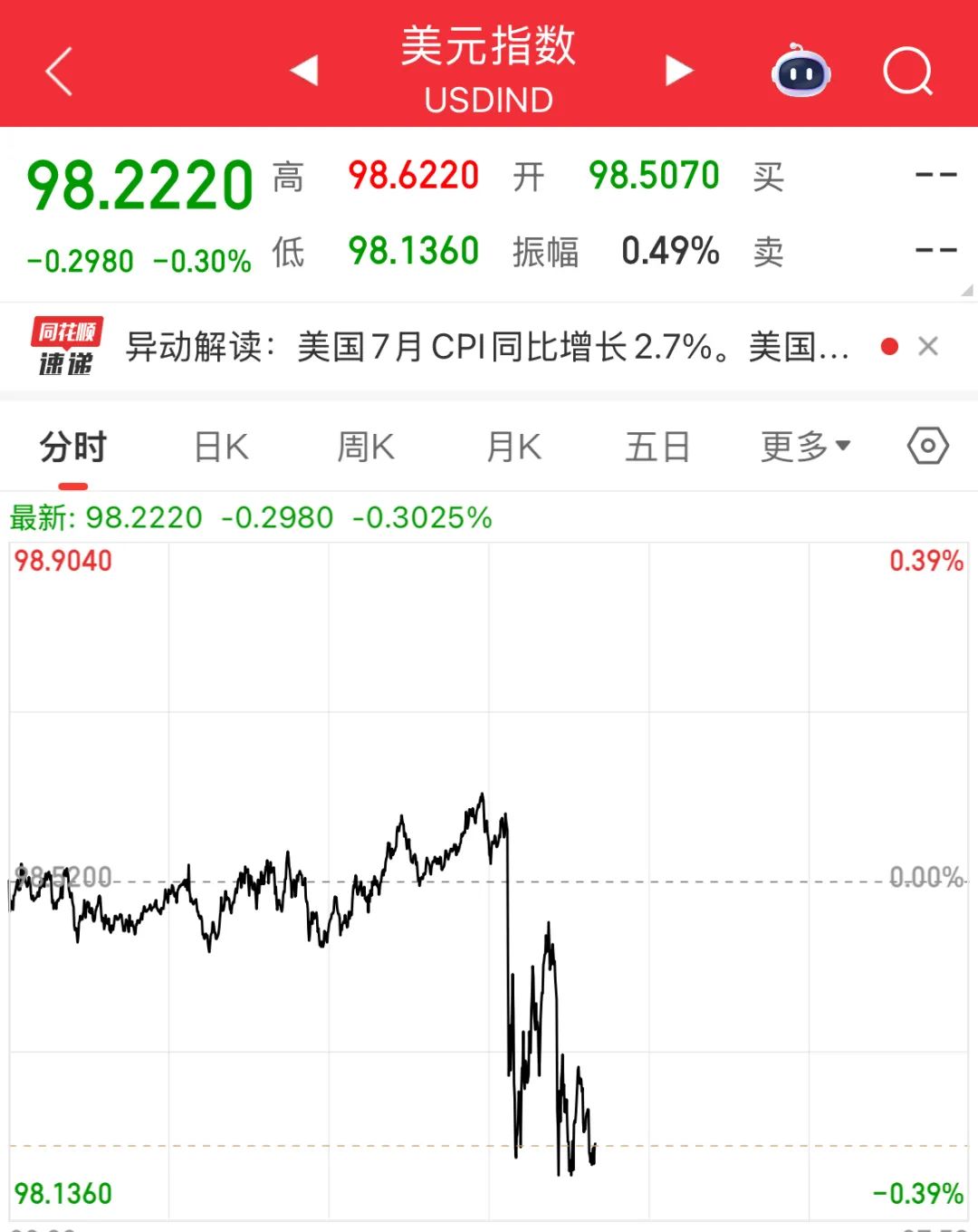
北京时间8月12日晚8点,美国劳工统计局公布的数据显示,美国7月消费者物价指数(CPI)同比上涨2.7%,前值为2.7%,预期为2.8%;环比上涨0.2%,预 期为0.2%,前值为0.3%。 芝商所的"美联储观察"工具显示,美联储在9月降息25个基点的概率达到90.1%,到10月累计降息50个基点的概率为62.5%。 掉期交易显示,投资者押注美联储在今年年底前将进行两次25个基点的降息。更有一些投资者押注美联储会在9月大幅降息50个基点。而在降息预期的推 动下,美债收益率已降至4月底以来的最低水平。 CPI数据公布后,美国国债收益率短线下挫,2年期国债收益率下行近5个基点;美元指数短线走低,日内跌0.3%。现货黄金短线飙升至3354美元/盎司高点 后大幅回落,现报3349美元/盎司。 富国银行认为,价格调整过程仍处于早期阶段,仍需观察更高的进口税最终将如何在最终客户、国内卖家和外国出口商之间分配。通胀预计将在今年下半 年回升,但不会大幅走高,核心CPI和核心PCE平减指数在第四季度将恢复到3%左右。 目前,交易员加大9月降息押注。 上周,在美国就业市场走弱的迹象出现后,市场对9月降息的预期就开始升温。 美国劳 ...

全面关税生效冲击升级,今晚美国CPI成市场“试金石”
Sou Hu Cai Jing· 2025-08-12 09:45
今晚美国率先公布本周的重磅指引——美国7月CPI,由于零售商逐步提高各种受进口关税上调影响的商品价格,预计物价压力进一步上升,市场预期CPI年 率为2.8%(前值2.7%),CPI月率预计0.3%(前值0.2%),核心CPI年率预计达到3%(前值2.9%),意味着通胀可能录得今年年初以来的最大涨幅,但汽油 价格下跌可能有助于缓和整体物价上涨压力。 值得关注的是,本次的数据是自本月初美国总统因就业报告低迷而下令解雇美国劳工统计局局长埃里卡·麦肯塔弗以来,首次公布的CPI报告,而当前投资者 依然存在政府统计数据可能削弱信心的担忧。 尽管与关税相关的价格上涨越来越明显,但美国消费者6月份仍继续支出,但是这可能受到进一步物价压力的影响。受关税上调影响最大的商品价格在6月份 有所回升,但整体通胀率仍然相对低迷。随着贸易关税的影响开始显现,华尔街策略师发出警告称,美国经济正走向滞胀,这可能会限制美联储降息的能 力。 上周公布的纽约联邦储备银行的月度调查显示,7月份美国消费者通胀预期上升,就业市场看法改善。未来一年的预期通胀率从6月份的3%小幅升至3.1%。 未来三年的预期通胀率稳定在3%,而未来五年的预期通胀率则跃升至2 ...

海外供给侧改革回顾:英美篇
Guo Tai Jun An Qi Huo· 2025-08-12 09:37
Report Summary 1. Investment Rating No investment rating information is provided in the report. 2. Core Viewpoints - In the 1980s, the Thatcher government in the UK and the Reagan government in the US implemented supply - side reforms to address the stagflation situation. These reforms shifted the policy focus from Keynesian demand management to supply - side and free - market economics, which affected industries such as steel and coal, leading to industry restructuring and ultimately promoting industry transformation and profitability improvement [2]. - Through "three removals, one reduction, and one supplementation" measures, including capacity reduction, inventory reduction, de - leveraging, cost reduction, and short - board supplementation, the two countries' economies recovered from stagflation and traditional industries achieved transformation and upgrading [8][15]. 3. Summary by Directory 3.1 Reform Background in the 1970s and 1980s - **Stagflation in the UK and the US**: In the 1970s, both countries faced stagflation, with low economic growth, high inflation, and rising unemployment. From 1973 - 1980, the UK's GDP grew at an average annual rate of only 1.74%, inflation reached 15.2%, and the unemployment rate exceeded 10%. The US had negative GDP growth in 1974, 1975, and 1980, with inflation peaking above 14% and the unemployment rate also exceeding 10% [6]. - **Shift from Keynesian to Supply - Side Economics**: Keynesian demand - side policies failed to control unemployment and instead increased deficits and debts. The supply side faced obstacles such as large - scale losses in state - owned enterprises, frequent strikes due to union monopolies, excessive government regulations, and high marginal tax rates. The Thatcher and Reagan governments launched supply - side reforms in 1979 and 1981 respectively to revitalize the supply side and promote economic recovery [8]. - **Over - capacity and Losses in the Coal and Steel Industries**: In the late 1970s, the UK and the US entered the "de - industrialization" stage. Traditional heavy industries such as steel and machinery manufacturing were severely affected by the Middle East oil crisis and faced cost shocks. They also faced competition from Japan and the "Four Asian Tigers" and needed to transform their energy structures due to environmental protection requirements [9]. 3.2 Reform Process: "Three Removals, One Reduction, and One Supplementation" - **Capacity Reduction** - **Coal Industry**: In the UK, the number of coal mines decreased from about 200 in 1980 to 65 in 1990, the number of miners dropped from about 230,000 to 49,000, and coal production decreased from 120 million tons to about 50 million tons. In the US, policies and market factors led to capacity reduction, such as the promotion of natural gas development and environmental protection requirements [17]. - **Steel Industry**: In the UK, the "Davignon Plan" and subsequent measures led to production cuts. The British Steel Corporation (BSC) was reformed, with reduced subsidies, capacity closures, and layoffs, and achieved profitability in 1986. In the US, environmental protection laws, tax reforms, and market competition led to capacity reduction, with 3800 million tons of nominal crude steel capacity withdrawn from 1983 - 1989 and 5280 million tons from 1986 - 2003 [18][19]. - **Inventory Reduction**: In the UK, Thatcher implemented the "right - to - buy" policy, selling about 140,000 public housing units from 1979 to 1987 and earning about £16 billion in revenue [20]. - **De - leveraging**: In the UK, the government reduced the government expenditure - to - GDP ratio from 43% in the early 1980s to 38% in the early 1990s and the deficit rate from 6% to 2%. In the US, the "Gramm - Rudman - Hollings Act" was passed in 1985 to control deficits [22]. - **Cost Reduction** - **UK**: The UK reduced the top marginal personal income tax rate from 83% in 1979 to 40% in 1988, the basic tax rate from 33% to 25%, and the corporate tax rate from 52% to 35%. - **US**: The US reduced the top marginal personal income tax rate from 70% in 1981 to 28% in 1986 and the corporate income tax from 46% to 34. It also carried out government institutional reforms and cut welfare spending [23]. - **Short - board Supplementation** - **UK**: The UK supported steel enterprises in mergers, acquisitions, and production layout optimization, promoting specialization and efficiency improvement. In 1988, the BSC was reorganized into specialized subsidiaries. - **US**: The SBIR program invested $2 billion annually in small - business R & D, promoting technological breakthroughs and job creation [24]. 3.3 Policy Effects - **UK Steel Industry**: From 1975 - 1988, UK steel capacity decreased by 11.87 million tons. In 1988, the number of converters decreased by 39% compared to 1975, but production increased by 35.8%. By 1986, the number of employees in the steel industry decreased by 77.4% compared to 1972. The industry achieved world - class levels in the 1990s and turned profitable [26]. - **US Coal Industry**: The concentration of coal enterprises increased, with the output share of large - scale coal enterprises rising. Production efficiency improved, the number of employees decreased, and coal exports increased. The US became a global benchmark for coal industry modernization in the 1990s [28]. - **US Steel Industry**: The industry's transformation laid the foundation for oligopolization, lightening, and high - end development in the 1990s. The CR4 of the steel industry increased from 35% in 1985 to 70% in 2000 [29].

预期美国滞胀且美联储降息空间有限,德银建议做空十年期美债
Hua Er Jie Jian Wen· 2025-08-12 00:53
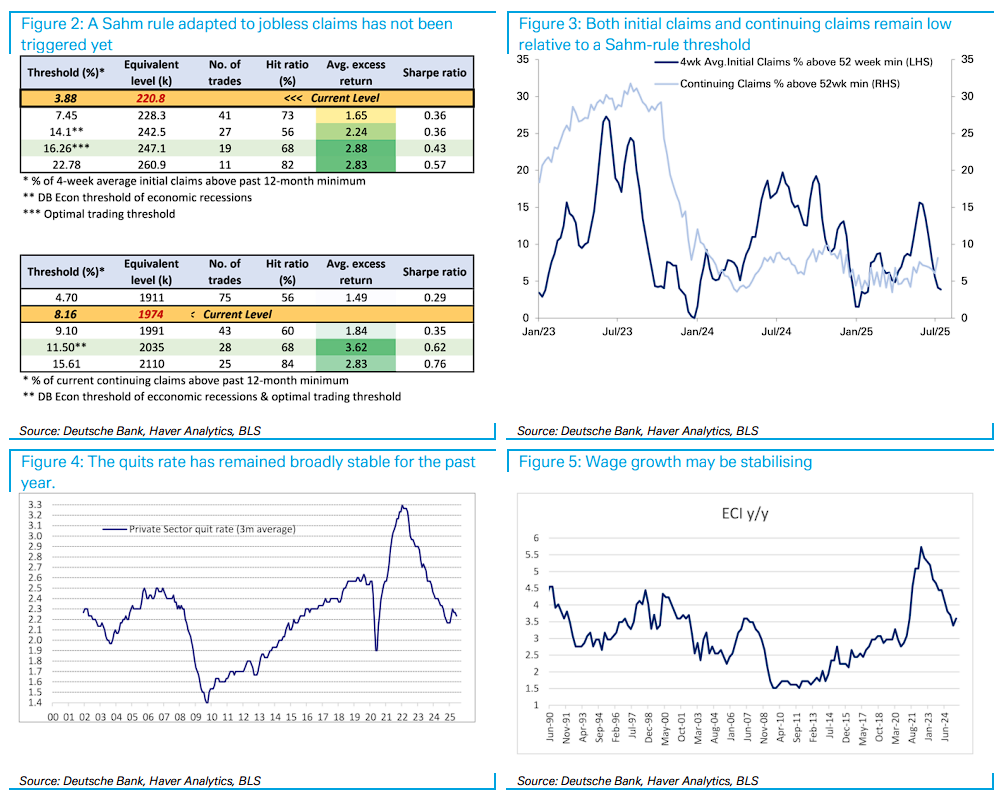
Core Viewpoint - Deutsche Bank's strategist team believes that the U.S. economy is facing stagflation risks due to supply-side shocks, recommending short positions on 10-year U.S. Treasuries [1] Economic Impact of Tariffs and Immigration Policies - The bank expects core CPI inflation to rise by approximately 0.5 percentage points in the coming months due to tariff impacts, significantly above market consensus [2] - Tariff policies are likened to a combination of VAT increases and negative supply shocks, with tariffs impacting low-income households more than high-income groups, leading to a mild negative effect on overall demand [4] - Stricter immigration policies further exacerbate labor market supply shocks, potentially lowering the non-farm employment growth equilibrium to a range of 50,000 to 100,000 jobs [4] Labor Market Analysis - Despite recent weak employment data, Deutsche Bank believes initial expectations have not materially changed, with the latest non-farm employment growth slightly below the equilibrium range [5] - The bank notes that the unemployment claims data has not triggered the Sam Rule, and wage growth remains resilient, consistent with interpretations of negative supply shocks [5] Inflation Risks and Interest Rates - Deutsche Bank's analysis indicates significant upside risks to inflation, with core CPI month-on-month growth expected to be in the range of 0.3% to 0.4% [11] - The current market pricing of the terminal rate at around 3% is considered low compared to a neutral real rate close to 2%, suggesting that the market may be underpricing future inflation [11] Investment Strategy - Deutsche Bank recommends shorting 10-year U.S. Treasuries, with a target yield of 4.60% and a stop-loss at 4.05%, citing technical and seasonal factors supporting this strategy [12] - For investors looking to hedge spread risks, the bank suggests going long on 10-year SOFR with a target of 4.10% and a stop-loss at 3.55% [12]

隔夜美股|三大指数收跌 C3.ai(AI.US)收跌25.6%
Jin Rong Jie· 2025-08-11 23:12
Market Overview - Major U.S. indices opened high but closed lower, with the market awaiting key inflation reports such as CPI and PPI [1] - The Dow Jones fell by 200.52 points (0.45%) to 43,975.09, the Nasdaq dropped by 64.62 points (0.3%) to 21,385.4, and the S&P 500 decreased by 16 points (0.25%) to 6,373.45 [1] - C3.ai saw a significant decline of 25.6%, while Intel rose by 3.51% and Nvidia fell by 0.35% [1] European Market - The German DAX30 index decreased by 118.41 points (0.49%) to 24,074.93, while the UK FTSE 100 index increased by 29.03 points (0.32%) to 9,124.76 [2] - The French CAC40 index fell by 44.48 points (0.57%) to 7,698.52, and the European Stoxx 50 index dropped by 15.99 points (0.30%) to 5,331.75 [2] Asia-Pacific Market - The Nikkei 225 index rose by 1.85%, while the KOSPI index in South Korea fell by 0.1% [3] - The Indonesian Composite Index increased by 0.96% [3] Currency and Commodities - The U.S. Dollar Index rose by 0.35% to 98.519, with the Euro and Pound both declining against the dollar [3] - Crude oil prices saw slight increases, with light crude futures for September rising by $0.08 to $63.96 per barrel (0.13%) and Brent crude for October increasing by $0.04 to $66.63 per barrel (0.06%) [3] Gold and Metals - Spot gold fell by 1.61% to $3,342.88 per ounce, with a daily low of $3,341.40 [4] - Trump's comments regarding tariffs on gold did not provide further clarity, impacting market sentiment [4] Cryptocurrency - Bitcoin decreased by 0.65% to $118,484.7, while Ethereum fell by 1.2% to $4,200.54 [5] Macro News - Trump's team is considering candidates for the Federal Reserve Chair position, including Bowman, Jefferson, and Logan, with an announcement expected in the fall [6] - The potential for stagflation poses a new risk to the U.S. dollar, as highlighted by TD Securities [7] Company News - Tesla's stock rose for the fourth consecutive day, driven by increased demand and extended delivery times for its Model Y [8] - Intel's CEO received a positive endorsement from Trump after previously facing calls for resignation, leading to a rise in Intel's stock price [8] - Marathon Digital Holdings (MARA) is in talks to acquire a majority stake in Exaion from EDF for approximately $168 million, marking its entry into the AI infrastructure space [9] - Ford announced a $5 billion investment in the U.S. to produce new electric vehicles, creating nearly 4,000 jobs [9]
三大指数收跌 C3.ai(AI.US)收跌25.6%
Zhi Tong Cai Jing· 2025-08-11 23:00
Market Overview - Major U.S. indices opened high but closed lower, with the market awaiting key inflation reports such as CPI and PPI [1] - The Dow Jones fell by 200.52 points (0.45%) to 43,975.09, the Nasdaq dropped by 64.62 points (0.3%) to 21,385.4, and the S&P 500 decreased by 16 points (0.25%) to 6,373.45 [1] - C3.ai saw a significant drop of 25.6%, while Intel rose by 3.51% and Nvidia fell by 0.35% [1] European and Asian Markets - The German DAX30 index decreased by 118.41 points (0.49%) to 24,074.93, while the UK FTSE 100 rose by 29.03 points (0.32%) to 9,124.76 [2] - The French CAC40 index fell by 44.48 points (0.57%) to 7,698.52, and the European Stoxx 50 index dropped by 15.99 points (0.30%) to 5,331.75 [2] - In Asia, the Nikkei 225 index increased by 1.85%, while the KOSPI index fell by 0.1% [2] Currency and Commodities - The U.S. Dollar Index rose by 0.35% to 98.519, with the Euro and Pound both declining against the dollar [3] - Crude oil prices saw slight increases, with light crude futures for September rising by $0.08 to $63.96 per barrel (0.13%) and Brent crude for October increasing by $0.04 to $66.63 per barrel (0.06%) [3] Metals and Gold - Spot gold prices fell by 1.61% to $3,342.88 per ounce, with a low of $3,341.40 during the day [4] - Trump's comments regarding tariffs on gold have created market fluctuations, but no official order has been released yet [4] Cryptocurrency - Bitcoin decreased by 0.65% to $118,484.7, while Ethereum fell by 1.2% to $4,200.54 [5] Macro News - Trump's team is considering candidates for the Federal Reserve Chair position, including Bowman, Jefferson, and Logan, with an announcement expected in the fall [6] - The potential for stagflation poses a new risk to the U.S. dollar, as highlighted by TD Securities [7] Company News - Tesla's stock rose for the fourth consecutive day, driven by increased demand and extended delivery times for its Model Y [8] - Intel's CEO received a positive endorsement from Trump after previously facing calls for resignation, leading to a stock price increase of over 2% [8] - Marathon Digital Holdings is in talks to acquire a majority stake in Exaion for approximately $168 million, marking its entry into the AI infrastructure sector [9] - Ford announced a $5 billion investment in the U.S. to produce new electric vehicles, creating nearly 4,000 jobs [9]
华尔街多空对决:Stifel预言标普500或暴跌14% Trivariate却乐观预测两年内冲上7000点
智通财经网· 2025-08-11 22:40
Group 1 - The S&P 500 index has recently rebounded, surpassing 6400 points, but there is significant divergence in Wall Street's outlook for future trends [1] - Stifel's chief equity strategist, Barry Bannister, warns of high valuations and stagflation risks, comparing the current market to the late 1990s, suggesting the S&P 500 could drop to 5500 points [2] - Bannister highlights that the current P/E ratio of the S&P 500 is 24, above the five-year average of 22, indicating potential for a market correction similar to past crashes [2] Group 2 - A Bank of America survey reveals that 91% of investors believe U.S. stocks are overvalued, the highest in over a decade, yet there is an increase in equity allocation among investors [3] - The survey indicates a complex market sentiment, with only 5% expecting a "hard landing" for the U.S. economy and 41% concerned about an "AI stock bubble" [3] - Interest in emerging markets is rising, with a net increase in allocations reaching 37%, attributed to a nearly 10% depreciation of the dollar and improved expectations for the Chinese economy [3] Group 3 - In contrast to Bannister's caution, Trivariate Research's Adam Parker predicts the S&P 500 will reach 7000 points by the end of 2026, representing a potential upside of about 9.6% [4] - Parker anticipates a 10% growth in corporate profits by 2026, driven by banking sector earnings and productivity gains from AI, particularly in financial and healthcare sectors [4] - Recommended stocks include First Capital Credit, Morgan Stanley, Goldman Sachs, and healthcare companies like McKesson and Cardinal Health, which are expected to benefit from AI enhancements [4]
隔夜美股 | 三大指数收跌 C3.ai(AI.US)收跌25.6%
智通财经网· 2025-08-11 22:26
智通财经APP获悉,周一,三大指数高开低走,最终均收跌,市场等待CPI与PPI等关键通胀报告。周一 早间,纳指最高上涨至21544.21点,创盘中历史新高。 【美股】截至收盘,道指跌200.52点,跌幅为0.45%,报43975.09点;纳指跌64.62点,跌幅0.3%,报 21385.4点;标普500指数跌16点,跌幅为0.25%,报6373.45点。C3.ai(AI.US)收跌25.6%,英特尔 (INTC.US)涨3.51%,英伟达(NVDA.US)跌0.35%。黄金板块走弱,巴里克矿业(B.US)收跌2.54%,哈莫 尼黄金(HMY.US)跌1.81%。纳斯达克中国金龙指数微跌0.29%。 【宏观消息】 特朗普团队将鲍曼、杰斐逊和洛根纳入美联储主席候选人之列。据两名美国政府官员透露,美联储两位 副主席鲍曼和杰斐逊以及达拉斯联储主席洛根正在考虑在明年美联储主席一职空缺时出任该职位。负责 遴选的财政部长贝森特说,他将在未来几周内面试更多的候选人。官员说,特朗普预计将在今年秋天做 出最后宣布。知情人士说,其他仍在考虑中的人选包括特朗普经济顾问凯文·哈塞特、美联储理事沃 勒、经济学家马克·萨默林以及前美联储官 ...