
核心CPI

Search documents
7月份核心CPI同比涨幅连续扩大
Sou Hu Cai Jing· 2025-08-15 06:06
Core Insights - In July, the consumer price index (CPI) showed positive changes, with a month-on-month increase of 0.4%, reversing the previous month's decline of 0.1% [1][3] - The core CPI, excluding food and energy, increased by 0.8% year-on-year, marking a continuous expansion in its growth rate for three consecutive months [2][4] Consumer Price Trends - The rise in service prices was significant, driven by increased costs in transportation and travel-related services, with airfares and hotel prices rising between 4.4% and 17.9% [3][5] - Industrial consumer goods also saw a rebound, with prices for household appliances and personal care products increasing by 0.5% to 2.2% [3][4] Policy Impact - The increase in core CPI is attributed to effective implementation of consumption-boosting policies and the gradual release of consumer spending potential [4][6] - The government's initiatives, such as the "old-for-new" policy for consumer goods and regulation of low-price competition among enterprises, have contributed to price recovery [4][5] Market Dynamics - Despite the positive trends, the market remains characterized by strong supply and weak demand, leading to low price levels overall [6]

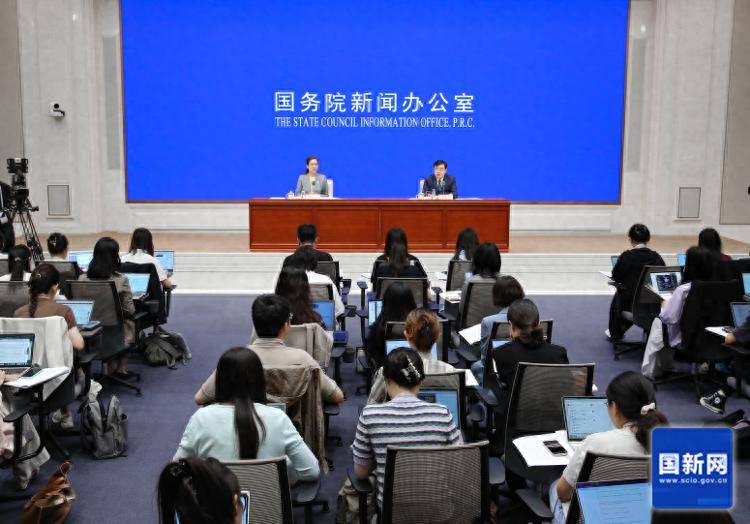
国家统计局:核心CPI涨幅连续3个月扩大,市场供求出现积极变化
Sou Hu Cai Jing· 2025-08-15 04:48
Group 1 - The core viewpoint is that in July, the consumer price index (CPI) for residents turned from a decline to an increase, driven by rising prices in services and industrial consumer goods, indicating positive changes in market supply and demand [1][2] - The core CPI, which excludes food and energy, increased by 0.8% year-on-year in July, marking a 0.1 percentage point rise from the previous month, and has shown a continuous upward trend for three months [1][3] - The increase in core CPI is attributed to effective implementation of consumption-boosting policies, gradual release of consumption potential, and steady progress in building a unified domestic market, which collectively promote price recovery [1][2] Group 2 - The overall stability of consumer prices in July reflects positive changes, although the market still faces strong supply and weak demand, leading to low price levels [2] - Factors contributing to the reasonable recovery of overall price levels include the expansion of domestic demand and the deepening of the national unified market construction [2] - Seasonal factors such as the peak travel season in summer have led to significant increases in transportation-related service prices, contributing to the rise in service prices [3]
国家统计局解读!核心CPI同比涨幅连续扩大
Zheng Quan Ri Bao Wang· 2025-08-15 04:05
Group 1 - In July, the Consumer Price Index (CPI) showed positive changes, with a month-on-month increase of 0.4%, reversing the previous month's decline of 0.1% [1] - The rise in CPI was primarily driven by increases in service and industrial consumer goods prices, with significant price hikes in transportation-related services due to the summer travel season [1][2] - The core CPI, which excludes food and energy prices, increased by 0.8% year-on-year, marking a 0.1 percentage point increase from the previous month, indicating a steady upward trend [2][3] Group 2 - The increase in core CPI is attributed to effective implementation of consumption-boosting policies and gradual release of consumption potential, alongside the establishment of a unified domestic market [3] - Prices of industrial consumer goods, excluding energy, rose by 1.2% year-on-year, with household appliances seeing a 2.8% increase, reflecting a positive impact on CPI [3] - Service prices also experienced a year-on-year increase of 0.5%, with notable rises in household and educational services, contributing to the overall CPI growth [3][4] Group 3 - Overall, the CPI in July remained stable, with positive changes continuing to emerge, although the market still faces a situation of strong supply and weak demand [4] - Future policies aimed at expanding domestic demand and furthering the construction of a unified national market are expected to continue yielding positive effects on price levels [4]
国家统计局:两个原因带动核心CPI连续三个月扩大
Xin Jing Bao· 2025-08-15 03:40
Core Insights - The core CPI has expanded for three consecutive months, primarily due to the implementation of consumption-boosting initiatives and the regulation of corporate competition [1][2] - In July, the national consumer price index remained flat year-on-year, with a month-on-month increase of 0.4%, indicating a low operating trend for the year [1] - The core CPI, excluding food and energy prices, rose by 0.8% year-on-year in July, with the growth rate increasing by 0.1 percentage points from the previous month [1] Economic Factors - The implementation of consumption-boosting initiatives has gradually released the potential for goods and services consumption, enhancing price momentum [1] - The steady progress in building a unified domestic market has curbed disorderly low-price competition among enterprises, contributing to price recovery [1] Price Structure - Both industrial consumer goods prices and service prices have shown stable increases, driving the expansion of the core CPI [1] - In July, industrial consumer goods prices, excluding energy, rose by 1.2% year-on-year, marking three consecutive months of growth [1] - Service prices increased by 0.5% year-on-year, surpassing the CPI growth rate, and have been on the rise since March [1] - The prices of gold and platinum jewelry increased significantly in July, by 37.1% and 27.3% year-on-year, respectively, contributing to the rise in core CPI [1]
国家统计局:7月CPI同比持平,猪肉价格下降9.5%
Sou Hu Cai Jing· 2025-08-15 03:11
Economic Overview - In July, the national consumer price index (CPI) remained flat year-on-year, with a month-on-month increase of 0.4% [1] - The core CPI, excluding food and energy prices, increased by 0.8% year-on-year, with the growth rate expanding by 0.1 percentage points compared to the previous month [3] Price Changes by Category - Food and tobacco prices decreased by 0.8% year-on-year, while clothing prices increased by 1.7% [3] - Housing prices rose by 0.1%, and prices for daily necessities and services increased by 1.2% [3] - Transportation and communication prices fell by 3.1%, while education, culture, and entertainment prices rose by 0.9% [3] - Medical care prices increased by 0.5%, and other goods and services saw an increase of 8.0% [3] Specific Price Movements - Within the food and tobacco category, pork prices dropped by 9.5%, fresh vegetable prices decreased by 7.6%, and grain prices fell by 1.0% [3] - Fresh fruit prices, however, increased by 2.8% [3] Industrial Producer Prices - In July, the national industrial producer price index (PPI) decreased by 3.6% year-on-year and by 0.2% month-on-month [3] - The national industrial producer purchase price index fell by 4.5% year-on-year and by 0.3% month-on-month [3] - From January to July, the year-on-year decline in industrial producer prices was 2.9%, while the purchase prices decreased by 3.2% [3]
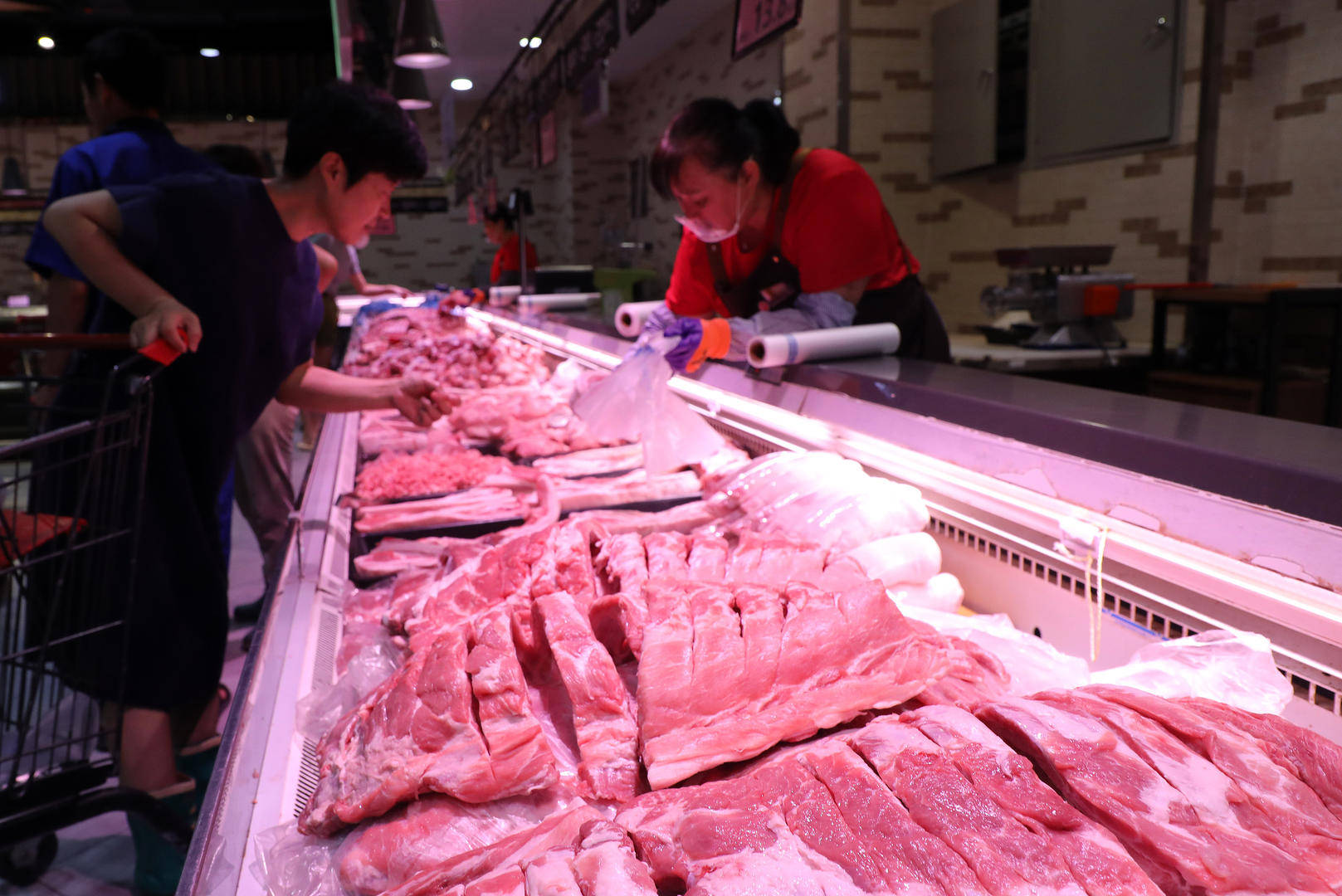
7月核心物价持续回升,“股债跷跷板”效应明显
Sou Hu Cai Jing· 2025-08-13 10:58
冉学东 7月份物价指数的轻微上涨,浇灭了国债市场做多的热情,国债利率连续两日大涨,12日,十几年期国债利率上涨 1.113%到1.726%,30年期国债收益率上涨1.668%到2.011%,国债期货也是连续两天大跌,原因主要是周末出台的 CPI和PPI物价指数。这一次,尤其是核心物价的持续回升,对于物价趋势预期发生了重大影响。 8月9日,国家统计局发布了2025年7月份居民消费价格指数(CPI)和工业生产者出厂价格指数(PPI)。数据显 示,2025年7月CPI同比0.0%,前值0.1%,而预期是下降0.1%;核心CPI同比0.8%,前月0.7%。PPI同比-3.6%,预 期下降3.4%,前值-3.6%。 但是,反内卷政策的持续贯彻,必然会改善竞争秩序,我们看统计局解读最为权威,"全国统一大市场建设纵深推 进,煤炭、钢材、光伏、水泥和锂电等行业市场竞争秩序持续优化,煤炭开采和洗选业、黑色金属冶炼和压延加 工业、光伏设备及元器件制造、水泥制造、锂离子电池制造价格环比降幅比上月分别收窄1.9个、1.5个、0.8个、 0.3个和0.1个百分点,合计对PPI环比的下拉影响比上月减少0.14个百分点。" 核心CPI的上 ...

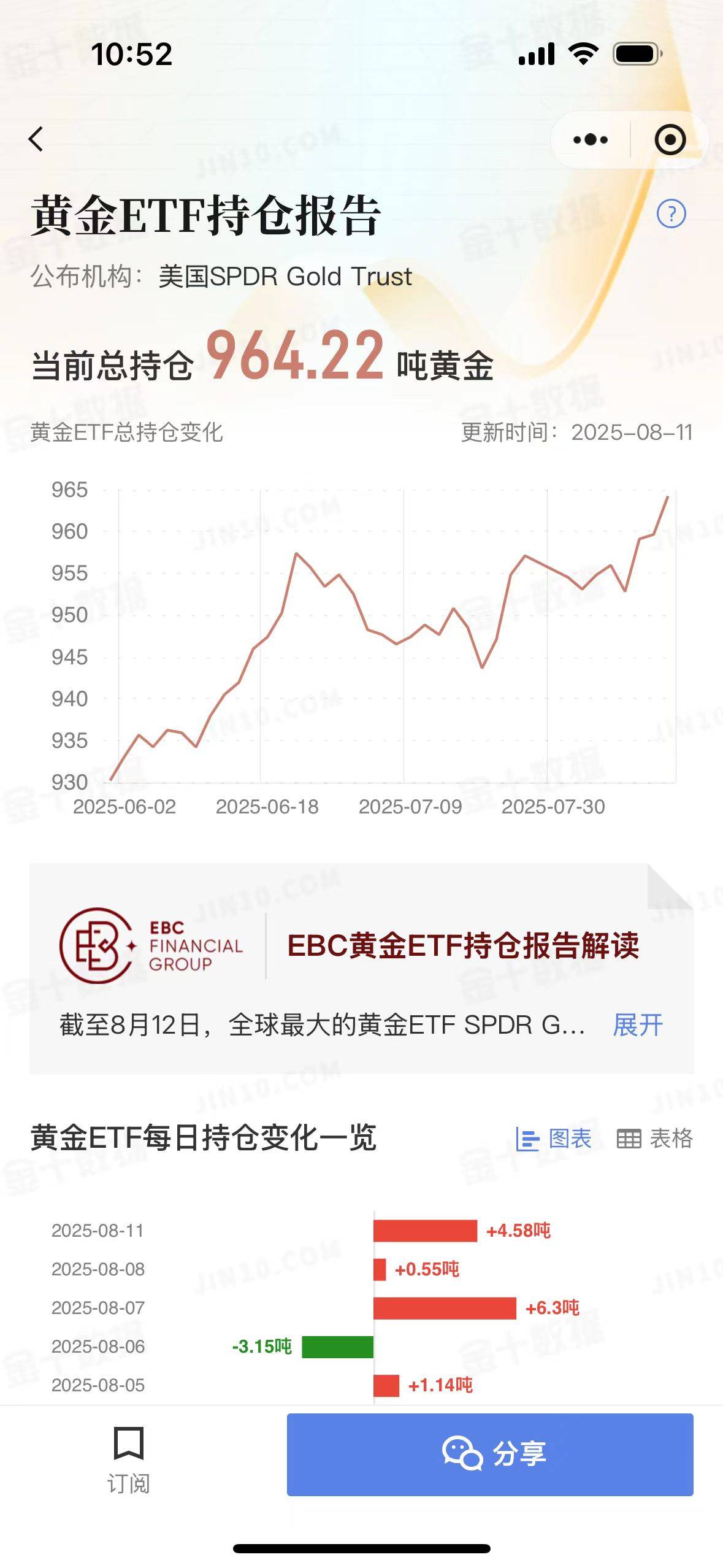
黄金ETF持仓量报告解读(2025-8-13)多因素影响 金价走势如何
Sou Hu Cai Jing· 2025-08-13 07:12
Core Viewpoint - The SPDR Gold Trust's holdings remain stable at 964.22 tons of gold as of August 12, 2025, amidst fluctuating gold prices influenced by U.S. inflation data [5]. Group 1: Gold ETF Holdings - As of August 12, 2025, the SPDR Gold Trust holds 964.22 tons of gold, unchanged from the previous trading day [5]. - The report indicates that the gold ETF's total holdings have not experienced any significant changes recently [5]. Group 2: Gold Price Movements - On August 12, 2025, spot gold prices fluctuated within a range of approximately $30, peaking at $3,358.29 per ounce and dipping to $3,330.81 per ounce, closing at $3,348.07 per ounce, reflecting a slight increase of $5.48 or 0.16% [5]. - Following a significant drop in the previous trading day, gold prices stabilized around $3,350 per ounce during Asian and European market hours [5]. Group 3: U.S. Inflation Data Impact - The U.S. Consumer Price Index (CPI) for July showed a year-over-year increase below expectations, with core CPI rising by 3.1%, marking the highest level since February [5]. - The core CPI's month-over-month increase of 0.3% is the largest since January, leading to increased speculation about a potential interest rate cut by the Federal Reserve in September [5][6]. - Analysts caution that the higher-than-expected core CPI may complicate the Fed's decision-making regarding rate cuts, with further insights expected from the upcoming Jackson Hole symposium [5][6]. Group 4: Market Sentiment and Technical Analysis - Market sentiment is leaning towards a consensus for a September rate cut, but upcoming CPI and non-farm payroll reports will be closely monitored [6]. - Technical analysis indicates a lack of clear direction for gold prices, with the 14-day RSI hovering around 50, suggesting potential downward movement [6]. - If gold prices decline further, short-term targets include the 100-day simple moving average around $3,297, with subsequent support levels at $3,268 and $3,250 [6].
第一创业晨会纪要-20250813
First Capital Securities· 2025-08-13 03:40
Macro Economic Group - The U.S. CPI for July showed a year-on-year increase of 2.7%, matching the previous month but slightly below the expected 2.8% [5] - The core CPI year-on-year for July reached 3.1%, the highest since February 2025, exceeding the expected 3.0% and the previous 2.9% [5] - Following the CPI data release, the market reacted with a decline in the dollar and an increase in U.S. stock futures, indicating a 90.1% probability of a 25 basis point rate cut by the Federal Reserve in September [6] Advanced Manufacturing Group - In the first half of the year, investments in key energy projects in China exceeded 1.5 trillion yuan, a year-on-year increase of 21.6%, with new energy storage projects seeing over 30% growth [8] - The successful completion of an integrated energy system by Shandong Shifeng Group, featuring a 108 MW solar power station and a 100 MW/200 MWh energy storage station, is expected to save 46,000 tons of standard coal and reduce CO2 emissions by 160,000 tons annually [8] - Ford announced a $5 billion investment to develop a general electric vehicle platform, aiming to produce a series of economical vehicles to compete with Chinese electric vehicle giants [9]
美国7月CPI同比上涨2.7%
Zhong Guo Xin Wen Wang· 2025-08-13 01:22
Core Insights - The U.S. Consumer Price Index (CPI) rose by 2.7% year-on-year and 0.2% month-on-month in July [1] - The core CPI, excluding volatile food and energy prices, increased by 3.1% year-on-year and 0.3% month-on-month, marking the largest month-on-month increase in six months [1] - The housing cost index contributed significantly to the CPI increase, with a year-on-year rise of 3.7% and a month-on-month rise of 0.2% [1] Inflation Drivers - Beef prices saw a notable increase of 1.5% month-on-month, influenced by drought conditions affecting ranch production and tariffs raising import beef prices [1] - Energy prices decreased, with the energy price index falling by 1.6% year-on-year and 1.1% month-on-month, partially offsetting inflationary pressures [1] - Gasoline prices decreased by 2.2% month-on-month, contributing to the overall decline in energy prices [1] Economic Implications - The inflation data indicates a slowdown in rent increases and a drop in gasoline prices, which may mitigate the impact of tariff measures [1] - Many businesses are likely absorbing a significant portion of the tariff costs, suggesting potential implications for pricing strategies [1] - The stability in July's inflation data keeps the possibility of a Federal Reserve interest rate cut next month on the table [1]
美国7月份CPI同比增长2.7% 低于市场预期
Zheng Quan Ri Bao Wang· 2025-08-12 13:45
Core Insights - The Consumer Price Index (CPI) for July in the United States showed a year-on-year increase of 2.7%, slightly below the expected 2.8% and consistent with June's figure [1] - Month-on-month, the CPI rose by 0.2%, matching expectations and down from June's 0.3% increase [1] - The core CPI, excluding volatile food and energy prices, increased by 3.1% year-on-year, surpassing the expected 3.0% and up from 2.9% in June [1] - On a month-on-month basis, the core CPI rose by 0.3%, in line with expectations and higher than June's 0.2% [1]