
光互联

Search documents
未知机构:广发通信源杰科技拟125亿元投建二期工厂彰显2728年光互联超高-20260210
未知机构· 2026-02-10 02:00
Summary of Conference Call Notes Company and Industry Involved - **Company**: Yuanjie Technology (源杰科技) - **Industry**: Optical Communication and Semiconductor Industry Key Points and Arguments 1. **Investment in Expansion**: Yuanjie Technology plans to invest approximately 1.25 billion RMB in the second phase of its optical communication semiconductor chip and device R&D production base, with a construction period of 18 months [1] 2. **Capacity Expansion Timeline**: The company expects to begin equipment installation and debugging by the end of 2026, with production capacity expected to be released around Q2-Q3 of 2027, and full capacity release anticipated by the end of 2027 to Q1 of 2028 [1][2] 3. **Current Asset Status**: As of Q3 2025, the company's fixed assets and construction in progress were 570 million RMB and 145 million RMB, respectively. The large-scale investment of 1.25 billion RMB aims to ensure capacity meets the strong demand expected in 2027 and demonstrates confidence in the industry demand and the company's market share for 2028 [1] 4. **Core Equipment and Production Growth**: The company is accelerating the arrival and process debugging of core equipment such as MOCVD and E-BEAM, with the U.S. factory expected to gradually start production in 2026. The company anticipates a multiple increase in production capacity in 2026, continuing to double in 2027, and maintaining high growth in 2028 [2] 5. **CPO Product Development**: The development of CW lasers for the CPO (Co-Packaged Optics) field has entered a critical productization stage. The value and technical difficulty of CPO CW laser products are several times higher than those of CW laser products used in optical modules [2] 6. **Market Opportunities**: As the CPO products ramp up, Yuanjie Technology is expected to benefit significantly from the full-scenario deployment of both external and internal optical interconnects. The production equipment for the 300mW CPO products is largely consistent with that for optical modules, allowing for a smooth transition in production capacity [2] 7. **Long-term Industry Outlook**: The company emphasizes strong demand for pluggable optical modules and Scale Up CPO/NPO over the next five years, positioning Yuanjie Technology as a leading domestic optical chip manufacturer with a commitment to large-scale expansion, reflecting confidence in the industry's development [2] 8. **Overall Industry Sentiment**: The overall sentiment in the domestic optical interconnect industry is positive, particularly under the trend of "optical interconnects within cabinets" [2]

2月9日主题复盘 | 三大指数集体大涨,光通信全线强势,光伏热度不减,AI应用再度爆发
Xuan Gu Bao· 2026-02-09 08:38
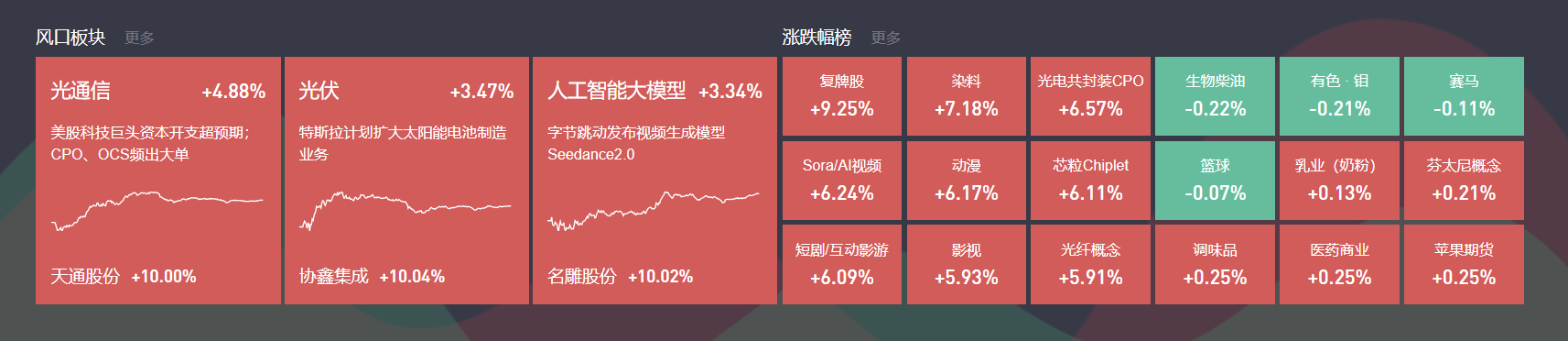
Market Overview - The market experienced a strong upward trend, with the Shanghai Composite Index rising over 1% and surpassing 4100 points, while the Shenzhen Component Index increased by over 2% and the ChiNext Index rose nearly 3% [1] - AI application stocks showed active performance, with companies like 360 and Zhongwen Online hitting the daily limit [1] - The computing power hardware sector saw explosive growth, with stocks like Jepu Tech and Changfei Fiber reaching new highs [1] - The photovoltaic sector continued its upward momentum, with stocks such as Jinjing Technology and TCL Zhonghuan also hitting the daily limit [1] - Overall, more than 4600 stocks in the Shanghai and Shenzhen markets were in the green, with a total trading volume of 2.27 trillion [1] Key Sectors Optical Communication - The optical communication sector saw significant gains, with stocks like Jepu Tech and Tiantong Co. hitting the daily limit, and Tianfu Communication rising over 17% to reach a historical high [4] - Lumentum, a leader in optical communication, reported new multi-million dollar CPO orders, contributing to a 9.4% increase in its stock price [4] - The overall market for optical interconnection is expected to maintain rapid expansion, driven by various network connection scenarios [6] Photovoltaics - The photovoltaic sector experienced another surge, with companies like GCL-Poly, Yamaton, and TCL Zhonghuan hitting the daily limit [6] - Tesla is evaluating multiple sites in the U.S. to expand its solar cell manufacturing business, aiming for an annual production capacity of 100 gigawatts over the next three years [6] AI Applications - AI application stocks surged, with companies like Mingdiao Co., Rongxin Culture, and Haikan Co. hitting the daily limit [8] - ByteDance launched the Seedance 2.0 video generation model, which supports various input types and significantly enhances video generation capabilities [8] - The introduction of Seedance 2.0 is expected to reduce production costs dramatically, making AI video generation a viable industrial tool [8][10] Notable Stocks - Jepu Tech (688025) saw a 20% increase, driven by CPO developments [15] - GCL-Poly (002506) achieved a 10.04% rise, reflecting strong market interest in photovoltaic solutions [7] - Mingdiao Co. (002830) rose by 10.02%, benefiting from advancements in AI applications [9]


东吴证券:光互联市场空间有望维持高速扩张 重点布局配置三条核心主线
智通财经网· 2026-02-09 01:25
Core Insights - The future of optical interconnection is driven by diverse network connection scenarios such as Scale-out, Scale-up, and Scale-across, indicating a high-speed expansion of the overall market space [1] - Various technical solutions have independent market expansion foundations, presenting long-term and sustainable development opportunities [1] - The report suggests focusing on three core lines: large optics, small optics, and new optics, based on market cycles and industry evolution stages [1] Group 1: Demand for Optical Modules - Confidence in future demand for optical modules is increasing, with major cloud service providers (CSPs) like Amazon, Google, Microsoft, and Meta disclosing a combined capital expenditure of $660 billion by 2026, a significant 60% year-on-year increase, primarily directed towards AI computing power [1] - The sustained increase in capital investment by major CSPs in AI-related infrastructure will prioritize network connectivity, crucial for computing clusters [1] - The demand for optical modules will remain strong due to the ongoing release of GPU/TPU/ASIC chips and the rapid iteration of next-generation chips, establishing a solid demand foundation for 2027 [1] Group 2: CPO Industry Progress - Lumentum has announced additional orders worth hundreds of millions of dollars for ultra-high power lasers in the CPO field, with substantial deliveries expected in the second half of 2026 and Scale-up CPO products anticipated by the end of 2027 [2] - NVIDIA has revealed that partners CoreWeave, Lambda, and TACC will deploy IBCPO systems in the first half of 2026, with Ethernet CPO products set to ship in the second half of 2026 [2] - The CPO industry is progressing faster than previously expected, with significant advancements anticipated throughout the year, suggesting a growing market space [2] Group 3: NPO's Unique Advantages - Tencent has released specifications for its NPO technology, which centralizes the optical engine deployment near device chips, enabling single-layer Scale-up networking and supporting DSP-free designs [3] - NPO offers greater flexibility and cost-effectiveness, making it a favored choice among CSP customers and potentially a long-term technical option [3] - The NPO technology can reduce costs and power consumption through high-density interconnections while maintaining higher decoupling in the supply chain, enhancing the growth potential and performance of related industry players [3]

通信行业点评报告:当前时点如何看光模块/CPO/NPO投资机会
Soochow Securities· 2026-02-08 05:59
Investment Rating - The report maintains an "Overweight" rating for the communication industry, indicating a positive outlook for the sector over the next six months [1][8]. Core Insights - The demand for optical modules is expected to increase significantly, driven by major cloud service providers (CSPs) like Amazon, Google, Microsoft, and Meta, which are projected to spend a total of $660 billion on capital expenditures in 2026, a 60% year-on-year increase, primarily focused on AI computing infrastructure [5]. - The CPO (Co-Packaged Optics) industry is accelerating its progress, with Lumentum announcing substantial orders for high-power lasers, and Nvidia's partners set to deploy CPO systems in 2026, indicating a robust market expansion [5]. - NPO (Near-Package Optics) technology is gaining traction due to its cost-effectiveness and flexibility, making it a preferred choice among CSP clients, which could enhance the long-term growth potential of related companies [5]. - The report emphasizes that multiple optical interconnection solutions will coexist in the long term, suggesting that investors should focus on different investment priorities based on market cycles and technological advancements [5]. Summary by Sections Optical Modules - The future demand for optical modules is expected to remain strong, with a competitive edge due to the ongoing evolution of products like 800G, 1.6T, and 3.2T modules, leading to quarterly revenue growth for related companies [5]. CPO Industry - The CPO sector is witnessing accelerated industrialization, with significant orders expected to materialize in 2026 and 2027, indicating a clear commercial value and expanding market space [5]. NPO Technology - NPO technology is recognized for its unique advantages, including cost and power efficiency, and is anticipated to become a long-term technical choice for CSPs, suggesting a strong growth trajectory for companies involved in this space [5]. Investment Focus - The report recommends focusing on three core investment themes: 1. Large-scale optical modules benefiting from high-speed interconnect demand, with key recommendations for companies like Zhongji Xuchuang and attention to new opportunities in the second-tier market [5]. 2. Smaller optical modules with increased customer demand, highlighting potential breakthroughs for companies like LianTe Technology and HuiLv Ecology [5]. 3. New optical technologies that are emerging, with a focus on companies like Tianfu Communication and potential opportunities in the technology upgrade cycle [5].


北美投入超预期,CPOOIO打破算存瓶颈
2026-02-03 02:05
Summary of Conference Call Notes Industry Overview - The focus is on the optical communication industry, particularly the investment opportunities in the optical sector from 2023 to 2025, with expectations of a market reversal after short-term fluctuations [1][2]. Key Points and Arguments 1. **Capital Expenditure Trends**: - Companies like Meta and Microsoft have reported higher-than-expected revenues driven by AI, indicating a positive outlook for capital expenditures [1]. - Upcoming earnings reports from Google and Amazon are anticipated to reflect optimistic capital expenditure guidance, further supporting the optical communication investment thesis [2]. 2. **Long-term Contracts and Demand**: - Meta has signed a significant five-year supply agreement worth approximately $6 billion with Corning, highlighting the growing demand for optical communication products [2]. - The demand for optical components, including MPO jumpers and related products, is expected to continue increasing due to the rapid growth in optical communication needs [2]. 3. **Company Performance**: - Companies such as Xuchuang, Xinyi, Tianfu, and Yuanjie have released optimistic earnings forecasts, with Xinyi exceeding market expectations [3]. - The overall performance of these companies is expected to improve in Q4 2023, driven by easing material costs and increasing demand [3]. 4. **Emerging Technologies and Market Dynamics**: - The CPU sector is experiencing significant growth, with strong performance noted in January 2023, indicating a robust demand for optical components [4]. - The optical communication market is expected to benefit from advancements in new technologies and applications, particularly in the context of AI and data centers [5]. 5. **Specific Company Updates**: - **Jieput**: Reported a net profit of approximately 80 million yuan for Q4, marking a 170% year-on-year increase, driven by growth in its new energy and optical communication businesses [6]. - **Zhongci Electronics**: Focused on expanding its 800G substrate business and is well-positioned to capture market share in the 1.6T market, with ongoing production ramp-up [10]. 6. **Market Opportunities**: - The optical communication sector is poised for growth, particularly with the anticipated demand for high-capacity optical modules and components as AI technologies advance [18][36]. - The transition from copper to optical solutions in data centers is expected to create substantial market opportunities for optical communication companies [18][36]. Additional Important Insights - The conference highlighted the importance of understanding the evolving landscape of AI and its implications for optical communication, particularly in terms of network architecture and data center efficiency [13][27]. - The potential for optical solutions to address the bandwidth and connectivity challenges posed by AI workloads was emphasized, suggesting a significant shift in market dynamics [18][36]. - The upcoming events, such as OFC and GTC, are expected to provide further insights and developments in the optical communication sector, reinforcing the positive outlook for the industry [38]. This summary encapsulates the key insights and developments discussed during the conference call, focusing on the optical communication industry and its growth potential.
广发证券:ODCC举办2026超节点大会 重视光互联Scale-Up投资机会
智通财经网· 2026-01-27 07:09
Core Insights - The report from GF Securities highlights the significance of the Scale-Up architecture in addressing the challenges posed by training and inference of trillion-parameter models, particularly focusing on the advancements in AI computing power [1][2]. Group 1: Current Trends in AI Computing - The core characteristics of model inference, such as long context, high concurrency, and real-time interaction, are driving the upgrade of Scale-Up systems [2]. - The need for high-performance networks during the inference phase is emphasized, as the architecture allows all accelerators' memory to be presented as a single shared pool, addressing bandwidth and latency requirements [2]. Group 2: Domestic Developments in Scale-Up - Alibaba Cloud introduced the new generation of Panjiu AI Infra2.0 AL128 supernode server, which aims to optimize computing power and communication synergy, achieving a 50% improvement in inference performance compared to traditional architectures [3]. - Tencent's ETH-X supernode project is being developed in two phases, focusing on optimizing GPU and memory communication and exploring full optical interconnection for Scale-Up [3]. - Huawei announced a three-year computing power plan, with the Ascend 950 supernode expected to launch in Q4 2026, indicating a strong commitment to advancing Scale-Up technology [3]. Group 3: Investment Opportunities in Optical Interconnection - Current Scale-Up networks primarily use copper cabling, which has limitations in system design and transmission distance, making it less suitable for future expansions [4]. - The advantages of optical interconnection are highlighted, as it can cover much greater distances compared to copper, which is limited to around 7 meters for certain applications [4].



AI主题基金调仓曝光 基金经理如何看待估值“泡沫”?
Zheng Quan Shi Bao· 2026-01-19 23:47
Core Insights - The performance of several funds heavily invested in the AI sector has been notable, with some achieving significant gains in 2025, but there are differing opinions among fund managers regarding future prospects [1][2]. Group 1: Fund Performance and Adjustments - The fund "China Europe Digital Economy" achieved a 143.07% increase in 2025, ranking high among active equity funds, with notable increases in holdings of companies like Shengyi Technology and Inspur Information in Q4 [2]. - The "Qianhai Kaiyuan Hong Kong-Shenzhen Enjoy Life" fund also saw significant growth, adjusting its top holdings to focus more on optical communication and liquid cooling sectors [3]. Group 2: Investment Opportunities and Risks - Fund managers are optimistic about hardware investment opportunities linked to computing power, with expectations that the share of "light" and "storage" in capital expenditures will increase by 2026 [4]. - There is a potential energy crisis due to the rapid construction of AI data centers outpacing traditional grid expansion, leading to investment opportunities in power infrastructure companies [5]. Group 3: Perspectives on Valuation and Market Sentiment - There is a debate among fund managers regarding the valuation of AI stocks, with some arguing that while valuations have recovered, they do not necessarily indicate a bubble [6]. - The concept of "bubble" is viewed as neutral, with the focus on whether technological advancements can sustain new applications and whether commercialization can convert capital into real income [7].
ETF盘中资讯|光模块CPO短线回调,创业板人工智能ETF(159363)净申购超1亿份!机构:海外算力链景气度保持向上
Sou Hu Cai Jing· 2026-01-06 06:38
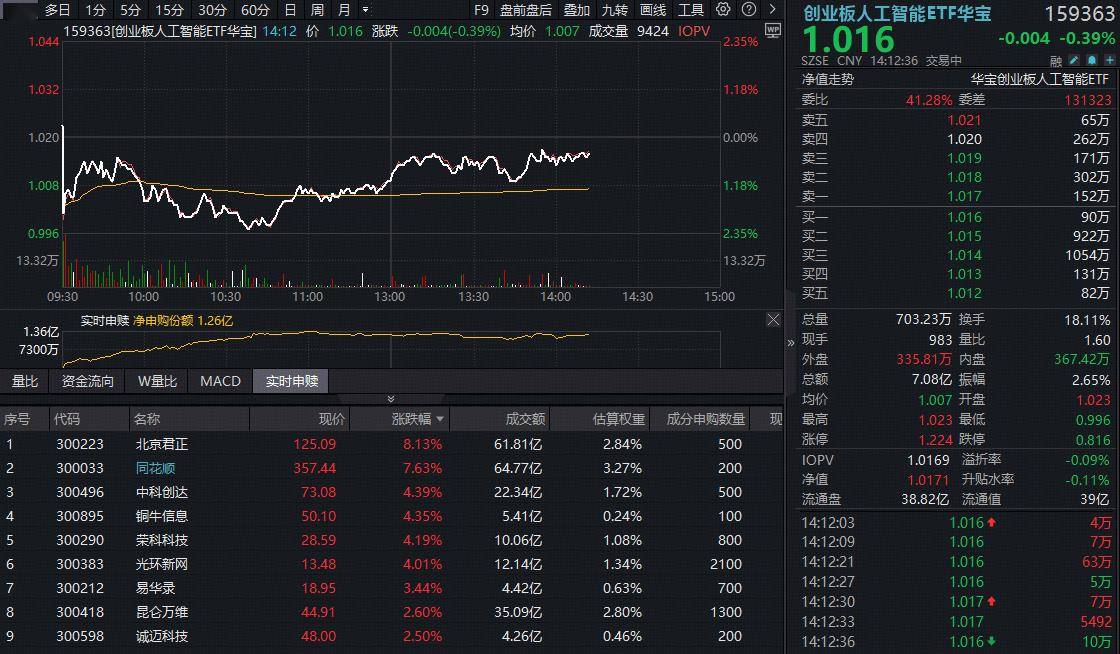
Core Viewpoint - The article discusses the fluctuations in the artificial intelligence sector on the ChiNext board, highlighting the performance of various stocks and ETFs related to AI and optical modules, with a focus on investment opportunities in the context of increasing demand for computing power and AI applications [1][3]. Group 1: Market Performance - On January 6, the ChiNext artificial intelligence sector experienced a decline, with notable pullbacks in optical module CPO concept stocks such as New Yi Sheng and Zhong Ji Xu Chuang, both dropping over 3% [1]. - In contrast, storage chips and AI application stocks showed strong performance, with Beijing Junzheng leading gains at over 8%, followed by Tonghuashun with over 7%, and several other stocks like Zhongke Chuangda and Tongniu Information rising over 3% [1]. - The ChiNext artificial intelligence ETF (159363) saw early morning fluctuations, initially dropping over 2% but later narrowing the decline to 0.49%, with a trading volume exceeding 700 million yuan and net subscriptions surpassing 10 million shares [1][2]. Group 2: Investment Opportunities - A report from Dongwu Securities highlights that by 2026, the overseas computing power chain is expected to maintain an upward trend, benefiting from the demand for optical interconnects driven by both overseas and domestic computing power needs [3]. - The high-end optical module market is projected to grow annually, with increasing visibility of demand extending further into the future, which will support rapid growth in the performance of supply chain companies [3]. - The report emphasizes three key investment directions: 1. High-certainty leading stocks that are integrated into the domestic and overseas computing power supply chain, which are expected to benefit significantly from the rapid growth of the optical interconnect industry [3]. 2. Critical material positioning in the supply chain, as the demand for high-speed optical modules will lead to significant growth in upstream optical chips and components [3]. 3. Potential new players in the supply chain, as increased demand for various products and customer needs may allow more suppliers to enter the core supply chain of major North American CSPs [4]. Group 3: ETF and Index Performance - The ChiNext artificial intelligence index achieved a remarkable annual growth of 106.35% in 2025, significantly outperforming other AI-themed indices [4]. - The first ChiNext artificial intelligence ETF (159363) is recommended for investment, focusing on leading optical module companies and capturing AI thematic market trends, with over 70% of its portfolio allocated to computing power and over 20% to AI applications [5].



光模块CPO短线回调,创业板人工智能ETF(159363)净申购超1亿份!机构:海外算力链景气度保持向上
Xin Lang Cai Jing· 2026-01-06 06:23
Core Viewpoint - The AI sector in the ChiNext market is experiencing volatility, with significant fluctuations in stock prices, particularly in the optical module CPO concept stocks, while storage chips and AI applications show active performance [1][8]. Group 1: Market Performance - On January 6, the ChiNext AI index saw a decline, with notable drops in optical module CPO stocks like New Yi Sheng and Zhong Ji Xu Chuang, both falling over 3% [1][8]. - Conversely, stocks in the storage chip and AI application sectors performed well, with Beijing Junzheng leading with an increase of over 8%, followed by Tonghuashun with over 7%, and several others rising more than 3% [1][8]. - The ChiNext AI ETF (159363) experienced a morning drop of over 2%, which later narrowed to a decline of 0.49%, with a trading volume exceeding 700 million CNY and net subscriptions surpassing 10 million units [1][8]. Group 2: Investment Opportunities - A report from Dongwu Securities highlights that by 2026, the overseas computing power chain is expected to maintain upward momentum, benefiting from both overseas and domestic demand for optical interconnects [3][10]. - The high-end optical module market is projected to grow annually, with increasing visibility of demand extending further into the future, which will drive rapid growth in the performance of supply chain companies [3][10]. - The report emphasizes three key investment directions: 1. High-certainty leading stocks that are integrated into the domestic and overseas computing power supply chain, expected to benefit from the rapid growth of the optical interconnect industry [3][10]. 2. Critical material positioning in the supply chain, where the demand for high-speed optical modules will lead to significant growth in upstream optical chips and components [3][10]. 3. Potential new players in the supply chain, as increased demand for speed and products will allow more suppliers to enter the core supply chains of major North American CSPs [3][10]. Group 3: Index Performance - The ChiNext AI index achieved a remarkable annual growth rate of 106.35% in 2025, significantly outperforming other AI-related indices [4][11]. - The index's performance over the years from 2021 to 2025 shows fluctuations, with annual returns of 17.57%, -34.52%, 47.83%, 38.44%, and 106.35% respectively [12][11]. - The ChiNext AI ETF is designed to track this index, focusing over 70% of its portfolio on computing power and over 20% on AI applications, effectively capturing the AI theme market [12][6].
2026年通信投资机会梳理-算力为核-卫星为翼
2026-01-04 15:35
Summary of Key Points from the Conference Call Industry Focus - The conference call primarily discusses the **communication sector** with a focus on **optical interconnection**, **commercial aerospace**, **edge AI**, **liquid cooling**, and **fiber optic cables** [2][9]. Core Insights and Arguments 1. **Investment Opportunities in Communication Sector**: - Five key areas identified for investment: optical interconnection, commercial aerospace, edge AI, liquid cooling, and fiber optic cables [2]. - Optical interconnection is highlighted due to the increasing demand from North American data centers, with expectations for rapid growth in the demand for new chip models from NVIDIA and Google [2][3]. 2. **Trends in Optical Interconnection**: - The transition from 800G to 1.6T bandwidth is a clear trend, with significant demand growth anticipated, especially in 2027 [3]. - New technologies such as OCS, CPO, and NPO are expected to be commercially available by the end of 2025 to 2026, meeting customer needs [4][5]. 3. **Characteristics of Overseas Supply Chain**: - The overseas supply chain is expanding bandwidth capabilities and accelerating the introduction of new technologies [5]. - Factors driving this include increased demand confidence, the release of various rate products, and the rapid deployment of new technologies [6]. 4. **Market Dynamics for CPO Switches**: - There is some market disagreement regarding the commercial rollout of CPO switches, with delays noted due to industrial complexities [7]. - Despite these delays, the overall trend towards CPO technology remains strong, indicating a high demand for CPU and related high-density interconnection systems [7]. 5. **Growth in Computing Power and Optical Interconnection**: - Significant developments are expected in computing power and optical interconnection in 2026, with domestic internet companies maintaining high investment levels [8]. - The penetration of domestic computing power supernodes is expected to increase, with major companies like Alibaba adopting optical interconnection solutions [8]. 6. **Commercial Aerospace Prospects**: - The commercial aerospace sector is anticipated to enter a golden development period in 2026, driven by advancements in reusable rockets and low-orbit satellite internet launches [9]. 7. **Edge AI Developments**: - The edge AI market is expected to expand with more smartphone manufacturers launching AI-enabled devices, enhancing user engagement [10]. 8. **Liquid Cooling Technology**: - Liquid cooling technology is entering a full liquid cooling era in overseas markets, with increasing penetration rates [10]. - Domestic liquid cooling suppliers are expected to achieve breakthroughs in overseas supply chains and benefit from domestic supernode growth [12]. 9. **Trends in Fiber Optic Cable Industry**: - The fiber optic cable industry is showing signs of improvement, driven by increased AI computing power demand and the release of new applications [13]. - Long-term trends indicate a shift towards high-end applications, which will enhance profit margins for manufacturers [13]. Additional Important Insights - The conference highlights the potential for domestic liquid cooling companies to thrive in both overseas and domestic markets, suggesting a dual catalyst for growth [12]. - The fiber optic cable sector is expected to face challenges from increased demand for specialty fibers in overseas markets, which may impact domestic supply [13]. This summary encapsulates the key points discussed in the conference call, providing a comprehensive overview of the current trends and future opportunities within the communication sector.