市场回调

Search documents
纽约金价18日下跌
Xin Hua Cai Jing· 2025-09-19 01:09
Group 1 - The core point of the article highlights a decline in gold and silver prices, with the most active gold futures for December 2025 dropping by $39.6 to close at $3678.2 per ounce, reflecting a decrease of 1.07% [1] - Short-term futures traders are taking profits, leading to a market correction that may persist for some time [1] - Despite the Federal Reserve's 25 basis point rate cut aligning with market expectations, the market is still processing the implications of this decision and its signals [1] Group 2 - The Bank of England announced on the same day that it would maintain its bank rate at 4.00%, which did not provide new upward momentum for gold prices [1] - Analysts believe that despite the recent drop in gold prices following the Fed's rate cut, there remains strong buying interest in the gold market [1] - Silver futures for December delivery also saw a slight decline, with prices falling by 5.2 cents to close at $42.100 per ounce, a decrease of 0.12% [1]
曾精准预言“夏日抛售”的华尔街大佬重磅发声:美股散户狂热买盘或于9月暂歇
智通财经网· 2025-08-19 23:48
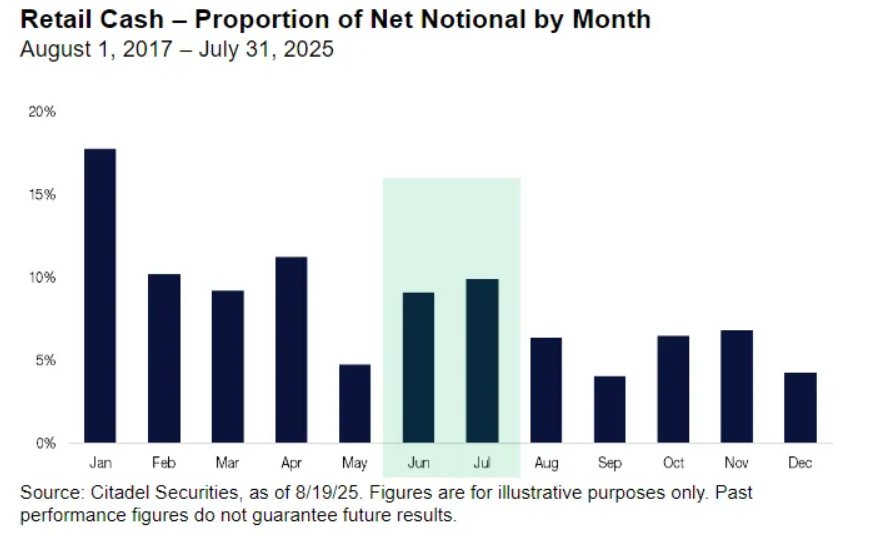
Group 1 - The core viewpoint is that retail investors, who have been a significant driving force behind the recent highs in the U.S. stock market, are expected to slow down their buying activity in September but may resume later in the year [1][2][5] - Scott Rubner, a prominent strategist, has accurately predicted major market corrections in the past and suggests that the current surge in retail buying is structural rather than cyclical, reflecting consumer health and market participation [2][5] - Historical data indicates that after strong buying activity in June and July, retail investors typically reduce their buying in August, with September often marking a low point for retail participation [2][9] Group 2 - Retail investors have been net buyers in the U.S. stock market for 16 out of the past 18 weeks and have consistently been net buyers of stock options for 16 weeks, marking one of the longest bullish streaks since 2020 [1][5] - The focus of Wall Street has increasingly shifted towards retail investor behavior, as they have played a crucial role in the recovery of the S&P 500 index following significant sell-offs [5][9] - Retail investors are not just buying meme stocks but are also favoring large-cap stocks with solid fundamentals, such as Tesla, Nvidia, and UnitedHealth Group, indicating a more strategic approach to investing [8][9] Group 3 - Wall Street strategists are cautious about the short-term trends in the U.S. stock market, anticipating potential corrections but viewing them as temporary interruptions in a long-term bull market [10][11] - Major financial institutions like Citigroup and Morgan Stanley have raised their year-end targets for the S&P 500 index, reflecting a growing consensus on the long-term bullish outlook despite expected short-term volatility [11][12] - The anticipated corrections are seen as buying opportunities, particularly due to the strong earnings growth and capital expenditures in technology giants like Nvidia, Microsoft, and Google [12]


?曾精准预言“夏日抛售”的华尔街大佬重磅发声:美股散户狂热买盘或于9月暂歇
Zhi Tong Cai Jing· 2025-08-19 23:47
Group 1 - Retail investors have been net buyers in the U.S. stock market for 16 out of the past 18 weeks, marking a significant trend in market participation [2] - Scott Rubner, a prominent strategist, predicts that the retail buying frenzy may slow down in September but could resume later in the year [1][2] - Historical data indicates that retail buying activity typically decreases in August and reaches a low point in September, before potentially rebounding in the fourth quarter [2] Group 2 - Retail investors have played a crucial role in driving the market, particularly in the context of "meme stocks" and broader market rallies [3] - Recent statistics show that retail investors accounted for approximately 20% of total options activity, surpassing levels seen during the meme stock frenzy in 2021 [5] - The current generation of retail investors is characterized by a lack of experience with bear markets, having only experienced prolonged bull markets [4] Group 3 - Wall Street strategists are increasingly cautious about the short-term trends in the U.S. stock market, anticipating potential corrections amid record high valuations [6] - Despite concerns, there is a consensus among strategists that any upcoming market corrections will be temporary and present buying opportunities [7] - Citigroup has raised its year-end target for the S&P 500 index from 6,300 to 6,600, reflecting a growing bullish sentiment among Wall Street analysts [8]
全球市场下半年剧本:关税落地,没有TACO了,基本面决定一切
Hua Er Jie Jian Wen· 2025-08-04 07:55
Group 1: Trade Tariffs and Economic Impact - The Trump administration has finalized tariff rates on major trading partners, eliminating a significant uncertainty in the market, but high tariffs pose a threat to the global economy [1][3] - The effective tariff rate in the U.S. has increased from 16.3% to 17.5%, with varying impacts on different economies [3] - Countries like the EU, South Korea, and Japan will face a 15% tariff, while India faces a surprising 25% tariff, significantly higher than expected [3][4] Group 2: Employment Data and Market Reactions - The U.S. non-farm payroll report for July showed only 73,000 new jobs added, far below expectations, indicating a cooling labor market [5] - The unemployment rate rose to 4.248%, the highest since October 2021, raising concerns about potential market corrections [5] - The weak employment data, combined with high market valuations, may trigger short-term market pullbacks [5] Group 3: Capital Flows and Market Sentiment - There has been a reversal in capital flows, with foreign investors turning to net sellers of emerging Asian stocks, particularly driven by the Indian market's challenges [6][7] - Emerging market ETFs have seen outflows, while U.S.-focused ETFs have recorded net inflows, indicating a shift in investor sentiment [7] - Chinese ETFs listed in the U.S. have seen net inflows for three consecutive weeks, suggesting resilience amid rising global risk aversion [8] Group 4: Earnings Expectations and Market Outlook - Earnings expectations for Asian companies are being downgraded, with a 1.2% reduction in consensus earnings for FY25E among 43% of MSCI Asia (excluding Japan) companies [9] - In contrast, U.S. companies have shown strong earnings growth, with a 10.3% year-over-year increase reported by 66% of S&P 500 companies [9] - The outlook for Asian markets is challenging due to tariff pressures and a slowing global economy, with limited upside potential anticipated for MSCI Asia (excluding Japan) by the end of 2025 [9]

东南亚指数双周报第4期:估值高位,回调渐现-20250804
Haitong Securities International· 2025-08-04 07:34
Market Overview - Southeast Asia ETF dropped by 1.37%, indicating a general pullback after a previous upward trend[4] - The drop was influenced by cooling expectations of the Federal Reserve's interest rate cut, leading to some funds flowing to the Asia-Pacific market[4][37] Country-Specific Performance - iShares MSCI Indonesia ETF decreased by 0.45%, outperforming by 0.92 percentage points due to positive impacts from a US-India trade agreement and central bank rate cuts[5][38] - iShares MSCI Singapore ETF fell by 2.61%, underperforming by 1.24 percentage points, as the market corrected after a continuous rise[5][38] - iShares MSCI Thailand ETF increased by 0.41%, outperforming by 1.78 percentage points, supported by tax incentives to boost tourism[5][38] - iShares MSCI Malaysia ETF rose by 0.21%, outperforming by 1.58 percentage points, but the market remains in an adjustment phase[5][38] - Global X MSCI Vietnam ETF increased by 0.10%, outperforming by 1.47 percentage points, but faced a significant correction due to rapid valuation increases[5][38] Risk Factors - The report highlights macroeconomic downturn risks and geopolitical tensions as potential threats to market stability[36][39]
每日市场观察-20250801
Caida Securities· 2025-08-01 03:19
Market Performance - On July 31, the Shanghai Composite Index fell by 1.18%, the Shenzhen Component Index dropped by 1.73%, and the ChiNext Index decreased by 1.66%[2] - A total of 4,133 stocks declined, 68 remained flat, and 1,019 stocks rose, with a trading volume exceeding 1.9 trillion yuan[1] Sector Analysis - Only six sectors closed in the green, including chemical pharmaceuticals, software development, internet, power equipment, biopharmaceuticals, and medical services[1] - The sectors with the largest declines were energy metals, steel, coal, mining, and photovoltaics[1] Investment Insights - The market has shown signs of a pullback after a rebound of nearly 600 points since the low on April 7, indicating a completed technical move[1] - Investors are advised to focus on sectors at relatively low levels for investment opportunities and prioritize high-performing stocks in the short term[1] Fund Flow - On July 31, net outflows from the Shanghai Stock Exchange amounted to 17.249 billion yuan, while the Shenzhen Stock Exchange saw net outflows of 9.606 billion yuan[4] - The top three sectors for capital inflow were IT services, software development, and communication equipment, while the largest outflows were from liquor, real estate development, and electricity sectors[4] Economic Indicators - The manufacturing PMI for July was reported at 49.3%, a decrease of 0.4 percentage points from the previous month, indicating a slight contraction in manufacturing activity[7] - The non-manufacturing business activity index was at 50.1%, still above the critical point, suggesting overall expansion in the service sector[7] Global Trends - In Q2 2025, global gold demand reached 1,249 tons, a year-on-year increase of 3%, driven by significant inflows into gold ETFs, which totaled 170 tons[11] - The first half of 2025 saw a record high for global gold ETF demand at 397 tons, the highest since 2020[11] Fund Dynamics - Public funds have seen nearly 5 billion yuan in self-purchases this year, with passive index funds being particularly favored, accounting for 20.65% of total self-purchases[12] - The second quarter report indicated a continued expansion in public fund asset sizes, with active equity funds increasing their stock positions in sectors like communication and finance[14]
美股屡创新高背后暗藏风险!Verdence首席投资官:市场定价“过于完美” 回调风险加剧
贝塔投资智库· 2025-07-28 04:09
Core Viewpoint - Investors are overly complacent regarding the upcoming U.S. trade tariff deadline on August 1, with the market currently pricing in a perfect scenario [1] Group 1: Market Concerns - Megan Horneman highlights potential risks including uncertainty around Federal Reserve policies and overbought conditions in the market [1] - There is a concern that if expectations for interest rate cuts are removed and trade issues remain uncertain, the market may experience a valuation correction [1] - Technical indicators suggest that growth stocks, particularly large tech stocks, are in an overbought state, which could disrupt the current market rebound [1] Group 2: Long-term Outlook - Despite a cautious short-term outlook, Horneman remains bullish in the long term, viewing market pullbacks as investment opportunities [2] - International stocks are identified as a preferred choice during market weakness, as they are relatively undervalued compared to the U.S. market [2] - The S&P 500 index has seen a 16% increase over the past three months, while the Nasdaq index has risen by 21% in the same period [2]

迷因股热潮引发华尔街分歧:是泡沫还是买入机会?
Jin Shi Shu Ju· 2025-07-28 02:03
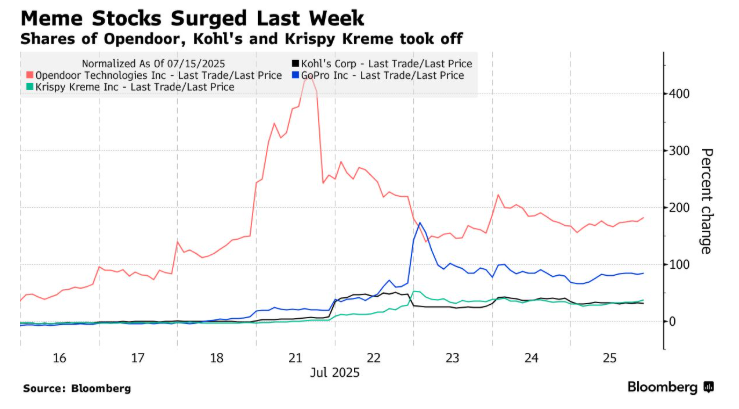
Group 1 - The recent meme stock surge has created a dilemma for professional investors, who must decide whether to follow retail investors in chasing gains or view it as a warning signal for a market correction [1] - Stocks like Opendoor Technologies and Kohl's Corp. have seen significant price movements, although some have retraced gains, while broader indices like the S&P 500 and Nasdaq 100 have rebounded to historical highs [1][3] - There are signs that investors are abandoning restraint, with margin debt on the New York Stock Exchange surpassing previous highs from the tech bubble, indicating a record level of borrowing to invest in stocks [3] Group 2 - The S&P 500's expected price-to-earnings ratio is nearing 23 times, significantly above the ten-year average of approximately 18 times, suggesting that stocks may be overvalued [3][4] - Market fatigue is evident as the latest meme stock rally quickly lost momentum, and Bitcoin, a symbol of speculative fervor, has also retreated from its historical highs [3] - Comparisons are being drawn to the January 2021 meme stock event, where retail investors drove significant price increases, highlighting the similarities in current market behavior [5][6] Group 3 - Current macroeconomic conditions differ from 2021, with higher interest rates leading to expectations that the Federal Reserve may lower benchmark rates later this year, potentially providing further support for stock prices [6] - Despite concerns over increased tariffs from the Trump administration, trade agreements have generally yielded better outcomes than anticipated in early April, and inflation remains manageable with steady earnings growth [6] - Short-term corrections in the market could be seen as healthy, providing buying opportunities for investors, as any pullback may be viewed as a chance to acquire stocks at lower prices [8]
美股屡创新高背后暗藏风险!Verdence首席投资官:市场定价“过于完美” 回调风险加剧
Zhi Tong Cai Jing· 2025-07-28 01:23
Group 1 - The core concern is that investors are overly complacent regarding the upcoming U.S. trade tariff deadline on August 1, with the market currently pricing in a perfect scenario [1] - There are uncertainties surrounding Federal Reserve policies and technical indicators showing overbought conditions, which could lead to a valuation correction in the market [1] - The market has seen significant gains, with the S&P 500 index rising 16% and the Nasdaq index increasing 21% over the past three months [2] Group 2 - The chief investment officer of Verdence Capital Advisors, Megan Horneman, remains bullish in the long term, viewing market pullbacks as investment opportunities, particularly favoring international stocks [1] - Despite high valuation levels, international stocks are considered relatively cheap compared to the U.S. market, indicating a potential rotation of funds into these assets [1] - Trader Guy Adami expressed concerns about the market being somewhat bubble-like, primarily driven by retail investors [2]
日股狂飙后,多个指标亮起红灯!
Hua Er Jie Jian Wen· 2025-07-25 06:52
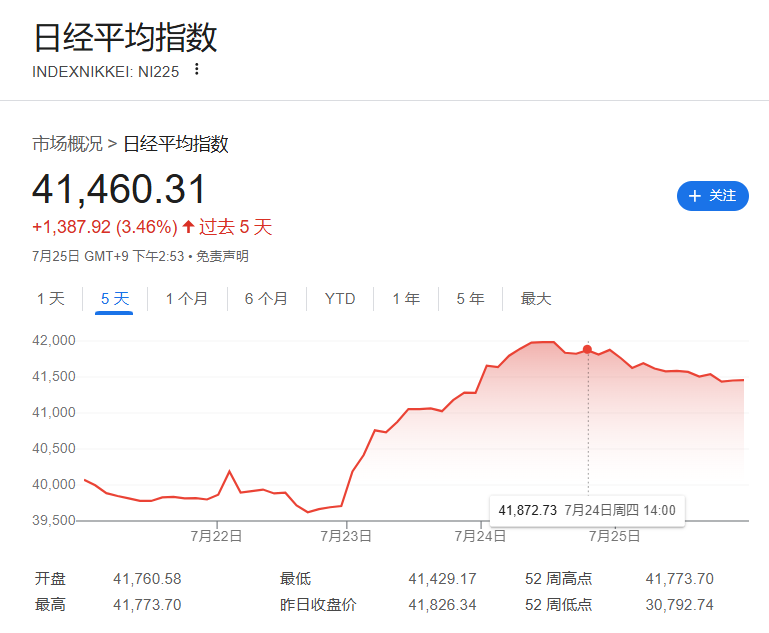
Group 1 - The core viewpoint of the articles highlights the recent surge in Japanese stock markets driven by a trade agreement with the U.S., but it also raises concerns about potential market corrections due to overbought conditions and historical precedents of market crashes [1][2][5] - The Tokyo Stock Exchange Index and Nikkei 225 Index saw a cumulative increase of over 3% following the announcement of a 15% tariff by the U.S. on Japan, with the Tokyo Stock Exchange Index closing at 2977.55 points, surpassing its previous historical high set on July 11, 2024 [1] - Technical indicators, such as the 14-day Relative Strength Index (RSI) reaching approximately 79, suggest that the market is nearing overbought territory, similar to conditions observed before last year's market crash [1][2] Group 2 - Analysts express caution regarding the rapid market rise, referencing the market crash in August 2024 triggered by unexpected interest rate hikes and hawkish comments from the Bank of Japan, which could lead investors to reassess risks despite current macroeconomic drivers [2] - The forward price-to-earnings ratio of the Tokyo Stock Exchange Index stands at 15.7, close to the 15.87 level seen before last year's downturn, indicating that stock valuations need to be supported by corporate earnings as the earnings season approaches [5] - Foreign investors have been net buyers of Japanese stocks for 15 consecutive weeks, but underlying political and fiscal issues in Japan, including concerns over government bond yields, could complicate the market outlook [6]