
新型政策性金融工具

Search documents
大国博弈,科技领航——2026年中国经济展望
李迅雷金融与投资· 2025-12-30 02:41
Core Viewpoint - The GDP growth target for 2026 is expected to remain around 5%, with macro policies focusing on promoting consumption and expanding investment to ensure a good start for the 14th Five-Year Plan [3] Export Performance - China's export performance in 2025 was better than expected, with nominal exports increasing by 5.4% in USD and 6.2% in RMB in the first 11 months. After adjusting for price factors, actual export growth was 7.9% in USD and 9.0% in RMB [4][5] - The strong external demand contributed significantly to China's economic growth, with net exports boosting GDP growth by 1.5 percentage points in the first three quarters of 2025, accounting for 29.0% of the cumulative GDP growth [4] - The expected growth rate for China's exports in 2026 is projected at 3.4% in USD terms, supported by stable US-China tariffs and China's cost advantages [9][28][30] Manufacturing Investment - Manufacturing investment is expected to recover slightly in 2026, from around 1% growth in 2025 to approximately 2% in 2026, driven by resilient exports and policy support for advanced manufacturing [31][46] - The decline in manufacturing investment in 2025 was attributed to "strong supply and weak demand" and trade friction, but the outlook for 2026 suggests a recovery due to improved export expectations and continued policy support [36][46] Real Estate Sector - The direct drag of the real estate sector on the economy is expected to weaken in 2026, with a projected decline in commodity housing sales area of about 5% and a narrowing of the decline in real estate investment to around -11% [55][58] - The real estate sector's recovery will depend on improved consumer confidence and the successful resolution of credit risks among property developers [56][57] Consumption and Investment - Expanding domestic demand is crucial for achieving the 5% GDP growth target in 2026, with a focus on promoting consumption and investment [64] - The government is expected to maintain support for consumption through long-term special bonds, with a funding scale at least equal to the 300 billion RMB allocated in 2025 [66][68] - Infrastructure investment is projected to rebound to 8% growth in 2026, supported by previously announced policies [64]


湛江:从战略“交汇点”向“支撑点”跨越
Xin Lang Cai Jing· 2025-12-27 05:19
Core Insights - The completion of the Guangzhan High-Speed Railway on December 22, 2025, significantly reduces travel time between Guangzhou and Zhanjiang to 1 hour and 32 minutes, enhancing connectivity within the Guangdong-Hong Kong-Macao Greater Bay Area and the western Guangdong region [1] - The official launch of the Hainan Free Trade Port on December 18 marks a critical step in China's high-level opening-up strategy, with Zhanjiang positioned as a key hub linking various national strategies [1] Group 1: Strategic Positioning - Zhanjiang is recognized as an important gateway for the Guangdong-Hong Kong-Macao Greater Bay Area and a core support point for the Hainan Free Trade Port, enhancing its strategic value [2] - The city is actively aligning its development with the needs of Hainan, focusing on mutual growth and resource integration, particularly in logistics and transportation [2][3] Group 2: Infrastructure Development - The Guangzhan High-Speed Railway is expected to operate up to 64 trains daily, facilitating faster movement of people and goods, thus reshaping the regional economic landscape [4][5] - Zhanjiang is enhancing its port capabilities, particularly at Xuwen Port, to create a modern transportation hub that connects the Greater Bay Area and Hainan [2][3] Group 3: Economic Integration - The establishment of the Xuwen International Logistics Park aims to support the supply chain for the Hainan Free Trade Port, with a total investment of 5 billion yuan and a planned area of 1,629 acres [3] - The introduction of a "parallel port" logistics model is expected to reduce transportation costs significantly and improve shipping efficiency, with a reported 80% increase in vessel loading rates [8] Group 4: Reform and Development - Zhanjiang is focusing on reform to enhance its business environment, achieving a ranking of 4th in overall satisfaction with the business environment in the province [7] - The city is pioneering a diversified financing model to support key projects, achieving a leverage effect of over 50 times with 17.03 billion yuan in new policy financial tools [7]
精准谋划,激活发展新动能
Qi Lu Wan Bao· 2025-12-26 09:33
Group 1 - The meeting focused on strategic planning for key projects in 2026, involving various local government departments and investment teams to enhance collaboration and project execution [1][2] - Key areas of discussion included 11 major projects in real estate, park operations, new energy, commercial ventures, and equity investment, along with 6 fund cooperation projects and 15 urban commercial and livelihood improvement projects [1] - The meeting emphasized the importance of precise planning and resource sharing to support the successful implementation of projects, aiming for high-quality development in the region [2] Group 2 - The meeting established a clear project planning approach, highlighting the need for a structured management system to accelerate project readiness and transformation [2] - A focus on high-quality project construction is intended to ensure a strong foundation for the region's economic and social development during the 14th and 15th Five-Year Plans [2]
前11个月广义财政支出超收入近10万亿
Di Yi Cai Jing Zi Xun· 2025-12-26 02:31
Core Viewpoint - The article discusses the performance of China's broad fiscal revenue and expenditure in the first 11 months of the year, highlighting a slight decline in revenue but an increase in expenditure, reflecting a proactive fiscal policy aimed at stabilizing economic growth and expanding domestic demand [2][5]. Fiscal Revenue - In the first 11 months, broad fiscal revenue reached 24,079 billion yuan, showing a year-on-year decline of approximately 0.2% [2]. - The general public budget revenue increased by 0.8% compared to the same period last year, slightly better than the initial forecast of 0.1% [5]. - The decline in government fund revenue was 4.9%, significantly lower than the expected growth of 0.7%, primarily due to a 10.7% drop in local government land use rights transfer income [6]. Fiscal Expenditure - Broad fiscal expenditure amounted to 34,066 billion yuan, with a year-on-year increase of about 4.5%, aligning closely with the economic growth rate of around 5% [2][7]. - The expenditure growth rate was lower than the initial official forecast, which anticipated a 9.3% increase for the year [7]. - To maintain fiscal expenditure levels, the central government allowed local governments to issue an additional 500 billion yuan in bonds in the fourth quarter to support local financial capacity and major project construction [7]. Government Debt - Net financing from government bonds reached 1.315 trillion yuan in the first 11 months, an increase of 361 billion yuan year-on-year [8]. Fiscal Policy Focus - The fiscal expenditure structure has been optimized, with increased focus on social welfare and public services, such as a 1 billion yuan childcare subsidy [9]. - Experts predict that the fiscal deficit rate for 2026 may be set around 4%, with an expected increase in government debt issuance to support fiscal spending [9].

前11个月广义财政支出超收入近10万亿
第一财经· 2025-12-26 02:25
Core Viewpoint - The article discusses the performance of China's broad fiscal revenue and expenditure in the first 11 months of the year, highlighting a slight decline in revenue and an increase in expenditure, reflecting a proactive fiscal policy aimed at stabilizing economic growth and expanding domestic demand [3][5]. Fiscal Revenue - In the first 11 months, broad fiscal revenue reached 24,079 billion yuan, showing a year-on-year decline of approximately 0.2% [3]. - The national general public budget revenue increased by 0.8% year-on-year, slightly better than the initial forecast of 0.1%, driven by stable economic performance and active capital markets [5]. - Government fund revenue decreased by 4.9% year-on-year, falling short of the initial forecast of 0.7%, primarily due to a sluggish real estate market and lower land transfer income [5]. Fiscal Expenditure - Broad fiscal expenditure amounted to 34,066 billion yuan, with a year-on-year increase of about 4.5%, which is lower than the expected growth rate of 9.3% for the year [6]. - The government allowed local governments to issue an additional 500 billion yuan in bonds in the fourth quarter to support local financial capacity and major project construction [6][7]. - The fiscal expenditure structure has been optimized, with increased focus on social welfare and public services, such as social security and education, which grew faster than average expenditure growth [9]. Government Debt - Net financing of government bonds reached 1.315 trillion yuan in the first 11 months, an increase of 361 billion yuan year-on-year [8]. - Experts anticipate that the fiscal deficit rate for 2026 will be set around 4%, with total government debt expected to exceed 12 trillion yuan, potentially reaching between 13 trillion and 16 trillion yuan [9].

国海证券首席经济学家夏磊:2026年“十五五”开局 中国经济在变局中突围
Mei Ri Jing Ji Xin Wen· 2025-12-25 22:50
External Environment - The uncertainty of U.S. policies significantly impacts the global economic order, with frequent changes in tariff policies since the Trump administration took office in early 2025 [2] - The core goal of China's economic development during the "14th Five-Year Plan" period is to lay the foundation for achieving a per capita GDP of $23,000 by 2035, which is necessary to be classified as a moderately developed economy [2][3] Economic Growth Drivers - Despite a complex external environment, China's economic foundation is solid, with a focus on promoting consumption, stabilizing investment, and strengthening exports to stimulate internal growth [4] - In the first three quarters of 2025, final consumption expenditure contributed 53.5% to economic growth, indicating its critical role as the main engine of growth [4] - Investment in high-tech industries is expected to become a significant growth driver, with a focus on key areas such as integrated circuits and advanced materials [5] - The export market is diversifying, with significant growth in exports to ASEAN, Africa, and Latin America, while the structure of export products is shifting towards high-value-added items [6] Policy Outlook - Macroeconomic policies in 2026 will continue to support stable economic operation, with ample room for both fiscal and monetary policies [7] - The government debt ratio is at a manageable level of 68.7%, allowing for sustainable fiscal policies that focus on technology innovation and basic livelihood support [7] - Monetary policy adjustments are facilitated by the U.S. Federal Reserve's interest rate cuts, providing a favorable environment for domestic economic stability [8] Asset Allocation - The A-share market is expected to maintain a slow bull trend, supported by government emphasis on capital market stability and a solid liquidity foundation [9] - The technology sector is identified as a core investment focus during the "14th Five-Year Plan," with significant advancements in AI and a complete industrial system [10] - Demand for gold as a safe-haven asset is expected to remain strong due to increasing global economic uncertainties and geopolitical conflicts, with central banks continuing to accumulate gold [11]

【广发宏观吴棋滢】延续必要强度,优化发力路径:2026年财政政策展望
Xin Lang Cai Jing· 2025-12-25 01:33
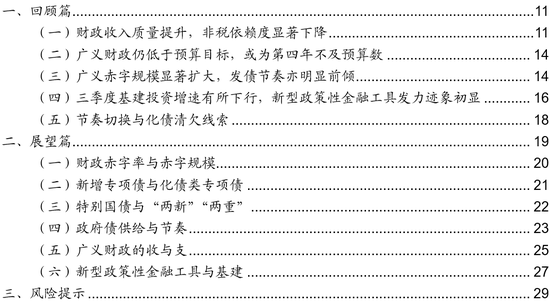
Group 1 - The core viewpoint of the report is that the fiscal policy for 2025 will be "more proactive," leading to significant increases in both narrow and broad fiscal deficits, with narrow deficit expected to rise by 39% and broad deficit by 27% [1][13][14] - The issuance of government bonds will be accelerated, with net supply expected to increase by 128% year-on-year in the first half of 2025, while broad fiscal expenditure is projected to show a "U"-shaped trend in 2024 and a "front high and back low" trend in 2025 [1][14] - The structure of fiscal revenue is improving, with a target growth rate for non-tax revenue set at -14.2%, indicating a reduced reliance on non-tax income [2][15][16] Group 2 - The expansion of debt resolution measures and diversification of debt resolution methods are highlighted, including the issuance of special bonds and policies targeting corporate arrears and PPP projects [2][16][17] - The expected slowdown in infrastructure investment growth in the second half of 2025 is attributed to several factors, including the completion of prior funding projects and the diversion of funds to debt resolution [3][18][19] - For 2026, the central economic work conference emphasizes the continuation of a more proactive fiscal policy, with expectations for a slight increase in fiscal strength compared to 2025 [4][20][21] Group 3 - The anticipated fiscal revenue growth for 2026 is projected to rebound to 3%-5%, driven by price increases and tax policy adjustments [5][26][27] - The introduction of new policy financial tools is expected to significantly impact fixed asset investment, with an estimated investment scale of 1.5-2 trillion yuan in 2026 [6][28][29] - The report indicates a structural shift in consumption patterns, with a focus on new types of consumption and service consumption, as traditional durable goods consumption is expected to slow down [8][32][33] Group 4 - The report discusses the expansion of debt resolution to include non-hidden debts, with measures to clear local government arrears to enterprises [9][34][35] - The importance of improving the local tax system is highlighted, with potential reforms in consumption tax expected to accelerate [10][36][37] - The overall impact on the asset side suggests that continued fiscal strength and proactive measures will support nominal growth and micro-activity in 2026 [11][37]
盘前公告淘金:“煤炭一哥”千亿级并购方案官宣落地,盛新锂能再签20万吨锂盐供应大单
Jin Rong Jie· 2025-12-22 01:04
Investment and Operations - China Shenhua plans to increase capital by 6 billion yuan to the State Energy Group Financial Co., and intends to purchase related assets held by the State Energy Group and its wholly-owned subsidiary, Western Energy, for a transaction price of 133.598 billion yuan [1] - Fudan Microelectronics identifies FPGA as an ideal solution in low-orbit satellite communication and other fields [1] - Qingdao Port plans a total investment of 15.7 billion yuan to construct two terminal projects in Dongjiakou Port Area [1] - Heng Rui Medicine's SHR-2906 injection clinical trial has been approved, with no similar drugs approved for market domestically or internationally [1] - Health元's subsidiary NS-041 tablets have received approval for a new indication to conduct clinical trials, with no new generation targeted KCNQ2/3 drugs available in the market [1] - Jinggong Technology plans to invest 426 million yuan to build an intelligent manufacturing base, aiming to produce 45 sets of aerospace and low-altitude manned equipment and 6,000 sets of humanoid robot carbon fiber components annually [1] Contracts and Collaborations - Zhongyuan Neipei's subsidiary signed a strategic cooperation framework agreement with Ningbo Puzhi Company regarding humanoid robot-related business [2] - Dongfang Cable and its subsidiaries won bids totaling 3.125 billion yuan for deep-sea technology and other projects, accounting for 34.37% of 2024 revenue [2] - Jifeng Co., Ltd. has been designated for a passenger car seat assembly project, with a total lifecycle amount expected to be 9.8 billion yuan [2] Capital Operations - Guankang Technology is planning to acquire no less than 60% of Liao Jing Electronics' shares, with trading suspension starting from December 22 [2] - Shangfeng Cement's invested company, Yuexin Semiconductor, has received acceptance for its IPO on the ChiNext [2] - *ST Dongyi's restructuring plan has been approved by the court [2]

21社论丨着力拓展投资增长空间,确保稳增长
21世纪经济报道· 2025-12-20 03:30
Core Viewpoint - The article emphasizes the importance of expanding effective investment during the "14th Five-Year Plan" period, focusing on the integration of investment in physical assets and human capital to stimulate economic growth and support the new development pattern [1]. Group 1: Investment Strategy - The central economic work conference highlights the need to stabilize investment as a key task, especially in light of external environmental changes and domestic economic challenges [1]. - Fixed asset investment growth has declined, with a year-on-year decrease of 2.6% from January to November, influenced by local government debt and real estate adjustments [1]. - Long-term effective investment opportunities remain, as per capita capital stock in China is still lower than that of developed economies, indicating room for growth in infrastructure and public services [1]. Group 2: Funding Sources - The central economic work conference proposes to implement a more proactive fiscal policy, increase central budget investment, optimize local government special bond usage, and leverage new policy financial tools to enhance funding sources [2]. - Predictions suggest that upcoming policies will help alleviate local financial pressures and amplify government investment's impact [2]. - The focus on high-quality implementation of major national strategies and projects aligns with the need for improved infrastructure and human resource development [2]. Group 3: Private Investment - The article stresses the necessity of a collaborative investment approach led by the government and driven by the market, aiming to enhance private sector participation in major projects [3]. - Measures have been introduced to stimulate private investment, including expanding access, addressing bottlenecks, and strengthening guarantees [3]. - The central economic work conference calls for improving regulations to boost private sector confidence and investment willingness [3]. Group 4: Future Investment Demand - The development of new industries and the need to address existing gaps will continuously generate investment demand [4]. Group 5: Investment Growth Expectations - Investment is expected to have a greater elasticity compared to consumption, and with the implementation of various policies, investment growth in the coming year looks promising [5]. - More detailed work is required to ensure sustainable investment growth and optimize supply structure [5].

着力拓展投资增长空间,确保稳增长
2 1 Shi Ji Jing Ji Bao Dao· 2025-12-20 00:43
Core Viewpoint - The National Development and Reform Commission emphasizes the importance of effective investment during the 14th Five-Year Plan period, focusing on expanding domestic demand and enhancing government investment to stimulate private investment and reform investment mechanisms [1][2]. Group 1: Investment Strategy - The central economic work conference identifies stabilizing investment as a key task for the upcoming year, with a focus on reversing the decline in fixed asset investment, which has decreased by 2.6% year-on-year from January to November [1][2]. - The government aims to combine investment in physical assets and human capital, enhancing infrastructure and public services while addressing the needs of new urbanization and rural revitalization [2][3]. Group 2: Funding Sources - The central economic work conference proposes a more proactive fiscal policy, including increasing central budget investment and optimizing the use of local government special bonds to enhance funding sources for investment [2][3]. - New policy financial tools are highlighted as crucial for stabilizing investment, indicating a shift towards early implementation of these tools [2]. Group 3: Project Implementation - The 15th Five-Year Plan will prioritize high-quality implementation of major national strategies and projects, focusing on infrastructure and public service development in response to demographic changes [3][4]. - The government aims to create a collaborative investment environment by enhancing the role of private enterprises in major project construction and increasing the proportion of private investment [3][4]. Group 4: Private Investment Activation - The State Council has issued measures to stimulate private investment, including 13 targeted initiatives to improve access, eliminate bottlenecks, and strengthen guarantees for private investors [4]. - The central economic work conference emphasizes the need to boost private sector confidence through improved regulations and timely payment of debts owed to enterprises, fostering a conducive environment for private investment [4].