
春季躁动行情

Search documents
中国银河证券:A股市场长牛、慢牛基础进一步夯实 关注“两条主线+两条辅助线”
Zhi Tong Cai Jing· 2026-01-19 00:20
Core Viewpoint - The report from China Galaxy Securities indicates that investor sentiment has become highly active since the beginning of 2026, with a continuous increase in margin financing balance, reflecting policy signals aimed at guiding rational investment and maintaining market stability [1][4]. Group 1: Market Performance - During the week of January 12-16, the A-share market showed mixed performance, with the overall index rising by 0.49%. The Sci-Tech 50 index led with a 2.58% increase, while the Shanghai Composite Index and CSI 300 recorded declines [2]. - Small-cap stocks outperformed, with the CSI 1000 index rising by 1.27%, compared to a 0.57% drop in the CSI 300. Growth and cyclical styles also saw gains of 1.78% and 0.94%, respectively, while financial stocks fell by 2.73% [2]. Group 2: Fund Flows - A-share market trading activity significantly increased, with daily trading volume averaging 34,651 billion yuan, up by 6,131.1 billion yuan from the previous week. The average turnover rate rose to 2.705%, an increase of 0.47 percentage points [3]. - As of Thursday, the margin financing balance reached 27,187.27 billion yuan, an increase of 911.36 billion yuan from the previous week [3]. - In the week, 17 new equity funds were established, with a total issuance of 13.152 billion units, up by 12.191 billion units from the previous week, representing 68.17% of total issuance [3]. - From January 8 to January 14, global funds saw a net inflow of 4.111 billion USD into A-shares, accelerating from a previous inflow of 0.374 billion USD [3]. Group 3: Valuation Changes - The overall A-share index's PE (TTM) valuation increased by 0.28% to 23.28 times, placing it at the 94.63 percentile since 2010. The PB (LF) valuation also rose by 0.28% to 1.92 times, at the 56.28 percentile since 2010 [3]. Group 4: Investment Outlook - The report emphasizes that the recent increase in margin financing balance and the adjustment of financing margin ratios are intended to stabilize the market and promote rational investment. The central bank has implemented a series of monetary policy measures to support economic transformation and indicated that there is still room for further rate cuts, which is expected to boost market confidence [4].

新基金发行加速 多只产品提前结募
Zhong Guo Zheng Quan Bao· 2026-01-18 20:45
Core Viewpoint - The public fund issuance market has shown significant growth since the beginning of the year, characterized by rapid increases in both volume and efficiency, reflecting a recovery in market confidence and changes in product strategies and investor allocation concepts [1][4]. Group 1: Fund Issuance Trends - Over 80 new funds have been launched as of January 18, 2023, marking an increase compared to the same period last year [1]. - In the week from January 12 to January 18, 36 new funds were launched, indicating sustained high demand for new products [1]. - Equity funds, including ordinary stock, mixed, and QDII stock funds, dominate the new fund landscape, accounting for over 70% of total new issuances [1]. Group 2: Focus on Equity Funds - Most newly issued ordinary stock funds are index funds, with only two actively managed funds focusing on technology sectors [2]. - Approximately 40% of active equity funds are sector-focused, targeting areas such as low-carbon economy, manufacturing upgrades, pharmaceuticals, semiconductors, and technology [2]. - In the QDII stock fund category, two new products focus on the Hong Kong market, investing in popular sectors like healthcare and technology [2]. Group 3: Fundraising Efficiency - The efficiency of new fund fundraising has improved, with many equity funds completing their fundraising in just 1 to 3 trading days [3]. - Several funds, including the Penghua CSI Industrial Nonferrous Metals Theme ETF, completed their fundraising in just one day, indicating strong market interest [3]. - The trend of early fundraising closures has become more common, reflecting a shift in market dynamics [3]. Group 4: FOF Product Highlights - FOF products have also seen rapid fundraising, with some funds completing their fundraising in as little as two days, such as the GF Yueying Stable Three-Month Holding Period Mixed FOF, which raised over 3.2 billion yuan [4]. - The Wanji Qi Tai Stable Three-Month Holding Period Mixed FOF reached nearly 2.1 billion yuan in just one day, showcasing the strong demand for these products [4]. Group 5: Underlying Factors for Growth - The surge in new fund issuance is attributed to a combination of policy support, favorable market conditions, increased investor interest, and heightened competition within the industry [5]. - Recent policies have aimed to enhance the scale and proportion of equity investments in public funds, improving registration and issuance efficiency [5]. - The positive performance of the A-share market and expectations of economic recovery have further fueled investor enthusiasm for new fund products [5].
小群的思想政治课——A股一周走势研判及事件提醒
Datayes· 2026-01-18 15:25
Core Viewpoint - The article discusses the current state of the A-share market, highlighting the volatility and the significant net redemption of stock ETFs, indicating a shift in investor sentiment and market dynamics [14][44]. Market Overview - A-share market experienced a significant net redemption of stock ETFs amounting to 114.83 billion yuan, the largest in 13 months, contrasting with the previous week's net subscription of 17.145 billion yuan [14]. - The market sentiment has shown signs of overheating, with the Morgan Stanley A-share sentiment index surpassing the 78 threshold, reaching 93% on January 12, 2026 [17]. - The article notes that the market is expected to remain volatile in the coming week, reflecting the previous structural overheating [17]. Investment Strategies - Analysts suggest that despite short-term regulatory impacts, the overall market trend remains upward, with a focus on sectors expected to perform well during the upcoming earnings season [18]. - The article emphasizes the importance of focusing on companies with strong earnings growth potential, particularly in technology and advanced manufacturing sectors [23]. Sector Performance - The article highlights that the computer sector attracted the most capital inflow, with a net inflow of 36.184 billion yuan, followed by electronics and media sectors [47]. - Conversely, the defense, non-bank financials, and banking sectors experienced significant net outflows [44]. Industry Insights - The semiconductor sector is noted for its positive outlook, with expectations of continued price increases in memory chips, projected to rise by 55%-60% in Q1 2026 [29]. - The article also mentions the ongoing developments in the aerospace sector, with companies like China Aerospace Technology Group making progress in commercial rocket launches [24]. Economic Indicators - The article reports that China's total electricity consumption is expected to exceed 10 trillion kilowatt-hours by 2025, marking a significant milestone in global energy consumption [36]. - The article also discusses the anticipated increase in prices for various materials, including passive components and refrigerants, driven by rising demand and supply constraints [30][31].


【十大券商一周策略】回归业绩!主题轮动加快,聚焦这些板块
券商中国· 2026-01-18 15:07
Group 1 - The core viewpoint emphasizes a shift from narrative-driven trends to performance-based evaluations as the market enters the earnings forecast period, with a focus on sectors like chemicals, non-ferrous metals, and power equipment [2][5] - The adjustment of financing margins is seen as a part of counter-cyclical regulation, which does not affect the overall upward market trend but influences market structure [2][6] - The article suggests that a good investment combination should be based on "resources + traditional manufacturing pricing weight estimation," with recommendations to increase allocations in non-bank sectors and high-growth areas like semiconductors [2][6] Group 2 - The article discusses the acceleration of thematic rotation in the market, particularly focusing on domestic semiconductor and power sectors, driven by regulatory actions and increased demand for domestic computing power [3][4] - It highlights the importance of monitoring investor sentiment and market stability, suggesting that the current market may enter a period of volatility with potential for structural differentiation in investments [4][8] - The focus on performance-driven investment strategies is expected to intensify as companies begin to disclose earnings, with a recommendation to prioritize sectors that are likely to benefit from cyclical recovery and technological advancements [5][11] Group 3 - The article notes that the recent increase in financing margins reflects a policy signal aimed at guiding rational investment and maintaining market stability, which is crucial for the long-term bullish outlook [7][10] - It emphasizes that while the market may face short-term pressures, the underlying fundamentals and supportive policies are expected to sustain a gradual upward trend in the market [8][9] - The discussion includes the potential for new growth drivers post-holiday, with a focus on sectors like electronics, power equipment, and non-ferrous metals, as well as the ongoing interest in commercial aerospace [9][12] Group 4 - The article indicates that the AI industry chain is becoming a focal point for investment, with a notable shift in capital towards sectors related to AI applications and computing power [12] - It suggests that despite some funds exiting high-flying sectors, liquidity remains strong, allowing for continued investment in less leveraged sectors like chemicals and home appliances [12] - The overall sentiment is that the market is transitioning from rapid growth to a more stable and sustainable pace, with a focus on sectors that can provide solid returns amidst changing market dynamics [10][11]




证券研究报告、晨会聚焦:固收林莎:从星辰到算力,春季躁动基础仍在?-20260118
ZHONGTAI SECURITIES· 2026-01-18 12:46
Group 1 - The report highlights a spring market rally in A-shares driven by a "fear of missing out" mentality, leading to significant price increases [3][4] - The adjustment in financing margin ratios by the China Securities Regulatory Commission aims to prevent overheating in the market, promoting a slow bull market rather than ending the current bull run [3][6] - The report notes a shift in capital from high-leverage sectors to low-leverage sectors, indicating a more cautious investment approach [4][6] Group 2 - The AI industry chain is identified as a key investment focus, with a consensus forming around the logic of "storage drives computing power, and computing power leads to applications" [5] - The insurance sector is highlighted as a suitable contributor to absolute returns, benefiting from a bull market and showing defensive characteristics during corrections [5] - A combination investment strategy is recommended, focusing on sectors with high technological contributions and stable growth, such as chemicals, home appliances, and display panels [5] Group 3 - The report indicates that the balance of margin financing has reached 2.68 trillion yuan, surpassing previous highs, suggesting a cautious but optimistic market outlook [6][10] - The report discusses the performance of various sectors, noting that industries such as computers, non-bank financials, and pharmaceuticals have seen increased leverage, while others like defense and agriculture have begun to deleverage [7][8] - The report emphasizes the strong inflow of foreign capital, which has become a significant short-term market driver, contrasting with the more modest increase in margin financing [8][9] Group 4 - The report on the medical consumables procurement indicates a clear shift towards rational price competition, with a mechanism introduced to prevent extreme low pricing [15][16] - The procurement results show a high selection rate for domestic companies, particularly in the urology intervention market, indicating a trend towards domestic substitution [16] - The report suggests that the optimized procurement rules will positively impact leading companies with strong product capabilities and nationwide supply capabilities, enhancing their competitive position [16][17]
东吴证券:如何理解近期市场的波动
Xin Lang Cai Jing· 2026-01-18 09:14
Group 1 - The core viewpoint of the article is that the market has shown a "spring rally" since December 17, 2025, with the Shanghai Composite Index achieving a record of seventeen consecutive gains and surpassing 4100 points, indicating a significant recovery from a previous low [1][9] - The stock-foreign exchange hedging index is used to assess market turning points, highlighting the divergence between A-shares and the RMB exchange rate, which serves as a valuation anchor for Chinese assets [1][9] - Historical trends validate the effectiveness of the stock-foreign exchange hedging index in predicting market movements, with notable instances in September 2024 and August 2025 where divergences led to subsequent corrections in the market [2][10] Group 2 - The current market rally is characterized by increased liquidity, driven by external factors such as the easing of uncertainties from overseas economic data and the consensus on the 2026 "14th Five-Year Plan" focusing on strategic industries like satellite and aerospace [3][11] - The structure of new capital inflows shows a combination of long-term investments, active short-term trading, and foreign capital returning to the market, indicating a robust investment environment [4][12] - Significant inflows into the A500 ETF and a surge in short-term trading activities have been observed, with net inflows of nearly 400 billion RMB in financing funds during late December 2025 [5][13] Group 3 - Recent signals suggest a "slow bull" market strategy, with regulatory measures aimed at controlling excessive leverage and stabilizing market fluctuations, which is crucial for maintaining a steady market environment [6][14] - The Shanghai Composite Index's unprecedented seventeen consecutive gains indicate a potential overheating of market sentiment, necessitating measures to moderate this trend and prevent systemic risks [7][15] - Looking ahead, the market is expected to enter a second phase of the spring rally, supported by regulatory guidance and a focus on performance metrics as annual earnings reports approach [8][16] Group 4 - Investment focus should be on sectors with strong performance indicators, including AI hardware, renewable energy, and cyclical price increases in industrial metals, as well as emerging industries highlighted in the "14th Five-Year Plan" [8][17] - Specific areas of interest include domestic AI capabilities, energy storage, and advancements in new technologies such as quantum communication and brain-computer interfaces, which are expected to benefit from policy support and industry progress [8][17]

防御价值凸显!红利低波ETF(512890)近60个交易日逆势吸金近27亿 机构:全面降息仍需等待合适时机
Xin Lang Cai Jing· 2026-01-16 04:29
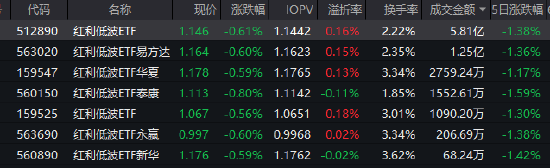
Market Overview - On January 16, the market opened high but retreated, with all three major indices closing lower. The Shanghai Composite Index closed at 4103.45 points, down 0.22%; the Shenzhen Component Index closed at 14293.08 points, down 0.10%; and the ChiNext Index closed at 3367.45 points, down 0.01% [1][6]. ETF Performance - The Dividend Low Volatility ETF (512890) fell by 0.61%, closing at 1.146 yuan, with a turnover rate of 2.22% and a transaction amount of 581 million yuan [1][6]. - Over the past five trading days, the Dividend Low Volatility ETF experienced a net outflow of 132 million yuan, while it saw a net inflow of 1.169 billion yuan over the past 20 days and 2.697 billion yuan over the past 60 days. As of January 15, 2026, the ETF's circulation scale was 26.205 billion yuan [2][7]. Monetary Policy Measures - The central bank introduced eight monetary policy measures focusing on structural monetary policy tools to support domestic demand, technological innovation, and financing needs of small and micro enterprises. Key measures include a 0.25 percentage point reduction in the interest rates of various structural monetary policy tools, expected to save banks approximately 13.5 billion yuan [4][10]. - The total quota for structural monetary policy tools has been expanded by 1.9 trillion yuan, and the minimum down payment ratio for commercial property loans has been lowered to 30% [4][10]. Economic Outlook - Analysts from Galaxy Securities noted a clear collaboration between monetary and fiscal policies, with expectations of a 50 basis point reserve requirement ratio cut in the first quarter to maintain reasonable liquidity. A comprehensive interest rate cut is anticipated to wait for a suitable timing [4][10]. - Dongwu Securities' chief economist indicated that the current spring market rally is in its latter half, with potential for a price-volume divergence if transaction volumes do not continue to rise [4][10]. Fund Performance - The Dividend Low Volatility ETF, established on December 19, 2018, has a total return of 130.38%, outperforming its benchmark. It ranks 107th among 502 funds, making it a stable tool for asset allocation in volatile markets [5][11].
朱雀基金:积极关注科技产业布局机会 需警惕短期过热
Zhong Zheng Wang· 2026-01-16 01:51
Group 1 - The A-share market has shown strong performance since the beginning of 2026, with sectors like commercial aerospace and AI software standing out, while traditional sectors like banks and brokerages are cooling down [1] - The current spring rally in the A-share market is primarily driven by liquidity rather than fundamental economic growth, which differs from previous market phases [1][2] - The equity risk premium (ERP) for A-shares has surpassed one standard deviation and is approaching two standard deviations, indicating heightened market risk appetite [1] Group 2 - The risk appetite for A-share heavyweight stocks has increased only slightly, with the CSI 500 index showing the most rapid rise in risk appetite, nearing two standard deviations [2] - The AI sector is viewed as a revolutionary investment opportunity, but it is subject to emotional fluctuations, making it challenging to identify precise investment opportunities [2] - Domestic AI applications are expected to benefit from a large market, high user acceptance, and diverse scenarios, indicating a potential turning point for AI commercialization [3]
午评:创业板指跌逾1%,券商、医药等板块走低,有色板块逆市拉升
Zheng Quan Shi Bao Wang· 2026-01-15 04:01
Market Overview - The major stock indices in the A-share market experienced a downward trend, with the ChiNext Index falling over 1% and the Sci-Tech 50 Index declining nearly 2% [1] - By midday, the Shanghai Composite Index dropped 0.6% to 4101.52 points, while the Shenzhen Component Index fell 0.44%, and the ChiNext Index decreased by 1.02% [1] - The total trading volume in the Shanghai, Shenzhen, and North markets reached approximately 1.9 trillion yuan [1] Sector Performance - Sectors such as military, retail, brokerage, pharmaceuticals, coal, steel, and semiconductors saw declines, while the GEO concept experienced a significant drop [1] - Conversely, sectors like tourism, non-ferrous metals, lithium mining, phosphorus concepts, and solid-state battery concepts showed resilience and activity [1] Future Outlook - According to Galaxy Securities, the A-share market has entered a "volatile" phase since mid-December 2025, with expectations for a continued spring rally [1] - There is a need to monitor the support from fundamental data as January marks the window for annual performance forecasts, with a focus on earnings announcements and economic data [1] - The policy expectations for the start of the 14th Five-Year Plan are anticipated to bolster market confidence, with short-term market volatility likely to increase as the market reaches new highs [1] - Emphasis is placed on identifying structural investment opportunities [1]

产业升级红利资产受宠,政策助力强化股东回报,国企红利ETF(159515)聚焦红利资产性价比机遇
Xin Lang Cai Jing· 2026-01-15 03:47
Group 1 - The core viewpoint of the news highlights the performance and significance of the state-owned enterprise dividend sector, particularly the fluctuation of the China Securities State-Owned Enterprise Dividend Index and the trading activity of the State-Owned Enterprise Dividend ETF [1][2] - The State-Owned Enterprise Dividend ETF has seen a notable increase in scale and shares over the past three months, with a growth of 716.87 million yuan in scale and 660.00 million shares [1][3] - The ETF closely tracks the China Securities State-Owned Enterprise Dividend Index, which selects 100 listed companies with high cash dividend yields and stable dividends from state-owned enterprises, reflecting the overall performance of high dividend yield securities [3] Group 2 - In the context of economic restructuring and industrial upgrading, state-owned enterprises are leveraging their financial strength and technological capabilities to lead in emerging industries and traditional industry transformations, particularly in new energy, high-end manufacturing, and digital economy sectors [2] - The new "National Nine Articles" policy encourages listed companies to enhance shareholder returns, resulting in a record high in the number and amount of cash dividends, providing a solid foundation for long-term investment in dividend ETFs [2] - The dividend strategy is gaining popularity among investors due to its bond-like attributes, especially in a low-interest-rate environment, making it a more attractive investment option [3]