碳边境调节机制

Search documents
摩洛哥中小企业面临较大“碳压力”
Shang Wu Bu Wang Zhan· 2025-10-17 05:37
Core Insights - The European Union's Carbon Border Adjustment Mechanism (CBAM) is set to be implemented in early 2026, prompting large Moroccan industrial enterprises to adopt decarbonization strategies, while small and medium-sized enterprises (SMEs) struggle with funding, manpower, and information gaps [1][2] - From 2026, carbon costs of €60 to €100 per ton will be imposed on imports of products like steel, cement, and fertilizers, which currently account for only 3.7% of Morocco's exports to the EU, indicating limited short-term impact [1] - Concerns exist that if the carbon tax expands to sectors like automotive and aviation, the entire Moroccan industrial system could face significant challenges, as global trade partners may follow the EU's lead in imposing carbon taxes [1] Challenges for SMEs - SMEs in Morocco face three main challenges: a lack of qualified personnel for EU-standard carbon emissions accounting, high costs for carbon audits, equipment upgrades, and clean energy replacements, and limited access to policy information [1][2] - Without compliant data, the EU will assign a "default carbon value" that is often higher than actual emissions, leading to increased tax rates on exports [1] Government Initiatives - The Moroccan government is advancing a "National Low Carbon Strategy" and a "Green Development Support Plan" to address these challenges [2] - The Economic, Social and Environmental Council (CESE) recommends establishing a national carbon tax mechanism to facilitate compliance with EU regulations and prevent capital outflow, alongside a proposed "decarbonization fund" for SMEs, with an estimated annual investment of $270 million to $300 million [2] - The CESE warns that without unified coordination, rapid response, and targeted financial support, the CBAM could become an "invisible trade barrier" for Morocco's industrial sector, potentially forcing many SMEs out of the green transition race [2]
韩国钢铁业“拉响警报”应对欧美夹击
Huan Qiu Shi Bao· 2025-10-12 22:52
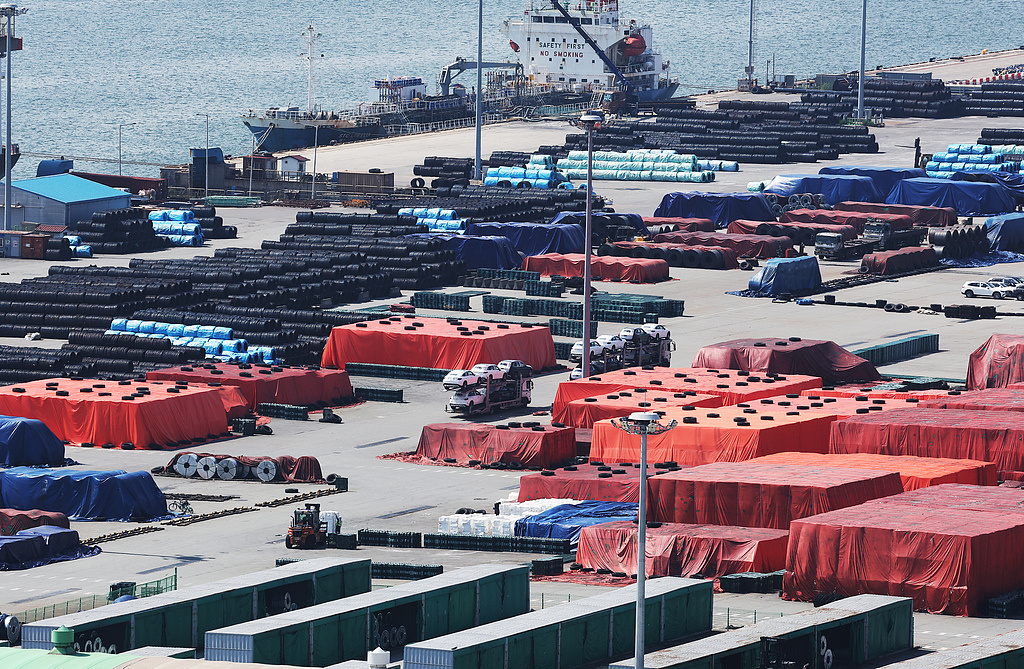
Core Points - The EU has announced plans to reduce the import quota for steel products and increase tariffs from 25% to 50%, raising concerns in the South Korean steel industry about potential export impacts [1][3] - The total import quota for steel is set to decrease to 18.3 million tons, a reduction of 47% compared to 2024 levels, with new origin rules for steel products being introduced [3] - South Korean steel exports to the EU and the US were valued at $4.48 billion and $4.35 billion respectively last year, and the industry is currently facing pressures from declining exports and overcapacity [3][4] Industry Impact - The South Korean steel industry is alarmed by the EU's measures, which are perceived as more threatening than US tariffs due to the simultaneous implementation of the Carbon Border Adjustment Mechanism (CBAM) [3] - The industry is considering strategies such as overseas production and supply chain diversification to mitigate risks, although establishing production facilities in Europe is seen as challenging due to high costs and environmental regulations [4] - Major South Korean steel manufacturers are currently investing in new facilities in the US, indicating a shift in focus away from Europe [4] Government Response - The South Korean government is actively negotiating with the EU to secure the maximum possible tariff-free quotas and is emphasizing its role as a key partner in providing high-quality steel [4] - A plan to enhance the steel industry's competitiveness through low-carbon transformation and value addition is expected to be released by the South Korean Ministry of Trade, Industry and Energy [4]

陶氏:欧洲化工业陷入多重危机
Zhong Guo Hua Gong Bao· 2025-09-17 02:59
Group 1 - The European chemical and petrochemical industry is facing a "multiple crisis" due to weak domestic demand and significant new capacities being built overseas [1] - The market is shrinking as a result of a large influx of imported products, with only a 4% reduction in ethylene capacity announced, which is insufficient to address the underlying issues [1] - Consumer demand recovery is crucial, as purchasing behavior has changed, necessitating the industry to adapt quickly and improve production agility and efficiency [1] Group 2 - EU policymakers need to take decisive action, as current legislation, particularly the Carbon Border Adjustment Mechanism (CBAM) and the European Green Deal, does not adequately support the chemical industry [1] - The existing CBAM mechanism is not suitable for complex value chains like polymers, contradicting its original intent [1] - The EU Emissions Trading System (EU ETS) is seen as promoting deindustrialization rather than decarbonization, and without foundational support for decarbonization, it becomes merely a cost burden [1] Group 3 - The U.S. government demonstrates greater synergy with the industry regarding regulatory goals compared to the EU, which needs to reach consensus on "goal setting" and "implementation pathways" [2] - China is noted to be ahead of Europe in certain sustainable development areas, particularly in electrification and having a surplus of green energy, indicating that Europe needs to scale up its decarbonization efforts [2]

系统性破解碳市场发展关键难题
2 1 Shi Ji Jing Ji Bao Dao· 2025-09-02 21:51
Core Viewpoint - The recent release of the "Opinions on Promoting Green and Low-Carbon Transition and Strengthening National Carbon Market Construction" marks a significant step towards establishing a comprehensive carbon emission trading system in China, integrating mandatory and voluntary measures, government and market forces, as well as domestic and international elements [1][2]. Summary by Sections Carbon Market Development - The carbon market has become a crucial policy tool for climate governance in China, with pilot programs initiated in 2011 across seven provinces and cities, covering over 20 industries [2]. - The national carbon emission trading market was officially launched on July 16, 2021, and has since become the largest market globally in terms of greenhouse gas emissions coverage, with a cumulative trading volume of 694 million tons and a total transaction value of 47.716 billion yuan as of August 28 [2]. - The voluntary carbon market started later, officially launching on January 22, 2024, with a cumulative trading volume of 250,160 tons and a transaction value of 21 million yuan by August 28, 2025 [2]. Challenges and Policy Directions - The current carbon market faces challenges such as low market activity, insufficient data quality, and underutilization of market mechanisms. The "Opinions" provide specific policy directions to address these issues [3]. - The document emphasizes the need to diversify market participants by introducing financial institutions, non-compliance entities, and individuals to enhance market activity [3]. Data Quality and Management - Data quality is identified as a critical issue, with the "Opinions" proposing measures to enhance data management, including increasing penalties for violations and improving corporate carbon management capabilities [4]. - The establishment of a robust regulatory framework and the development of a digital management information system are also highlighted as essential steps to ensure data integrity and compliance [4]. Market Mechanisms and Opportunities - The "Opinions" propose optimizing quota management and introducing total control, paid allocation, and quota reserve systems to improve carbon pricing mechanisms [5]. - New market opportunities are anticipated in sectors such as renewable energy, industrial energy efficiency, carbon management, and carbon finance, as the document outlines strategies for economic development in response to climate change [5][6].
不甘心落后中美,想突破发展瓶颈,欧盟报告盘点清洁能源技术家底
Huan Qiu Shi Bao· 2025-08-14 22:53
Core Insights - The European solar energy market is experiencing a slowdown, with a projected decline of 1.4% in new photovoltaic installations by 2025, marking the first drop in over a decade [2] - The EU's reliance on imports for solar components and the high manufacturing costs compared to China are significant challenges for the industry [2][3] - The EU's battery manufacturing sector is facing uncertainty, particularly after the bankruptcy protection filing by Northvolt, a key player in the market [3] Group 1: Solar Energy Industry - The EU's solar energy sector is described as a "zombie" industry, having lost its previous leadership in patent numbers and production to China [2] - Since 2020, solar technology costs have risen by 34.4% due to supply chain disruptions, inflation, and rising interest rates [2] - The EU's solar photovoltaic products are approximately 60% more expensive to manufacture domestically compared to Chinese imports, leading to weakened global competitiveness [2][3] Group 2: Battery Manufacturing Sector - The EU aims to achieve a battery manufacturing capacity of at least 550 GWh by 2030, but the recent bankruptcy of Northvolt raises doubts about this goal [3] - The demand for lithium batteries in the EU is expected to increase twelvefold by 2030 and twenty-onefold by 2050, highlighting the growing need for key raw materials [3] - Several battery projects in Europe have been paused or canceled, indicating a broader trend of stagnation in the sector [3] Group 3: Competitive Landscape - Experts indicate that the EU is heavily dependent on China for clean energy technologies, particularly in solar and battery sectors [4][8] - The EU has strengths in high-end heat pump solutions and geothermal energy systems, but overall, it lags behind China in terms of integrated supply chain capabilities [5][6] - The EU's public R&D spending in clean energy technology remains high, but private investment is crucial for maintaining competitiveness [7] Group 4: Policy and Future Outlook - The EU has initiated policies like the "Net Zero Industry Act" to stimulate investment in clean technology, aiming for 40% self-sufficiency in clean energy technology by 2030 [9] - There are internal disagreements within the EU regarding subsidies for clean technology, which may hinder progress towards achieving self-sufficiency goals [9][10] - The EU's transition to clean energy is uneven across member states, with some countries advancing while others lag behind, creating uncertainty in the overall strategy [10][11]
低碳氨开发“摸着石头过河”
Zhong Guo Hua Gong Bao· 2025-08-12 02:51
Group 1 - The low-carbon ammonia market is facing significant financing challenges, with investors requiring long-term purchase agreements before funding projects, which adds obstacles in the current economic climate [3] - The uncertainty of policies in Europe and the U.S. is hindering market development, particularly the ambiguity surrounding the Clean Hydrogen Production Tax Credit and the EU's Carbon Border Adjustment Mechanism (CBAM) [3][6] - Despite an initial surge in projects, the low-carbon ammonia market has shifted towards caution, with only a small number of projects having reached final investment decisions, resulting in a projected actual capacity of 27 million tons per year by 2050, far below the theoretical potential of 323 million tons per year [3][4] Group 2 - The global ammonia market is expected to grow significantly, with a projected annual growth rate of 2% over the next 25 years, driven mainly by energy applications [4] - By 2050, global ammonia production is anticipated to reach 372 million tons, aligning with demand forecasts, with blue and green ammonia expected to play a substantial role [4] - However, from 2028 to 2035, low-carbon ammonia capacity utilization may decline due to high production costs and emerging demand not being able to absorb this capacity [5] Group 3 - The implementation of the CBAM starting January 1, 2026, may create new premium opportunities for low-carbon ammonia producers, although the specific impacts remain uncertain [6] - The current market lacks a premium for low-carbon ammonia, which is necessary for market development, but there is an expectation that a pricing system will eventually emerge as carbon intensity differences become more apparent [8] - Companies from China and India are competing in the European green ammonia market at prices below $700 per ton, indicating a competitive landscape [6] Group 4 - Fertiglobe's CEO highlighted the need for long-term purchase agreements to support renewable green ammonia projects, with the company securing a contract for green ammonia at €1000 per ton, set to begin supply in 2027 [7]
报道:美欧即将就“非关税贸易争端”达成协议
Hua Er Jie Jian Wen· 2025-06-21 01:06
Group 1 - The US and EU are nearing an agreement on various non-tariff trade disputes, including issues related to forest logging rules and the treatment of US tech companies in Europe, but the outlook on upcoming tariff measures remains unclear [1] - A draft of a "reciprocal trade agreement" indicates preliminary agreements on specific trade issues such as the EU's Digital Markets Act, carbon border tariffs, and shipbuilding [1][2] - The draft does not address any tariff measures threatened or already imposed by Trump, including the previously suspended 20% "reciprocal tariffs" and higher tariffs on specific industries like automobiles and steel [1] Group 2 - The draft agreement includes significant concessions on tech regulation, allowing for dialogue on the implementation of the EU's Digital Markets Act and a temporary exemption from enforcement actions against US companies during negotiations [2] - The EU has previously fined two US companies, Apple and Meta Platforms, under the Digital Markets Act, and the exemption for US companies may weaken the effectiveness of this landmark EU digital law [3] Group 3 - The draft also addresses environmental policy coordination, with the EU postponing the implementation of forest logging regulations by one year, which is not a new measure as it was already decided last year [4] - The US and EU will coordinate on the design and implementation of the carbon border adjustment mechanism, with US products receiving a one-year exemption after the policy is enacted [4] Group 4 - US energy exports to Europe will be exempt from EU methane regulations, and the EU will consider measures to encourage shipbuilding and shipping industry development from market economies [5] - The US and EU will enhance coordination in defense procurement and critical minerals sectors [5]
中孚实业20250611
2025-06-11 15:49
Summary of Zhongfu Industrial Conference Call Company Overview - **Company**: Zhongfu Industrial - **Industry**: Aluminum Production Key Points and Arguments 1. **Market Conditions**: Aluminum prices remain stable above 20,000 RMB, with low inventory levels indicating that the market has passed stress tests. This has led to an undervaluation of the aluminum sector, including Zhongfu Industrial, which has potential for value re-evaluation [2][4][24] 2. **Capacity Expansion**: Zhongfu Industrial has increased its electrolytic aluminum capacity to 750,000 tons through equity acquisitions, including 500,000 tons from hydropower in Sichuan and 250,000 tons from thermal power in Henan. This positions the company favorably in terms of cost advantages [2][5][24] 3. **Profit Growth**: The company's net profit attributable to shareholders is projected to grow at a compound annual growth rate (CAGR) of 8.7% from 2020 to 2024, despite a slight decline in 2024 due to rising raw material costs [2][6] 4. **Debt Management**: By the end of 2024, the company's debt-to-asset ratio is expected to decrease to 33.1%, which is lower than industry peers, providing a solid foundation for value re-evaluation [2][12] 5. **Employee Incentives**: The introduction of an employee stock ownership plan is expected to enhance management and operational vitality, alongside a significant increase in dividend payout ratios [2][4][8] 6. **Future Profit Projections**: Under cautious assumptions, net profits for 2025, 2026, and 2027 are projected to be 1.8 billion, 2.3 billion, and 2.7 billion RMB, respectively, with corresponding price-to-earnings (PE) ratios of 8.1, 6.3, and 5.5, indicating lower valuations compared to peers [2][7][24] Additional Important Insights 1. **Green Energy Transition**: The company is well-positioned to benefit from changes in Sichuan's electricity trading policies, which are expected to lower electricity costs and enhance its role in the green supply chain for Europe and the U.S. [2][3][5] 2. **Impact of EU Regulations**: The implementation of the EU Carbon Border Adjustment Mechanism (CBAM) is anticipated to favor companies with green electricity, granting them pricing power and market access [3][20][24] 3. **Financial Health**: The company has shown a recovery from previous losses, with a complete coal, electricity, and aluminum industry chain advantage, and a self-supply rate of 44% [6][8] 4. **Sales Margins**: From 2020 to 2024, the company's gross profit margin decreased from 19.14% to 9.7%, while the net profit margin improved from -31.7% to 3.29%, indicating a recovery in profitability despite challenges [9] 5. **Global Carbon Policies**: The global trend towards carbon neutrality is influencing the aluminum industry, with many countries setting ambitious carbon reduction targets, creating a window for green transformation and long-term value reconstruction [19][22] This summary encapsulates the critical insights from the conference call regarding Zhongfu Industrial's market position, financial health, strategic initiatives, and the broader industry context.

“离婚冷静期”里的中美欧
吴晓波频道· 2025-05-26 17:02
Core Viewpoint - The article discusses the escalating trade tensions between the U.S. and the EU, highlighting the potential economic impacts and strategic implications of the proposed tariffs and countermeasures. Group 1: U.S.-EU Trade Tensions - The U.S. President threatened to impose a 50% tariff on EU products starting June 1, 2025, which was later postponed to July 9, 2025 [1][2][6] - This situation is referred to as "Tariff War 2.0," indicating a renewed escalation in trade conflicts following a brief period of calm in U.S.-China relations [3][4] - The EU's response to U.S. tariffs is critical, as it is the third-largest economy globally, with approximately 2% of its GDP dependent on U.S. demand [12] Group 2: EU's Countermeasures - The EU has initiated countermeasures against U.S. tariffs, including a detailed list of products worth €95 billion targeted for tariffs, covering various sectors such as aircraft, automobiles, and agricultural products [14][15][16] - The EU's strategy includes not only retaliatory tariffs but also alternative measures like the proposed digital services tax, which could significantly impact U.S. tech companies operating in Europe [20][22] - The EU's internal divisions among member states regarding the response to U.S. tariffs may slow down its reaction, as different countries have varying levels of economic dependence on the U.S. [31][33] Group 3: Strategic Implications - The ongoing trade tensions may provide opportunities for China to strengthen its economic ties with the EU, as both regions navigate their relationships with the U.S. [37][40] - The EU aims to maintain its status as a key ally of the U.S. while also exploring deeper economic relations with China, reflecting a complex geopolitical landscape [41][48] - The article suggests that the EU's internal market barriers could be reduced, potentially enhancing its competitive position against the U.S. [39][37]

G20财长齐聚南非,全球经济“新角力”一触即发!
Wind万得· 2025-02-26 22:44
Core Viewpoint - The G20 Finance Ministers and Central Bank Governors meeting in Cape Town is addressing the challenges of differentiated growth, inflation pressures, and debt restructuring, with significant implications for global economic stability [3]. Group 1: Meeting Background and Strategic Significance - The G20 represents 85% of global GDP and 80% of trade, making its policy coordination crucial for global economic stability [3]. - Since the 2008 financial crisis, the G20 has taken actions such as crisis response, coordinated monetary policies, and debt relief initiatives to mitigate systemic risks [3]. Group 2: Global Economic Landscape Analysis - The global economy is experiencing a "three-speed" growth pattern, with widening growth disparities among developed economies, emerging markets, and vulnerable countries [4]. - Economic growth forecasts for 2024 show varied rates: - Developed economies: - USA: 2.8% driven by service sector resilience and AI investments [4] - Eurozone: 0.4% influenced by falling energy prices [4] - Japan: 1.2% due to yen depreciation boosting exports [4] - Emerging markets: - India: 5.6% supported by infrastructure investment and digital payments [4] - Brazil: 1.4% with iron ore export recovery [4] - Southeast Asia: 4.1% from the shift in electronic manufacturing [4] - Vulnerable economies: - Sub-Saharan Africa: 3.0% driven by mineral development investments [4] Group 3: Monetary Policy Divergence - Major central banks are exhibiting divergent policy stances, leading to increased market volatility [5]. - The Federal Reserve maintains a high interest rate of 5.5% while accelerating balance sheet reduction, impacting global liquidity [6]. - The European Central Bank has initiated a rate cut cycle while engaging in quantitative tightening [6]. - Japan has exited negative interest rates, raising its policy rate to 0.1% [6]. Group 4: Key Issues and Potential Breakthroughs - The meeting will focus on global trade rule restructuring, particularly regarding digital taxes and supply chain security [6]. - There are ongoing disputes over digital service taxes, with the EU proposing a 7% global minimum tax on large tech firms [6]. - The potential for a multilateral agreement on mineral supply chain security is being discussed, given China's dominance in rare earth processing [6]. Group 5: Debt Restructuring Mechanisms - The meeting may lead to innovative approaches to debt restructuring, addressing the rising debt-to-GDP ratios in various countries [7]. - The U.S. has a debt-to-GDP ratio of 132%, Japan at 263%, and Italy at 152% [6]. Group 6: Market Impact Projections - If consensus on currency intervention is reached, the U.S. dollar index may decline from 104 to 100, enhancing arbitrage opportunities for emerging market currencies [13]. - A successful sovereign debt restructuring could lead to a rebound in bond prices for defaulting nations [13]. - The establishment of a unified green finance standard could direct over $500 billion annually towards renewable energy infrastructure [13].