
算力基建

Search documents
长飞光纤市值破千亿 算力基建热潮催生光通信龙头行情
Chang Jiang Shang Bao· 2025-12-23 23:48
Core Viewpoint - The recent surge in the stock price of Yangtze Optical Fibre and Cable (长飞光纤) is driven by positive industry fundamentals and the growing demand for computing infrastructure, leading to a market capitalization exceeding 100 billion yuan [1][2][3]. Group 1: Stock Performance - Yangtze Optical Fibre's stock price experienced three consecutive limit-up days within four trading sessions, reaching a closing price of 126.07 yuan per share and a total market value of 104.4 billion yuan as of December 23 [1][2]. - The stock's rolling price-to-earnings ratio was approximately 169 times as of December 22, indicating a potential overvaluation risk [2]. Group 2: Industry Dynamics - The demand for optical fibers and cables is expected to increase due to the ongoing development of AI applications and data centers, with a projected sales growth of 50% for optical modules and related products by 2025, reaching over 23 billion dollars [3][4]. - Yangtze Optical Fibre has maintained its position as the global leader in the sales of optical preform, fiber, and cable for nine consecutive years, with over 30% of its revenue coming from international markets [3][4]. Group 3: Technological Innovation - The company invests approximately 5% of its revenue annually in research and development, focusing on advanced technologies such as hollow-core fibers, which are seen as the next disruptive technology in optical communication [4][5]. - Yangtze Optical Fibre is the only company globally that has industrialized the three main preform preparation technologies: PCVD, OVD, and VAD, enhancing its competitive edge [3][4]. Group 4: Financial Performance and Shareholder Returns - For the first three quarters of 2025, the company reported revenues of 10.275 billion yuan, reflecting an 18.18% year-on-year growth [1][5]. - Since its listing in 2018, the company has distributed approximately 1.926 billion yuan in dividends, with the last three years accounting for 30.03% of its cumulative net profit [5].

狂飙的算力基建,如何实现「价值闭环」?丨GAIR 2025
雷峰网· 2025-12-18 10:10
Core Viewpoint - The key to achieving a commercial closed loop in the computing power industry is to provide "convenient, easy to use, and inexpensive" computing power [3][12]. Group 1: Current State of Computing Power Infrastructure - The average utilization rate of computing power in intelligent computing centers is below 40%, indicating a significant issue with computing power consumption [4]. - The demand for reasoning has shifted as large model training has declined, leading to fragmented reasoning scenarios that need to be addressed [4][25]. - The industry is transitioning from a focus on construction to a focus on usability and cost-effectiveness, emphasizing the need for clear user scenarios before building [9][12]. Group 2: Commercial Closed Loop in Computing Power - The commercial closed loop is defined as the ability for AI solutions to be implemented in business scenarios and generate profit [12][14]. - Key conditions for achieving this closed loop include the ease of use and low cost of computing power, which allows creators and developers to fully leverage their capabilities [12][14]. - The MaaS (Model as a Service) model has emerged as a solution to enhance the usability and cost-effectiveness of computing power [12][18]. Group 3: Future Trends and Opportunities - The AI reasoning market is on the verge of a significant explosion, with predictions of a 10-fold growth in the coming year [5][25]. - The integration of multi-modal applications is expected to drive the next wave of growth in computing power demand, with advancements in image and video generation technologies [25][27]. - The widespread adoption of AI glasses and other hardware products could lead to a dramatic increase in token consumption, potentially reaching hundreds of billions [35][36]. Group 4: Key Milestones and Industry Developments - The rise of DeepSeek has reshaped public and industry perceptions of AI, highlighting the importance of AI infrastructure software [31][32]. - Domestic companies are making strides in the super-node architecture, which could lead to breakthroughs in computing power capabilities [33][34]. - The introduction of AI glasses is expected to accelerate data collection and model training processes, marking a significant milestone in the data dimension [34][35].


标的指数股息率升至5%!红利低波ETF(512890)四季度以来累计吸金近46亿
Xin Lang Cai Jing· 2025-12-16 06:08
Group 1 - Recent market sentiment has turned cautious due to internal and external disturbances, with the U.S. tech sector experiencing adjustments that raise concerns about the AI bubble and computing infrastructure prospects [1][4] - Domestic data indicates a slowdown in the year-on-year growth rate of social retail sales in November 2025, suggesting that the recovery of domestic demand needs to be solidified [1][4] - In this context, dividend-paying assets are expected to serve as important tools for risk defense due to their lower volatility and higher profit certainty [1][4] Group 2 - The benchmark dividend-themed ETF, the Dividend Low Volatility ETF (512890), has seen significant net inflows since Q4 2025, accumulating 4.599 billion yuan over 48 trading days, with 35 days of net inflows [1][4] - The ETF has recorded a daily average trading volume of 570 million yuan, significantly higher than the average of 476 million yuan earlier in the year [1][4] - The latest scale of the Dividend Low Volatility ETF has grown to 25.364 billion yuan, making it the only dividend-themed ETF in the market to exceed 25 billion yuan [1][4] Group 3 - The dividend yield of the Dividend Low Volatility Index has been rising since mid-November 2025, currently at 5.03%, which is favorable compared to the 10-year government bond yield of 1.85%, indicating a high attractiveness for medium to long-term funds seeking enhanced returns [1][4] - As of December 15, 2025, the total dividend payout of the Dividend Low Volatility Index constituents has reached 678.016 billion yuan, accounting for 33.67% of all cash dividends in the A-share market [1][4] Group 4 - The Huatai-PineBridge CSI Dividend Low Volatility ETF Link Y (022951) has gained popularity among individual pension investors, with a fund size of 245 million yuan, marking a 440.36% increase since the end of 2024 [1][4] - Huatai-PineBridge has over 19 years of management experience in dividend-themed index investments, managing a total of 48.170 billion yuan across five dividend-related ETFs as of December 15, 2025 [1][4]
为何今天市场表现不佳!原因找到了
Zhong Guo Ji Jin Bao· 2025-12-15 08:40
Market Performance Summary - The A-share market experienced a decline on December 15, with the Shanghai Composite Index falling by 0.55%, the Shenzhen Component Index dropping by 1.1%, and the ChiNext Index decreasing by 1.77% [2] - A total of 2,314 stocks rose, with 65 hitting the daily limit, while 2,968 stocks fell [3] Sector Performance - The consumer sector showed resilience, with companies like Yangguang Dairy and Dongbai Group reaching their daily limit [3] - The commercial aerospace concept stocks remained active, with companies such as Leike Defense and Tongyu Communication also hitting their daily limit [4] - The insurance sector strengthened, with China Ping An's stock price increasing by nearly 5%, reaching a four-year high [5] - Conversely, computing hardware stocks weakened, with Changfei Optical Fiber and Yueling Co. hitting their daily limit down [6] Market Influences - The market's decline was influenced by negative sentiment from AI-related stocks in the US, where major tech companies like Nvidia, Oracle, and Broadcom experienced significant drops, reigniting concerns over the AI bubble and infrastructure prospects [7] - The overall risk appetite was further pressured by simultaneous declines in Japanese and South Korean markets, attributed to the spillover effect from the US tech stock downturn [7] - Economic data released on December 15 indicated a slowdown in retail sales growth, with November's total at 43,898 billion yuan, reflecting a year-on-year increase of only 1.3%, down from 2.9% previously [8] - Additionally, real estate development investment for January to November totaled 78,591 billion yuan, marking a year-on-year decrease of 15.9%, with residential investment down by 15.0% [8]

突发跳水!原因找到了
中国基金报· 2025-12-15 08:07
背后的原因,可能是受到以下几个消息的影响。 【导读】为何今天市场表现不佳 中国基金报记者 泰勒 兄弟姐妹们啊, 今天市场明显跳水,一起找找原因吧。 A股下跌 12月15日,A股震荡调整,深成指、创业板指均跌超1%。截至收盘, 沪指跌0.55%,深成指跌1.1%,创业板指跌1.77%。 市场共 2314个股上涨,65只个股涨停,2968只个股下跌。 | 880005 张跌家数 | | | | --- | --- | --- | | 日中 | 涨停 | 65 | | 涨幅 | > 7% | 104 | | 涨幅 | 5-7% | 87 | | 涨幅 | 3-5% | 208 | | 涨幅 | 0-3% | 1915 | | 跌幅 | 0-3% | 2475 | | 跌幅 | 3-5% | 355 | | 跌幅 | 5-7% | 88 | | 跌幅 | > 7% | 50 | | 其中 跌停 | | 24 | | 上涨家数 | | 2314 | | 下跌家变 | | 2968 | | 平盘停牌 | | 175 | | 自品种数 | | 5457 | | 总成交额 | | 17944.20亿 | | 总成交量 | | ...

英伟达、甲骨文、博通相继大跌,原因何在?
财联社· 2025-12-15 06:08
上周五,美股AI科技股迎来了一场"腥风血雨":英伟达、甲骨文和博通为首的科技股相继大跌,让投资者对AI泡沫和算力基建前景的担忧重燃。 事实上,在最近的财报季中,英伟达、甲骨文和博通都交出了强劲的财报业绩,公司高管们也在财报电话会上反复强调公司业绩增长的前途 无量。 但与AI热潮初期投资者们狂热的"all in AI"不同,这一次,投资者们的目光不在专注于那些令人头晕目眩的超高增速上,而是聚焦在了支出 成本、毛利率和风险因素之上。 这也表明,围绕AI的交易逻辑正逐渐从"宏大叙事"转向"现实回报"。一些投资者们担忧,AI泡沫的破裂,似乎已经进入倒计时。 "这只股票(博通)今年迄今已上涨75-80%。现在出现了一些回调也很正常,"瑞穗证券分析师维杰·拉凯什周五表示,"我们会 在回调时买入。" 但是,也有分析师认为,博通的股价下跌可能更多是由于市场对于AI泡沫的整体焦虑情绪。 博通的好成绩单却换来市场"毒打"? 在这样的转变潮流中,博通可谓是一个代表案例。该公司在上周发布了一份全面好于预期的财报后,股价却在周五暴跌11.43%。这是该股 自今年1月份暴跌17.4%以来最大的单日跌幅。 财报显示,在人工智能数据中心定制 ...



ING报告揭示2025-2026全球铜市“紧平衡”拉锯战 明年或冲高至1.2万美元
Zhi Tong Cai Jing· 2025-12-10 07:13
Core Viewpoint - The global copper market is experiencing a supply-driven "tight balance" in 2025, with prices expected to rise above $11,000 per ton, heavily influenced by demand from China [1] Supply Side Summary - Mining accidents, floods, and equipment failures have significantly impacted global copper supply, with the Grasberg mine in Indonesia delaying 4% of global production until 2027 due to a landslide [1] - The total supply gap for 2025 and 2026 has been revised upward to 800,000 tons, with 600,000 tons of refined copper shortage expected in 2026 [1] - The decline in ore grades in Chile and other mining disruptions have compounded supply issues, leading to a "domino effect" in global mining supply [1] Trade Flow Summary - U.S. refined copper imports surged over 50% year-on-year from January to August, driven by traders anticipating tariffs, resulting in a 300% increase in COMEX inventory, reaching a historical high of over 400,000 tons [1] - In contrast, LME and SHFE inventories have been declining, with global observable stocks outside the U.S. dropping to under 500,000 tons, a two-and-a-half-year low [1] Demand Side Summary - The Chinese real estate sector remains weak, affecting copper demand for construction, but other sectors like electric grids, renewable energy, and appliances are experiencing double-digit growth [2] - High copper prices have led to a "fear of heights" sentiment among downstream users, with the Yangshan copper premium dropping to its lowest since July, and an unusual increase in refined copper exports from China in October [2] - The processing fees (TC/RC) in China have plummeted to a historical low of negative $60, highlighting the conflict between mining shortages and soaring smelting capacity [2] Price Outlook Summary - ING projects the average price of London copper in 2026 to be $11,500 per ton, with prices expected to rise to $12,000 in the second quarter due to inventory overflow effects [3] - The price may moderate in the second half of the year depending on tariff developments, with potential price declines if tariffs are waived and inventory flows back into the market [3] - Long-term demand for copper is expected to be supported by electrification, renewable energy, and data center infrastructure, although the market will face volatility between supply challenges and hesitant demand in 2026 [3]
《厦门市促进集成电路产业发展的若干措施》公开征求意见
Zheng Quan Shi Bao Wang· 2025-12-09 01:32
Core Points - Xiamen City has released a draft for public consultation on measures to promote the integrated circuit industry [2] - The measures include financial support for companies involved in core equipment development for integrated circuit manufacturing and testing, with subsidies up to 10 million yuan per year [2] - There is a focus on supporting key materials research, with subsidies up to 5 million yuan for companies developing critical materials for integrated circuits [2] - The initiative also targets strategic emerging industries, providing up to 5 million yuan for companies engaged in high-performance chip manufacturing and advanced packaging technology [2] Financial Support Measures - Companies developing core equipment for integrated circuit manufacturing can receive subsidies of up to 30% of their R&D expenses, capped at 10 million yuan annually [2] - For companies focused on key materials such as photolithography materials and semiconductor materials, subsidies can reach 5 million yuan, also at 30% of R&D expenses [2] - Companies addressing urgent needs in strategic sectors like AI and new energy can receive similar support for advanced manufacturing processes, capped at 5 million yuan [2]
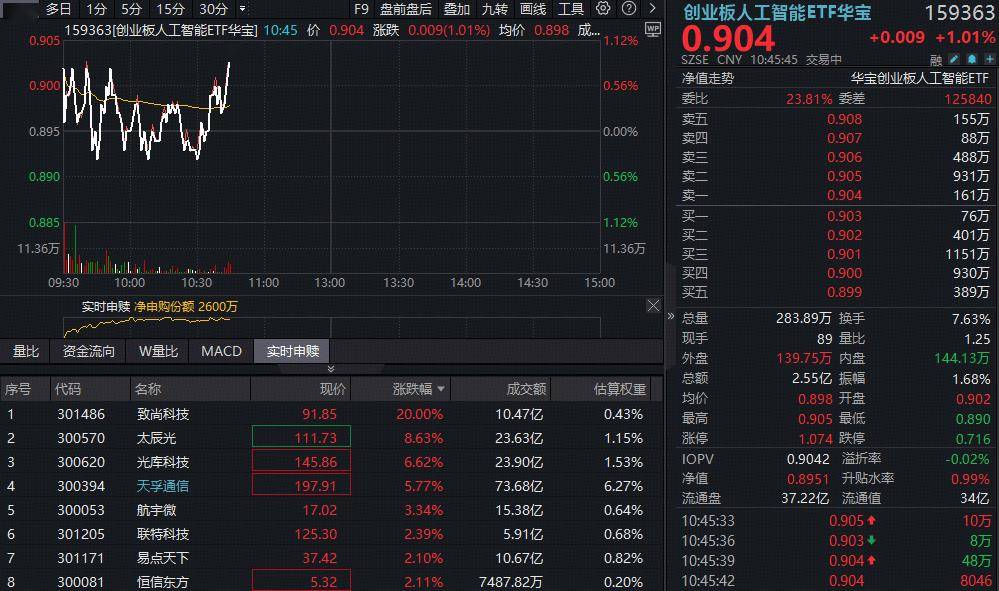
AI硬件逆市活跃,创业板人工智能ETF(159363)涨逾1%交投领跑!算力基建产业链迎戴维斯双击
Sou Hu Cai Jing· 2025-12-05 03:23
Group 1 - The core viewpoint of the news highlights the active performance of AI hardware stocks, particularly in the context of the entrepreneurial board, with significant gains in companies like Zhishang Technology and Taicheng Light [1] - The largest and most liquid AI-themed ETF, the Entrepreneurial Board AI ETF (159363), saw a 1% increase in value, with a trading volume exceeding 250 million yuan, leading the market in AI-themed ETFs [1] - Major AI hardware stocks such as optical modules and high-speed copper connections are experiencing a surge in demand, driven by the ongoing development of AI applications [3] Group 2 - Long-term investment opportunities are anticipated in the AI infrastructure sector, particularly in components like optical modules, PCBs, and copper cables, as demand rapidly increases [3] - Significant revenue growth and profit margin expansion are expected for leading optical module suppliers by 2025, supported by ongoing investments in AI infrastructure [3] - The Entrepreneurial Board AI ETF (159363) is positioned to capture market trends effectively, with over 70% of its portfolio allocated to computing power and more than 20% to AI applications [3]




中金:供需紧平衡且供给扰动频发 继续看涨锡价和锡板块估值扩张
智通财经网· 2025-11-25 09:00
Core Viewpoint - The demand for tin solder is expected to accelerate due to AI-driven computing infrastructure, innovation cycles in smart devices, and the electrification/intelligentization of automobiles, with a projected CAGR of 7% from 2024 to 2030 [1][2]. Group 1: Demand Drivers - The demand for tin solder is driven by AI advancements, smart device innovation, and the automotive sector's shift towards electrification and intelligence [2]. - Traditional demand is also expected to benefit from global fiscal and monetary policy easing, with a growing urgency for "safety stock" in the context of de-globalization, leading to a projected global tin demand CAGR of 4.3% from 2024 to 2030 [2]. Group 2: Supply Constraints - Major tin-producing regions are facing resource constraints and frequent disruptions, with China's tin reserves and static reserve-to-production ratio declining due to insufficient prior exploration [3]. - Indonesia is experiencing multiple issues, including shrinking tin reserves, declining grades, and increased mining difficulties, compounded by frequent policy changes that exacerbate supply disruptions [3]. - Myanmar's previous extensive mining practices have led to significant declines in grade and output, with uncertainties surrounding the resumption of production in the Wa region [3]. - Other regions have projects mostly in early stages, and the supply elasticity of recycled tin is limited due to the miniaturization of solder [3]. Group 3: Supply-Demand Balance and Price Outlook - The supply-demand balance is expected to remain tight, with projected supply-demand ratios for tin from 2025 to 2030 being -6%, -1%, +1%, +1.6%, +1%, and -0.3% respectively [4]. - The continuous decline in global tin ore grades is pushing up industry cost lines, alongside rising global inflation expectations and geopolitical risk premiums, which may elevate the incentive prices for potential global tin mining projects [4]. Group 4: Investment Recommendations - Since 2020, the central price of tin has increased, leading to overall improved industry profitability and valuation normalization, with the current industry PE at the 21st percentile of the past five years [5]. - The industry remains bullish on tin prices and valuation expansion, recommending a focus on companies like Tin Industry Co., Ltd. (000960.SZ) that have strong resource endowments and growth potential [5].
