贸易不确定性

Search documents
2025年终报道②丨被美国“不稳定关税”反复折磨的加拿大,将目光投向北美之外
Sou Hu Cai Jing· 2025-12-23 14:49
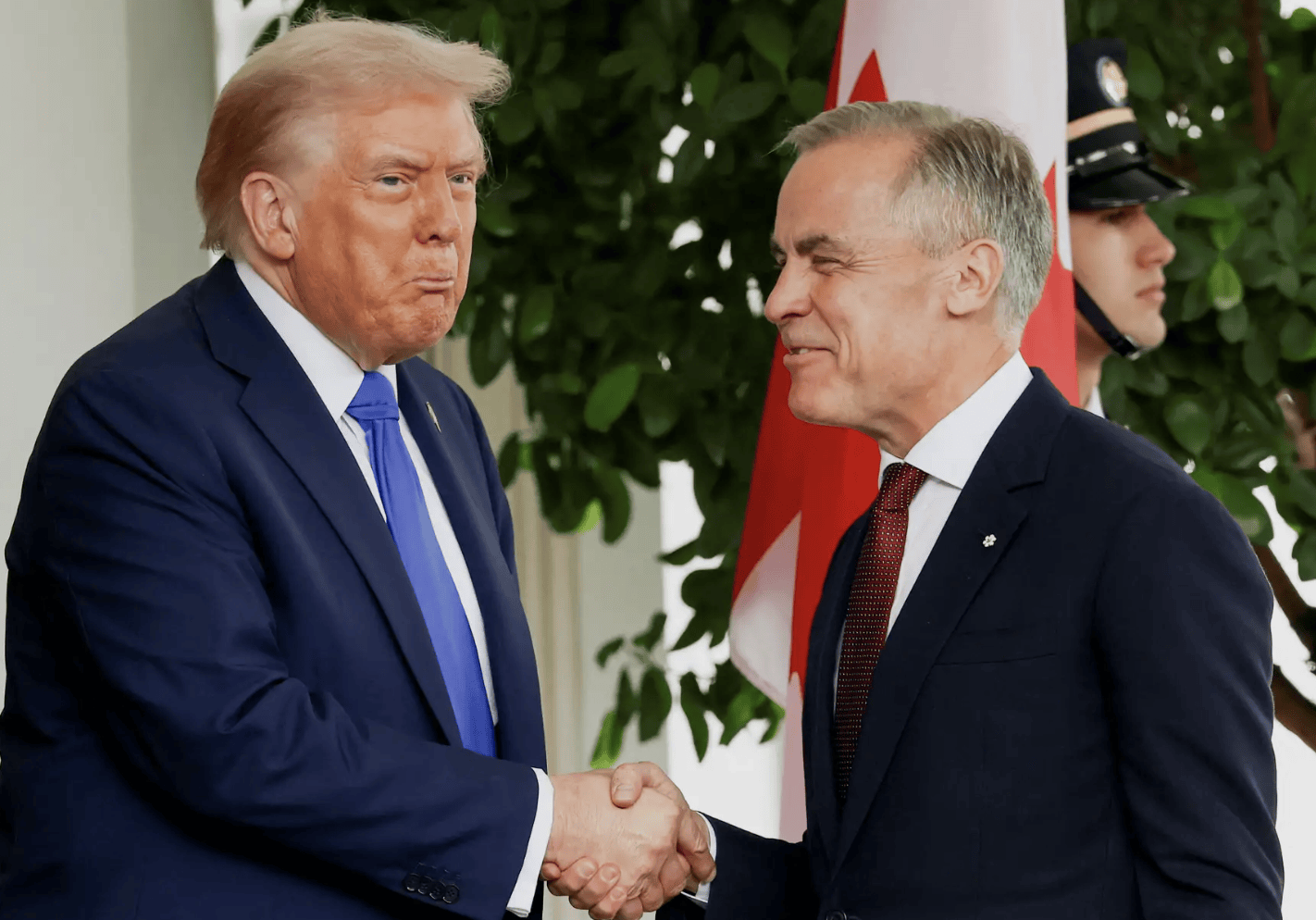
"要让加拿大成为美国第51个州""要给加拿大加关税""要停止与加拿大的贸易谈判"……自今年重返白宫以来,特朗普组建的政府多次挥舞"关税大棒"施压相 关国家与之谈判,而与之相邻的加拿大便成了重点目标。 在特朗普政府的反复威胁下,加拿大也掀起一阵"抵美风波":多地爆发抗议活动,加拿大商店下架美国酒类……如今,加拿大经济在美关税政策带来的"不 确定性"中颠簸。 加拿大独立企业联合会(CFIB)负责国际贸易与市场竞争的总监米歇尔·奥格尔在接受红星新闻采访时称,对加拿大企业,尤其是中小型企业而言,美国的 关税政策变化就意味着不确定性的增加,而这种不确定性会转化为切实的经济损失。奥格尔说,当下维系北美市场贸易的规则被打乱,贸易紧张局势动摇了 人们的信心,也让不少加企选择将业务重心从美国转移。 ▲特朗普与加拿大总理卡尼(资料图) 近半企业利润下滑 "保生存"成企业重点 在"给加拿大加关税"的问题上,特朗普政府呈现出反反复复的态度。有评价称,加拿大可能最终会与美国达成贸易协议,但没人知道到底是多久,"当我们 满怀希望看着总理(卡尼)和美总统之间的关系向好时,美商务部长卢特尼克就会带来坏消息。"奥格尔认为,美国这种不稳定的关税 ...

印度卢比跌至纪录新低 贸易不确定性和资金外流令市场情绪承压
Ge Long Hui· 2025-12-16 04:24
Group 1 - The Indian Rupee has hit a record low against the US Dollar due to continuous capital outflows from local assets and delays in finalizing a trade agreement with the US, impacting market sentiment [1] - The USD/INR exchange rate rose by 0.1% to 90.8250, reaching a new all-time high [1] - Foreign investors have sold nearly $18 billion worth of Indian stocks this year, with an additional $1 billion in bond sales in December, ending a five-month buying streak [1]
印度卢比一度跌至纪录新低 贸易不确定性和资金外流令市场情绪承压
Xin Lang Cai Jing· 2025-12-16 03:55
Core Viewpoint - The Indian Rupee has hit a record low against the US Dollar due to continuous capital outflows from local assets and delays in finalizing a trade agreement with the United States, which has negatively impacted market sentiment [1]. Group 1: Currency Movement - The USD/INR exchange rate rose by 0.1% to 90.8250, reaching a record high [1]. - The Indian Rupee's depreciation is attributed to ongoing foreign investor sell-offs [1]. Group 2: Foreign Investment Trends - Foreign investors have sold nearly $18 billion worth of Indian stocks year-to-date [1]. - In December, foreign investors also sold $1 billion in bonds that meet the country's index inclusion criteria, potentially ending a five-month buying streak [1].
印美贸易不确定性持续之际 印度卢比触及纪录新低
Xin Lang Cai Jing· 2025-12-11 08:40
Core Viewpoint - The Indian Rupee has depreciated over 0.5%, reaching a record low of 90.4863 Rupees per US Dollar due to ongoing uncertainties regarding the trade agreement with the United States [1] Group 1: Currency Performance - The Indian Rupee hit a record low against the US Dollar, trading at 90.4863 Rupees per Dollar [1] - The depreciation of the Rupee is attributed to foreign capital outflows and increased demand for US Dollars from importers [1]
印度宣布降息!
证券时报· 2025-12-05 07:27
Core Viewpoint - The Reserve Bank of India (RBI) has cut interest rates by 125 basis points this year, with the latest reduction of 25 basis points announced on December 5, marking the fourth cut of the year. The RBI is also easing its intervention in the currency market as the Indian rupee continues to depreciate [1][3]. Group 1: Interest Rate Cuts - The RBI's Monetary Policy Committee, led by Governor Sanjay Malhotra, unanimously voted to lower the repo rate to 5.25%, maintaining a neutral policy stance. Malhotra noted that low inflation and strong economic growth indicate a "rare golden period" for India, despite some key economic indicators showing weakness [3]. - The third quarter saw bank economic growth at 8.2%, exceeding expectations, while inflation was only 0.25%. However, there are concerns about potential economic slowdown in the second half of the fiscal year due to global trade uncertainties [3]. Group 2: Economic Indicators - Industrial activity in India fell to its lowest point in nearly 14 months in October, with the HSBC manufacturing PMI dropping to a near nine-month low in November, indicating an economic slowdown. Exports to the U.S. have also declined for two consecutive months, with a year-on-year drop of 8.5% in October and an overall export decline of 11.8% [3]. - In response to U.S. tariffs on Indian goods, the Indian government reduced the Goods and Services Tax rate in September to boost domestic demand. Tax revenue surged to ₹1.95 trillion in October, a 4.6% year-on-year increase, but growth slowed to 0.7% in November with total tax revenue at ₹1.7 trillion [3]. Group 3: Currency Depreciation - The RBI has signaled a tolerance for the depreciation of the Indian rupee, which has faced multiple risks, including an expanding trade deficit and capital outflows. The rupee fell to a historic low of 90 rupees per dollar on November 3 [6]. - The RBI's intervention strategy is shifting to focus on curbing excessive volatility rather than defending a specific exchange rate, as maintaining foreign exchange reserves is deemed ineffective under adverse fundamental conditions [6]. - Foreign investors have sold $17 billion worth of Indian stocks this year, contributing to the capital outflow, while foreign direct investment and trade flows have also slowed [6].
联合国报告:明年世界经济活动或保持“低迷”
Jin Shi Shu Ju· 2025-12-03 02:17
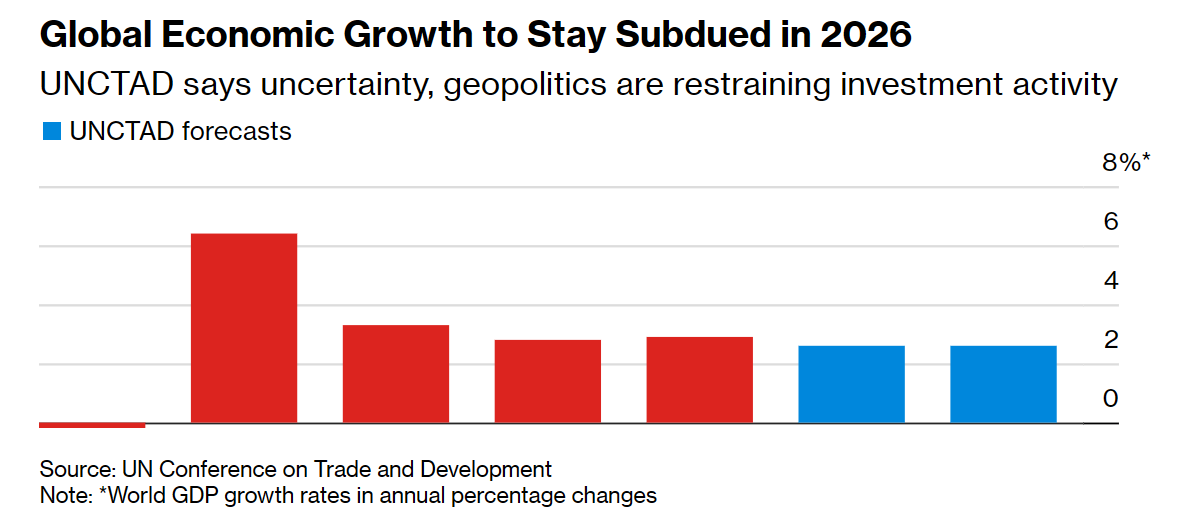
Core Insights - The UNCTAD report predicts a "sluggish" global economic activity in 2024, influenced by trade uncertainties and geopolitical tensions [1][3] - Global economic growth is expected to slow to 2.6% this year, maintaining this rate until 2026, which is 0.4 percentage points lower than the pre-pandemic average [1][3] Economic Risks - The report highlights risks in the economic and financial markets, particularly due to unpredictable tariff policies under the Trump administration [3] - Developing economies remain vulnerable to exchange rate fluctuations and punitive tariffs imposed by the US on their exports [3] Global Economic Disparities - There is a concerning gap among "Global South" economies, which account for over 40% of global GDP, half of foreign direct investment flows, and approximately 45% of goods trade, yet remain marginalized in global equity and bond markets [3] Trade and Financial Interdependence - Approximately 72% of global trade is governed by WTO's most-favored-nation rules, while 90% of international trade relies on a concentrated global financial system [3][4] - The interdependence in the short term helps avoid disruptions and signals policy adjustments, as seen in the market reactions following Trump's tariff announcements [4] Currency Dynamics - The report discusses the imbalance between the rules-based global trade matrix and the centralized global financial system, emphasizing the dominance of the US dollar [5] - Despite a decline in the dollar's share of international reserves, no suitable challenger has emerged to replace it, indicating a trend towards de-dollarization without a viable alternative currency [5]
美联储降息预期摇摆,黄金价值持续
Guo Xin Qi Huo· 2025-11-25 03:57
Report Industry Investment Rating - Not mentioned in the provided content Core Viewpoints of the Report - Gold will continue to demonstrate its unique allocation value in the medium to long term, supported by factors such as continuous gold purchases by global central banks, monetary policy shifts, ongoing trade uncertainties, and recurring geopolitical risks. Short - term fluctuations in the Fed's interest - rate cut expectations only limit gold's upward movement but do not reverse the bullish trend [3][12] - The Fed's interest - rate cut path may be "stop - and - go" due to inflation stickiness and economic data fluctuations. Policy expectation revisions will be a key factor affecting the volatility rhythm of precious metals [3][12] - Global trade tensions and geopolitical conflicts in the Middle East and between Russia and Ukraine provide support and increase the volatility of precious metals [3][12] Summary by Related Content Fed Policy and Personnel Changes - In 2026, the Fed's Monetary Policy Committee will undergo a major personnel reshuffle. Fed Chair Powell's term ends on May 15, 2026, and Trump's administration is accelerating the selection of a new chair. Five final candidates have been short - listed, with a possible pre - Christmas 2025 announcement. This may lead to a "dual leadership" situation in the first half of 2026 [6] - Atlanta Fed President Bostic will retire in February 2026. His retirement and the selection of his successor will be an important window to observe the White House's influence on the Fed. The Fed's internal policy differences will become more complex, with the dovish camp strengthening and the hawkish camp remaining a counterbalance [7] - Any news of personnel changes may cause the market to re - evaluate the direction of monetary policy, directly affecting precious - metal prices. Investors should closely monitor these changes to predict the 2026 precious - metal market volatility [8] Gold Market Performance in 2025 Q3 - The global gold market showed strong performance in Q3 2025, with both supply and demand booming. Total demand (including over - the - counter transactions) reached 1,313 tons, a record quarterly high, a 3% year - on - year increase. The demand value soared 44% year - on - year to $146 billion. Supply also increased by 3% to 1,313 tons, with mine production rising seasonally to 977 tons and recycled gold supply remaining at a high of 344 tons [8] - The LBMA gold price hit 13 record highs in Q3, with a quarterly average price of $3,456.54 per ounce, a 40% year - on - year increase [8] Gold Market Demand Structure - Investment demand continued to dominate the market in Q3 2025. Global gold ETF holdings increased by 222 tons, and demand for gold bars and coins exceeded 300 tons for the fourth consecutive quarter, reaching 316 tons. Gold jewelry consumption decreased to 371 tons but the consumption value increased to $4.1 billion due to rising gold prices [9] - Global gold ETFs' significant increase in positions drove up the total holdings, with North American and Asian markets being the main sources of capital inflows. As of November 20, 2025, the holdings of the world's largest gold ETF, SPDR Gold Shares, increased by 19.13% compared to the end of 2024, indicating strong institutional demand for gold [9] Price Trends and Investment Suggestions - The COMEX gold futures contract may form strong support in the range of $3,900 - $4,000 per ounce. If it can effectively break through the $4,200 mark, the next target may be around $4,400 per ounce. The Shanghai gold futures contract may fluctuate in the range of 900 - 950 yuan per gram [4][13] - Silver is more elastic due to the resonance of supply - demand tightness and financial attributes. Investors are advised to maintain a long - position strategy when gold prices pull back, and focus on the Fed's interest - rate decision path, inflation data inflection points, and geopolitical situations [4][13]
G20国家受关税影响贸易额创WTO观测史上最大增幅,后续会怎样?|全球贸易观察
Di Yi Cai Jing· 2025-11-14 10:35
Group 1 - The trade volume affected by tariffs among G20 countries has increased approximately fourfold compared to the previous reporting period, marking the largest increase in WTO trade monitoring history [1][4] - During the period from mid-October 2024 to mid-October 2025, 14.3% of imported goods in G20 countries (approximately $2.599 trillion) are impacted by tariffs and other measures, which is more than four times the previous record of $599 billion [4] - The WTO reported that a total of 185 measures are affecting trade valued at approximately $2.9 trillion, compared to $829 billion in the previous G20 report [4] Group 2 - G20 countries have implemented 184 new trade facilitation measures covering about $2.055 trillion in trade, nearly double the previous report's $1.07 trillion [5] - In the services trade sector, G20 countries introduced 52 new measures, with over two-thirds aimed at promoting trade [5] - The WTO noted that despite rising trade barriers, there is a continued dialogue among members rather than retaliatory actions [5] Group 3 - The WTO economists predict a global goods trade growth rate of 2.4% for 2025, but this forecast has been significantly downgraded to 0.5% for 2026 [6] - Oxford Economics reported a slowdown in global trade growth from 4% in 2025 to 1% in 2026, with U.S. tariffs impacting trade performance differently across countries [7] - The uncertainty surrounding trade policies is expected to have a negative impact on investment, with trade policy uncertainty remaining above long-term averages [7][8]

金荣中国:白银亚盘继续震荡走高,市场趋势转向看涨方向
Sou Hu Cai Jing· 2025-11-11 03:51
Group 1: Market Overview - Silver prices experienced a daily increase of 1.60%, reaching $50.72 per ounce, influenced by internal divisions within the Federal Reserve regarding further interest rate cuts [1] - The longest government shutdown in U.S. history lasted 41 days, causing significant economic pressure, yet optimism about a potential resolution has emerged, raising market risk appetite [3] - Despite improved risk sentiment, gold prices continued to rise, driven by lingering economic concerns and expectations of interest rate cuts [3] Group 2: Economic Factors - The Federal Reserve faces challenges balancing inflation pressures and weak employment, with differing views among its members on the need for further rate cuts [1] - U.S. container cargo imports fell by 7.5% year-on-year in October, with a notable 16.3% drop in goods from China, reflecting ongoing trade uncertainties [4] - The U.S. Treasury yield curve is flattening, indicating investor concerns about rising inflation expectations and the potential pause in the Fed's rate-cutting cycle [4] Group 3: Technical Analysis - The silver market is currently in an upward price trend, with a support level identified at approximately $49.36 [8] - The MACD indicator shows a bullish trend, although market activity is decreasing, suggesting cautious trading strategies [8] - Suggested trading strategies include positioning for long trades near the support level and short trades at resistance levels, emphasizing a light trading approach [8]

美国疲软数据加剧经济担忧,金价狂飙近3%收复4100!
Sou Hu Cai Jing· 2025-11-11 03:11
Core Viewpoint - The recent surge in gold prices is driven by weak U.S. economic data and rising expectations for interest rate cuts by the Federal Reserve, making gold an attractive non-yielding asset for investors [1][3]. Economic Data Impact - A series of disappointing economic indicators from the U.S. has shattered market optimism about economic strength, particularly a significant drop in October job numbers and a decline in consumer confidence [3]. - The market now assigns a 64% probability to a rate cut in December, increasing to approximately 77% by January [3]. Federal Reserve Divergence - There is a notable division within the Federal Reserve regarding the approach to further rate cuts, with some members advocating caution due to inflation concerns, while others support aggressive cuts [4][5][6]. - This internal debate adds uncertainty to the gold market, but the prevailing low-rate expectations are likely to support gold prices [6]. Government Shutdown and Market Sentiment - The prolonged U.S. government shutdown has created significant economic strain, but recent legislative progress suggests a potential resolution, which has improved market risk appetite [7]. - Despite this positive sentiment, gold prices continue to rise due to lingering economic damage and persistent rate cut expectations [7]. External Factors Influencing Gold Prices - Gold prices are also influenced by external factors such as tariffs and global trade uncertainties, with a notable decline in U.S. imports from China [8]. - The flattening of the U.S. yield curve and rising short-term rates reflect investor concerns about inflation, further boosting gold's appeal as a safe haven [8]. Future Outlook - The outlook for gold remains optimistic, with predictions suggesting prices could range between $4,200 and $4,300 by year-end, and potentially reach $5,000 in Q1 of the following year [9]. - Continued low interest rates, economic uncertainty, and geopolitical trade tensions are expected to drive gold's performance [9].