高技术产业

Search documents
X @外汇交易员
外汇交易员· 2025-10-24 03:07
Strategic Emerging Industries - The "Suggestions" propose accelerating the development of strategic emerging industry clusters such as new energy, new materials, aerospace, and the low-altitude economy, which will generate several trillion-yuan-level (trillion CNY) or even larger markets [1] - The "Suggestions" also propose forward-looking layouts for future industries, promoting quantum technology, bio-manufacturing, hydrogen energy and nuclear fusion energy, brain-computer interfaces, embodied intelligence, and 6G mobile communication to become new economic growth points, which will recreate a Chinese high-tech industry in the next 10 years [1] Industrial System Development - The "Suggestions" place "building a modern industrial system and consolidating and strengthening the foundation of the real economy" as the top strategic task, deploying four key tasks that can be grasped from "strengthening the foundation and upgrading, innovating and cultivating new, expanding capacity and improving quality, and strengthening the foundation and increasing efficiency" [2]
河南开封加速优势主导产业转型升级
Zhong Guo Jing Ji Wang· 2025-10-22 15:04
Core Insights - The automotive industry in Kaifeng is undergoing a transformation, with companies like Quansheng Automotive Parts leveraging automation and high-quality production to serve both domestic and international markets [1][2] - Kaifeng is focusing on high-quality manufacturing, aiming to develop three trillion-level industrial chains in automotive manufacturing, new chemical materials, and modern food, along with four five-hundred-billion-level chains [2][3] Group 1: Automotive Industry Development - Quansheng Automotive Parts has implemented advanced robotic welding lines and automated assembly processes, producing high-quality metal components for automotive seats that are integrated into global supply chains [1] - The city has attracted nearly a hundred related enterprises, forming a trillion-level automotive manufacturing cluster, with significant contributions from leading companies like Chery, Haima, and BYD [1][2] - From January to August, Chery's production reached 175,600 vehicles, marking a 30.16% increase, with exports totaling 90,500 vehicles, a remarkable growth of 109.98% [1] Group 2: Industrial Chain and Investment - During the 14th Five-Year Plan, Kaifeng has prioritized high-quality development in manufacturing, successfully signing 56 projects with a total investment of 32.2 billion yuan in key industries [2] - The modern food sector in Kaifeng is thriving, with 36 nationally recognized agricultural products and significant investments from well-known food companies, aiming for a total industry output value exceeding 6 billion yuan by 2024 [2] - The fine chemical park in Kaifeng has become the only development zone in Henan focused on fine chemicals, with leading production capacities in various chemical products [2] Group 3: Technological Advancements and Support - Kaifeng is actively updating equipment and undergoing technological transformations, with 24 projects included in the Ministry of Industry and Information Technology's special relending project list [3] - The city is enhancing its business environment and supporting enterprises, focusing on key projects like Chery's passenger vehicle upgrades and the expansion of the chemical park [3] - High-tech and strategic emerging industries in Kaifeng are experiencing over 10% growth in added value, indicating a robust industrial development trajectory [3]
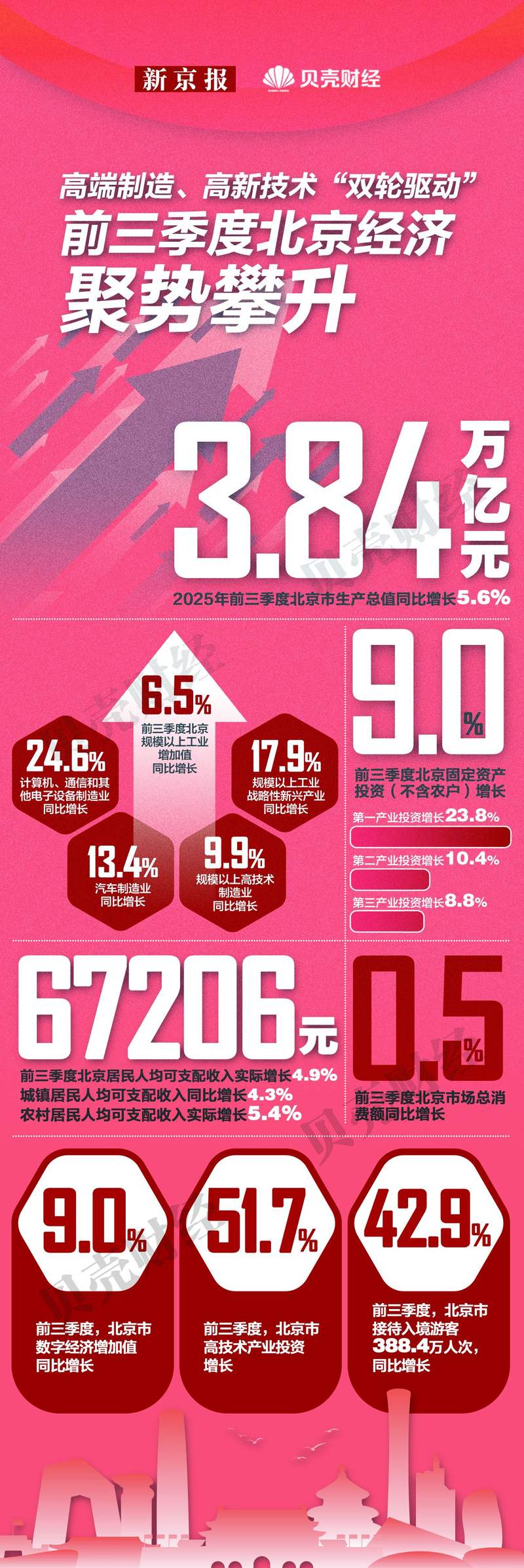
北京经济前三季度“稳中提质”,三大优势行业引领增长
Xin Jing Bao· 2025-10-22 12:56
Economic Performance - Beijing's GDP reached 38,415.9 billion yuan in the first three quarters, with a year-on-year growth of 5.6% at constant prices [1] - The information transmission, software and IT services, financial services, and industrial sectors contributed over 80% to the city's economic growth, accounting for 52.5% of the GDP [1] Sector Contributions - The third sector's value added grew by 5.8% year-on-year, with an increase of 0.2 percentage points compared to the first half of the year [1] - The information transmission, software, and IT services sector saw an 11.2% increase in value added, while the financial sector grew by 9.0% [1] - Digital economy value added increased by 9.0%, with core industries growing by 10.7% [1] Industrial Growth - The industrial output value for large-scale enterprises grew by 6.5% year-on-year, with significant growth in computer, communication, and electronic equipment manufacturing (24.6%) and automotive manufacturing (13.4%) [2] - High-tech manufacturing and strategic emerging industries saw value added growth of 9.9% and 17.9%, respectively, with their shares in industrial output increasing [2] Consumer Trends - Service consumption in Beijing grew by 4.8% year-on-year, with significant increases in large events and cultural spending [2] - The number of inbound tourists reached 3.884 million, marking a 42.9% increase year-on-year [2]

前三季度北京新能源汽车产量同比增长1.5倍
Zhong Guo Xin Wen Wang· 2025-10-22 06:23
Group 1: Industrial Growth in Beijing - In the first three quarters of this year, the output of new energy vehicles in Beijing increased by 1.5 times year-on-year [1] - The added value of strategic emerging industries and high-tech manufacturing in Beijing grew by 17.9% and 9.9% respectively [1] - The production of lithium-ion batteries, wind turbines, service robots, and CNC metal cutting machine tools also saw significant increases, with growth rates of 1.6 times, 47.1%, 39.6%, and 19.1% respectively [1] Group 2: Economic Indicators - The industrial added value in Beijing, calculated at comparable prices, increased by 6.5% [1] - The sales output of industrial enterprises above designated size reached 20,223.5 billion yuan, marking a growth of 6.7% [1] - The domestic sales output was 18,634.6 billion yuan, also growing by 6.7%, while the export delivery value increased by 6.0% [1] Group 3: Consumer Prices and Producer Prices - In the first three quarters, the consumer price index in Beijing decreased by 0.4%, with consumer goods prices down by 0.7% and service prices remaining stable [2] - The producer price index for industrial producers continued to decline, with a decrease of 1.8% in factory prices and a 1.7% drop in purchase prices [2]
团结湖参考|最近披露的数据里,有条清晰的“线”
Sou Hu Cai Jing· 2025-10-22 03:39
Group 1 - China's goods trade import and export increased by 4% year-on-year in the first three quarters, despite the challenges posed by the US tariff war [1] - Exports have shown continuous growth for eight months, with a notable increase of 8% in September, indicating a steady upward trend [1] - The significant increase in foreign trade coincided with a sharp decline in exports to the US, which fell by 33% in August and 27% in September, demonstrating a diversification away from reliance on a single market [1] Group 2 - The GDP growth rate for the first three quarters was 5.2%, with a third-quarter growth of 4.8%, which is higher than most major economies [1] - Core CPI, excluding food and energy, rose by 0.6% in the first three quarters, with a 1.0% increase in September, indicating increased economic activity [2] - High-tech product exports grew by 11.9% in the first three quarters, contributing over 30% to overall export growth, reflecting an optimization in export product structure [2] Group 3 - China's trade with countries involved in the Belt and Road Initiative accounted for over 51% of total trade in the first three quarters, highlighting the strategic importance of this initiative amid US-China tensions [2] - The ongoing 20th Central Committee meeting is focused on formulating the 15th Five-Year Plan, emphasizing the long-term vision for national economic and social development [3]
新兴产业持续发展壮大!前三季度无人机制造销售收入同比增长69.8%
Sou Hu Cai Jing· 2025-10-17 09:25
Core Insights - The latest VAT invoice data from the National Taxation Administration indicates significant growth in emerging industries, particularly in integrated circuit manufacturing, robotics, and drone manufacturing, with sales revenue increasing by 17%, 21.7%, and 69.8% year-on-year respectively [1] Group 1: Industry Performance - High-tech industries and equipment manufacturing saw sales revenue growth of 15.2% and 9% year-on-year in the first three quarters [1] - Specific sectors such as computer communication equipment manufacturing, transportation equipment manufacturing (including railways, ships, and aerospace), instrument manufacturing, and general equipment manufacturing reported year-on-year growth rates of 13.5%, 10.5%, 9.9%, and 9.1% respectively [1] Group 2: Policy Impact - The tax authorities are effectively implementing tax reduction and fee exemption policies to support technological innovation, ensuring that policy benefits reach businesses quickly [1] - From January to August, the total tax reductions and refunds related to major policies supporting technological innovation amounted to 1.3336 trillion yuan, significantly alleviating the tax burden on enterprises and encouraging increased R&D investment [1] - The data shows that the amount spent by enterprises on R&D and technical services increased by 6.1% year-on-year in the first three quarters, indicating a sustained increase in R&D efforts [1]
A股成交额连续28个交易日超2万亿元
Zhong Guo Zheng Quan Bao· 2025-09-19 20:18
Market Overview - On September 19, the A-share market experienced a volatile adjustment, with all three major indices declining. Over 3,400 stocks fell while more than 1,900 stocks rose, indicating a prominent structural market trend with significant rotation [1][2] - The market's trading volume was 2.35 trillion yuan, marking the 28th consecutive trading day with volumes exceeding 2 trillion yuan, reflecting active trading [2] Index Performance - The Shanghai Composite Index fell by 1.30% this week, while the Shenzhen Component and ChiNext indices rose by 1.14% and 2.34%, respectively. The coal, electric equipment, and electronics sectors led the gains [1][3] - On September 19, the Shanghai Composite Index, Shenzhen Component, ChiNext Index, and other indices showed slight declines, with the Shanghai 50 Index down by 0.11% and the CSI 300 Index up by 0.08% [1][2] Sector Performance - The coal sector saw significant gains, with Huayang Co. rising over 7%, and other companies like Lu'an Environmental Energy and Jinkong Coal also increasing by over 5% [3] - In the non-ferrous metals sector, Ganfeng Lithium hit the daily limit, with its Hong Kong stock rising over 9%. The company is actively developing solid-state batteries for electric vehicles and drones [3] - The AI computing and robotics sectors, which previously led the market, experienced a pullback, indicating a normal rotation of profit-taking [3][6] Fund Flow Analysis - On September 19, the net outflow of main funds from the Shanghai and Shenzhen markets was 685.51 billion yuan, with 1,700 stocks experiencing net inflows and 3,448 stocks seeing net outflows [4][5] - The cautious sentiment among main funds continued, with net outflows recorded for five consecutive trading days, totaling over 3.8 billion yuan on September 15-18 [5] Investment Strategy - Analysts suggest that the A-share market is likely to continue its upward trend, although short-term volatility should be monitored. The changing market volume is a crucial observation signal [6] - Investment recommendations include focusing on technology sectors (AI, semiconductors) for aggressive strategies, while defensive strategies should consider pharmaceuticals and new consumption sectors [6]

从5432份中报看中国经济:3万亿净利背后产业升级的N个逻辑
21世纪经济报道· 2025-09-01 23:46
Economic Overview - In the first half of 2025, China's GDP reached 66.05 trillion yuan, with a year-on-year growth of 5.3% and domestic demand contributing nearly 70% [2][4] - The A-share market showed notable performance, with 5,432 listed companies reporting solid mid-year results, reflecting a stable operational trend [2][4] Industry Performance - Key industries such as steel, software services, building materials, media, and semiconductors exhibited significant net profit growth [5][8] - The "old-for-new" policy positively impacted sectors like home appliances, automobiles, and consumer electronics, leading to net profit increases [5][12] - New consumption and cultural tourism sectors continued to thrive, with many industries experiencing over 50% net profit growth [11][12] Financial Metrics - Total revenue for listed companies reached 35.01 trillion yuan, with a slight year-on-year increase of 0.16% [8] - Nearly 60% of companies reported revenue growth, and over 75% achieved profitability, with 1,943 companies showing both revenue and net profit growth [6][8] R&D Investment - A-share companies invested over 740 billion yuan in R&D, marking a year-on-year increase of 2.68% [13] - The R&D intensity reached 2.13%, with strategic emerging industries demonstrating significant innovation potential [13][14] Sector-Specific Highlights - The steel industry led with a remarkable net profit growth of 263.77%, followed by software services at 176.19% and building materials at 75.49% [7][8] - The new energy vehicle sector maintained high growth, with net profit increasing by 32% [12] - Emerging sectors like the pet economy and millet economy saw net profit growth of 39.67% and 54.21%, respectively [12]

从5432份中报看中国经济:3万亿净利背后产业升级的N个逻辑
2 1 Shi Ji Jing Ji Bao Dao· 2025-09-01 12:52
Economic Overview - In the first half of 2025, China's GDP reached 66.05 trillion yuan, with a year-on-year growth of 5.3%, driven largely by domestic demand contributing nearly 70% [4][5] - The A-share market reflects this positive macroeconomic backdrop, with 5,432 listed companies reporting solid mid-year results, indicating robust operational performance [5][9] Company Performance - Total revenue for all listed companies in the first half of 2025 was 35.01 trillion yuan, a year-on-year increase of 0.16%, while net profit reached 3 trillion yuan, growing by 2.54% [9][10] - Nearly 60% of companies reported revenue growth, and over 75% achieved profitability, with 2,475 companies showing positive net profit growth [9][10] Industry Highlights - Key industries such as steel, software services, building materials, media, and semiconductors exhibited significant net profit growth, with steel leading at 263.77% [8][9] - The "trade-in" policy has positively impacted sectors like home appliances, automobiles, and consumer electronics, with net profit growth exceeding 10% in these areas [10][13] Emerging Trends - New consumption trends are emerging, particularly in the tourism and pet economy sectors, with net profit growth exceeding 50% in related industries [11][13] - The government’s policies to stimulate consumption are yielding results, with the travel sector experiencing rapid growth due to improved visa policies [13] R&D Investment - A-share companies invested 745.69 billion yuan in R&D in the first half of 2025, marking a year-on-year increase of 2.68% [14][19] - The R&D intensity across various sectors is increasing, with the biopharmaceutical industry showing a remarkable R&D intensity of 13.21% [16][19]

2025年1—7月工业经济运行观察:政策效应显现,高技术产业引领增长
Bei Jing Shang Bao· 2025-08-27 11:36
Core Insights - The industrial economy in China is showing signs of stabilization and recovery, with a reported revenue of 78.07 trillion yuan for large-scale industrial enterprises from January to July, marking a year-on-year growth of 2.3% [2][3] - Despite a slight decrease in profit margin, high-tech manufacturing sectors have demonstrated significant profit growth, particularly in July, where profits surged by 18.9% compared to June [2][3] Revenue Growth - From January to July, large-scale industrial enterprises achieved a total profit of 40,203.5 billion yuan, reflecting a year-on-year decline of 1.7%, although the decline has narrowed by 0.1 percentage points compared to the first half of the year [3] - In July, the revenue growth rate was 0.9%, maintaining a continuous growth trend for seven months, which supports the recovery of corporate profits [2][3] Sector Performance - The mining sector reported a profit of 4,930.9 billion yuan, down 31.6% year-on-year, while the manufacturing sector saw profits of 30,235.8 billion yuan, an increase of 4.8% [3] - High-tech manufacturing has been particularly strong, with notable profit increases in aerospace manufacturing (40.9%) and integrated circuit manufacturing (176.1%) in July [3] Policy Impact - The "Two New" policies, which include large-scale equipment updates and consumer goods replacement incentives, have emerged as new drivers for industrial growth [5][6] - The equipment update policy has led to significant profit increases in specific sectors, such as electronic and electrical machinery (87.9%) and computer manufacturing (124.2%) [5][6] Financial Health - As of the end of July, the total assets of large-scale industrial enterprises reached 183.67 trillion yuan, a year-on-year increase of 4.9%, while total liabilities were 106.26 trillion yuan, up 5.1% [6] - The asset-liability ratio stands at 57.9%, reflecting a slight increase of 0.2 percentage points year-on-year, indicating a stable financial position [6] Future Outlook - Despite signs of recovery, challenges such as complex external environments and insufficient domestic demand remain, necessitating continued policy support and flexibility to bolster industrial economic foundations [7]