
K型复苏

Search documents
高盛提醒客户:在2008年金融危机爆发前,拉斯维加斯率先崩溃,而如今已经“复现”
Hua Er Jie Jian Wen· 2025-12-10 00:16
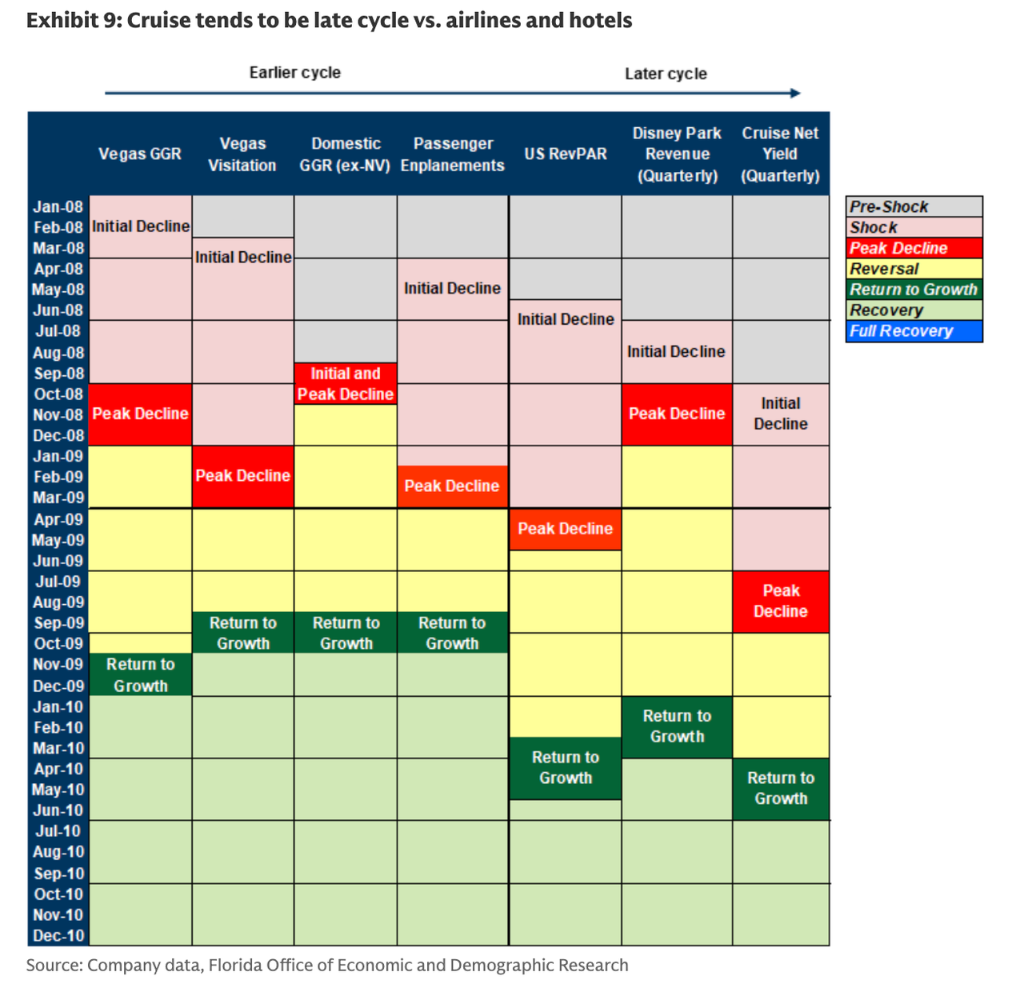
Group 1 - The current consumer spending environment is showing early warning signs similar to those before the 2008 financial crisis, with Las Vegas gaming revenue acting as an economic cycle indicator [1] - Goldman Sachs analysts, led by Lizzie Dove, report that consumer trends in Las Vegas are declining, reflecting early signs of economic recession [1][4] - Despite a K-shaped recovery and a bifurcated spending environment, the early signals warrant close attention from the market until early 2026 [1][4] Group 2 - The research establishes an analytical framework to identify the transmission path of consumer pressure, based on the responses of the tourism and leisure industry during the 2008-2009 recession [2] - Las Vegas and the airline industry were the first sectors impacted during the 2008 global financial crisis, with gaming revenue declining as early as February to March 2008 and airline boarding numbers showing a drop by mid-2008 [2] - In contrast, the hotel and cruise industries experienced a lag in their downturn, with U.S. hotel revenue per available room (RevPAR) starting to decline in late 2008 and cruise industry net yields reaching their lowest point by mid-2009 [2] Group 3 - The emphasis on historical consumer behavior patterns is due to the current K-shaped recovery and differentiated spending environment signaling early warning signs [4] - Las Vegas trends indicate a downward trajectory, consistent with early signs of economic downturn, while the airline sector remains robust [4] - If airline demand begins to decline following Las Vegas, it would provide clearer evidence of broader economic weakness, potentially necessitating macroeconomic policy adjustments [4]


美联储年终大戏即将上演
第一财经· 2025-12-09 01:07
2025.12. 09 本文字数:4121,阅读时长大约7分钟 作者 | 第一财经 樊志菁 当地时间12月9日,为期两天的美联储议息会议在美国华盛顿特区正式召开。 外界普遍预计,美联储将连续第三次降息,因为美国就业市场正在发出警报信号。 本次会议可谓看 点十足,表决可能再次出现多张反对票的情况,同时更新版经济预测如何预判就业和通胀前景,关键 的点阵图将如何表现,换届后是否会影响政策走向,如何通过资产负债表管理流动性等都将受到广泛 关注。 几张反对票 自今年夏季以来,美联储政策制定者之间的分歧逐渐显现。当时,通胀缓解进程陷入停滞,就业增长 同时放缓,这使得"2%通胀率"与 "充分就业"两大核心目标陷入直接冲突。 随后的政府停摆进一步加剧了局势复杂性 ——原本可能明确经济走向的数据发布被迫推迟,导致在 本周会议召开前,政策制定者对 "是否需要进一步降息以提振就业市场"这一问题持有的立场已基本 固化且分歧严重,反对者则认为当前通胀仍处于高位,降息风险过大。 纽约联邦储备银行行长威廉姆斯(John Williams)成为了打破僵局的关键。他在智利中央银行的一 场会议上表示,美国可以在不危及美联储通胀目标的前提下降息, ...
美联储年终大戏即将上演 一文解密四大看点
Di Yi Cai Jing· 2025-12-09 00:28
Core Viewpoint - The Federal Reserve is widely expected to lower interest rates for the third consecutive time due to alarming signals from the U.S. labor market, with significant attention on the potential for dissenting votes during the meeting and the implications for future monetary policy [1][2]. Group 1: Federal Reserve's Decision-Making Dynamics - Disagreements among Federal Reserve policymakers have become apparent since summer, with inflation and employment growth conflicting with the dual mandate of 2% inflation and full employment [2]. - The New York Fed President, John Williams, indicated that the U.S. could lower rates without jeopardizing inflation targets, suggesting room for further adjustments to the federal funds rate [2]. - Kansas City Fed President, Esther George, expressed concerns about high inflation and the risks of further rate cuts, while Boston Fed President, Susan Collins, showed hesitation towards additional cuts, citing the current policy as appropriate [3]. Group 2: Economic Outlook and Employment Trends - The latest economic outlook suggests moderate growth for the U.S. economy in 2026, with job creation expected to remain weak and inflation risks persisting [5]. - The median forecast for U.S. economic growth in 2026 is 2%, an increase from previous estimates, supported by stronger consumer spending and business investment [5]. - Inflation is projected to slightly decrease to 2.6% in 2026, with job growth remaining weak and the unemployment rate expected to rise to 4.5% [6]. Group 3: Interest Rate Predictions and Market Reactions - Market expectations indicate a potential for approximately 52 basis points of rate cuts by 2026, with predictions of two rate cuts occurring in the first three quarters of the year [9]. - Institutions like Morgan Stanley and Bank of America anticipate a 25 basis point cut in December, aligning with a more dovish outlook from Fed officials [9]. - The Fed's decision-making may be influenced by upcoming leadership changes, with a potential shift in policy direction depending on new appointments [9]. Group 4: Asset and Balance Sheet Management - The future trajectory of the Fed's balance sheet is considered as crucial as interest rate decisions, especially in light of recent pressures in the overnight funding market [12]. - The Fed has halted its balance sheet reduction process to avoid a repeat of past market crises, indicating a need for careful liquidity management [12]. - Analysts suggest that the Fed may initiate Treasury purchases to manage reserves, with expectations of monthly purchases starting in early 2024 [13].
美联储年终大戏即将上演,一文解密四大看点
Di Yi Cai Jing Zi Xun· 2025-12-09 00:24
Core Viewpoint - The Federal Reserve is widely expected to lower interest rates for the third consecutive time due to warning signals from the U.S. job market, with significant attention on the potential for dissenting votes during the meeting and the implications for future economic forecasts [1][3]. Group 1: Divergence Among Policymakers - Since summer, divisions among Federal Reserve policymakers have become apparent, particularly as inflation relief has stalled and job growth has slowed, creating a conflict between the goals of 2% inflation and full employment [3]. - The government shutdown has complicated the situation, delaying key economic data releases and solidifying differing stances on whether further rate cuts are necessary to boost the job market [3]. - New York Fed President John Williams indicated that the U.S. could lower rates without jeopardizing inflation targets, suggesting that current monetary policy is moderately restrictive and that there is room for adjustment [3]. Group 2: Economic Resilience and Rate Cut Hesitance - Boston Fed President Susan Collins expressed hesitance towards further rate cuts, believing current policy is appropriately restrictive and can maintain downward pressure on inflation [4]. - Despite some sectors showing weakness, the overall economy remains resilient, with consumer spending and business investment expected to support growth, although inflation risks persist [6]. - The Federal Open Market Committee (FOMC) may see multiple dissenting votes, with five policymakers previously expressing opposition or skepticism towards further rate cuts [5]. Group 3: Economic Outlook and Inflation - The latest economic outlook suggests moderate growth for the U.S. economy, with a median growth forecast of 2% for 2026, up from previous estimates, but job creation is expected to remain weak [6]. - Inflation is projected to slightly decrease to 2.6% by 2026, with tariffs identified as a significant factor driving prices higher [6]. - The labor market is anticipated to remain weak, with the unemployment rate expected to rise to 4.5% in early 2026, consistent with previous Fed forecasts [6]. Group 4: Future Rate Cut Predictions - Regardless of the December decision, internal resistance within the Fed is expected to be greater than at any time in the past eight years, with divisions likely to persist into the next year [8]. - Market expectations indicate a potential for approximately 52 basis points of rate cuts by 2026, equivalent to two rate cuts [8]. - Institutions predict that the Fed will complete two rate cuts in the first three quarters of the year, with varying timelines for implementation [8]. Group 5: Asset Management and Liquidity - The future direction of the Fed's balance sheet is considered equally important as interest rate decisions, especially in light of recent pressures in the overnight funding market [11]. - The Fed has halted its balance sheet reduction process to avoid a repeat of past market crises, indicating a focus on maintaining liquidity [11]. - Analysts suggest that the Fed may need to conduct regular Treasury purchases to manage reserves effectively, with expectations for monthly purchases starting in early 2024 [12][13].
重视免税板块投资机会
2025-12-01 16:03
Summary of Conference Call on Duty-Free Industry and China Duty-Free Group Industry Overview - The duty-free industry in China is experiencing a new growth phase, similar to the situations in 2020 and 2017, despite short-term economic challenges in China [1][2] - The overall trend remains positive, with stock market development and recovery in entrepreneur confidence being encouraging signals [1][2] Key Insights - **K-Shaped Recovery**: Consumer behavior is showing a K-shaped recovery, where high-income and low-end consumer groups are less affected. Government measures such as increased holidays and subsidies are promoting consumption [1][2] - **Sales Performance**: Since Q3 2025, duty-free sales in Hainan have gradually improved from a low base, significantly boosted by the launch of the iPhone 17 [1][3] - **Tourism Demand Shift**: Southeast Asian tourism demand is shifting to Hainan due to events like the Thailand fraud incident and tensions in Sino-Japanese relations, which is expected to enhance tourism and duty-free demand in Hainan [3] - **Luxury Goods Demand**: There is an increase in demand for luxury goods, particularly among high-income groups, with a notable rise in the sales proportion of premium products since July [3] Company-Specific Insights - **China Duty-Free Group (CDFG)**: CDFG is maintaining a strong position in the high-end consumer market, with top-tier properties in Sanya and Haikou. The LV store in Haitang Bay is noted as the best-selling LV store in China, showcasing CDFG's strong brand attraction and leasing capabilities [1][4] - **Market Position**: CDFG's market share and sales are on the rise, while other duty-free operators in Hainan, such as Shen免, Hai旅, and 中出服, are losing competitive edge in the cosmetics sector [2][5] Future Outlook - **Optimistic Projections**: The outlook for Hainan and airport duty-free stores is optimistic, with expectations of a full recovery across the duty-free industry chain if consumer policies are effectively implemented [6] - **Competitive Landscape**: CDFG is expected to maintain its leading position in the market, especially in airport bidding processes, due to its historical advantages [6] - **Investment Opportunities**: It is considered a good time for investors to focus on the duty-free sector, particularly on leading companies like CDFG and Wangfujing, as the luxury segment is beginning to recover [8] Additional Considerations - **Policy Support**: New policies allowing unlimited use of a 100,000 yuan duty-free quota for island residents are anticipated to boost consumption during the New Year and Spring Festival [3] - **Investment Strategy**: While Wangfujing may offer short-term opportunities, CDFG is viewed as having a more stable market position and higher probability of success in the long run [7][8]

11.18日报
Ge Long Hui· 2025-11-18 12:23
Group 1 - The total GMV for Double Eleven reached 1,695 billion, a year-on-year increase of 14%, with traditional e-commerce at 1,619.1 billion (+12%) and instant retail at 67 billion (+138%), while community group buying dropped to 9 billion (-90%) [1] - The data indicates a K-shaped recovery, where high-end consumption, such as high-end cosmetics, grew by approximately 20%, while mid-to-low-end consumption remained flat [1] - The performance of high-end consumption is linked to the bull market, suggesting that those benefiting from the stock market are typically higher-income individuals, contrasting with the more accessible real estate market [1] Group 2 - Yum China (KFC China) announced plans to return 100% of its free cash flow to shareholders starting in 2027, equating to an approximate dividend yield of 6% or share buybacks, with future growth expectations [1] - Luckin Coffee reported Q3 revenue growth of 50% year-on-year, but net profit decreased by 2.7%, indicating that aggressive subsidies in the delivery battle may not be sustainable long-term [2] - Xpeng Motors achieved Q3 revenue of 20.38 billion, a year-on-year increase of 101.8%, with a gross margin of 20.1% (+4.8%), and a narrowed net loss of 380 million, but market sentiment remains cautious due to previous stock price increases and ongoing profitability concerns [2]
美银Hartnett:2026年“最佳交易”是“做空云大厂债券”,明年5月前市场不太可能“停止做多股市”
美股IPO· 2025-11-17 03:38
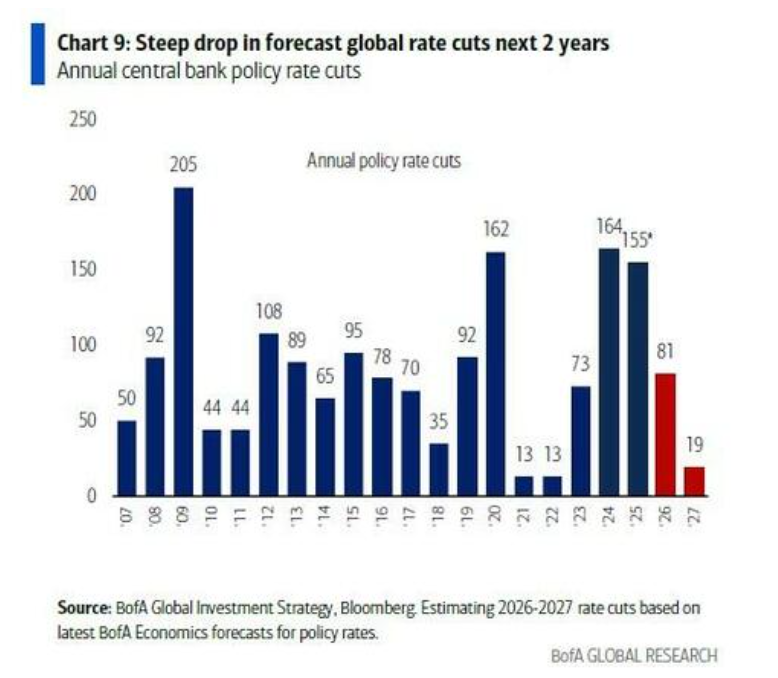
Group 1 - The core viewpoint of the article is that the AI-driven capital expenditure will exceed corporate cash flow capabilities, leading to significant debt accumulation, while the global financial conditions have peaked, increasing credit risks [1][3][4] - Michael Hartnett predicts that the best trade entering 2026 will be shorting the bonds of hyperscaler companies heavily investing in AI, as the debt pressure from AI will become their Achilles' heel [3][4] - Hartnett emphasizes that the easing financial conditions that supported the AI boom are reaching a turning point, with a significant reduction in expected interest rate cuts from 167 in the past year to 81 in the next [3][4][6] Group 2 - The tightening liquidity is causing increasing concerns about credit market strains and financing for capital expenditure, with technology companies' capital spending for AI exceeding cash flow support [6][10] - Hartnett highlights the disparity in borrowing costs, noting that while Wall Street benefits from loose financial conditions, Main Street faces unaffordable borrowing costs, with government borrowing at 4% and credit card rates as high as 20% [10][11] - The article discusses a "Goldilocks" scenario where lower rates and higher profits continue to drive the market until May 2024, supported by various options that keep asset allocators bullish on stocks [13][14] Group 3 - Hartnett identifies macro trading opportunities, suggesting that tax cuts, interest rate reductions, and U.S. industrial policies will boost the Purchasing Managers' Index (PMI) towards the expansion zone [15][17] - The article points out that U.S. small-cap stocks are undervalued compared to the S&P 500, presenting a potential for catch-up gains [19] - Hartnett warns that the rebound in early cyclical sectors like real estate and retail may be weak, indicating potential negative impacts from AI on employment and job security [20][21]

美银Hartnett:2026年“最佳交易”是“做空云大厂债券”,明年5月前市场不太可能“停止做多股市”
Hua Er Jie Jian Wen· 2025-11-17 01:08
Core Viewpoint - The report by Bank of America strategist Michael Hartnett predicts that the best trade entering 2026 will be shorting the bonds of hyperscaler companies heavily invested in AI, as debt pressures from AI will become a significant vulnerability for these tech giants [1][2]. Group 1: Financial Conditions and Debt Risks - Hartnett's bearish logic is based on the changing financial conditions, noting that the past year saw 167 rate cuts by global central banks, but this momentum is expected to decrease to 81 cuts in the next year [2][4]. - The tightening of liquidity is leading to increased concerns about credit market strains and the financing of capital expenditures for AI, which have exceeded cash flow capabilities, resulting in widening bond spreads and credit default swaps (CDS) [4][6]. Group 2: Economic Disparities and Borrowing Costs - Hartnett highlights a core contradiction in the U.S. economy, where financial conditions have led to prosperity for Wall Street, but borrowing costs for Main Street remain "unaffordable," with various interest rates significantly higher than government borrowing costs [6][7]. - The disparity in borrowing costs is illustrated by the following rates: U.S. government borrowing at 4%, investment-grade companies at 5%, and credit card APRs reaching 20% [6][7]. Group 3: Market Sentiment and Future Outlook - Despite credit concerns, Hartnett believes that the macro narrative supporting the market remains strong, characterized by a "Goldilocks" scenario of lower rates and higher profits, with expectations of continued stock market preference until May 2026 [8]. - The date of May 15, 2026, is significant as it marks the appointment of a new Federal Reserve chair, with expectations of a more dovish stance, which may support stock preferences until then [8]. Group 4: Macro Trading Opportunities - Hartnett identifies macro trading opportunities, suggesting that tax cuts, interest rate reductions, and U.S. industrial policies will drive the Purchasing Managers' Index (PMI) towards an expansionary range [9][11]. - He expresses optimism for commodities and U.S. small-cap stocks, which are currently undervalued compared to the S&P 500 index, indicating potential for a rebound [11][13]. Group 5: Inflation and Long-term Bonds - Hartnett proposes a "reverse trade" regarding inflation, suggesting that if the U.S. core Consumer Price Index (CPI) falls to 2%, it would benefit long-term U.S. Treasuries [15]. - He anticipates that the government may intervene directly in pricing to control costs in key sectors, which could negatively impact profit margins but create further upside for long-term bonds [15].
摩根大通:AI和半导体上升周期将延长至2027年,看好亚洲科技股在明年的表现
美股IPO· 2025-11-12 10:19
Core Viewpoint - Morgan Stanley's latest research indicates that despite ongoing concerns about an AI bubble, the semiconductor upcycle driven by AI is far from peaking, with its duration expected to extend beyond typical cycles until 2027, providing strong support for Asian tech stocks in 2026 [1] Semiconductor Revenue Growth - The firm has raised its forecasts, predicting global semiconductor revenue to grow by 18% and 11% in 2026 and 2027, respectively, driven by the early adoption curve of generative AI, strong capital expenditure from leading cloud service providers (CSPs), and conservative capacity expansion strategies in key supply chain segments [3] Asian Tech Market Dynamics - In 2026, the Asian tech market is expected to exhibit a "delicate" balance, where investor concerns about the cycle peaking coexist with continuous upward adjustments in earnings per share (EPS) driven by AI infrastructure development and price increases in certain components [4][9] Market Sentiment and Earnings Revisions - Morgan Stanley notes that while classic indicators suggest the current upcycle is nearing its late stage, this does not alter the upward trend. In the first half of 2026, Asian tech stocks are anticipated to have room for growth due to strong earnings from AI-leading companies [9] Supply Shortages and Price Increases - The strong demand for AI is "crowding out" supply across the tech industry, leading to shortages in various sectors, including advanced packaging, wafer foundries, and high bandwidth memory (HBM), with suppliers increasing capacity at a slower pace than normal, resulting in price hikes that will further boost corporate earnings revisions [11] Unique Characteristics of the Current Cycle - The current cycle is characterized by a "K-shaped recovery," with a divergence between AI and non-AI demand since mid-2023, where AI-related demand remains robust while other tech sectors face adjustments [12] - Generative AI adoption is following a steep S-curve, similar to the early stages of smartphones and public cloud, with expectations of 50%-60% year-on-year growth in 2026, indicating significant growth potential [13] - Leading CSPs are expected to maintain strong capital expenditure, with the top six CSPs projected to increase capital spending by 32% in 2026 after a 67% growth in 2025, demonstrating their financial capacity to support ongoing AI infrastructure expansion [16] Supply Chain Constraints - The current cycle has seen conservative growth in semiconductor capital expenditure, with supply concentrated among a few manufacturers. TSMC's capital expenditure is expected to grow by only 16% in 2026, while the DRAM sector's capital expenditure is projected to increase by 11%, indicating that supply shortages in critical areas will persist until 2026 [20] Investment Strategy Recommendation - Based on these insights, Morgan Stanley recommends a "barbell" investment strategy for 2026, allocating one end to leading AI enablers and the other to companies benefiting from price increases and margin expansion, with TSMC identified as a preferred stock [22]


中信证券2026年社会服务业投资策略:重视景气边际变化 看好龙头兑现增长
Zheng Quan Shi Bao Wang· 2025-11-12 00:41
Core Viewpoint - The report from CITIC Securities indicates a differentiated recovery in the service sector consumption by 2025, influenced by macroeconomic factors, wealth effects, competitive dynamics, and policy guidance [1] Demand Side - The expectation of a K-shaped recovery trend remains, with leading brands in the mid-range consumer segment benefiting from a low base effect [1] - The demand for overseas expansion is transitioning from pilot exploration to large-scale replication [1] Supply Side - Normalized supply innovation is expected to enhance emotional value premiums, with policy guidance playing a positive role [1] - AI empowerment is anticipated to improve efficiency and optimize costs [1] Investment Recommendations - Three main investment lines are suggested: 1. Companies in the gaming and ready-to-drink beverage sectors with high demand elasticity during recovery [1] 2. Quality targets in the leisure travel sector [1] 3. Leading companies in cyclical sectors that are stable and have growth potential [1]
