太空算力

Search documents
火箭回收大战背后,大航天时代已经拉开序幕
Xin Lang Cai Jing· 2026-01-04 11:30
Core Viewpoint - The article highlights the intense competition in the reusable rocket sector, particularly between Chinese companies and SpaceX, with significant advancements in technology and launch capabilities being made by both sides [1][22][41]. Group 1: Chinese Space Achievements - China achieved a record of 88 space launches in 2025, nearing the 100-launch milestone, with notable events including the successful emergency launch of Shenzhou 22 and a record of three launches in one day [1][21]. - The Long March 12甲 rocket successfully launched on December 23, becoming the first methane rocket from China's national team and the fifth globally to achieve this feat, although it did not succeed in its first-stage recovery [4][25]. Group 2: SpaceX Dominance - SpaceX continues to lead the industry with a record of 163 launches in 2025, including a monthly record of 15 launches in October and a successful launch of 29 satellites in one go on December 9 [1][21]. - The Falcon 9 rocket has achieved a record of 32 reuses, showcasing the effectiveness of its recovery technology [1][21]. Group 3: Reusable Rocket Developments - Blue Origin's New Glenn rocket successfully completed its second launch with first-stage recovery, marking it as the third rocket globally to achieve vertical landing after Falcon 9 and Falcon Heavy [2][23]. - The Blue Arrow Zhuque-3 rocket, despite a landing failure, is significant as China's first attempt at orbital rocket landing and the world's second stainless steel rocket [2][23]. Group 4: Market Dynamics and Future Prospects - The emergence of multiple Chinese reusable rockets, including Zhuque-3, Long March 12甲, and Tianlong-3, indicates a strategic move to compete directly with SpaceX's Falcon 9, targeting the high-demand market segment [9][30][31]. - The article emphasizes that the 10-20 ton rocket class is becoming the market's mainstay due to its ability to efficiently deploy multiple satellites and meet the growing demand for low Earth orbit satellite constellations [11][32][34]. Group 5: Strategic Implications - The competition in the reusable rocket sector is seen as a precursor to broader geopolitical and technological rivalries, with the potential for China to surpass the U.S. in space capabilities [20][41]. - The article suggests that the ongoing developments in reusable rockets are not just about technology but also about establishing a sustainable space economy and infrastructure for future advancements [19][40].


商业航天行业点评:新年献词首提商业航天,2026年行业更上一层楼
Guolian Minsheng Securities· 2026-01-04 03:15
Investment Rating - The report maintains a "Recommended" rating for the commercial aerospace industry [4] Core Insights - The commercial aerospace sector is expected to transition from initial scale expansion to a critical development phase focused on quality improvement and efficiency enhancement by 2026, as highlighted in a recent speech by President Xi Jinping [8] - The introduction of the Shanghai Stock Exchange's guidelines for commercial rocket companies is anticipated to accelerate the IPO process for private enterprises in the sector, particularly those with reusable rocket technology [8] - The efficiency of satellite constellation deployment is expected to improve, driven by advancements in rocket capacity and cost control, with reusable rockets playing a crucial role [8] - The concept of space computing is moving towards practical implementation, with SpaceX planning an IPO in 2026, which may influence domestic developments in space computing [8] Summary by Sections - **Rocket Sector**: The report indicates that 2026 will see the listing of main rocket manufacturers and a potential turning point for reusable technology, which is expected to enhance the launch capabilities of private companies [8] - **Satellite Sector**: The report emphasizes that the acceleration of low Earth orbit satellite launches will depend on the management of launch costs and rocket capacity, with reusable rockets being a key driver [8] - **Space Computing**: The report outlines a government-led initiative to develop a multi-core plan for space computing, focusing on specialized computing constellations and the integration of terrestrial and space computing capabilities [8] - **Investment Recommendations**: The report suggests focusing on leading companies in rocket components and satellite operations, which are likely to benefit from increased launch capacity and reduced costs [8]
技术突破驱动与政策红利释放,推动商业航天长期发展
ZHONGTAI SECURITIES· 2026-01-03 11:47
Investment Rating - The report maintains an "Accumulate" rating for the industry [6] Core Viewpoints - The commercial aerospace industry is expected to enter an explosive growth phase over the next two years, driven by technological breakthroughs and policy incentives. The demand for launch services and satellite networking is anticipated to increase significantly, supported by the U.S. "America First" space policy and China's advancements in rocket launch capabilities [9][21] - The establishment of a dedicated regulatory body, the "Commercial Aerospace Administration," and the rapid acceptance of Blue Arrow Aerospace's IPO indicate accelerated policy and capital support for the commercial aerospace sector [11][22] - The integration of artificial intelligence with commercial aerospace is transforming "space computing" from a concept into a commercial reality, enhancing demand for satellite manufacturing and launch services [12][23] Summary by Sections Industry Overview - The industry comprises 142 listed companies with a total market value of 32,882.43 billion CNY and a circulating market value of 28,949.45 billion CNY [3] Key Developments - The successful launch of the "Fengyun-4C" satellite and the "Long March 7" rocket demonstrates China's growing capabilities in aerospace technology [14][30] - The first operational 30 MW pure hydrogen gas turbine marks a significant milestone in aviation equipment, showcasing advancements in green energy technology [13][28] Market Performance - The defense and military industry index rose by 3.05%, ranking second among 31 major industry sectors, with a current PE(TTM) of 78.4 times [41][48] Investment Opportunities - Recommended companies in the missile and military electronics sector include Hongyuan Electronics, Torch Electronics, and Macro Electronics [24] - In the aerospace engine sector, companies like Aero Engine Corporation of China and supporting firms such as Yingliu Co. and Aerospace Technology are highlighted [25] - For military trade, key players include AVIC Chengfei, AVIC Shenyang, and AVIC Xi'an [26] - In the new domain construction, companies like Guolian Aviation and Superjet Co. are suggested for investment in commercial aerospace [27]
【财经早报】港股重要调整!3月生效
Zhong Guo Zheng Quan Bao· 2026-01-03 00:35
重要新闻提示 国家集成电路基金在中芯国际H股的持股比例从4.79%提升至9.25% 特斯拉电动车年销量首次被比亚迪超越 恒生指数公司:将于2月13日公布2025年第四季度恒生指数系列检讨结果,成分股变动将于3月9日生效 财经新闻 1. 1月2日,恒生指数公司发布公告称,将于2月13日(星期五)宣布2025年第四季度之恒生指数系列检 讨结果,恒生指数系列成分股变动将于3月9日(星期一)生效。 1. 中芯国际:1月2日,香港交易所信息显示,中芯国际同意向国家集成电路产业投资基金股份有限公司 发行3.57亿股股份。国家集成电路基金在中芯国际H股的持股比例于12月29日从4.79%升至9.25%,持股 比例接近翻倍。 2. 据新华社报道,美国电动汽车制造商特斯拉公司2日公布的数据显示,该公司2025年全球交付汽车 163.6万辆,同比下降约8.6%。这是特斯拉有史以来首次在全年电动汽车销量上被中国汽车制造商比亚 迪超越。 3. 长安汽车:长安汽车1月2日在其微信公众号披露,2025年销量291.3万辆,同比增长8.5%,创近九年 新高。其中,新能源销量110.9万辆,同比增长51%。海外销量63.7万辆,同比增长18 ...
95%的卫星数据被浪费!中国商业航天的「能力过剩」困局
Xin Lang Cai Jing· 2026-01-02 00:04
Core Insights - The utilization rate of remote sensing data from satellites in China is less than 5%, indicating that 95% of the data collected remains unused [3][50]. - Despite significant investments in the commercial space industry, with 2024 financing reaching 18.1 billion yuan, many satellite companies are operating at a loss [5][50]. - There is a mismatch in the commercial space industry where capital is heavily invested in upstream and midstream sectors, while remote sensing applications receive only 2% of the financing [10][54]. Industry Overview - As of 2023, there are 537 registered commercial space companies in China, with 140 in satellite manufacturing, 205 in application services, and only 52 in launch services [12][56]. - The commercial space market is projected to grow at an annual rate of over 20%, but the actual revenue from satellite operations and applications is only 804 billion yuan, accounting for just 3.5% of the overall market size of 2.3 trillion yuan [21][66]. Challenges in the Industry - The industry faces a structural imbalance where the focus is on satellite production rather than on how to effectively utilize the data generated [90][92]. - The cost structure is a significant barrier, with domestic satellite launch costs being approximately 15,000 yuan per kilogram, compared to SpaceX's Falcon 9 at around 3,000 yuan per kilogram [25][72]. - There is a lack of awareness and adoption among potential users regarding the capabilities and applications of satellite data, leading to a perception of "pseudo-demand" [28][63]. Potential Solutions - The concept of "space computing" is gaining traction, which involves processing data in orbit to provide real-time analysis, potentially reducing the bottleneck of ground processing [34][83]. - Efforts are being made to lower the barriers to entry for remote sensing data, with initiatives to make data more accessible to small businesses and individuals [36][85]. - The low-altitude economy presents a significant opportunity, particularly in drone management, which could lead to a substantial market for satellite applications [38][87]. Investment Insights - Investors are advised to look beyond satellite manufacturing and rocket companies, focusing on downstream data services and application development as key areas for potential profitability [43][46]. - The commercial space sector is currently dominated by companies involved in satellite manufacturing and launch services, with few companies effectively monetizing satellite data [45][46].

中信证券:太空光伏有望步入万亿元市场规模,建议把握太空光伏长期投资机会
Xin Lang Cai Jing· 2026-01-01 09:13
Core Viewpoint - The consensus on space computing power is gradually forming, with major overseas companies like SpaceX, Starcloud, and Google planning to establish space data centers, while domestic commercial aerospace is entering a phase of large-scale deployment, expected to experience explosive growth in the coming years [1] Group 1: Industry Trends - The system cost of solar power, as the only energy source for satellites, is expected to continue increasing [1] - Current solar wing panels primarily use gallium arsenide technology, but new technologies such as P-type heterojunction and perovskite/silicon tandem are anticipated to gradually replace it in the medium to long term [1] Group 2: Market Potential - The space photovoltaic market is projected to reach a scale of trillions of yuan, indicating significant long-term investment opportunities in space photovoltaics [1]

首都在线20251230
2025-12-31 16:02
首都在线 20251230 摘要 首都在线受益于大模型推理应用增长,边缘云需求随之提升,公司致力 于打造国产与英伟达适配平台,支持 MiniMax 等大模型企业出海,客户 依赖性增强。 基于 MaaS 服务和 Converged UI 平台的新业务每月增长率达 20%- 30%,有望显著提升公司毛利和收入水平。 首都在线转型较早,与智谱等公司建立了深度合作,积累了技术投入和 用户理解优势,并具备全球资源适配能力,满足客户国内外资源布局需 求。 公司通过"铁三角战略"(销售、产品技术解决方案、大客户服务)深 耕大客户,提供国产设备适配服务,确保业务合规性和连续性。 首都在线积极布局前瞻领域,包括太空算力相关业务,已在文昌建设算 力中心,在庆阳设立算力中心支持酒泉卫星发射,并探索 AI 生成短剧等 行业应用。 公司采取根据客户需求逐步扩大资产和合作的策略,国内重点布局庆阳、 怀来、芜湖和海南等八大节点,海外布局包括达拉斯和新加坡。 首都在线通过 MAAS 服务及 ComfyUI 与模型厂商合作推广业务,获取 较高毛利,并通过政府补助及政策支持,实现区域内较高盈利。 Q&A 近期大模型上市和 AI 应用发展对首都在 ...

TMT|2026年度科技投资展望
2025-12-31 16:02
TMT|2026 年度科技投资展望 20251230 2025 年科技领域的发展可以分为几个关键阶段。1 月至 3 月,我们提出了春 季科技进攻的思路,并在 1 月建议进行科技抄底。3 月时,我们对科技年报和 一季报进行了展望。在 4 月市场低迷期间,我们再次明确了科技方向作为进攻 方向的重要性。到 9 月份,我们对 AI 产业动态进行了分析,并展望了四季度行 情,坚定了对 AI 投资的信心。 对于 2026 年的科技投资,您有哪些核心观点和判断? 展望 2026 年,我们认为通信、电子、计算机和传媒四个行业将位于涨幅榜的 前 1/3,甚至有可能进入前 10 名。特别是通信板块,有望位于涨幅榜的前五名。 这一判断基于全球 AI PC 产业变革带来的基础设施建设高潮,以及国内外算力 需求持续增长。 具体来说,海外算力板块在 2026 年的业绩增速预计为 AI 领域 2026 年预计出现大模型大战,各大厂商争夺流量。流量分配方 式可能变化,生成式引擎优化(GEO)兴起,多模态 AI 应用带来娱乐方 式变革。 商业航天及太空算力发展超预期,通过部署在晨昏轨道上的卫星,可以 24 小时不间断地接收太阳能,从而显著提高 ...
信息科技产业2026年年度策略:拥抱“AI+”与商业航天两大投资主线
HUAXI Securities· 2025-12-31 15:24
Group 1 - The report emphasizes the core investment themes of "AI+" and commercial aerospace, indicating a significant shift in market dynamics and opportunities for growth in these sectors [1][4]. - The A-share market has experienced a technology bull market, with the Sci-Tech Innovation Board leading the gains, particularly in "hard technology" assets [11][12]. - Revenue and gross profit for the Sci-Tech Innovation Board have shown signs of recovery, with a year-on-year revenue increase of 8.13% in the first three quarters of 2025 [15][21]. Group 2 - The report highlights the ongoing AI revolution, with a focus on the evolution of large language models (LLMs) from scale to efficiency and reasoning capabilities, marking the onset of an application era [41][43]. - Gemini 3 Pro, a new large language model from Google, has demonstrated significant breakthroughs in multi-modal interaction and industry benchmark tests, showcasing its advanced capabilities [47][49]. - The domestic large model landscape is rapidly evolving, with Chinese models achieving competitive performance against international counterparts, emphasizing high performance and low cost as foundational for AI applications [49][51]. Group 3 - The report notes that AI has permeated various aspects of daily life, with significant user engagement in AI-native applications, indicating a shift in consumer behavior [55][57]. - AI agents are becoming crucial tools for enterprise process restructuring, with a notable increase in the adoption rate among companies, particularly in technology and finance sectors [65][67]. - The investment landscape in China's equity market has shown growth, with a 19.8% increase in investment cases and a 9.0% rise in investment amounts in 2025 compared to the previous year, particularly in the AI sector [40][41].
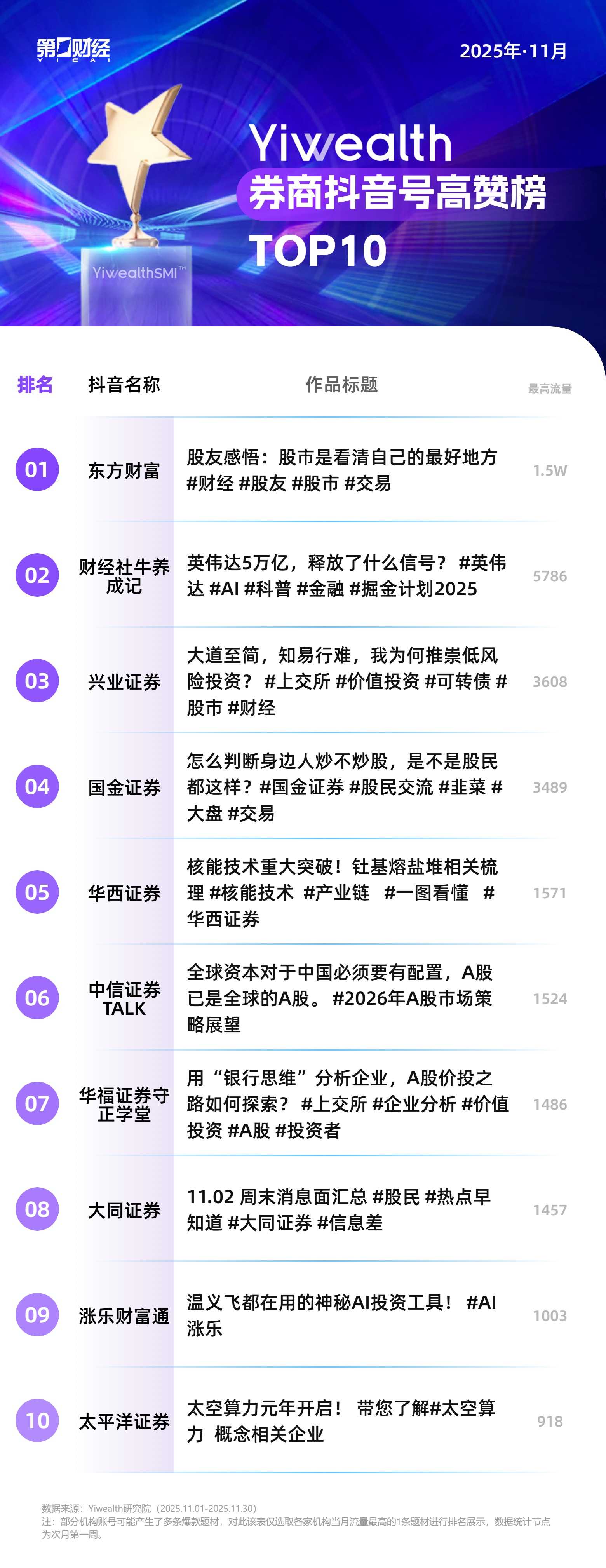
YiwealthSMI|东方财富登顶榜首,趣味、专业兼顾的投教内容获青睐
Di Yi Cai Jing· 2025-12-31 12:13
Group 1 - The Securities Social Media Index (SMI) for November 2025 shows a stable top tier, with significant ranking changes among brokerages [1] - The top three positions are held by Dongfang Caifu, CITIC Securities, and Guojin Securities, with Dongfang Caifu rising from second to first place and Guojin Securities jumping from eighth to third [1] - New entrants to the list include Guotai Haitong, Hu'an Securities, Kaiyuan Securities, and Huafu Securities, while firms like Debang Securities and Shanxi Securities dropped out [1] Group 2 - The Douyin high-praise list for November highlights emotional, trending, and practical content, with Dongfang Caifu's post on investment behavior resonating emotionally, achieving 15,000 likes [2] - Guojin Securities used a humorous approach to engage users by discussing characteristics of stock investors, which also garnered significant attention [2] - Other notable content includes analyses on Nvidia's market value and nuclear technology breakthroughs, indicating a growing interest in educational and global perspectives among users [2] Group 3 - Video content from brokerages focuses on brand promotion and in-depth research, with CITIC Securities discussing A-share market strategies for 2026, receiving nearly 1,000 likes [6] - Hongta Securities analyzed new opportunities in the consumer industry related to the "Double Eleven" shopping festival, providing a comprehensive investment overview [6] Group 4 - The public account rankings emphasize important market information and investment foresight, with CITIC Securities' extensive report on 2026 trends achieving over 100,000 reads, showcasing the demand for in-depth research [12] - The content reflects a shift in investor needs, focusing on emotional resonance and understanding rather than just investment advice, highlighting the importance of engaging and relatable communication [15]