
智能化

Search documents
比亚迪、签约埃克森美孚
DT新材料· 2026-01-29 16:05
【DT新材料】 获悉, 1月26日, 埃克森美孚(中国)投资有限公司 (以下简称"埃克森美孚中国")在深圳 比亚迪 总部与其签署长期战略合作备忘录, 标志着 双方在新能源混动技术领域迈入全新合作阶段。 此前, 埃克森美孚中国与比亚迪联合推出了专为插电式混合动力车型打造的比亚迪美孚™混动专加系列定制发动机油,在提升燃油经济性的同时 ,兼具优异的 水分处理能力和乳化稳定性,能够应对PHEV发动机经常因低温短途运行而容易产生水分的问题,为发动机提供出色的润滑保护,保障PHEV发动机在各种工况下 的平稳运行。 基于此,双方将继续发挥在技术共研与成果转化方面的创新能力,重点围绕定制化产品研发、技术协同与标准共建、品牌联合赋能等领域深化合作, 并积极探索 新材料应用等更多协同创新可能,共同助力行业向可持续 、智能化的未来发展,实现"强强联合、共创共赢"的长期愿景。双方也将协同优化供应链流程,进一步 提升比亚迪全球供应链的韧性,从而更高效地响应市场需求,服务全球消费者。 本次签约,比亚迪集团董事长兼总裁 王传福 、比亚迪集团副总裁兼第二十一事业部总经理任林,埃克森美孚全球润滑油业务总裁 贺达威 、埃克森美孚北亚润滑 油业务 ...



中国海防:公司已建立规范的财务管理以及内部控制制度
Zheng Quan Ri Bao Wang· 2026-01-29 13:41
Group 1 - The company has established a standardized financial management and internal control system [1] - The company possesses an independent financial accounting management system [1] - The company aims to continuously improve the level of financial digitization and intelligence, enhancing its financial management capabilities [1]

电动无人驾驶矿卡企业伯镭科技获比亚迪亿元战略投资
Xin Lang Cai Jing· 2026-01-29 11:59
Core Viewpoint - The strategic investment of 100 million yuan from BYD signifies market recognition of Berai Technology's technological direction and commercial value [1] Group 1: Investment Details - Berai Technology received a strategic investment of 100 million yuan from BYD [1] - The funds will be primarily used to enhance R&D investment, expand intelligent production capacity, accelerate domestic and international market expansion, and deepen industrial ecosystem cooperation [1] Group 2: Company Profile - Berai Technology is a leading provider of electric unmanned mining trucks and zero-carbon mining solutions in China [1] - The company has developed a full-stack technology system that addresses operational pain points in traditional mining [1] Group 3: Strategic Alignment - BYD's Chief Investment Officer, Li Qian, stated that Berai Technology's capabilities in unmanned mining and green energy supply complement BYD's core technological advantages in electrification and intelligence [1]
一汽解放:公司连续七年位列中国商用车创新排行榜第一名
Zheng Quan Ri Bao· 2026-01-29 11:41
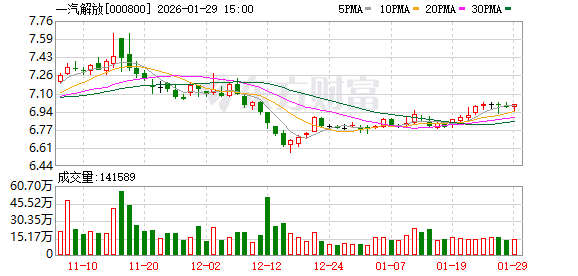
Core Viewpoint - Company emphasizes its commitment to technological investment and R&D成果转化, leading the industry in成果转化率 and ranking first in China's commercial vehicle innovation for seven consecutive years [2] Group 1: Technological Advancements - Company has successfully tackled multiple critical technologies, enhancing its competitive edge in the market [2] - In the new energy sector, the company is advancing three technological routes: pure electric, hybrid, and hydrogen energy, with the launch of the 蓝途3.0 platform [2] - The self-developed electric drive bridge and electric drive box contribute to the company's innovation in core components, with the liquid hydrogen heavy truck achieving a range of over 1000KM [2] Group 2: Intelligent Solutions - Company focuses on intelligent vehicle technology across various scenarios, including trunk logistics, port operations, factory logistics, and sanitation [2] - The company plans to release the world's first full-platform standard L2 intelligent commercial vehicle, the J7创领版, in 2024 [2] - New products are under development for trunk logistics, port, and factory logistics scenarios, showcasing the company's commitment to innovation [2] Group 3: Value Creation - Company aims to leverage technology to enhance product upgrades and efficiency, effectively translating technological achievements into value for users and shareholders [2]

全国人大代表武汉琦:融合发展,保持制造业合理比重
Ren Min Ri Bao· 2026-01-29 09:00
Group 1 - The core viewpoint emphasizes the importance of maintaining a reasonable proportion of the manufacturing industry as it is crucial for economic stability and national security [1] - The transition from a manufacturing power to a manufacturing strong nation requires a focus on intelligent, green, and integrated development to build a modern industrial system [1] - Manufacturing serves as a "ballast" for economic development, supporting both traditional and emerging industries through innovation and application scenarios [1] Group 2 - There is a call to accelerate the development of advanced manufacturing by leveraging digital and green technologies to enhance the vitality and competitiveness of traditional industries [2] - The promotion of strategic emerging industries is essential, with a focus on deep integration of technological and industrial innovation to cultivate new productive forces [2] - The development of the manufacturing service industry should be expedited, supported by a comprehensive policy framework and fostering collaboration between industry, academia, and research [2]
全国人大代表逄子剑:形成特色鲜明、错位协同的产业图谱
Ren Min Ri Bao· 2026-01-29 09:00
Core Viewpoint - The article emphasizes the need for regions in China to leverage their unique advantages and resources to create a distinctive and collaborative industrial landscape, avoiding redundant and homogeneous development [1] Group 1: Regional Development Strategy - Regions should assess their unique geographical, resource, and market advantages to find their optimal position within the national framework [1] - The goal is to form a distinctive and collaborative industrial map to prevent low-level repetitive construction and homogenization [1] Group 2: Industrial Upgrading - The article highlights the importance of "three transformations": intelligent, green, and integrated development as a mutually reinforcing system [1] - Intelligent development involves integrating artificial intelligence and big data across the entire industrial chain to achieve quality and efficiency transformations [1] - Green development requires embedding environmental standards and technological innovation into the industrial DNA, which also creates significant new market opportunities [1] - Integrated development focuses on breaking down barriers to promote deep integration between advanced manufacturing, modern services, digital economy, and traditional industries [1] Group 3: Collaborative Growth - A modern industrial system is described as a highly organic ecosystem that supports both advanced regions and underdeveloped areas [1] - Strategies such as co-building industrial parks, developing "flying economy," and supply chain collaboration are essential for driving foundational growth in less developed regions [1] - The ultimate aim is to achieve overall advancement and shared prosperity, allowing innovations from developed areas to benefit suitable regions [1]
中国气象局答澎湃:春运期间深化智能化、信息化的技术应用,及时发布最新气象预报
Xin Lang Cai Jing· 2026-01-29 04:20
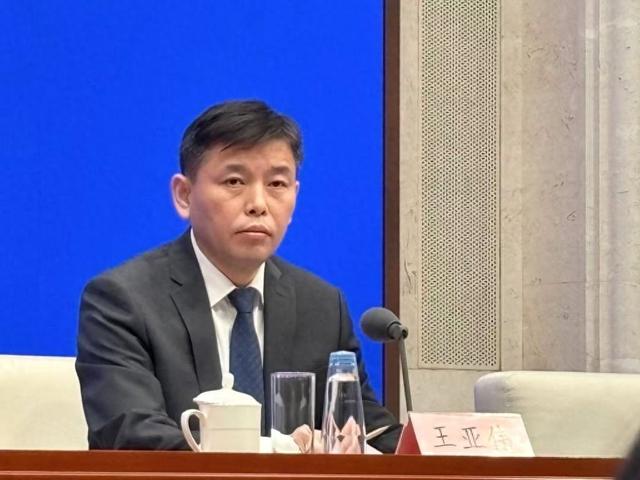
Core Viewpoint - The Chinese Meteorological Administration is enhancing its weather monitoring and forecasting services to ensure safety during the 2026 Spring Festival travel season, particularly in the face of increasing extreme weather events due to global climate change [2][3]. Group 1: Weather Monitoring and Forecasting - The Chinese Meteorological Administration is improving its meteorological monitoring and forecasting service system, focusing on an integrated observation system that includes land, sea, and air [2]. - The administration is utilizing artificial intelligence models, such as "Wind Thunder," "Wind Clear," and "Wind Smooth," to enhance forecasting accuracy, which has shown initial positive results [2]. - A new national emergency warning information release system has been established to improve the public's access to meteorological warning information [2]. Group 2: Technology and Communication - During the Spring Festival travel period, the meteorological department will employ various technologies, including meteorological satellites, weather radars, digital forecasting, and artificial intelligence, to strengthen monitoring and precise forecasting of hazardous weather [3]. - The department will utilize multiple channels, including traditional media, internet new media, and map navigation, to timely disseminate the latest weather forecasts and alerts to relevant departments and the public [3]. - Meteorological experts will provide authoritative interpretations to offer more precise and considerate weather services for travelers [3]. Group 3: Collaboration and Emergency Response - The meteorological department will collaborate with relevant agencies to enhance extreme weather forecasting and emergency response in key areas such as road, rail, shipping, and water passenger transport [3]. - A focus will be placed on monitoring and warning for severe weather conditions like fog, strong winds, and rain and snow, aiming to improve the accuracy and lead time of forecasts [3]. - Prior to significant hazardous weather events, the department will strengthen joint assessments with multiple agencies, ensuring that meteorological warnings align closely with local government and emergency response measures [3].
中国气象局:春运期间深化智能化、信息化的技术应用,及时发布最新气象预报
Jin Rong Jie· 2026-01-29 04:10
Core Viewpoint - The Chinese meteorological department will enhance disaster weather monitoring and forecasting during the 2026 Spring Festival travel season using advanced technologies and multi-channel communication methods [1] Group 1: Technological Application - The meteorological department will utilize satellite, weather radar, digital forecasting, and artificial intelligence to improve weather monitoring and forecasting accuracy [1] - There will be a focus on deepening the application of intelligent and information technologies [1] Group 2: Communication and Public Service - The department plans to disseminate timely weather forecasts and alerts through traditional media, internet new media, and navigation maps [1] - Meteorological experts will provide authoritative interpretations to offer more precise and considerate weather services for the public [1]
中联重科成功发行港股可转债 中长期战略布局再添强劲动能
Zheng Quan Ri Bao Wang· 2026-01-29 03:47
Core Viewpoint - Zhonglian Heavy Industry successfully issued HK convertible bonds, marking a significant milestone in its international capital operations, with funds aimed at enhancing R&D and overseas business development [1][2]. Group 1: Issuance Details - The issuance scale of the convertible bonds reached 6 billion RMB, with a 5-year term, a coupon rate of 0.70%, and a conversion price of 10.02 HKD [2]. - The issuance received strong interest from global institutional investors, reflecting confidence in the company's long-term growth prospects and credit quality [2]. Group 2: Investor Participation - The bond issuance attracted participation from renowned international investment institutions across various countries, including China, the US, UK, Germany, France, Switzerland, Ireland, and Singapore, indicating broad recognition of the company's development strategy and financial health [3]. - In a context of global economic uncertainty, the company has maintained investor trust through a clear development strategy and strong financial performance [3]. Group 3: Strategic Context - The company is navigating a transformative industry landscape characterized by globalization, green transition, and technological innovation, aligning its strategies with these trends [4]. - Funds raised will be allocated 50% to support global development initiatives and 50% to drive innovation in new technologies such as robotics and renewable energy [4]. Group 4: Future Outlook - The full conversion of the bonds will enhance the liquidity of the company's H-shares and improve its international capital image, supporting its global development strategy [5]. - The successful issuance serves as a model for Chinese manufacturing firms aiming to ascend the global value chain, with the company committed to sustainable development and high standards of corporate governance [5].

未知机构:伯特利深度线控底盘领军者人形机器人未来的中坚力量国联民生汽车崔琰团队-20260129
未知机构· 2026-01-29 02:10
Summary of Berteli's Conference Call Company Overview - **Company**: Berteli - **Industry**: Automotive and Robotics Key Points 1. Core Barriers to Growth in Automotive Sector - Berteli has established itself as a leader in the domestic automotive brake system market due to its strong core barriers, which include advanced manufacturing capabilities and integrated system design [1] 2. Revenue Growth and ASP Increase - The company has achieved continuous growth in Average Selling Price (ASP) and revenue in its automotive business, driven by increased penetration of intelligent electronic control systems such as EPB (Electric Parking Brake) and line control braking systems [2] 3. Expansion into Robotics - Berteli is leveraging its deep technical expertise from the automotive sector to expand into robotics, aiming to become a key player in core components and joint modules for humanoid robots, as well as control and vision modules [1][2] 4. Technological Accumulation - The company has accumulated significant experience in precision component manufacturing, mechatronic system design, sensor integration, software development, and supply chain management, which positions it well for future growth in robotics [1] 5. Strategic Initiatives - **Intelligent and Electric Integration**: Berteli is focusing on creating a platform for line control braking systems and has become the first in China to achieve mass production of EPB, with plans to expand into ESC (Electronic Stability Control) and electric tailgate systems [2] - **Global Expansion**: The company has successfully launched its production base in Mexico in 2023 and is planning to establish a base in Morocco in 2024, indicating a deepening global presence [2] 6. Financial Projections - Revenue projections for 2025-2027 are estimated at 12.875 billion, 16.441 billion, and 20.831 billion yuan, with net profits of 1.508 billion, 1.867 billion, and 2.314 billion yuan respectively. The corresponding EPS is projected to be 2.49, 3.08, and 3.81 yuan [2] 7. Investment Rating - The company maintains a "Recommended" rating with a price-to-earnings (PE) ratio forecast of 23, 19, and 15 times for the years 2025, 2026, and 2027 respectively, based on the closing price of 57.70 yuan per share on January 23, 2026 [2] 8. Risk Factors - Potential risks include lower-than-expected automotive sales, slower product and customer expansion, underperformance in humanoid robotics, increased industry competition, and rising raw material costs [2]
