债券市场

Search documents
以自我优化为抓手,提升债券市场服务科技创新型企业能力|资本市场
清华金融评论· 2025-05-16 10:27
Core Viewpoint - The Chinese bond market has significant room for growth, particularly in supporting technology innovation enterprises, which requires a reform to enhance its capabilities and optimize its structure [1][2]. Group 1: Current State of the Bond Market - The bond market's ability to serve technology innovation enterprises is currently limited and requires optimization [2][3]. - The market is dominated by state-owned and large enterprises, lacking a high-yield bond market that could directly support small and medium-sized technology enterprises [2][3]. - The investor structure is concentrated, primarily involving commercial banks, which lack motivation to invest in convertible bonds due to regulatory constraints [3][4]. Group 2: Information Disclosure and Risk Management - The bond market's information disclosure mechanisms and credit risk management systems need significant improvement [4][5]. - Current risk management tools are limited and lack flexibility, with the credit risk mitigation contracts being underdeveloped [4][5]. - The credit rating system is overly simplistic, with 85% of issuers rated AA or above, leading to issues of credibility and differentiation [5]. Group 3: Policy Recommendations for Improvement - There is a need to accelerate the development of a high-yield bond market to diversify financing channels for technology innovation enterprises [8][10]. - Establishing a specialized evaluation system for technology enterprises is crucial to identify those with innovative potential [9][10]. - The bond market should implement a registration system reform to create a more transparent and predictable financing environment for technology innovation enterprises [12][13]. Group 4: Enhancing Investor Participation - Expanding the investor base and encouraging risk-oriented investment strategies are essential for matching supply and demand in the high-yield bond market [10][14]. - Developing targeted bond financing tools, such as asset securitization, can provide stable funding for technology innovation enterprises [11][12]. - Strengthening investor protection mechanisms and establishing strict default clauses will enhance market fairness and transparency [10][14].

重要数据发布,债券市场或迎来趋势机会
Sou Hu Cai Jing· 2025-05-16 03:32
Group 1 - The bond market has experienced adjustments after a strong start in 2025, but some investors are increasing their positions, indicating confidence in the market [1] - In April, social financing increased by 1.16 trillion yuan, which is approximately 1.2 trillion yuan more than the previous year, aligning with market expectations [1][3] - The first four months of 2025 saw a cumulative increase in social financing of 16.34 trillion yuan, which is 3.61 trillion yuan more than the same period last year [3] Group 2 - The recent implementation of monetary policy measures is expected to favor short-term bonds, with potential downward pressure on funding rates, creating opportunities in the bond market [4] - The government is promoting the issuance of special local government bonds and ultra-long-term special treasury bonds, which enhances market confidence in long-term bonds [4] - The credit bond market is seeing increased demand for high credit quality assets, supported by easing policies that reduce financing pressures and default risks [7] Group 3 - The convertible bond market is witnessing structural opportunities due to easing trade tensions between China and the U.S., with growth potential in technology and domestic consumption sectors [7] - Specific sectors such as pet care, domestic beauty products, and low-temperature dairy are expected to benefit from ongoing policy support, enhancing the performance of related companies [7] - The BoShi Convertible Bond ETF is viewed as a stable investment option, particularly during periods of high stock market volatility, as it can help mitigate overall portfolio risk [7]
双降&中美经贸会谈后的债市展望
2025-05-15 15:05
Summary of Conference Call Records Industry Overview - The focus is on the bond market, particularly the impact of monetary policy, real estate market dynamics, and U.S.-China trade relations on bond pricing and liquidity [1][2][3][4][5][6][7][8][9]. Key Points and Arguments Bond Market Expectations - The expected range for the ten-year government bond yield is between 1.6% and 1.9% for the year, with increased volatility anticipated compared to last year [1][2]. - The bond market is characterized as a "震荡偏强" (oscillating and slightly strong) market, indicating fluctuations rather than a one-way decline [2]. Monetary Policy Changes - The central bank's monetary policy has shifted from a steep yield curve last year to preventing rapid declines in interest rates this year [1][9]. - The focus is on maintaining low funding costs, which may provide trading opportunities in the short to medium term [1][7][12]. Real Estate Market Impact - The real estate market's bottoming logic was disproven in Q1, leading to a more favorable outlook for the bond market in Q2 and Q3 [5]. - Future observations will be necessary to determine if the real estate market stabilizes in Q4, particularly around key political meetings [5]. Trade Policy and Economic Impact - U.S.-China trade policies have a negative long-term impact on the economy, but short-term effects are limited, making it difficult to break out of the established yield range [6]. - The trade discussions have not significantly altered the market's expectations regarding interest rates [6]. Liquidity and Market Dynamics - Traditional liquidity indicators have become less effective, with personal investor behavior now being a critical factor in market movements [21]. - The liquidity environment has improved due to several factors, including a decrease in government bond supply and seasonal adjustments in financial deposits [11][14]. Investment Strategies - For credit bond investments, maintaining liquidity is crucial, with a focus on high liquidity premium varieties while being cautious with low liquidity options [26]. - Investors are advised to consider long-duration positions if their funding is stable, as this could yield higher coupon rates [7][24]. Market Sentiment and Future Outlook - The overall sentiment towards the market is cautiously optimistic, with a focus on high-rated credit opportunities while remaining vigilant against potential market volatility [27]. - The bond market is expected to experience a small bull market rather than a significant bull market due to moderate growth in financial products [22]. Other Important Insights - Insurance companies are increasing their bond purchases to convert maturing deposits, despite average premium growth [17]. - Agricultural commercial banks and funds are amplifying market volatility without changing the overall market direction [18]. - The seasonal patterns of funding are influenced by government bond issuance cycles, affecting liquidity throughout the year [13]. This summary encapsulates the key insights from the conference call, highlighting the bond market's dynamics, monetary policy shifts, and the interplay between real estate and trade policies.
固收指数月报 | 彭博中国综合指数录得正回报,逆转连续两月负值
彭博Bloomberg· 2025-05-15 06:48
Core Insights - Bloomberg is the first global index provider to include Chinese bonds in mainstream global indices, offering a unique perspective on the Chinese bond market through the Bloomberg China Fixed Income Index series [1][3] Group 1: April Key Insights - The Bloomberg China Aggregate Index recorded a positive return of 1.09% in April, following two consecutive months of negative returns, with a year-to-date return of 0.42% [3] - The 30-day volatility of the index showed a declining trend during this period [3] - The China Treasury and Policy Banks Index achieved a return of 1.17% in April, while the year-to-date return in local currency was 0.42%, ranking 24th among 27 currencies in the global composite index [3] Group 2: Index Performance - The performance of various indices in April is as follows: - China Aggregate Index: 1.09% return for the month, 0.42% year-to-date [5] - China Treasuries: 1.44% month-to-date return, 0.59% year-to-date [5] - China Corporate Index: 0.42% month-to-date return, 0.46% year-to-date [5] - 10+ Year Maturity Index: 3.08% month-to-date return, 1.64% year-to-date [5] Group 3: Foreign Investment Trends - In March, the proportion of foreign investors in interbank certificates of deposit rose to 6%, the highest level in six months, with foreign capital increasing holdings by 238.7 billion RMB in the first quarter [13] - If the current pace continues, foreign holdings of interbank certificates of deposit could exceed those of government bonds by 2026 [13]

机构:5月债市在波折中前行,30年国债ETF博时(511130)连续3天净流入
Sou Hu Cai Jing· 2025-05-13 03:19
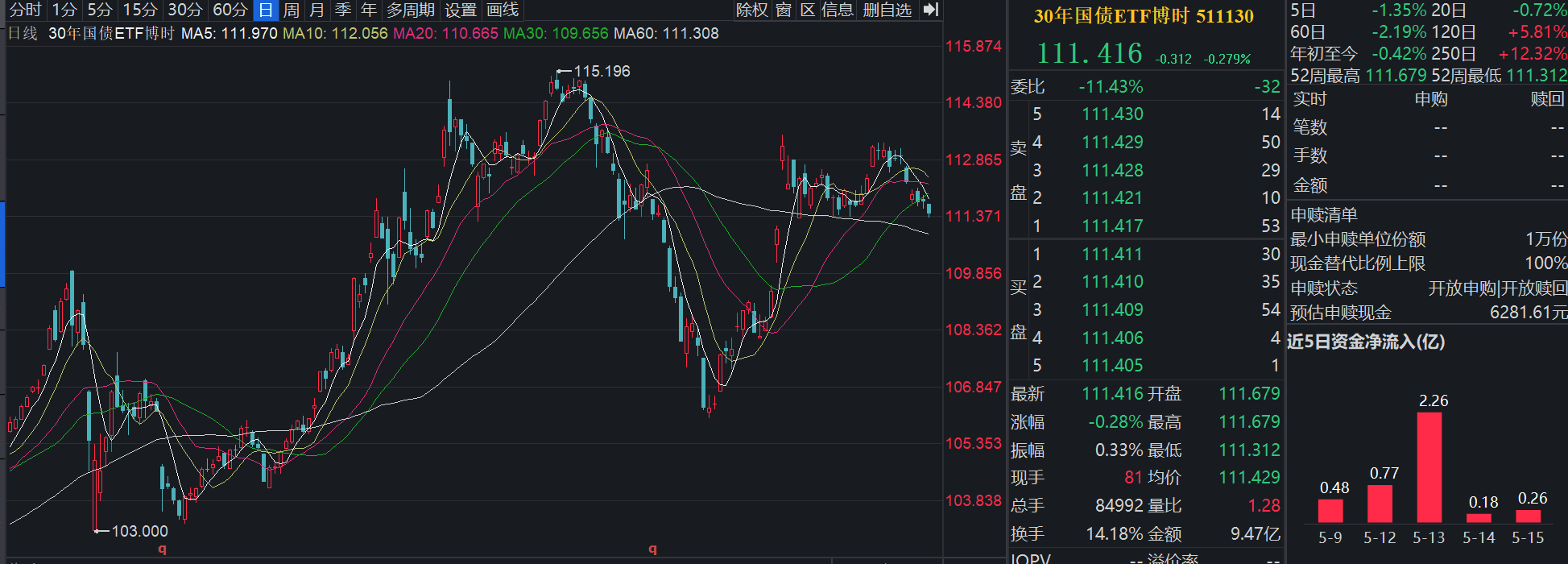
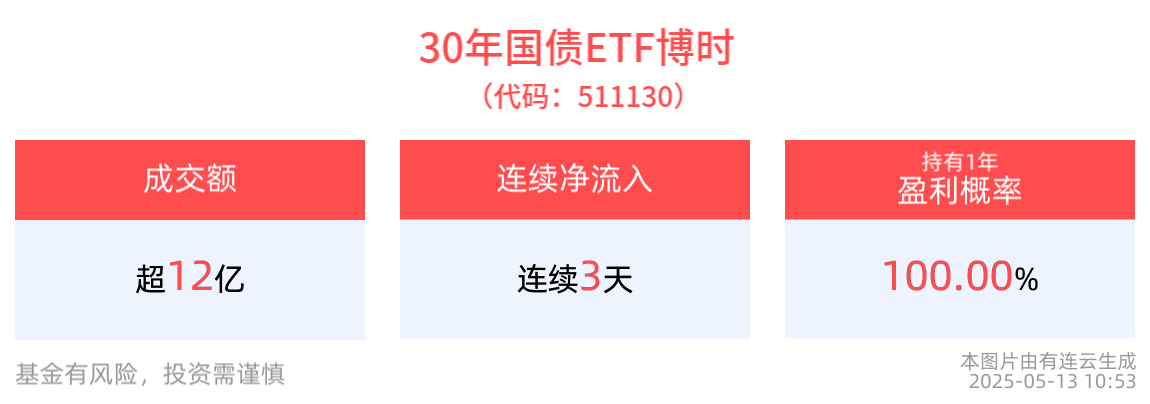
信达证券指出,尽管长端利率短期面临扰动,但考虑债市面临的环境相较于4月初关税措施落地前仍然更加有利,我们认为10年国债调整的上限可能也就在 1.7%附近;拉长时间维度来看,考虑经济进入旺季尾声短期面临回落压力,外需下行对基本面的影响尚未完全显现,货币政策仍处于宽松周期的状态,债 券市场的趋势可能并未改变。因此在目前状态下,我们认为5月债市仍有望在波折中前行。 30年国债ETF博时紧密跟踪上证30年期国债指数,上证30年期国债指数从上海证券交易所上市的国债中,选取符合中国金融期货交易所30年期国债期货近月 合约可交割条件的债券作为指数样本,以反映沪市相应期限国债的整体表现。 规模方面,30年国债ETF博时最新规模达64.26亿元。 从资金净流入方面来看,30年国债ETF博时近3天获得连续资金净流入,最高单日获得7691.27万元净流入,合计"吸金"1.52亿元,日均净流入达5063.03万 元。 数据显示,杠杆资金持续布局中。30年国债ETF博时前一交易日融资净买额达1318.14万元,最新融资余额达6484.67万元。 截至5月12日,30年国债ETF博时近1年净值上涨15.50%,指数债券型基金排名3/37 ...
场内债券ETF规模破700亿元,海富通多只债券ETF规模创新高,机构建议把握二、三季度债市配置窗口期
Sou Hu Cai Jing· 2025-05-13 02:05
Group 1 - The short-term bond ETFs have seen significant growth, with the short bond ETF reaching a record high of 39.162 billion yuan, and the city investment bond ETF also hitting a new high of nearly 17 billion yuan [1] - The current market discussion is focused on whether there is still room for interest rate declines in the second quarter, with optimistic institutions expecting further easing in the bond market [1][2] - The overall bond ETF scale managed by Hai Fu Tong Fund has surpassed 70 billion yuan, indicating strong investor interest in bond products [1] Group 2 - Short-term market sentiment is improving as external negative factors diminish, with expectations for a return to technology growth in the market during May and June [2] - The monetary market rates need to be lowered to alleviate the current low-interest spread in the financial system, which could lead to a downward trend in actual interest rates [2] - The bond market is expected to benefit from reduced supply pressure and ongoing expectations for policy easing, suggesting a favorable environment for bond investments in the second and third quarters [2][3] Group 3 - The market is shifting focus from external risks to domestic economic fundamentals, with expectations for strong export data and continued economic growth in the second quarter [3] - The positive outcomes from US-China trade negotiations may improve short-term risk sentiment, potentially leading to a rise in interest rates, although the effects of monetary easing have yet to fully materialize [3]
中美经贸会谈后的市场展望
2025-05-12 15:16
Summary of Key Points from the Conference Call Industry Overview - The conference call discusses the impact of the recent US-China trade negotiations on various industries, particularly focusing on technology and military sectors, which are expected to see optimistic structural trends in the medium term [1][2]. Core Insights and Arguments - **Tariff Reductions**: The reduction in tariffs exceeded expectations, boosting market confidence. Short-term fluctuations are anticipated, but medium-term outlooks for technology and military sectors remain positive [1][2]. - **Export Growth**: The annual export growth is projected to be between -1.2% and -2%, an improvement from previous pessimistic forecasts of -4.1%. This indicates a narrowing drag on GDP from 0.5 percentage points to between -0.1 and -0.2 percentage points [1][4]. - **Impact on Consumer Goods**: New tariff policies will most significantly affect consumer goods, especially electronics. The US's high dependency on direct imports from China means that demand for certain products like furniture and footwear is expected to normalize following tariff reductions [1][5]. - **Intermediate Goods Dependency**: The US relies heavily on Chinese intermediate goods such as chemicals and plastics, which are expected to be most affected by tariff changes. The 90-day exemption period is likely to positively impact direct trade, potentially leading to a short-term export rebound [1][8][9]. - **Domestic Policy Continuity**: The outcomes of the negotiations will not significantly alter domestic policies aimed at stabilizing foreign trade and employment, as well as promoting technology consumption. Counter-cyclical policies will continue to be implemented [1][10]. Additional Important Insights - **Market Reactions**: The market reacted positively to the unexpected results of the trade negotiations, with expectations of a strong opening following the announcement. The structural optimism for technology and military sectors is highlighted [2][15]. - **Long-term Trade Relations**: The new trade policies reflect ongoing issues with US political credibility and suggest that further negotiations will be necessary to establish a stable economic relationship between the two countries [6]. - **Consumer Goods and Electronics**: Consumer goods account for 40% to 50% of total exports to the US, with electronics being particularly sensitive to tariff changes. The exemption for certain consumer electronics is noted, with a significant portion of imports still subject to tariffs [5][7]. - **Future Economic Outlook**: The presence of the 90-day exemption period is expected to lead to improved export data in the coming months, with a strong likelihood of GDP growth exceeding 5% if current trends continue [11][12]. This summary encapsulates the key points discussed in the conference call, focusing on the implications of the US-China trade negotiations on various sectors and the overall economic outlook.
Q1货政报告的5个关键增量信息
2025-05-12 15:16
Summary of Key Points from the Conference Call Industry Overview - The conference call primarily discusses the monetary policy and bond market in China, focusing on the People's Bank of China's (PBOC) strategies and implications for the economy and financial markets. Core Insights and Arguments - The PBOC is likely to adopt a more accommodative monetary policy in response to a complex international economic environment and a recovering domestic economy that still requires consolidation [1][2] - The central bank emphasizes the balance between supporting the real economy and maintaining the stability of the banking system, indicating a potential reduction in deposit rates to sustain bank net interest margins, marking the sixth adjustment since April 2022 [1][2] - The market-oriented adjustment mechanism for deposit rates links them to the 10-year government bond yield and the 1-year Loan Prime Rate (LPR), resulting in a more significant decline in long-term deposit rates compared to short-term rates, which is beneficial for the long-term bond market [1][3] - The PBOC has clarified its future liquidity injection tools, elevating government bond transactions to a position equal to reserve requirement ratio (RRR) cuts, which will help lower bank financing costs [1][4] - The timing of the resumption of government bond transactions is crucial, as it directly affects market supply and demand, with expectations for the PBOC to resume purchases shortly to avoid passive withdrawal of base currency [1][5][6] - The 1-year government bond yield is considered a key indicator for observing whether the PBOC will resume government bond transactions, with a significant drop in yield suggesting large-scale purchases [1][7] - The PBOC highlights the importance of strengthening the bond market, noting that long-term government bonds carry interest rate and duration risks that investors must closely monitor [1][8] - The efficiency of pricing in China's bond market and the risk management capabilities of institutional investors are seen as areas needing improvement, with state-owned banks expected to play a more significant role in guiding market pricing [1][9][10] Additional Important Insights - The current structure of bond types shows a trend towards increased activity in long-term government bonds, with about 30% of trading volume concentrated in a small number of bonds, indicating potential liquidity improvements for less active bond types [1][11] - The PBOC identifies low inflation, particularly in core CPI, as a result of supply-demand imbalances, suggesting that monetary policy alone may not lead to price increases without coordinated efforts across various policy areas [1][12] - Future monetary policy is expected to remain accommodative, with a focus on further reducing social financing costs to support a more robust economy [1][13]
5月债市在波折中前行
Xinda Securities· 2025-05-12 12:41
Group 1: Report Industry Investment Rating - Not provided in the content Group 2: Core Viewpoints of the Report - The bond market in May is expected to move forward amidst fluctuations. The benchmark expectation is that the central bank will continue to guide the capital interest rate closer to the policy rate after the interest rate cut. The subsequent trend of monetary policy may depend on the fundamental state, and there is a possibility of further policy rate cuts if there are no fiscal incremental measures in the short term. The bond market environment is more favorable compared to the beginning of April [2][3] Group 3: Summary According to the Table of Contents 1. The capital interest rate center is expected to continue to move closer to the policy rate after the interest rate cut - The conditions for "opportunistically cutting the reserve requirement ratio and interest rate" have emerged, and the Politburo meeting in April mentioned "timely cutting the reserve requirement ratio and interest rate." The central bank announced a comprehensive reserve requirement ratio cut of 0.5% and a 10BP reduction in the policy rate to 1.4% on May 7, earlier than market expectations [6][7] - Market adjustments often occur after the implementation of reserve requirement ratio and interest rate cuts, mainly due to the increase in capital interest rates after the interest rate cut or the strengthening of fiscal policies. The actual state of the capital side after the implementation of this reserve requirement ratio and interest rate cut may be the key factor affecting the bond market performance in May [8] - Before the implementation of this reserve requirement ratio and interest rate cut, the capital interest rate had been above the policy rate since January. Although it began to gradually return to the policy rate in March, the average DR007 in April was still more than 20BP above the OMO rate. The central bank's interest rate cut may be to support the real economy and boost market confidence, and the capital interest rate is expected to follow the policy rate down [11][12] - After the interest rate cut, the capital interest rate has declined, but the increase in bank net financing is relatively moderate, and the capital gap index is at a neutral and low level. The central bank is expected to continue to guide the capital interest rate to the 1.5%-1.6% range, but further observation of the central bank's operations is needed [13] 2. The monetary policy implementation report is more of a summary of the Q1 state, and the overall trend of monetary policy is still in the process of easing - The Q1 monetary policy implementation report did not mention the May reserve requirement ratio and interest rate cut and had little mention of the impact of US tariffs on monetary policy. It is considered more of a summary of the previous quarter's monetary policy state [18][19] - Some information in the report may explain why the reserve requirement ratio and interest rate cuts did not occur in the first quarter, such as the need to strengthen bond market construction and macro - prudential management, and the fact that the relationship between money and prices is affected by multiple factors. The central bank's cautious attitude towards monetary easing and its expectation of fiscal expansion are not the core factors determining short - term monetary policy operations [20][22] - After the tightening of the capital side in Q1, the weighted average interest rates of new loans and personal housing loans increased slightly, which deviated from the goal of reducing the comprehensive financing cost of society. In the context of escalating trade frictions, the domestic economy faces greater uncertainty, which may be the main reason for the May reserve requirement ratio and interest rate cuts. The subsequent trend of monetary policy needs to observe the fundamental state [22][25] 3. The increased demand for Chinese intermediate goods due to other economies' rush to export to the US, and the fundamental environment is still favorable for the bond market - Although the impact of trade frictions on exports is not significant in April, with exports reaching 8.1% year - on - year, it is mainly due to the spill - over effect of other economies' rush to export to the US. The current situation is different from that in 2020 when US fiscal expansion drove up demand [26][28] - The US economic prosperity has declined, and after the short - term rush to import and inventory build - up, if consumption does not continue to rise, its commodity demand may face downward pressure. The export growth of Vietnam, China Taiwan and other economies may decline, which may reduce their driving effect on China's exports [28][34] - The recent Sino - US trade negotiation has made progress, but the tariff rate is still higher than before April, and there is a possibility of further increases. The domestic economy has shown signs of weakening since April, and the central bank's motivation to restrict the decline of long - term interest rates through liquidity tightening has weakened, which is more favorable for the bond market compared to the beginning of April [40][48] 4. The flattening of the interest rate curve reflects the change in the macro - model, and the bond market in May moves forward amidst fluctuations - Although the bond market environment is relatively favorable, the tariff agreement may cause emotional fluctuations. The current interest rate curve is relatively flat, and the market is worried about the fragility of the bond market. However, the continuous flattening of the interest rate curve since 2024 is essentially a change in the market's pricing method for the economy and policy model [50] - Historically, the change in the domestic yield curve was often dominated by short - term interest rates. After 2011, the domestic economy was mainly regulated by real estate and urban investment policies, and monetary policy was used to cooperate with these policies. In the upward real estate cycle, long - term interest rates were generally priced with a premium over short - term interest rates, and the narrowing of the spread usually occurred in the monetary tightening cycle [52][57] - Since 2021, the real estate policy has been continuously relaxed, but real estate sales have continued to decline, indicating a fundamental change in the economic model. The central bank has taken measures to lower the broad - spectrum interest rate since 2022, but the policy rate cut has been relatively lagging, which has increased the pressure on bank spreads. In the context of weak economic expectations, the domestic bond market has shown a state where the yield curve continues to flatten [58][64] - The domestic central bank has no clear guidance on future policy rates, so the domestic interest rate curve above 1 year is unlikely to invert, and the 1Y certificate of deposit rate and 10 - year treasury bond rate may be difficult to fall below the OMO rate. However, if the macro - expectation remains weak, the spreads between these interest rate combinations may continue to compress [64]
中短债受“双降”利好影响,利率出现明显下行!谁在买入短债资产?
Mei Ri Jing Ji Xin Wen· 2025-05-12 07:51
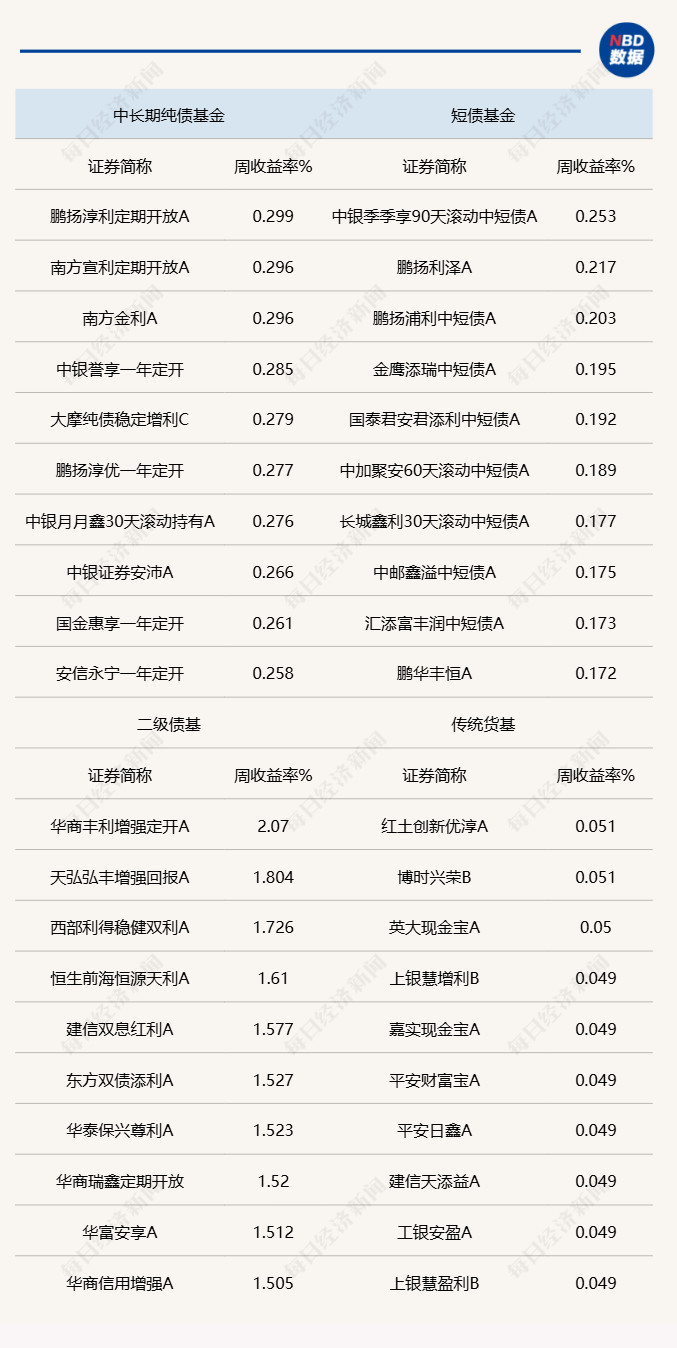
Core Viewpoint - The recent interest rate cuts have positively impacted short and medium-term bonds, leading to a notable decline in rates, while long-term bonds are experiencing a "buying expectation, selling reality" scenario [1][2]. Group 1: Market Reactions - Following the "double cut" (interest rate and reserve requirement ratio), the 1-year government bond yield fell to 1.40%, while long-term bonds showed mixed performance due to market dynamics [2]. - The average yield of long-term bond funds slightly outperformed that of short-term bond funds, with yields at 0.13% and 0.10% respectively, indicating a growing interest in short-term assets [4]. Group 2: Key Players in the Market - Major buyers of short-term bonds include rural commercial banks and foreign investors, with net purchases exceeding 10 billion yuan for bonds with maturities of one year or less [2]. - Non-bank institutions have also been active in the secondary market, significantly increasing their purchases of certificates of deposit, with eight out of twelve types of institutions net buying [2][3]. Group 3: Fund Performance - The performance of various bond funds showed minimal yield differences, with top-performing long-term funds yielding around 0.299% and short-term funds yielding around 0.253% [6][7]. - The overall leverage ratio in the bond market has remained low, with a slight increase to 106.70%, while fund leverage has seen a rebound, indicating a shift in investment strategies [3]. Group 4: Future Outlook - The bond market is expected to remain in a volatile state, with the potential for further rate declines, although the pace may not be smooth [5]. - The market is currently in a phase where the effects of previous policy stimuli are diminishing, and economic fundamentals are showing signs of weakening, suggesting a cautious approach moving forward [4][5].