
滞胀

Search documents
滞胀风险施压英镑 英国央行陷政策两难
Jin Tou Wang· 2025-08-06 02:41
Core Viewpoint - The British pound is facing significant challenges due to the UK's economic situation, characterized by stagnation and high inflation, leading to a potential downtrend against the US dollar in the coming months [1] Economic Conditions - The Bank of England is caught in a "stagflation" dilemma, balancing between weak economic growth and high inflation [1] - Despite inflation remaining above target levels, the central bank may have to implement excessive rate cuts due to economic weakness [1] - The tightening of fiscal policy in the UK is increasing pressure on the central bank to stimulate the economy [1] Currency Forecast - Analyst Lale Akoner predicts a downward trend for the GBP/USD exchange rate over the next 3-6 months, reflecting the divergence in monetary policies between the UK and the US [1] - The recent technical analysis shows that the GBP/USD pair has encountered resistance at the 21-day simple moving average after breaking a downward trend line [1] - The 14-day Relative Strength Index (RSI) remains below 40, indicating that recent rebounds in the currency pair are merely technical corrections [1]
华尔街“黄金空头”罕见空翻多,深市最大上海金ETF(159830)涨超0.2%,连续两日获资金净流入
2 1 Shi Ji Jing Ji Bao Dao· 2025-08-06 02:26
Core Viewpoint - The recent trends in gold prices and related ETFs indicate a shift in market sentiment towards gold as a safe-haven asset, driven by expectations of interest rate cuts by the Federal Reserve and a weakening U.S. economy [3][4]. Group 1: Gold Market Trends - On August 5, COMEX gold futures rose by 0.25%, closing at $3435 per ounce [1]. - The Shanghai Gold ETF (159830) saw a slight increase of 0.23% as of August 6 [2]. - The Shanghai Gold ETF (159830) has a current size of 1.467 billion yuan and has experienced a net inflow of 6.99 million yuan over the past two days [3]. Group 2: Institutional Sentiment - Citigroup, known for its bearish stance on gold, has revised its three-month price forecast from $3300 to $3500 per ounce, indicating a shift in institutional sentiment towards gold [3]. - The expected trading price range for gold has also been adjusted from $3100-$3500 to $3300-$3600 per ounce [3]. Group 3: Economic Indicators - The U.S. second-quarter GDP data shows a slowdown in domestic demand, suggesting a weakening economy, which supports the case for potential interest rate cuts [4]. - The unexpected decline in the U.S. job market has increased expectations for a rate cut in September, further bolstering gold prices [4]. - The resignation of Federal Reserve Governor Quarles raises concerns about the independence of the Fed, which may also contribute to upward pressure on gold prices [4].
滞胀是美国经济不能碰触的红线
Sou Hu Cai Jing· 2025-08-06 02:14
而在美债高速增长周期步入滞胀,则更具破坏力,因为在滞胀环境中货币政策效应显著下降,主要依靠的就是财政手段治理,美国若陷入滞胀泥潭,其问题 的严重性不言而喻,将直指美国的债务货币体系,将直击美元命运,全球的去美元化潮流将难以阻挡,美元的国际储备占比会快速下降,为了维护美元的国 际霸权地位,可以预见美国将会更加激进,在摆脱债务困境这一问题上会更加依赖债务军事化,所以能否步入滞胀周期,对全球的和平发展大环境有着深远 影响,这是值得高度重视的问题。 目前最为关键的关税谈判还没有靴子落地,由于中国是全球制造业中心,因此中美关税谈判在相当大的程度上决定了美国能否步入滞胀周期,如果美国对华 制定了偏高关税,美国经济大概率要步入滞胀周期,这是国际供应链与美国市场需求关系决定的。 来源:馨月 更多精彩文章:权重股护盘沪指领涨 结构性强势中多呈技术性卖点 美国周二公布的ISM非制造业指数显示7月服务业零增长,同时上周非农数据不佳,再加上关税等因素影响,华尔街对美国滞胀风险的忧虑在升温。服务业 占美国经济总量约70%,服务业的放缓也预示美国经济将面临更大风险。 突然大降的非农数据以及不佳的服务业数据等,说明美国就业与经济增速在下滑 ...


期指:上涨后的震荡
Guo Tai Jun An Qi Huo· 2025-08-06 01:39
1. Report Industry Investment Rating - No information provided on the industry investment rating 2. Core View of the Report - On August 5th, all four major stock index futures contracts for the current month rose. IF increased by 0.86%, IH by 0.8%, IC by 0.72%, and IM by 0.9%. The total trading volume of stock index futures declined on the trading day, indicating a decrease in investors' trading enthusiasm. In terms of positions, IF's total position increased by 1005 lots, IH's by 660 lots, IC's decreased by 1806 lots, and IM's decreased by 7110 lots [1][2] 3. Summary by Relevant Catalogs 3.1 Periodic Index Data Tracking - **CSI 300 and Its Futures Contracts**: The CSI 300 index closed at 4103.45, up 0.80%. Among its futures contracts, IF2508 closed at 4095, up 0.86% with a basis of -8.45; IF2509 closed at 4082, up 0.84% with a basis of -21.45; IF2512 closed at 4051, up 0.85% with a basis of -52.45; IF2603 closed at 4020.6, up 0.84% with a basis of -82.85 [1] - **SSE 50 and Its Futures Contracts**: The SSE 50 index closed at 2790.73, up 0.77%. Among its futures contracts, IH2508 closed at 2789.4, up 0.80% with a basis of -1.33; IH2509 closed at 2791, up 0.83% with a basis of 0.27; IH2512 closed at 2792.8, up 0.82% with a basis of 2.07; IH2603 closed at 2794, up 0.87% with a basis of 3.27 [1] - **CSI 500 and Its Futures Contracts**: The CSI 500 index closed at 6303.24, up 0.66%. Among its futures contracts, IC2508 closed at 6265.4, up 0.72% with a basis of -37.84; IC2509 closed at 6198.6, up 0.66% with a basis of -104.64; IC2512 closed at 6040.2, up 0.65% with a basis of -263.04; IC2603 closed at 5909.8, up 0.62% with a basis of -393.44 [1] - **CSI 1000 and Its Futures Contracts**: The CSI 1000 index closed at 6787.48, up 0.71%. Among its futures contracts, IM2508 closed at 6754.4, up 0.90% with a basis of -33.08; IM2509 closed at 6682, up 0.90% with a basis of -105.48; IM2512 closed at 6490.8, up 0.90% with a basis of -296.68; IM2603 closed at 6311, up 0.78% with a basis of -476.48 [1] 3.2 Trading Volume and Position Changes - **Trading Volume**: IF's total trading volume increased by 3421 lots, IH's by 2218 lots, IC's decreased by 11728 lots, and IM's decreased by 33934 lots [2] - **Positions**: IF's total position increased by 1005 lots, IH's by 660 lots, IC's decreased by 1806 lots, and IM's decreased by 7110 lots [2] 3.3 Top 20 Member Position Changes in Futures - **IF Contracts**: For IF2508, long positions decreased by 155 with a net change of 692, and short positions decreased by 181 with a net change of 533; for IF2509, long positions increased by 601; for IF2512, long positions decreased by 126; for IF2603, long positions increased by 372 [5] - **IH Contracts**: For IH2508, long positions decreased by 216 with a net change of 1299; for IH2509, long positions increased by 1020 and short positions increased by 507 with a net change of 1105; for IH2512, long positions increased by 495 [5] - **IC Contracts**: For IC2508, long positions decreased by 1509 and short positions decreased by 1519; for IC2509 and IC2512, long positions decreased by 1274 and 537 respectively, and short positions decreased by 985 and 202 respectively; for IC2603, long positions increased by 700 [5] - **IM Contracts**: For IM2508, long positions decreased by 1730 and short positions decreased by 2259; for IM2509, long positions decreased by 4474 with a net change of -7498, and short positions decreased by 3785 with a net change of -6783; for IM2512, long positions decreased by 1294 [5] 3.4 Trend Intensity - The trend intensity of IF and IH is 1, and that of IC and IM is also 1. The trend intensity ranges from -2 to 2, with -2 indicating the most bearish and 2 indicating the most bullish [6] 3.5 Important Drivers - Seven departments including the People's Bank of China jointly issued the "Guiding Opinions on Financial Support for New - type Industrialization", strengthening medium - and long - term loan support for digital infrastructure construction such as 5G, industrial Internet, data and computing power centers, and using various financing methods to broaden the funding sources. They also put forward requirements in multiple aspects such as promoting the financing of emerging industries in the capital market, and the State Council emphasized consolidating and expanding the upward trend of the economic recovery [7][8]
七部门出台金融支持新兴工业化指导意见
Dong Zheng Qi Huo· 2025-08-06 01:07
Report Industry Investment Ratings - Gold: The price trend is volatile, and it has not yet broken out of the volatile range. It is recommended to wait and see [10][11][12]. - Stock Index Futures: It is recommended to allocate each stock index evenly. The market remains in a state of high - risk preference, where it is easy to rise and difficult to fall [13][15][16]. - US Dollar Index: It is expected to fluctuate in the short term [17][20][21]. - US Stock Index Futures: Whether the economic downward pressure intensifies still needs more data verification. Attention should be paid to the callback risk at the current level [22][23][24]. - Treasury Bond Futures: August is a favorable period for the bond market. It is recommended to look for short - term opportunities to narrow the spread between T09 - 12 contracts when the bond market sentiment warms up [25][26][27]. - Agricultural Products (Beans Meal): The internal strength and external weakness will continue. The operating center of beans meal will rise [28][30][31]. - Agricultural Products (Edible Oils): For palm oil, do not short. Consider gradually laying out long positions in the 01 contract when the price pulls back to 8800 yuan/ton. For soybean oil, it is recommended to choose the 01 contract for long positions [32][33][34]. - Agricultural Products (Cotton): The short - term downward space of Zhengzhou cotton is limited. There may be a rebound before a large number of new cotton hits the market [35][37][38]. - Agricultural Products (Corn Starch): The upward movement of the price difference between rice and flour is expected to be weak [39][40]. - Black Metals (Steam Coal): It is expected that the coal price will rise to around 670 yuan (the long - term agreement price) and fluctuate. Pay attention to the price performance after the decline in rigid demand [41][42]. - Black Metals (Iron Ore): The price is expected to fluctuate, and it is difficult to fall sharply in the short term. Pay attention to the actual implementation of production restrictions in mid - August [42][43]. - Agricultural Products (Corn): In the medium to long term, corn is expected to maintain a volatile downward trend. It is recommended to continue holding short positions in new crops [44]. - Black Metals (Rebar/HRC): The short - term market fluctuates greatly. It is recommended to operate with a light position [45][46][47]. - Black Metals (Coking Coal/Coke): In the short term, it will fluctuate. The 09 contract will focus on the delivery situation, and the market may return to fundamentals [48][49]. - Non - ferrous Metals (Copper): It is recommended to wait and see on a single - side basis. Pay attention to the internal - external reverse arbitrage strategy [50][52][53]. - Non - ferrous Metals (Polysilicon): In the short term, the price may operate between 45000 - 57000 yuan/ton. Consider selling out - of - the - money put options [55][56][57]. - Non - ferrous Metals (Industrial Silicon): Consider gradually stopping losses on short positions. Wait for an opportunity to go long after the macro - sentiment is released [58][59]. - Non - ferrous Metals (Nickel): In the short term, pay attention to band trading opportunities. In the medium term, look for opportunities to short at high prices [60][61][62]. - Non - ferrous Metals (Lithium Carbonate): Wait and see before the risk event is resolved. Stop profiting from the 9 - 11 reverse arbitrage [63][64]. - Non - ferrous Metals (Lead): Look for opportunities to buy at low prices and manage positions well. Wait and see on the arbitrage side [65][66]. - Non - ferrous Metals (Zinc): On a single - side basis, it is recommended to wait and see. Hold low - level speculative long positions with good position management. Pay attention to medium - term positive arbitrage opportunities [70][71]. - Energy Chemicals (Carbon Emissions): It will fluctuate in the short term [72][73]. - Energy Chemicals (Urea): Pay attention to the relevant meeting in Beijing tomorrow. The price has strong support in the short term [74][75][76]. - Energy Chemicals (Styrene): Pay attention to the opportunity to stop profiting from the position of narrowing the styrene - pure benzene price difference [77][78]. - Energy Chemicals (Caustic Soda): The subsequent market will fluctuate [79][80]. - Energy Chemicals (Pulp): The market is expected to decline following the commodity market [81][82]. - Energy Chemicals (PVC): The market will fluctuate in the short term [83][84]. - Energy Chemicals (PX): It will adjust in the short - term [85][86]. - Energy Chemicals (PTA): It will adjust in the short - term [87][88][89]. Core Viewpoints - The US economic data is weak, with the ISM non - manufacturing PMI falling short of expectations. There are signs of stagflation, and the inflation pressure will increase after the implementation of tariffs. The market risk preference has weakened [11][17][20]. - China's seven - department policy on financial support for new - type industrialization and the free pre - school education policy have boosted the stock market, and the market has strong expectations for policies [13][14][15]. - The bond market's reaction to the rise of the stock market needs to be closely monitored. In early August, the fundamentals and capital situation are favorable for the bond market [25]. - For commodities, different varieties have different supply - demand situations. For example, the supply of some agricultural products is affected by weather and planting conditions, and the supply of some non - ferrous metals is affected by production capacity and inventory [35][50][52]. Summary According to the Directory 1. Financial News and Comments 1.1 Macro Strategy (Gold) - Trump criticized Powell for late interest - rate cuts and announced tariff increases, which raised market risk aversion. The US July ISM non - manufacturing PMI was lower than expected, showing stagflation risks. The gold price fluctuated and was waiting for a breakthrough [10][11]. 1.2 Macro Strategy (Stock Index Futures) - Seven departments issued a guiding opinion on financial support for new - type industrialization, and the State Council announced free pre - school education. The stock market was strong, and the Shanghai Composite Index reached a new high this year. The market priced in policy expectations boldly and remained in a high - risk - preference state [13][14][15]. 1.3 Macro Strategy (Foreign Exchange Futures - US Dollar Index) - The US July ISM non - manufacturing PMI was lower than expected, and the economic downward pressure increased. The market risk preference weakened, and the US dollar index fluctuated [17][20]. 1.4 Macro Strategy (US Stock Index Futures) - The US Treasury plans to issue a record - high amount of four - week Treasury bonds. The weakening of the service PMI has increased market concerns, and the US stock market is expected to continue to pull back [22][23]. 1.5 Macro Strategy (Treasury Bond Futures) - The central bank conducted a 7 - day reverse repurchase operation, with a net withdrawal of funds. The bond market's reaction to the rise of the stock market was dull. If it becomes insensitive to the stock market rise, the bond market can be more optimistic in the short term [25]. 2. Commodity News and Comments 2.1 Agricultural Products (Beans Meal) - The far - month basis trading volume of beans meal increased. The cost of imported soybeans supported the futures price, and the market was worried about the future supply of imported soybeans [28][30]. 2.2 Agricultural Products (Edible Oils) - The supply of palm oil from Indonesia and Malaysia may decrease by 20% in the next five years, which has increased market concerns. The export of soybean oil from China has increased, and the price has risen [32][33]. 2.3 Agricultural Products (Cotton) - The global cotton production, consumption, and trade volume in the 2025/26 year will change little. The growth progress of US cotton is slightly slow, and the excellent rate is stable. The short - term downward space of Zhengzhou cotton is limited [35][37][38]. 2.4 Agricultural Products (Corn Starch) - The spot price of corn starch is stable at a high level. The downstream demand is weak, and the loss of enterprises in North China is expected to expand [39][40]. 2.5 Black Metals (Steam Coal) - The price of steam coal in the northern port market is rising steadily. The price is expected to rise to around 670 yuan and fluctuate, and the daily consumption will reach an inflection point in mid - to late August [41][42]. 2.6 Black Metals (Iron Ore) - The Onslow project's iron ore shipment volume has increased significantly. The iron ore price will fluctuate, and the port inventory is expected to decline in the next 1 - 2 weeks [42][43]. 2.7 Agricultural Products (Corn) - The成交 rate of imported corn auctions has dropped significantly, and the market sentiment has turned pessimistic. In the long - term, corn is expected to decline [44]. 2.8 Black Metals (Rebar/HRC) - The passenger car sales forecast has been raised, and the steel price has rebounded. The short - term market is volatile [45][46][47]. 2.9 Black Metals (Coking Coal/Coke) - The coking coal market in Luliang is oscillating. The supply of coal and coke is gradually recovering, and the market will oscillate in the short term [48][49]. 2.10 Non - ferrous Metals (Copper) - Mitsubishi may cut its copper smelting business, and Codelco's mine has an accident. The market is worried about the US recession, and the copper price may be under pressure [50][51][53]. 2.11 Non - ferrous Metals (Polysilicon) - The photovoltaic power generation utilization rate in June was 95.4%. The spot price of polysilicon has increased slightly, and the price is expected to operate between 45000 - 57000 yuan/ton [54][55][57]. 2.12 Non - ferrous Metals (Industrial Silicon) - Yunnan and Inner Mongolia Tongwei passed the industrial silicon measurement audit. The supply of industrial silicon may increase in August, but the demand from polysilicon will also rise, and the inventory may decrease [58]. 2.13 Non - ferrous Metals (Nickel) - The LME nickel inventory increased. The raw material price is weakening, but the nickel price is difficult to fall deeply in the short term. It is recommended to pay attention to short - term band opportunities and medium - term short - selling opportunities at high prices [60][61][62]. 2.14 Non - ferrous Metals (Lithium Carbonate) - POSCO plans to acquire lithium assets. The demand for lithium carbonate is growing, but the supply is uncertain. It is recommended to wait and see before the risk event is resolved [63][64]. 2.15 Non - ferrous Metals (Lead) - The LME lead spread was at a discount. Anhui's environmental protection measures affected the production of recycled lead. The short - term bottom of the lead price was established, but the downward trend has not been reversed [65][66]. 2.16 Non - ferrous Metals (Zinc) - The LME zinc inventory decreased. Glencore and Western Mining's zinc production increased. The supply of zinc is high, and the demand is weak. The zinc price will oscillate, and there is a risk of a short - term upward movement from the external market [67][68][70]. 2.17 Energy Chemicals (Carbon Emissions) - The CEA price was 72.38 yuan/ton, down 0.33%. The trading volume did not increase significantly. The CEA price is expected to fluctuate around 73 yuan/ton [72]. 2.18 Energy Chemicals (Urea) - The government issued agricultural disaster - prevention measures. The urea price rose slightly, and the market was affected by the India tender and export policy expectations [74][75][76]. 2.19 Energy Chemicals (Styrene) - The price of caprolactam was stable. The styrene market fluctuated slightly, and the inventory was expected to increase in August. It is recommended to pay attention to the opportunity to stop profiting from the styrene - pure benzene spread [77][78]. 2.20 Energy Chemicals (Caustic Soda) - The price of caustic soda in Shandong decreased slightly. The supply decreased slightly, and the demand was weak. The subsequent market will fluctuate [79][80]. 2.21 Energy Chemicals (Pulp) - The price of imported wood pulp decreased. The market was affected by weak fundamentals and the end of the "anti - involution" sentiment [81][82]. 2.22 Energy Chemicals (PVC) - The PVC price rose. The market was affected by the rise of coking coal prices and will fluctuate in the short term [83][84]. 2.23 Energy Chemicals (PX) - The PX price was slightly stronger. The demand was in the off - season, and the supply was expected to increase. The price will adjust in the short term [85][86]. 2.24 Energy Chemicals (PTA) - The PTA spot price weakened, and the trading improved slightly. The market was affected by the downstream off - season and followed the crude oil price. It will adjust in the short term [87][88][89].
特朗普,重磅!
Zhong Guo Ji Jin Bao· 2025-08-06 00:19
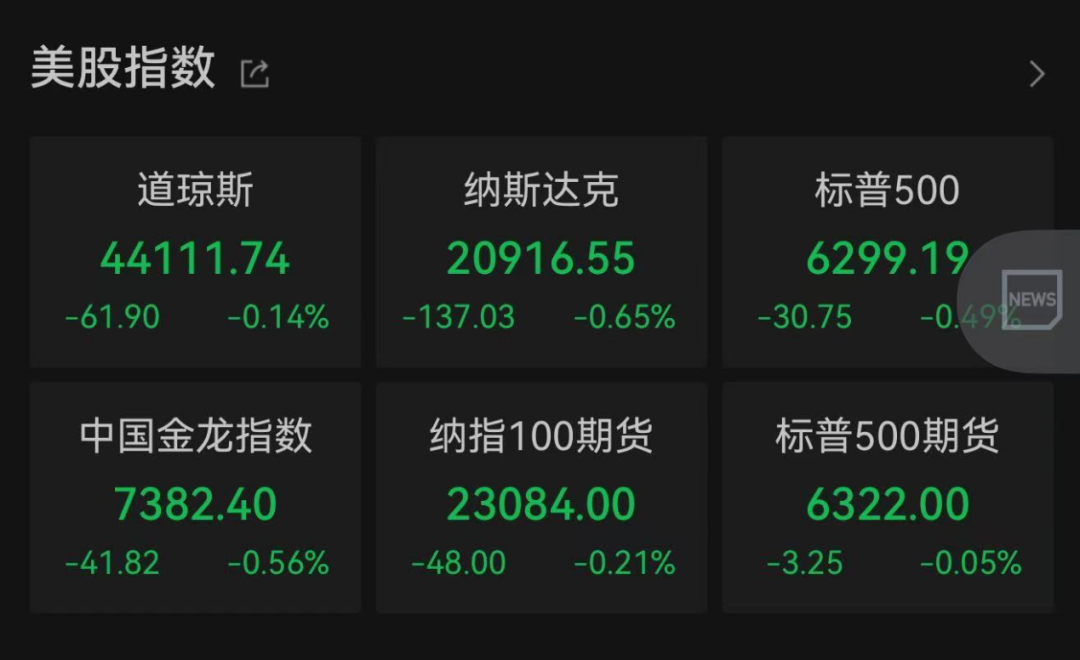
Market Overview - On August 5, U.S. stock indices collectively declined, with the Dow Jones down 0.14% at 44,111.74 points, the S&P 500 down 0.49% at 6,299.19 points, and the Nasdaq down 0.65% at 20,916.55 points [2][4]. Economic Factors - Analysts attribute the decline in U.S. stocks to tariff announcements and economic data concerns. President Trump announced plans to impose "small tariffs" on imported drugs, with rates potentially rising to 250% over time. He also hinted at upcoming tariffs on semiconductors and chips [4][16]. - Economic indicators show a worrying trend, with the ISM non-manufacturing index for July at 50.1, below expectations of 51.5, indicating stagnation in the services sector. Employment indicators also fell from 47.2 to 46.4, raising concerns about stagflation [4][18]. Technology Sector Performance - Major tech stocks experienced declines, with Nvidia down 0.97%, Microsoft down 1.47%, Apple down 0.21%, Google down 0.22%, Meta down 1.67%, and Tesla down 0.19%. However, Amazon saw a slight increase of 0.99% [5][6]. - Amazon announced that its cloud computing division, AWS, will offer OpenAI's models, which may enhance its competitive position against Microsoft Azure [5]. Cryptocurrency Market - Coinbase plans to issue $2 billion in convertible bonds to raise funds for stock buybacks and debt repayment, leading to a stock price drop of over 6% [10]. Commodity Prices - International gold prices rose by 0.25%, closing at approximately $3,535 per ounce [11]. Company Earnings Reports - Taiwan Semiconductor Manufacturing Company (TSMC) reported Q2 revenue of $7.69 billion, a 32% year-over-year increase, but net profit fell by 31% to $781 million, leading to a stock price drop of over 2% [13][15]. - Advanced Micro Devices (AMD) reported Q4 net sales of $5.76 billion, below the expected $6.01 billion, with a stock price decline of 1.67% [16].
全球市场早报 | 美股三大股指齐收跌 大型科技股多数下跌
Sou Hu Cai Jing· 2025-08-05 23:47
大型科技股多数下跌,脸书跌逾1%,微软跌逾1%,英伟达跌近1%,苹果跌0.21%,谷歌跌0.19%,特 斯拉跌0.17%,亚马逊涨近1%。 美股三大股指周二集体收跌。 Wind截图 美东时间8月5日16:00(北京时间8月6日04:00),道指收跌61.9点,报44111.74点,跌幅为0.14%;纳指 收跌137.03点,报20916.55点,跌幅为0.65%;标普500指数收跌30.75点,报6299.19点,跌幅为0.49%。 中概股涨跌不一,纳斯达克中国金龙指数跌0.56%。热门中概股方面,天境生物涨超15%,知乎涨逾 6%,阿特斯太阳能涨超4%,新蛋涨逾4%,大全新能源涨超3%。联掌门户跌近20%,百胜中国跌超 6%,亚朵跌逾4%,霸王茶姬跌超3%,盛美半导体跌逾3%。 消息方面,美股盘前,美国总统特朗普表示,可能很快宣布美联储新任主席,他已将潜在的未来美联储 主席范围缩小到四名候选人,该名单不包括财政部长斯科特·贝森特。鉴于印度持续购买俄罗斯石油, 他将在未来24小时内"大幅"提高对印度输美商品征收的关税,目前税率为25%。美国将首先对进口药品 征收"小额关税",并在一年左右的时间内提高税率。 美 ...
特朗普发声 事关美联储新任主席!华尔街警告美股准备迎接股市下跌 什么情况?
Mei Ri Jing Ji Xin Wen· 2025-08-05 22:09
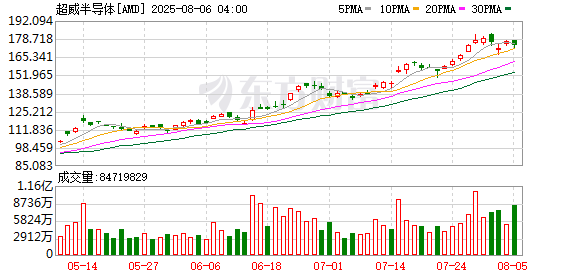
据央视新闻,当地时间8月5日,美国总统特朗普表示,可能很快宣布美联储新任主席,美联储理事的人 选决定将于本周末做出。 AMD第二季度营收76.9亿美元,同比增长32%,预估74.3亿美元,经调整毛利率43%,上年同期53%, 预估43.1%。第二季度调整后净利润7.81亿美元,同比下降31%,调整后每股收益0.48美元,上年同期 0.69美元,预估0.49美元。公司对于2025年第三季度预计收入约为87亿美元,上下浮动3亿美元。AMD 盘后跌超3%。 超微电脑股价盘后跌超14%,因季度盈利前景令人失望。 当地时间8月5日,美股三大指数集体收跌,道指跌0.14%,纳指跌0.65%,标普500指数跌0.49%。 热门科技股多数下跌,微软、Meta、博通均跌超1%,英伟达跌近1%,英特尔涨超3%,亚马逊涨近 1%。贵金属、工业金属原材料涨幅居前,金田涨超6%,金罗斯黄金涨超5%,泛美白银、世纪铝业涨超 3%。半导体、稳定币概念走低,康特科技跌超8%,Coinbase、Circle跌超6%,科磊跌超3%,阿斯麦跌 超1%。 美国总统特朗普在接受美国消费者新闻与商业频道(CNBC)采访时表示,他已将潜在的未来美联储主 ...
特朗普发声,事关美联储新任主席!超威电脑盘后大跌超14%,原油跌超1%!华尔街警告美股准备迎接股市下跌,什么情况?
Mei Ri Jing Ji Xin Wen· 2025-08-05 22:00
据央视新闻,当地时间8月5日,美国总统特朗普表示,可能很快宣布美联储新任主席,美联储理事的人 选决定将于本周末做出。 美国总统特朗普在接受美国消费者新闻与商业频道(CNBC)采访时表示,他已将潜在的未来美联储主 席范围缩小到四名候选人,该名单不包括财政部长斯科特·贝森特。 | < . AMD US 空 | 超微半导体 > @ Q | | --- | --- | | 177.990 昨收 176.780 量比 | 1.06 | | 174.310 172.291 市值 2826.3亿 换 | 4.92% | | -2.470 -1.40% 开 177.565 市盈™ 126.91 额 138.68亿 | | 超微电脑股价盘后跌超14%,因季度盈利前景令人失望。 | 57.260 % | 57.4UU DFYX 30.23U 里山 I.UI 56.790 市值 341.74亿 换 | 9.10% | | --- | --- | --- | | -0.970 -1.67% 开 | 58.810 市盈™ 28.33 额 | 26.10亿 | | 盘后 49.000 -8.260 - - 14.43% ⊙ 17:16 ...

今夜!跳水!
Zhong Guo Ji Jin Bao· 2025-08-05 16:17
Market Performance - US stock market experienced a significant drop after a disappointing services sector report, with the Dow Jones falling approximately 100 points and both the Nasdaq and S&P 500 declining about 0.5% [3][4] - The ISM services index for July showed almost zero growth, raising concerns about stagflation, which is characterized by high inflation and low employment [4][5] Economic Indicators - The ISM services index decreased to 50.1, below all economists' forecasts, indicating a slowdown in the services sector, which constitutes about 70% of the US economy [5] - The employment index fell to 46.4, marking the fourth contraction in five months and reaching one of the lowest levels since the pandemic [5] - The new orders index dropped to 50.3, nearing stagnation levels, reflecting a slowdown in business activity [6] Industry Insights - Despite some sectors like transportation, wholesale trade, and finance showing growth, seven industries contracted, with the accommodation and food services sector experiencing the largest decline [6] - Concerns over tariffs and rising prices were frequently mentioned by survey participants, indicating ongoing challenges for businesses [6] Investor Sentiment - Major Wall Street firms, including Morgan Stanley and Deutsche Bank, are warning investors to prepare for a market pullback due to high stock valuations and deteriorating economic data [8][9] - Predictions suggest that the S&P 500 could see a short-term decline of up to 10% to 15% in the coming weeks to months [9][10] - Historical data indicates that August and September are typically weak months for the S&P 500, with an average decline of 0.7% [10] Market Valuation - The S&P 500's 14-day Relative Strength Index (RSI) reached 76, indicating overbought conditions, as it surpassed the 70 threshold considered as a warning sign [10] - The cost of options to hedge against a 10% decline in the SPDR S&P 500 ETF (SPY) is nearing the highest level since the regional banking crisis in May 2023, reflecting increased concerns about potential market downturns [10]
