风险管理

Search documents
商业银行纷纷调整积存金业务并提示风险
Zheng Quan Ri Bao· 2025-11-04 15:40
Core Insights - Several commercial banks have recently adjusted their gold accumulation businesses, with major banks like Industrial and Commercial Bank of China and China Construction Bank announcing suspensions and subsequent resumption of certain services [1][2] Group 1: Business Adjustments - On November 3, Industrial and Commercial Bank of China and China Construction Bank announced the suspension of certain gold accumulation services, including "Ruyi Gold Accumulation" and "Easy Gold" [1] - Later that same day, Industrial and Commercial Bank of China announced the resumption of its "Ruyi Gold Accumulation" services, including account openings and physical gold withdrawals [1] - Other banks, such as Bank of China, Ping An Bank, and Industrial Bank, have also raised the minimum investment thresholds for their gold accumulation products since October [1] Group 2: Reasons for Adjustments - The adjustments in gold accumulation services are influenced by macroeconomic policies, market risk management, and compliance requirements [2] - Global uncertainties, including fluctuations in the US dollar, shifts in monetary policy, and geopolitical risks, have led to price volatility in precious metals, prompting banks to adopt a more cautious approach to asset safety and liquidity management [2] - The rapid growth in customer numbers for gold accumulation services has raised operational, liquidity, and compliance risks, leading banks to pause new business and physical withdrawals as a preventive measure [2] Group 3: Future Outlook - If market volatility increases or regulatory scrutiny tightens, other banks may implement similar measures, although these adjustments typically target new or high-risk businesses, ensuring that existing customer rights are protected [3] - Recent communications from multiple banks have highlighted the need to mitigate risks associated with fluctuations in precious metal prices [3] - Investors are advised to maintain a balanced approach to gold investments, considering the asset's volatility and the influence of international economic data, monetary policy, and geopolitical factors [3]


“期实结合 润泽实体”系列|期现深度融合,大宗商品波动下的实体企业“稳定器”
Sou Hu Cai Jing· 2025-11-04 14:50
Core Viewpoint - The article emphasizes the importance of the futures market in supporting the real economy and enhancing risk management for various industries, particularly in the context of increasing price volatility in global markets [1][2]. Group 1: Role of Futures Market - The Zhengzhou Commodity Exchange (ZCE) has listed 27 futures products and 20 options, covering key sectors such as agriculture, energy, and chemicals, forming a market-based risk management chain [1]. - The collaboration between Dahuacaifang and ZCE aims to explore the practical applications of the futures market in supporting the construction of a strong manufacturing and agricultural nation [1]. Group 2: Risk Management in Industries - In the context of rising commodity price fluctuations, futures tools are becoming essential for stabilizing operations across various industries, transitioning from single hedging to multi-dimensional tools [2]. - Companies like COFCO and Dongguan Fuzhiyuan are utilizing futures tools to effectively manage price volatility risks, shifting from traditional pricing to basis trading as a mainstream practice [3][5]. Group 3: Case Studies of Successful Implementation - Dongguan Fuzhiyuan has adopted a systematic hedging approach since 2004, forming a risk-sharing mechanism with upstream and downstream enterprises [5]. - Guangzhou Yelong International Trade Company has developed four trading models, including basis trading and futures-spot combinations, to enhance profitability and manage risks [7][8]. Group 4: Impact on Chemical Industry - The launch of futures for caustic soda at ZCE provides chemical enterprises with diverse risk management strategies, addressing the increasing price volatility in the sector [11][13]. - Companies like Dongbo Chemical have established a futures-spot risk management system, leading to over 20% growth in sales and 30% increase in exports in recent years [13]. Group 5: Future Directions - The chemical industry is shifting from scale competition to a comprehensive competition model that includes energy efficiency and carbon management, with futures tools playing a crucial role in this transition [13][14]. - Companies are encouraged to promote derivative business models and enhance risk management capabilities across the industry [14].

关税波动与合规双重挑战下,中国外贸企业降风险保增长
Di Yi Cai Jing· 2025-11-04 13:55
Core Insights - Emerging markets and green trade are becoming the main engines for growth in the foreign trade sector [1][4] - Chinese companies are facing increased risks but are employing strategies like market diversification and supply chain restructuring to navigate challenges [1][2] Group 1: Trade Dynamics - The 2025 China International Import Expo will focus on "finding trade drivers" with 18 activities addressing key industry concerns [1] - The demand for risk management is structurally increasing due to heightened risk awareness among companies amid tariff fluctuations and geopolitical conflicts [2][3] Group 2: Supply Chain Challenges - Insufficient supply chain resilience is a significant issue, with geopolitical tensions potentially increasing costs and causing disruptions [3] - Companies are advised to diversify their supply chains and utilize digital risk management tools to enhance resilience [3] Group 3: Export Growth in RCEP - The energy-saving technology sector is experiencing significant export growth within the RCEP framework, particularly to emerging markets like Indonesia, the Philippines, and Vietnam [4][5] - China's lithium-ion battery exports have seen substantial growth, with a 26.75% increase in export value and a 19.14% increase in quantity year-on-year [5] Group 4: RCEP Opportunities - RCEP is viewed as a stabilizing factor, providing opportunities for green energy infrastructure and digital energy-saving technologies [7][8] - The reduction of tariffs and improved customs efficiency under RCEP are benefiting companies, with over 90% of products achieving zero tariffs [8] Group 5: Regulatory Challenges - Companies face challenges due to fragmented regulations and differing standards across RCEP member countries, impacting certification processes [10][11] - Establishing a comprehensive management system for rules, costs, and certifications is recommended to navigate these challenges [10][12] Group 6: Strategic Responses - Companies are focusing on supply chain diversification and technology output to mitigate the impacts of tariff uncertainties [11][12] - The future of battery companies is shifting towards providing solutions rather than just products, emphasizing the importance of compliance with ESG standards [12]

从“看见”到“走稳”,险企风险管理焦点难题待解
Bei Jing Shang Bao· 2025-11-04 12:44
Core Insights - The insurance industry is undergoing a significant transformation driven by multiple factors, including declining market interest rates, intense competition, and the digitalization wave [1][9] - The report highlights that while risk management has improved in terms of precision, there remains substantial room for enhancement in technology, models, and tools [1][5] Group 1: Current Challenges - Over 65% of institutions view declining market interest rates and internal competition as major challenges in operational management [4] - Life insurance companies are particularly concerned about the impact of declining interest rates, while property insurance companies focus more on competitive pressures [4] - The current benchmark interest rate for ordinary life insurance products has decreased to 1.90%, down from 1.99%, indicating ongoing challenges in the low-interest environment [4] Group 2: Regulatory Developments - The "reporting and operation unity" requirement has shown significant results in life insurance and auto insurance sectors and is now extending to non-auto property insurance [4] - The National Financial Regulatory Administration has issued guidelines to strengthen supervision in the non-auto insurance sector, addressing issues like irregular operations and irrational competition [4] Group 3: Digitalization and Internal Control - The insurance industry's risk management in the face of digitalization is still in its early stages, with many institutions adopting a wait-and-see approach [5] - Common management challenges include the integration of internal control matrices with business operations and the optimization of compliance management tools [5] - Property insurance companies face internal control issues such as insufficient management attention, outdated risk assessment methods, and communication barriers, which can lead to operational inefficiencies and financial risks [5] Group 4: Importance of Risk Management - The importance of risk management is underscored as a lifeline for insurance companies, with effective risk management being crucial for sustainable operations [7][9] - The industry is shifting from passive risk management to proactive strategies, balancing growth, profitability, and safety [9] - Recommendations for improving risk management include enhancing risk identification systems, optimizing processes for proactive control, increasing investment in technology, and adhering to compliance requirements [9]

Fed Should ‘Keep an Open Mind' on Rates for December, Daly Says
Youtube· 2025-11-03 19:06
Core Viewpoint - The decision to adjust the policy rate is seen as appropriate given the current economic conditions, which include resilient consumer spending and business investment, despite inflation remaining above the 2% target [1][6]. Economic Conditions - The economy has shown remarkable resilience, with consumers continuing to spend and businesses investing, contributing to good growth [1]. - Inflation is gradually decreasing but remains too high, necessitating continued efforts to bring it down [1][6]. Labor Market - The labor market has softened compared to last year, indicated by longer job search times and moderated wage growth [2]. - There is a need to balance inflation control with support for the labor market to avoid job losses while managing inflation [3][6]. Policy Considerations - The current policy rate remains in a modestly restrictive territory after a 50 basis point reduction this year, prompting discussions on whether further adjustments are necessary or if a pause to gather more information is warranted [4][5]. - The focus is on assessing incoming information to make balanced decisions that support economic stability and aim for a soft landing [7].

事关黄金!刚刚,工行公告:恢复受理→
Sou Hu Cai Jing· 2025-11-03 12:00
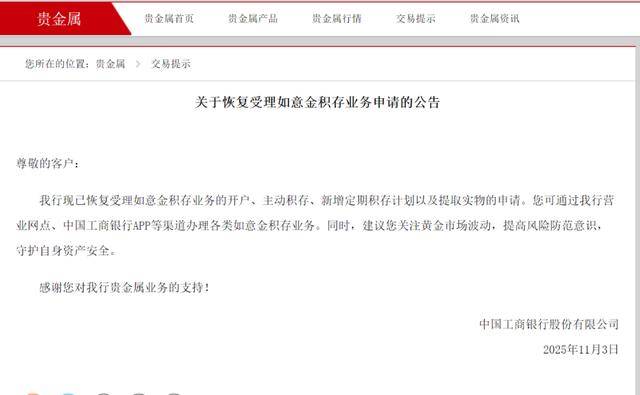
Group 1 - The Industrial and Commercial Bank of China (ICBC) has resumed accepting applications for the "Ruyi Gold Accumulation" business, including account openings, active accumulation, new fixed accumulation plans, and physical gold withdrawals [1][2] - The resumption of these services comes after a previous announcement that, effective November 3, 2025, ICBC would suspend these services due to macroeconomic policy impacts and risk management requirements [1][2] - Customers with existing fixed accumulation plans will not be affected in terms of execution, redemption, or account closure [2] Group 2 - Similarly, China Construction Bank (CCB) announced that it will suspend applications for its "Easy Storage Gold" business, including real-time purchases, new investment purchases, and physical gold exchanges, starting from November 3, 2025 [3] - Existing customers of CCB will still be able to execute their investment plans, redeem, and close accounts without any impact [3] - Both banks have advised customers to stay informed about the recovery of these services through future announcements [5]

ESG实践,企业如何做好风险管理?这场论坛提供多元新思路
Nan Fang Du Shi Bao· 2025-11-03 04:51
Core Insights - The forum "Global Practices of ESG and Supply Chain Management" was successfully held in Shenzhen, focusing on how companies can build resilient, transparent, and responsible value chains in the context of global sustainable transformation [2] Group 1: ESG Development and Corporate Strategy - LRQA's Executive Vice President emphasized the need for organizations to transition from traditional compliance to comprehensive risk management due to the increasingly complex global business environment [3] - The sustainable development director presented a "three-step" approach for companies to integrate sustainable strategies into operations, enhancing brand influence and achieving a win-win between commercial and social value [3] Group 2: Technological Integration in ESG - MioTech's Senior Vice President highlighted the necessity for digital solutions to address challenges such as fragmented ESG data sources and diverse standards, achieving 70% automated quantitative data collection through their ESGhub platform [4] - AI's potential in enhancing supply chain compliance, environmental performance, and responsible sourcing was discussed, with applications in carbon emission optimization and forced labor identification [6] Group 3: Industry Collaboration and Global Standards - The roundtable discussion featured representatives from various industries sharing practical experiences on transforming ESG from mere reporting metrics into core drivers of innovation and market competitiveness [7] - The upcoming SBTi's new standard aims to shift corporate target setting from "how much is covered" to "how much is impacted," urging companies to enhance supplier collaboration and data transparency [6]

交通银行前三季度营收、净利润均实现同比增长
Zheng Quan Ri Bao Zhi Sheng· 2025-11-03 04:09
Core Insights - The core viewpoint of the news is that Bank of Communications has demonstrated steady operational development in the first three quarters of 2025, with key financial indicators showing positive growth compared to the previous year [1][2]. Financial Performance - The bank achieved operating income of 199.645 billion yuan, representing a year-on-year increase of 1.80% [1]. - Net interest income and net fee and commission income both experienced positive growth, increasing by 1.46% and 0.15% respectively [1]. - The net profit attributable to shareholders reached 69.994 billion yuan, up by 1.90% year-on-year [1]. - Total assets amounted to 15.50 trillion yuan, reflecting a growth of 4.02% compared to the end of the previous year [1]. Loan and Financial Services - The customer loan balance stood at 9.07 trillion yuan, marking a 6.04% increase from the end of the previous year, with an additional 31.2 billion yuan year-on-year [1]. - The bank has focused on enhancing financial services for the real economy, with significant growth in technology finance, digital finance, pension finance, and manufacturing loans, all exceeding the average growth rate of corporate loans [1]. Strategic Initiatives - As a state-owned bank headquartered in Shanghai, Bank of Communications is deeply integrated into the strategic tasks assigned to Shanghai, enhancing its capabilities in technology finance and expanding its market leadership in financial services [2]. - The bank has established cooperation with 65 major municipal projects and 191 district-level projects in Shanghai during the reporting period [2]. - The bank facilitated "Bond Connect" transactions totaling 650.1 billion yuan and "Swap Connect" transactions of 634.4 billion yuan [2]. Risk Management - The bank maintains a prudent management philosophy, focusing on refined risk management and enhancing control over key risk areas [2]. - The non-performing loan ratio is reported at 1.26%, a decrease of 0.05 percentage points from the end of the previous year [2]. - The provision coverage ratio stands at 209.97%, an increase of 8.03 percentage points compared to the end of the previous year [2].

DWS:美联储内部分歧进一步凸显 12月是否再减息存疑
Sou Hu Cai Jing· 2025-11-03 03:07
智通财经APP获悉,DWS首席美国经济学家Christian Scherrmann指,一如市场预期,美联储在10月的 FOMC会议上将利率下调25个基点,并宣布于12月停止缩表,以平衡证券投资组合。唯一的意外是反对 票由一票增至两票,支持减息50个基点的Stephen Miran如期投下反对票,而Jeffrey Schmid则意外地强 硬,反对任何政策变动。投票结果进一步凸显美联储在货币政策上的分歧,这种分歧早已在最近的点阵 图分化及官员不统一的言论中初现端倪,而鹰派的反对声音则令分歧进一步加剧。 FOMC内部共识持续削弱,或与政府停摆导致通胀等关键经济数据缺失有关,这一点从声明中主要引用 过往数据可见一斑。尽管现有数据显示劳动市场与通胀未有明显改善,难以支持美联储的双重使命,但 两方面出现意外恶化的风险却在上升。此外,声明中的措辞微调显示,美联储似乎预期经济增长略为加 快,对就业有正面影响,但这种利好却难以抵销因政府停摆而对短期增长及招聘可能造成的负面影响。 在新闻发布会上,美联储主席鲍威尔坦言FOMC成员间存在分歧,并讨论了与双重使命相关的风险。他 提到,对于12月是否再减息有激烈讨论,但尚未作出决定,并 ...
工商银行:暂停受理部分如意金积存业务申请
财联社· 2025-11-03 02:46
工商银行今日发布公告,受宏观政策影响,根据我行风险管理要求,自2025年11月3日起, 工商银行暂停受理如意金积存业务的开户、主动积存、新 增定期积存计划以及提取实物的申请,存量客户处于有效期内的定期积存计划的执行以及办理赎回、销户不受影响。 相关业务恢复事宜,请关注我 行后续公告。 ...