社会融资规模

Search documents
信息量很大!央行发布重要报告
Jing Ji Wang· 2025-08-15 03:06
Financial Statistics Summary - As of the end of July 2025, the broad money supply (M2) reached 329.94 trillion yuan, reflecting a year-on-year growth of 8.8% [2] - The narrow money supply (M1) stood at 111.06 trillion yuan, with a year-on-year increase of 5.6% [2] - The cash in circulation (M0) amounted to 13.28 trillion yuan, showing a year-on-year growth of 11.8% [2] - In the first seven months of 2025, net cash injection totaled 465.1 billion yuan [2] Loan and Deposit Statistics - By the end of July 2025, the total balance of RMB loans was 268.51 trillion yuan, with a year-on-year growth of 6.9% [2] - In the first seven months, RMB loans increased by 12.87 trillion yuan, with household loans rising by 680.7 billion yuan [2][3] - The total balance of deposits in RMB reached 320.67 trillion yuan, reflecting a year-on-year growth of 8.7% [2][3] - Foreign currency loans decreased by 8.1% year-on-year, totaling 55.58 billion USD [2] Social Financing Scale - As of the end of July 2025, the total social financing scale was 431.26 trillion yuan, with a year-on-year growth of 9% [4] - The balance of RMB loans to the real economy was 264.79 trillion yuan, increasing by 6.8% year-on-year [4] - The balance of foreign currency loans to the real economy decreased by 23.2% year-on-year, equivalent to 1.21 trillion yuan [4][5] Incremental Financing Data - In the first seven months of 2025, the cumulative increase in social financing was 23.99 trillion yuan, which is 5.12 trillion yuan more than the same period last year [6] - The increase in RMB loans to the real economy was 12.31 trillion yuan, which is a decrease of 694 billion yuan compared to the previous year [6] - Government bond net financing reached 8.9 trillion yuan, which is an increase of 4.88 trillion yuan year-on-year [6]
2025年7月国内金融数据概览
Sou Hu Cai Jing· 2025-08-15 02:40
Group 1 - As of the end of July, the broad money supply (M2) reached 329.94 trillion yuan, with a year-on-year growth of 8.8% [1] - The narrow money supply (M1) stood at 111.06 trillion yuan, reflecting a year-on-year increase of 5.6% [1] - The cash in circulation (M0) amounted to 13.28 trillion yuan, showing a year-on-year growth of 11.8% [1] Group 2 - In the first seven months, the total social financing increased by 23.99 trillion yuan, which is 5.12 trillion yuan more than the same period last year [2] - The increase in RMB loans to the real economy was 12.31 trillion yuan, which is a decrease of 694 billion yuan compared to the previous year [2] - The net financing of government bonds reached 8.9 trillion yuan, an increase of 4.88 trillion yuan year-on-year [2] Group 3 - By the end of July, the total social financing stock was 431.26 trillion yuan, with a year-on-year growth of 9% [3] - The balance of RMB loans to the real economy was 264.79 trillion yuan, reflecting a year-on-year increase of 6.8% [3] - The balance of government bonds grew by 21.9% year-on-year, reaching 89.99 trillion yuan [3] Group 4 - The balance of RMB loans as of the end of July was 268.51 trillion yuan, with a year-on-year growth of 6.9% [4] - In the first seven months, RMB loans increased by 12.87 trillion yuan, with household loans rising by 680.7 billion yuan [4] - Loans to enterprises increased by 11.63 trillion yuan during the same period [4] Group 5 - The balance of RMB deposits reached 320.67 trillion yuan by the end of July, with a year-on-year growth of 8.7% [5] - In the first seven months, RMB deposits increased by 18.44 trillion yuan, with household deposits rising by 9.66 trillion yuan [5] - Non-financial enterprise deposits increased by 310.9 billion yuan during this period [5] Group 6 - In July, the weighted average interbank lending rate was 1.45%, down 0.36 percentage points year-on-year [6] - The weighted average repo rate was 1.46%, also down 0.36 percentage points compared to the previous year [6] Group 7 - The one-year loan market quoted rate was 3.00% as of July 21, down 0.1 percentage points from the end of last year [7] - The five-year loan market quoted rate was 3.50%, also down 0.1 percentage points compared to the end of last year [7] Group 8 - By the end of July, the CFETS RMB exchange rate index was 96.76, down 4.64% from the end of last year [8] - The RMB to USD exchange rate was 7.1494, appreciating by 0.55% compared to the end of last year [8] - The RMB to Euro exchange rate depreciated by 8.13% compared to the end of last year [8]

最新的金融数据说明了什么?
21世纪经济报道· 2025-08-15 00:37
Core Viewpoint - The article highlights the positive trends in China's financial data as of July, indicating a stable growth in social financing and improvements in credit structure, driven by effective financial policies and increased support for the real economy [1][3]. Group 1: Financial Data Overview - As of July, the year-on-year growth rates for social financing scale, broad money M2, and RMB loans were 9%, 8.8%, and 6.9% respectively, reflecting a stable growth in social financing and an optimized credit structure [1]. - The narrowing of the M1-M2 gap to 3.2 percentage points, down 11 percentage points from last September's peak, indicates enhanced liquidity and economic vitality, with M1 growing by 5.6% year-on-year [1][2]. Group 2: Factors Influencing M1 Growth - The recent increase in M1 is attributed to a lower base effect from previous negative growth and a trend of fund activation, driven by accelerated fiscal spending and improved efficiency in fund allocation [2]. - The active performance of the capital market and rising equity asset prices have encouraged entities to convert some fixed deposits into demand deposits for more flexible market participation [2]. Group 3: Social Financing and Credit Growth - The growth rate of social financing has outpaced that of RMB loans by 2.1 percentage points, primarily due to ongoing fiscal policy efforts, with government bond net financing significantly contributing to social financing [3]. - The RMB loan balance grew by 6.9% year-on-year as of July, with seasonal factors and regulatory measures impacting credit demand, particularly in the traditional off-peak season for credit issuance [3]. Group 4: Structural Changes in Financing - The diversification of corporate financing channels has made traditional loan metrics less reflective of financial support effectiveness, necessitating a broader analysis using indicators like social financing and M2 [4]. - The ongoing optimization of structural monetary policy tools has effectively enhanced financial support for key sectors, with significant growth in loans for technology, green initiatives, and small and micro enterprises [4][5]. Group 5: Policy Measures to Boost Consumption - Recent policies aimed at subsidizing personal consumption and service industry loans are designed to lower financing costs and direct credit towards key areas, thereby stimulating consumption and service sector recovery [5]. - The implementation of interest subsidy policies is expected to improve consumer repayment capacity and enhance the profitability of service industry entities, promoting credit demand and job creation [5].
中信建投:7月社融表现较好但信贷承压
Zheng Quan Shi Bao Wang· 2025-08-15 00:03
Core Viewpoint - The report from CITIC Securities indicates a positive performance in social financing in July, with a year-on-year growth of 9% in the total social financing scale and an 8.8% year-on-year increase in M2 money supply, suggesting a shift of "sedentary" funds in the financial system towards "active" funds [1] Summary by Relevant Categories Social Financing - In July, the total social financing scale showed a year-on-year increase of 9% [1] - The M2 money supply also increased by 8.8% year-on-year, indicating a healthy liquidity environment [1] Credit Performance - Credit performance in July was generally average, with several credit data points showing negative growth [1] - The seasonal nature of credit scale is highlighted, as July is traditionally a credit off-peak season [1] - Financial institutions are moving away from intense competition and the "scale obsession," which may lead to a "watered-down" effect on credit data [1] Economic Support - Despite fluctuations in monthly credit increment data, the overall financial system continues to provide strong support to the real economy, particularly with the increase in government bonds [1]

最新的金融数据说明了什么?
2 1 Shi Ji Jing Ji Bao Dao· 2025-08-14 22:34
Group 1 - The core viewpoint of the articles highlights the positive trends in China's financial data, indicating a stable growth in social financing and improvements in credit structure, driven by effective financial policies [1][3] - As of the end of July, the year-on-year growth rates for social financing scale, broad money M2, and RMB loans were 9%, 8.8%, and 6.9% respectively, reflecting enhanced financial support for the real economy [1] - The narrowing of the M1-M2 spread to 3.2 percentage points, down 11 percentage points from the previous year's high, indicates increased liquidity and economic vitality, with more "dormant deposits" being converted into demand deposits [1][2] Group 2 - The growth of M1, which includes cash and demand deposits, has been positively influenced by the acceleration of fiscal spending and the issuance of special bonds, leading to a significant increase in corporate demand deposits [2][3] - The divergence between social financing and loan growth, with social financing growth outpacing loan growth by 2.1 percentage points, is attributed to sustained fiscal policy efforts, including a notable increase in government bond net financing [3] - The issuance of new special bonds reached 2.16 trillion yuan in the first half of the year, a 45% year-on-year increase, with expectations for continued rapid issuance in August and September [3] Group 3 - The diversification of corporate financing channels has made traditional loan metrics less reflective of financial support effectiveness, necessitating a broader analysis using indicators like social financing and M2 [4] - Structural monetary policy tools have been optimized to enhance financial support for key sectors, with significant loan growth observed in technology, green, inclusive, and digital economy sectors [4] - By the end of July, inclusive small and micro loans reached 35.05 trillion yuan, growing 11.8% year-on-year, while medium to long-term loans in the manufacturing sector totaled 14.79 trillion yuan, up 8.5% year-on-year [4] Group 4 - Recent policies on personal consumption loans and service industry loan interest subsidies aim to strengthen fiscal and financial collaboration, directing more credit to key areas [5] - The interest subsidy policy is expected to lower repayment costs for residents, enhancing consumption capacity and willingness, while also alleviating financial pressure on service industry operators [5] - This initiative is anticipated to stimulate credit demand, expand business operations, and create more job opportunities [5]
中国7月新增社融1.16万亿元,人民币贷款减少500亿元,M2-M1剪刀差缩小
Sou Hu Cai Jing· 2025-08-14 17:31
Group 1 - In July, China's new social financing increased by 1.16 trillion yuan, with a decrease in RMB loans by 50 billion yuan and an increase in RMB deposits by 500 billion yuan, while household deposits decreased by 1.11 trillion yuan [1][4] - From January to July, the cumulative increase in social financing was 23.99 trillion yuan, which is 5.12 trillion yuan more than the same period last year [3][8] - As of the end of July, the total social financing stock was 431.26 trillion yuan, reflecting a year-on-year growth of 9% [11][12] Group 2 - The balance of RMB loans to the real economy increased by 12.31 trillion yuan from January to July, while foreign currency loans decreased by 725 billion yuan [8][14] - The balance of broad money (M2) was 329.94 trillion yuan at the end of July, with a year-on-year growth of 8.8%, while narrow money (M1) was 111.06 trillion yuan, growing by 5.6% [4][13] - The M2-M1 gap was 3.2 percentage points, narrowing by 0.5 percentage points from the previous month [4][12] Group 3 - The People's Bank of China indicated that monthly financial data should not be overly emphasized as they may not accurately reflect the economic activity and financial support for the real economy [6] - The traditional credit demand is decreasing while the demand in new growth areas is increasing, suggesting that financial institutions need to adapt their strategies [7][12] - The average weighted interest rate for interbank RMB lending in July was 1.45%, lower than both the previous month and the same period last year [18]
前7月社会融资增量逼近24万亿元
Mei Ri Jing Ji Xin Wen· 2025-08-14 14:14
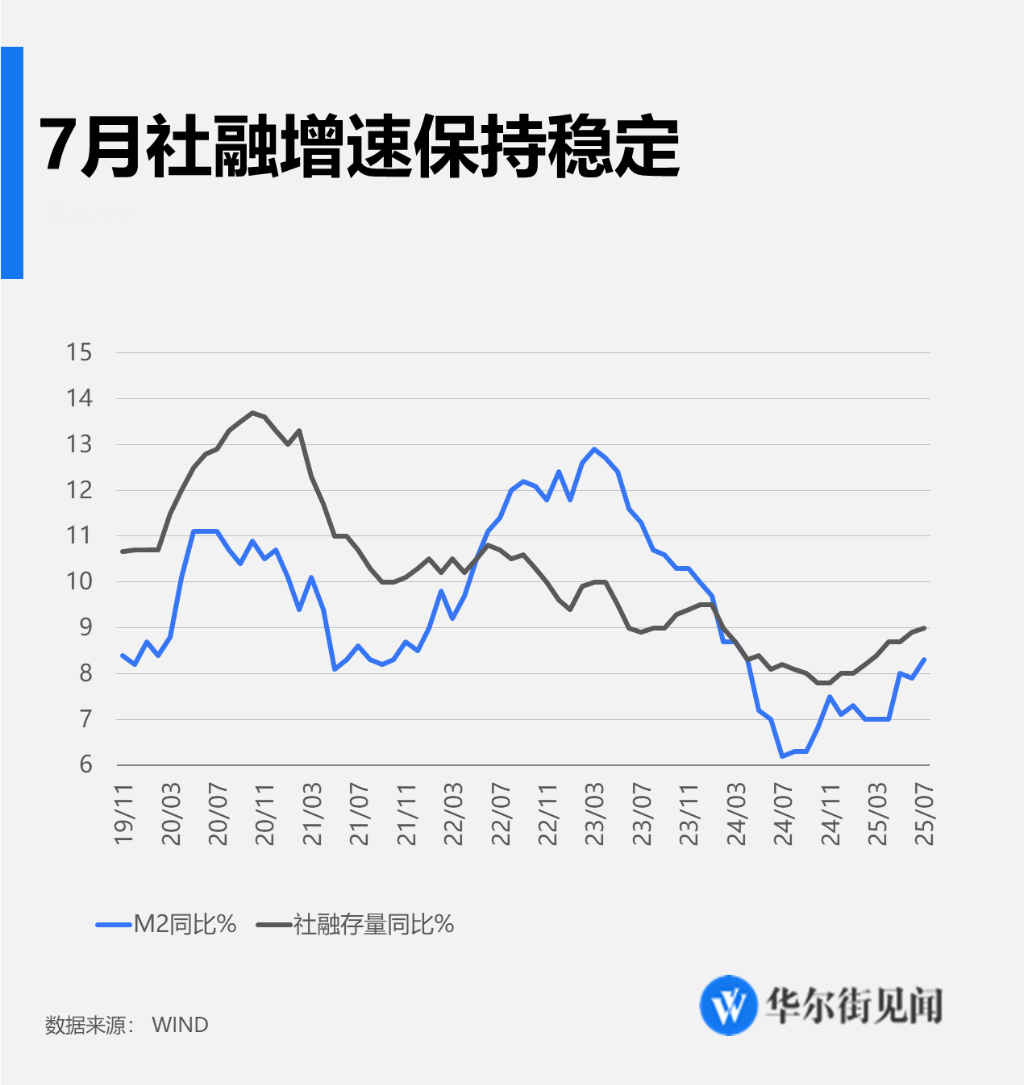
Core Viewpoint - The People's Bank of China reported that as of the end of July, the broad money supply (M2) reached 329.94 trillion yuan, reflecting an 8.8% year-on-year increase, while the total social financing scale increased by 23.99 trillion yuan in the first seven months of 2023, which is 5.12 trillion yuan more than the same period last year. Experts suggest that the diversification of corporate financing channels and the acceleration of government bond issuance make it increasingly difficult for loans to fully represent financial support for the real economy [1][5][6]. Group 1: Monetary Indicators - As of the end of July, the M2 balance was 329.94 trillion yuan, with a year-on-year growth of 8.8% [5] - The total social financing scale reached 431.26 trillion yuan at the end of July, showing a 9% year-on-year increase [5] - The growth rates of social financing scale and M2 indicate a moderately loose monetary policy, providing a suitable financial environment for the real economy [5][6] Group 2: Loan Dynamics - The balance of RMB loans was 268.51 trillion yuan at the end of July, with a year-on-year increase of 6.9%, while the total increase in RMB loans for the first seven months was 12.87 trillion yuan [3][5] - Experts emphasize the importance of analyzing loan data from multiple dimensions, including cumulative increases and balance growth rates, rather than just monthly increments [3][4] - The balance of loans to the real economy was 264.79 trillion yuan at the end of July, reflecting a year-on-year growth of 6.8% [5] Group 3: Interest Rates and Financing Costs - The new corporate loan interest rate was approximately 3.2% in July, down about 45 basis points from the previous year, while the new personal housing loan rate was about 3.1%, down approximately 30 basis points [7][8] - The decline in comprehensive financing costs indicates that monetary and credit conditions are favorable, meeting the effective financing needs of the real economy [8] - Initiatives to promote transparency in corporate financing costs are being implemented, which may help reduce the financing burden on enterprises [8]
7月金融数据点评:M1同比增速持续攀升
Great Wall Securities· 2025-08-14 09:02
Group 1: Monetary Supply and Financing - In July, the new social financing scale reached 1.16 trillion yuan, an increase of 0.39 trillion yuan year-on-year, with a year-on-year growth rate of 9%[2] - M1 growth accelerated to 5.6% in July, up from 4.6% in the previous month, marking the highest growth since January 2023[3] - M2 growth improved to 8.8% in July, up from 8.3% in June, with the M2-M1 gap narrowing to 3.2%[3] Group 2: Loan Demand and Government Financing - Government bond issuance from January to July reached 890 billion yuan, accounting for 75% of the annual issuance plan, significantly higher than the five-year average of 47%[3] - Corporate loan demand showed a contraction, with July's corporate loans decreasing by 700 billion yuan year-on-year, the lowest level in five years[4] - Residential loans in July also fell below the five-year average, with long-term and short-term loans decreasing by 1.1 trillion yuan and 3.8 trillion yuan respectively[4] Group 3: Economic Outlook and Risks - Overall liquidity has improved, but credit remains volatile due to seasonal factors, with only a slight decline in new loans compared to June[5] - The government is currently in a process of leveraging while the private sector is de-leveraging, necessitating improved efficiency in fiscal spending to stabilize demand[5] - Risks include potential underperformance of domestic macroeconomic policies and the possibility of slower government bond issuance if special treasury bonds are not issued[5]
瑞达期货沪铜产业日报-20250814
Rui Da Qi Huo· 2025-08-14 08:38
1. Report Industry Investment Rating - Not provided in the given content 2. Core Viewpoints - The Shanghai Copper main contract oscillated and declined, with a decrease in open interest, a premium in the spot market, and a strengthening basis. The copper concentrate TC fee has improved but remains in the negative range, and the domestic port inventory has slightly increased. The tight supply of copper ore still supports the copper price. The smelters are currently actively producing, but the production growth rate may gradually slow down due to the supply of copper concentrates. The downstream consumption demand may slow down due to the off - season and trade tariffs, and the total inventory remains at a medium - low level. The option market sentiment is bullish, and the implied volatility has slightly increased. Technically, the 60 - minute MACD shows that the double lines are below the 0 - axis and the green bars are expanding. It is recommended to trade with a light position in a volatile market and control the rhythm and trading risks [2] 3. Summary According to Relevant Catalogs 3.1 Futures Market - The closing price of the Shanghai Copper futures main contract was 78,950 yuan/ton, a decrease of 430 yuan; the LME 3 - month copper price was 9,762 dollars/ton, a decrease of 41 dollars. The spread between the main contract's adjacent months was 20 yuan/ton, an increase of 20 yuan. The open interest of the Shanghai Copper main contract was 152,341 lots, a decrease of 6,536 lots. The long - short position of the top 20 futures traders in Shanghai Copper was 4,902 lots, an increase of 5,608 lots. The LME copper inventory was 155,875 tons, an increase of 875 tons; the Shanghai Futures Exchange's cathode copper inventory was 81,933 tons, an increase of 9,390 tons; the LME copper canceled warrants were 11,550 tons, a decrease of 50 tons; the Shanghai Futures Exchange's cathode copper warrants were 24,434 tons, a decrease of 2,856 tons [2] 3.2 Spot Market - The SMM 1 copper spot price was 79,435 yuan/ton, a decrease of 40 yuan; the Yangtze River Non - ferrous Market 1 copper spot price was 79,500 yuan/ton, an increase of 100 yuan. The CIF (bill of lading) price of Shanghai electrolytic copper was 55 dollars/ton, unchanged; the average premium of Yangshan copper was 47 dollars/ton, unchanged. The basis of the CU main contract was 485 yuan/ton, an increase of 390 yuan; the LME copper cash - to - 3 - month spread was - 79.20 dollars/ton, an increase of 7.94 dollars [2] 3.3 Upstream Situation - The import volume of copper ore and concentrates was 234.97 million tons, a decrease of 4.58 million tons. The rough smelting fee (TC) of domestic copper smelters was - 38.06 dollars/kiloton, an increase of 4.03 dollars. The price of copper concentrates in Jiangxi was 69,720 yuan/metal ton, an increase of 320 yuan; in Yunnan, it was 70,420 yuan/metal ton, an increase of 320 yuan. The processing fee for rough copper in the South was 900 yuan/ton, unchanged; in the North, it was 750 yuan/ton, unchanged [2] 3.4 Industry Situation - The output of refined copper was 1.302 billion tons, an increase of 480 million tons. The import volume of unwrought copper and copper products was 480,000 tons, an increase of 20,000 tons. The social inventory of copper was 418.2 million tons, an increase of 43 million tons. The price of 1 bright copper wire in Shanghai was 55,690 yuan/ton, an increase of 200 yuan; the price of 2 copper (94 - 96%) in Shanghai was 68,150 yuan/ton, an increase of 200 yuan. The ex - factory price of 98% sulfuric acid of Jiangxi Copper was 640 yuan/ton, unchanged [2] 3.5 Downstream and Application - The output of copper products was 2.2145 billion tons, an increase of 118.5 million tons. The cumulative completed investment in power grid infrastructure was 291.066 billion yuan, an increase of 87.08 billion yuan. The cumulative completed investment in real estate development was 4,665.756 billion yuan, an increase of 1,042.372 billion yuan. The monthly output of integrated circuits was 4,505,785,400 pieces, an increase of 270,785,400 pieces [2] 3.6 Option Situation - The 20 - day historical volatility of Shanghai Copper was 9.52%, an increase of 0.23%; the 40 - day historical volatility was 9.65%, a decrease of 0.07%. The implied volatility of the current - month at - the - money IV was 9.85%, an increase of 0.0073%. The call - put ratio of at - the - money options was 1.26, an increase of 0.0109 [2] 3.7 Industry News - Chicago Fed President Goolsbee said more evidence of inflation improvement is needed, and every meeting has the possibility of action; Fed nominee Milan said there is no evidence that tariffs cause inflation. Traders have fully priced in a 25 - basis - point rate cut by the Fed in September. US Treasury Secretary Bessent said the Fed may cut rates by 50 basis points, and the current interest rate should be lowered by 150 - 175 basis points. The total US national debt exceeded 37 trillion dollars for the first time. In the first seven months of this year, the cumulative increase in social financing scale was 23.99 trillion yuan, 5.12 trillion yuan more than the same period last year; RMB loans increased by 12.87 trillion yuan. The 188 billion yuan investment subsidy funds for equipment renewal supported by ultra - long - term special treasury bonds in 2025 have been allocated, driving a total investment of over 1 trillion yuan [2]
瑞达期货铝类产业日报-20250814
Rui Da Qi Huo· 2025-08-14 08:38
1. Report Industry Investment Rating No relevant content provided. 2. Core Viewpoints of the Report - The alumina fundamentals may be in a stage of slight increase in supply and demand, with cost support and improved supply expectations due to policy influence. It is recommended to conduct short - selling transactions at high prices with a light position, while controlling the rhythm and trading risks [2]. - The electrolytic aluminum fundamentals may be in a situation of slight increase in supply and weak demand, with accumulated industrial inventory. The option market sentiment is slightly bullish, and it is also recommended to conduct short - selling transactions at high prices with a light position, while controlling the rhythm and trading risks [2]. - The cast aluminum fundamentals may be in a stage of slight contraction in supply and weak demand during the off - season, with accumulated industrial inventory. It is recommended to conduct short - selling transactions at high prices with a light position, while controlling the rhythm and trading risks [2]. 3. Summary by Relevant Catalogs 3.1 Futures Market - The closing price of the Shanghai aluminum main contract is 20,715.00 yuan/ton, down 75.00 yuan; the closing price of the alumina futures main contract is 3,240.00 yuan/ton, up 10.00 yuan. The main - second - consecutive contract spread of Shanghai aluminum is 25.00 yuan/ton, up 15.00 yuan; that of alumina is 9.00 yuan/ton, up 35.00 yuan [2]. - The main contract positions of Shanghai aluminum decreased by 13,505.00 hands to 202,961.00 hands, while those of alumina increased by 69,355.00 hands to 158,619.00 hands [2]. - The LME aluminum cancelled warrants remained unchanged at 14,225.00 tons, and the LME aluminum inventory decreased by 1,525.00 tons to 478,625.00 tons. The LME electrolytic aluminum three - month quotation is 2,608.50 US dollars/ton, down 14.00 US dollars [2]. - The closing price of the cast aluminum alloy main contract is 20,140.00 yuan/ton, down 60.00 yuan; the main - second - consecutive contract spread is 55.00 yuan/ton, up 30.00 yuan [2]. - The Shanghai aluminum SHFE inventory decreased by 3,913.00 tons to 113,614.00 tons, and the Shanghai aluminum SHFE warehouse receipts increased by 2,830.00 tons to 57,946.00 tons [2]. 3.2 Spot Market - The Shanghai Non - ferrous Network A00 aluminum price is 20,710.00 yuan/ton, down 50.00 yuan; the Yangtze River Non - ferrous Market AOO aluminum price is 20,820.00 yuan/ton, down 140.00 yuan [2]. - The alumina spot price in Shanghai Non - ferrous is 3,220.00 yuan/ton, unchanged; the average price of ADC12 aluminum alloy ingots nationwide is 20,350.00 yuan/ton, unchanged [2]. - The basis of cast aluminum alloy decreased by 500.00 yuan to 210.00 yuan/ton, and the basis of electrolytic aluminum increased by 25.00 yuan to - 5.00 yuan/ton [2]. - The Shanghai Wumaoh aluminum premium is 20.00 yuan/ton, up 40.00 yuan; the LME aluminum premium is - 4.91 US dollars/ton, down 0.38 US dollars [2]. - The basis of alumina decreased by 10.00 yuan to - 20.00 yuan/ton [2]. 3.3 Upstream Situation - The alumina production is 774.93 million tons, up 26.13 million tons; the national alumina operating rate is 84.01%, up 1.52 percentage points; the total alumina capacity utilization rate is 84.75%, up 0.45 percentage points [2]. - The demand for alumina (electrolytic aluminum part) is 696.19 million tons, down 23.83 million tons; the alumina supply - demand balance is 27.14 million tons, up 52.40 million tons [2]. - The average price of crushed raw aluminum in Foshan metal scrap is 16,300.00 yuan/ton, up 100.00 yuan; that in Shandong metal scrap is 15,900.00 yuan/ton, up 150.00 yuan [2]. - China's import volume of aluminum scrap and fragments is 155,616.27 tons, down 4,084.65 tons; the export volume is 64.33 tons, down 8.11 tons [2]. - The alumina export volume is 17.00 million tons, down 4.00 million tons; the import volume is 10.13 million tons, up 3.38 million tons [2]. - The WBMS aluminum supply - demand balance is 27.72 million tons, down 1.79 million tons; the electrolytic aluminum social inventory is 53.20 million tons, up 2.60 million tons [2]. 3.4 Industry Situation - The primary aluminum import volume is 192,314.50 tons, down 30,781.00 tons; the export volume is 19,570.72 tons, down 12,523.35 tons [2]. - The total electrolytic aluminum production capacity is 4,523.20 million tons, up 2.50 million tons; the electrolytic aluminum operating rate is 97.78%, up 0.10 percentage points [2]. - The aluminum product production is 587.37 million tons, up 11.17 million tons; the export volume of unwrought aluminum and aluminum products is 54.20 million tons, up 5.20 million tons [2]. - The production of recycled aluminum alloy ingots is 61.89 million tons, up 0.29 million tons; the export volume of aluminum alloy is 2.58 million tons, up 0.16 million tons [2]. 3.5 Downstream and Application - The total built - in capacity of recycled aluminum alloy ingots is 126.00 million tons, down 1.10 million tons; the National Real Estate Prosperity Index is 93.60, down 0.11 [2]. - The aluminum alloy production is 166.90 million tons, up 2.40 million tons; the automobile production is 280.86 million vehicles, up 16.66 million vehicles [2]. 3.6 Option Situation - The 20 - day historical volatility of Shanghai aluminum is 7.85%, up 0.05 percentage points; the 40 - day historical volatility is 8.25%, down 0.03 percentage points [2]. - The implied volatility of the Shanghai aluminum main at - the - money option is 9.27%, up 0.0028 percentage points; the call - put ratio is 1.16, down 0.0437 [2]. 3.7 Industry News - Traders have fully priced in a 25 - basis - point interest rate cut by the Fed in September. The US Treasury debt has exceeded $37 trillion for the first time [2]. - In the first seven months of this year, the cumulative increase in social financing scale was 23.99 trillion yuan, 5.12 trillion yuan more than the same period last year; RMB loans increased by 12.87 trillion yuan. At the end of July, M2 increased by 8.8% year - on - year, M1 increased by 5.6%, and the stock of social financing scale increased by 9% [2]. - Four departments including the central bank explained two discount policies, which are an innovative exploration of fiscal and financial cooperation to boost consumption. After the policy expires, an effect evaluation will be carried out [2]. - In 2025, 188 billion yuan of investment subsidies for equipment renewal supported by ultra - long - term special treasury bonds have been allocated, supporting about 8,400 projects and driving total investment of over 1 trillion yuan [2].